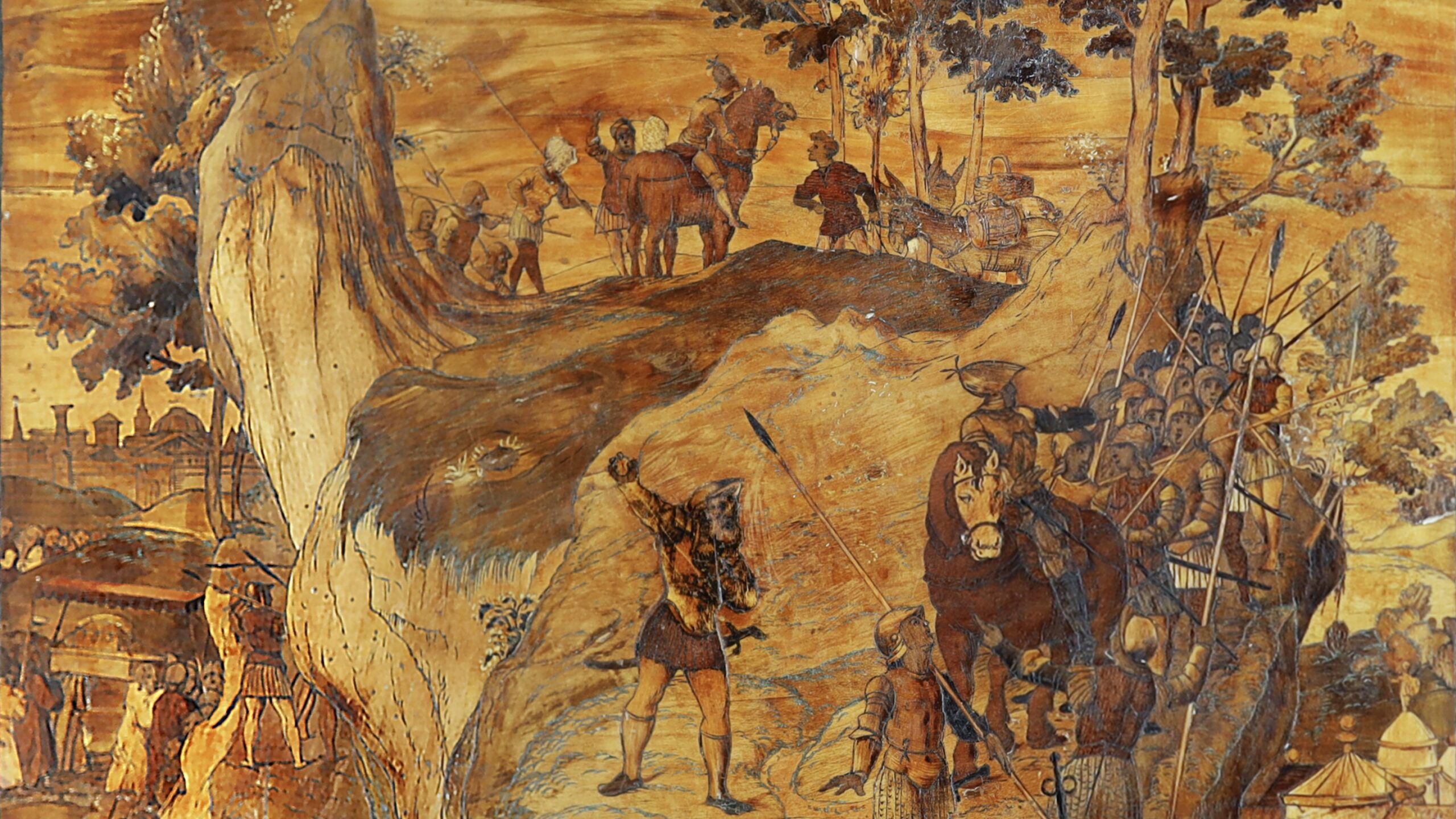
2 Samuel 16
1 When DavidI had passedII a littleIII beyond the summit,IV
Notes on verse 1a
I “David” = David. From the same as dod (beloved, love, uncle); the root may mean to boil, which is used figuratively to describe love. So, this implies someone you love such as a friend, a lover, or a close family member like an uncle. David’s name likely means something like “beloved one.”
II “passed” = abar. This is to pass over or cross over. It is used for transitions, whether literal or figurative. It can also mean to escape, alienate, or fail. This is the root verb from which “Hebrew” is drawn.
III “little” = me’at. From ma’at (being or becoming small, decrease, diminish, pare off). This is a little or few, lightly little while, very small matter.
IV “summit” = rosh. This may come a word that means to shake. It is the head, captain, or chief. It can also be excellent or the forefront. It can be first in position or in statue or in time (i.e. the beginning).
VZibaVI the servantVII of MephiboshethVIII
Notes on verse 1b
V {untranslated} = hinneh. From hen (lo! Behold! If, though; an expression of surprise). This is to draw attention, show suddenness or surprise, or to emphasize the importance of the coming statement. See! Lo! Behold!
VI “Ziba” = Tsiba. 16x in OT. From the same as Tsoba (Ziba, which may mean “station” or “engagement” or “collective” or “beauty” or “depression”); {from tsabah (to swell, grow, amass like an army)} OR from tsaba (to wage war, serve, assemble, fight, perform, muster, wait on). This is Ziba, meaning “station” or “alliance” or “collective” or “league of convenience.” See https://www.abarim-publications.com/Meaning/Ziba.html & https://www.abarim-publications.com/Meaning/Zobah.html
VII “servant” = naar. May be from na’ar (to shake, toss up and down, tumble around). This is a child or a servant. It is a child in their active years so they could be aged anywhere from infancy to adolescence.
VIII “Mephibosheth” = Mephibosheth. 15x in OT. From paah (to cut in pieces, scatter, blow away) + bosheth (shame as a feeling and a thing that creates shame; humiliation, confusion, or an idol); {from bosh (properly, to be pale, which implies shame, disappointment, or confusion)}. This is Mephibosheth, meaning “dispeller of shame” (a reference to Baal) or “one who destroys shame” or “end of shame.” See https://www.abarim-publications.com/Meaning/Mephibosheth.html
metIX him with a coupleX of donkeysXI saddled,XII
Notes on verse 1c
IX “met” = qara. This is to meet, befall, happen upon. It can be to encounter by chance or for aggression.
X “couple” = tsemed. From tsamad (to bind, attach, frame, serve, or contrive). This is a pair, together, yoke, team. It can also be used for an acre because it would take a team of cattle a whole day to plow it.
XI “donkeys” = chamor. From chamar (to be red, blush). This is a male donkey.
XII “saddled” = chabash. This is to wrap tightly or bind, to bandage, or heal. It can be to saddle an animal or wrap a turban. Figuratively, it can mean to stop or to govern.
carrying two hundredXIII loaves of bread,XIV one hundred bunches of raisins,XV one hundred of summer fruits,XVI
Notes on verse 1d
XIII “hundred” = meah. This is hundred or some number times one hundred (i.e. hundredfold or the base of two hundred, three hundred, etc.).
XIV “loaves of bread” = lechem. From lacham (to eat, feed on). This is bread, food, loaf. It can refer to food more generally for people or for animals.
XV “bunches of raisins” = tsimmuq. 4x in OT. From tsamaq (to shrivel, dry). This is cluster or bunch of raisins.
XVI “summer fruits” = qayits. From quts (summer, clip off). This is fruit, harvest, or summer – the dry season.
and one skinXVII of wine.XVIII 2 The kingXIX saidXX to Ziba, “Why have you brought these?”
Notes on verses 1e-2a
XVII “skin” = nebel. From nabel (to fall away, faint, wither, languish, sink; figuratively, being senseless, foolish, or wicked; to despise, disgrace, or fall to nothing, to be seen with contempt). This is a vessel, perhaps made of skins for holding liquids. It could be a skin, vase, or lyre as having a similar shape.
XVIII “wine” = yayin. Root may mean to effervesce, referring to the fermentation process. This is wine, grape, or banquet. It can imply intoxication.
XIX “king” = melek. From malak (to be or become king or queen, to rise to the throne, to be crowned; by implication, to take counsel). This is king or royal.
XX “said” = amar. This is to speak, say, answer, command, promise, report.
Ziba answered,XXI “The donkeys are for the king’s householdXXII to ride,XXIII the bread and summer fruit are for the young menXXIV to eat,XXV
Notes on verse 2b
XXI “answered” = amar. Same as “said” in v2. See note XX above.
XXII “household” = bayit. Probably from banah (to build, make, set up, obtain children; to build literally or figuratively). This is house, court, family, palace, temple.
XXIII “ride” = rakab. This is to ride an animal or in some vehicle. It can also mean bringing on a horse.
XXIV “young men” = naar. Same as “servant” in v1. See note VII above.
XXV “eat” = akal. This is to eat, devour, burn up, or otherwise consume. It can be eating in a literal or figurative sense.
and the wine is for those to drinkXXVI who faintXXVII in the wilderness.”XXVIII
3 The king said, “And where is your master’sXXIX son?”XXX
Notes on verses 2c-3a
XXVI “drink” = shathah. This is to drink literally or figuratively. It could also be a drinker.
XXVII “faint” = yaeph. 3x in OT. From yaeph (becoming tired or exhausted as following flight; to faint). This is weary, faint, exhausted.
XXVIII “wilderness” = midbar. From dabar (to speak, command, declare). This is mouth or speech. It can also be desert or wilderness. Additionally, it can be used for a pasture to which one drives cattle.
XXIX “master’s” = adon. From a root that means ruling or being sovereign. This is lord, master, or owner.
XXX “son” = ben. Related to “household” in v2. From banah (see note XXII above). This is son, age, child. It is son in a literal or figurative sense.
Ziba said to the king, “XXXIHe remainsXXXII in Jerusalem,XXXIII
Notes on verse 3b
XXXI {untranslated} = hinneh. Same as {untranslated} in v1. See note V above.
XXXII “remains” = yashab. This is to sit and so to remain and so to dwell. It is sitting for any reason – as a judge, in order to ambush, or just sitting quietly. Causatively, this can mean settling or marrying. This can also mean continue, endure, or establish.
XXXIII “Jerusalem” = Yerushalaim. From yarah (to throw, shoot, be stunned; to flow as water so figuratively to instruct or teach) +shalam (to make amends, to be complete or sound). This is Jerusalem, dwelling of peace.
for he said, ‘TodayXXXIV the houseXXXV of IsraelXXXVI
Notes on verse 3c
XXXIV “today” = yom. Root may mean being hot. This is the day in a literal or figurative sense. It can also mean birth, age, daylight, continually or other references to time.
XXXV “house” = bayit. Same as “household” in v2. See note XXII above.
XXXVI “Israel” = Yisrael. From sarah (to persist, exert oneself, contend, persevere, wrestle, prevail) +El (God or god). This is Israel, meaning God strives or one who strives with God; new name for Jacob and for his offspring. This refers to the people and to the land.
will give me backXXXVII my grandfather’sXXXVIII kingdom.’”XXXIX
Notes on verse 3d
XXXVII “give…back” = shub. To turn back, return, turn away – literally or figuratively. Doesn’t necessarily imply going back to where you started from. This is also the root verb for the Hebrew word for repentance “teshubah.”
XXXVIII “grandfather’s” = ab. This is father, chief, or ancestor. It is father in a literal or figurative sense.
XXXIX “kingdom” = mamlakut. Related to “king” in v2. 9x in OT. From the same as melek (see note XIX above). This is kingdom, dominion, or reign.
4 Then the king said to Ziba, “XLAllXLI that belonged to Mephibosheth is now yours.”
Ziba said, “I do obeisance;XLII
Notes on verse 4a
XL {untranslated} = hinneh. Same as {untranslated} in v1. See note V above.
XLI “all” = kol. From kalal (to complete). This is all or every.
XLII “do obeisance” = shachah. This is to bow down, make a humble entreaty, to do homage to royalty or to God.
let me findXLIII favorXLIV in your sight,XLV my lordXLVI the king.”
Notes on verse 4b
XLIII “find” = matsa. This is to find, catch or acquire. It can also mean to come forth or appear. Figuratively, this can mean to meet or be together with.
XLIV “favor” = chen. From chanan (beseech, show favor, be gracious; properly, to bend in kindness to someone with less status). This is grace, favor, kindness, beauty, precious.
XLV “sight” = ayin. This is eye in a literal or figurative sense so eye, appearance, favor, or a fountain (the eye of the landscape).
XLVI “lord” = adon. Same as “master’s” in v3. See note XXIX above.
5 When King David cameXLVII to Bahurim,XLVIII XLIXa manL
Notes on verse 5a
XLVII “came” = bo. This is to enter, come in, advance, fulfill, bring offerings, enter to worship, attack. It can also have a sexual connotation.
XLVIII “Bahurim” = Bachurim. 5x in OT. From bachur (choice, chosen, selected; a youth or young man); from bachar (to choose, appoint, try, excellent). This is Bahurim or Bachurim, meaning “young men” or “young men’s village” or “the preferred ones” or “village of young men.” See https://www.abarim-publications.com/Meaning/Bahurim.html
XLIX {untranslated} = hinneh. Same as {untranslated} in v1. See note V above.
L “man” = ish. Perhaps from enosh (human, humankind, mortal); from anash (to be weak, sick, or frail). This is man, husband, another, or humankind.
of the familyLI of the house of SaulLII came outLIII
Notes on verse 5b
LI “family” = mishpachah. From the same as shiphcah (maid, maidservant); root means to spread out. This is one’s circle of relatives – clan, family, kindred.
LII “Saul” = Shaul. From shaal (to ask, inquire, beg, borrow, desire, request; can also mean demand). This is Saul or Shaul, meaning “asked of the Lord.”
LIII “came out” = yatsa. This is to go or come out, bring forth, appear. It is to go out in a literal or figurative sense.
whose nameLIV was ShimeiLV son of Gera;LVI
Notes on verse 5c
LIV “name” = shem. May be from sum (to put, place, set). This is name, fame, renown. A name was thought to indicate something essential about a person – something about their individuality. So, this word can also mean honor, authority, or character.
LV “Shimei” = Shimi. From shama (hear, call, consent, or consider; implies listening intelligently, giving attention; obedience and action are often implied). This is Shmei or Shimeah.
LVI “Gera” = Gera. 9x in OT. Perhaps from gerah (a kernel, a tiny weight, a unit of currency of that weight); from garar (to drag or drag off in a rough fashion, chew, sweep, destroy; to chew the cud). This is Gera, a name that means “grain.”
he came outLVII cursing.LVIII 6 He threwLIX stonesLX at David
Notes on verses 5d-6a
LVII “came out” = yatsa + yatsa. Same as “came out” in v5. See note LIII above. The word is repeated twice – the second time as an Infinitive Absolute. The Infinitive Absolute serves to emphasize the sentiment of the word. It is rather like Foghorn Leghorn’s speech pattern, “I said, I said.”
LVIII “cursing” = qalal. This is to be little, insignificant, swift. It can also mean to bring down in esteem, create contempt, curse.
LIX “threw” = saqal. Properly, this means being weighty. However, it is used for stoning someone (to death) or for removing stones.
LX “stones” = eben. This is a stone, weight, or mason. It is part of the word “Ebenezer.”
and at all the servantsLXI of King David; now all the peopleLXII and all the warriorsLXIII were on his rightLXIV and on his left.LXV
Notes on verse 6b
LXI “servants” = ebed. From abad (to work, serve, compel; any kind of work; used causatively, can mean to enslave or keep in bondage). This is a servant, slave, or bondservant.
LXII “people” = am. From amam (to darken, hide, associate; creating shadows by huddling together). This is people or nation. It can be used specifically for a tribe, collectively of troops or armies, or figuratively to refer to a flock of animals.
LXIII “warriors” = gibbor. From gabar (to be strong or mighty; to prevail or be insolent). This is strong, mighty, or powerful. This can imply a warrior, hero, or tyrant.
LXIV “right” = yamin. May be from yamam (to go or choose the right, use the right hand; to be physically fit or firm). This can mean right hand, right side, or south. Since most people are right-handed, the metaphorical usage of this word presumes that the right hand is stronger and more agile. Thus, it is the instrument of power and action.
LXV “left” = semol. Perhaps from the same as simlah (mantle, clothes, wrapper); perhaps from semel (image, figure, likeness). This is left, left side, or north as the part that is dark.
7 LXVIShimei shoutedLXVII while he cursed, “Out! Out!LXVIII Murderer!LXIX Scoundrel!LXX
Notes on verse 7
LXVI {untranslated} = koh. Perhaps from ki (that, for when, certainly) + hu (he, she, it). This is like this, thus, here, now.
LXVII “shouted” = amar. Same as “said” in v2. See note XX above.
LXVIII “Out! Out!” = yatsa + yatsa. Same as “came out” in v5. See note LIII above.
LXIX “murderer” = ish + dam. Literally, “bloodthirsty man.” Ish is the same as “man” in v5. See note L above. Dam is perhaps from damam (to cease, be or become mute, silent, still, cut off, hold peace, be astonished, die). This is blood, bloodshed, bloodguilt, lifeblood, and death. It is used for people and animals. More often blood from a wound or the blood of the innocent. Used figuratively for violence or for wine. Closely tied to life and death.
LXX “scoundrel” = ish + beliyyaal. Literally, “worthless man.” Ish is the same as “man” in v5. See note L above. Beliyaal is from beli (lack, nothing, without, wearing out, failure, destruction); {from balah (to grow old, wear out, waste away, consume, spend)} + yaal (to gain, profit, do good, ascend, be useful or valuable; benefitted). This is lacking profit i.e. worthlessness, destruction, evil, ungodly person, wickedness, or Belial.
8 The LordLXXI has avengedLXXII on all of you the bloodLXXIII of the house of Saul, in whose placeLXXIV you have reigned,LXXV
Notes on verse 8a
LXXI “Lord” = YHVH. From havah (to be, become) or hayah (to come to pass, become, be). This is the name of the God of Israel, the self-existent and eternal one, the tetragrammaton. This pronunciation has been lost to time so “Lord” is generally used in its place.
LXXII “avenged” = shub. Same as “give…back” in v3. See note XXXVII above.
LXXIII “blood” = dam. Same as “murderer” in v7. See note LXIX above.
LXXIV “in…place” = tachat. This is underneath, below, the bottom, instead of.
LXXV “reigned” = malak. Related to “king” in v2 & “kingdom” in v3. See note XIX above.
and the LordLXXVI has givenLXXVII the kingdomLXXVIII into the handLXXIX
Notes on verse 8b
LXXVI “Lord” = YHVH. Same as “Lord” in v8. See note LXXI above.
LXXVII “given” = natan. This is to give, put, set, offer. It is to give literally or figuratively.
LXXVIII “kingdom” = melukah. Related to “king” in v2 & “kingdom” in v3 & “reigned” in v8. From the same as melek (see note XIX above). This is kingship, kingdom, reign. It can also mean royalty.
LXXIX “hand” = yad. This is hand, ability, power. Hand in a literal sense, but also what one can do or the means by which one does it.
of your son Absalom.LXXX See,LXXXI disasterLXXXII has overtaken you, for you are a man of blood.”
Notes on verse 8c
LXXX “Absalom” = Abishalom. Related to “grandfather’s” in v3 & to “Jerusalem” in v3. From ab (see note XXXVIII above) + shalom (completeness, soundness, welfare, favor, friend, good health; to be safe and figuratively well, happy, at peace, friendly; abstractly, includes the ideas of welfare and prosperity – not in excessive wealth, but in having enough); {from shalam (see note XXXIII above)}. This is Absalom or Abishalom, which means “my father is peace” or “father of peace” or “friendly.”
LXXXI “see” = hen. Related to {untranslated} in v1. See note V above.
LXXXII “disaster” = ra’. From ra’a’ (to be evil, bad, afflict; properly, to spoil – to destroy by breaking into pieces; figuratively, to cause something to be worthless; this is bad in a physical, social, or moral sense; that which displeases, to do harm or mischief, to punish or vex). This is bad, disagreeable, that which causes pain, misery, something having little or no value, something that is ethically bad, wicked, injury, calamity. This refers to anything that is not what it ought to be – a natural disaster, a disfigurement, an injury, a sin.
9 Then AbishaiLXXXIII son of ZeruiahLXXXIV said to the king, “Why should this deadLXXXV dogLXXXVI
Notes on verse 9a
LXXXIII “Abishai” = Abishay. Related to “grandfather’s” in v3 & “Absalom” in v8. From ab (see note XXXVIII above) + shay (gift, present; something given as an act of homage); {from shavah (to equalize, resemble, agree with, compare, adjust, compose, place, or yield)}. This is Abishai, could mean “my father is Jesse.” Alternately, it could mean “father of a gift,” which would likely mean “generous.”
LXXXIV “Zeruiah” = Tseruyah. Related to “Lord” in v8. From the same as tsori (root might be to crack as under pressure, to leak; gum from the balsam tree – perhaps commiphora gileadensis) + Yah (the shortened form of the name of the God of Israel; God, Lord); {from YHVH (see note LXXI above)} OR tsur (rock, stone, cliff, boulder, rocky; a refuge, God); {from tsur (to confine, cramp, or bind in a literal or figurative sense; to besiege, assault, or distress)} + Yah (see above). This is Zeruiah, meaning “wounded” or “balsam of the Lord” or “his rock is the Lord.” See https://www.abarim-publications.com/Meaning/Zeruiah.html & https://en.wikipedia.org/wiki/Balsam & https://en.wikipedia.org/wiki/Balm_of_Gilead.
LXXXV “dead” = mut. This is to die in a literal or figurative sense. It can also refer to being a dead body.
LXXXVI “dog” = keleb. This is yelping or attacking. It can also refer to a dog or it can be a term used for a male prostitute.
curse my lordLXXXVII the king? Let me go overLXXXVIII, LXXXIX and take offXC his head.”XCI
Notes on verse 9b
LXXXVII “lord” = adon. Same as “master’s” in v3. See note XXIX above.
LXXXVIII “go over” = abar. Same as “passed” in v1. See note II above.
LXXXIX {untranslated} = na. This particle is used for requests or for urging. It can be we pray, now, I ask you, oh. This is the same “na” in “hosanna.”
XC “take off” = sur. This is to turn aside in a literal or figurative sense – to depart, decline, rebel, remove, or withdraw.
XCI “head” = rosh. Same as “summit” in v1. See note IV above.
10 But the king said, “What have I to do with you, you sons of Zeruiah? If he is cursing because the LordXCII has said to him, ‘Curse David,’ who then shall say, ‘WhyXCIII have you doneXCIV so?’”XCV
Notes on verse 10
XCII “Lord” = YHVH. Same as “Lord” in v8. See note LXXI above.
XCIII “why” = maddua. From mah (what, how long) + yada (to know, be aware, see and so understand – includes observation, care, recognition; can also be used as a euphemism). This is why or how.
XCIV “done” = asah. This is to make, do, act, appoint, become in many senses.
XCV “so” = ken. Perhaps from kun (properly, in a perpendicular position; literally, to establish, fix, fasten, prepare; figuratively, it is certainty, to be firm, faithfulness, render sure or prosperous). This is to set upright. Generally used figuratively to mean thus, so, afterwards, rightly so.
11 David said to Abishai and to all his servants,XCVI “XCVIIMy ownXCVIII son seeksXCIX my life;C
Notes on verse 11a
XCVI “servants” = ebed. Same as “servants” in v6. See note LXI above.
XCVII {untranslated} = hinneh. Same as {untranslated} in v1. See note V above.
XCVIII “my own” = asher + yatsa + meeh. Literally, “who came from my body.” Yatsa is the same as “came out” in v5. See note LIII above. Meeh is inward parts, belly, heart, womb, intestines, vastness. It can also be figurative for sympathy.
XCIX “seeks” = baqash. This is to seek, ask, desire, or request. It can be any kind of searching. It can also mean to worship or pray – implies a striving for.
C “life” = nephesh. Related to naphash (to refresh or be refreshed). This is soul, self, person, emotion. It is a breathing creature. Can also refer to appetites and desires.
how much moreCI nowCII may this Benjaminite!CIII
Notes on verse 11b
CI “much more” = aph. This is also, furthermore, even.
CII “now” = attah. Perhaps from et (a period or season; whenever or continually); probably from anah (to answer, sing, announce); from ad (forever, all, old); from adah (to pass on, advance, decorate oneself). This is now, from now on.
CIII “Benjaminite” = Ben-yemini. Related to “household” in v2 & “son” in v3 and to “right hand” in v6. 9x in OT. From Binyamin (Benjamin; meaning “son of the right hand”; Jacob’s son, his descendants, and their territory); {from ben (see note XXX above) + from yamin (see note LXIV above)}. This is one descended from the tribe of Benjamin.
Let him alone,CIV and let him curse, for the LordCV has biddenCVI him. 12 It mayCVII be that the LordCVIII
Notes on verses 11c-12a
CIV “let…alone” = yanach. Perhaps from the same as nuach (to rest, calm, camp, free, place, remain, satisfy, settle, station, or wait; implies settling down in a literal or figurative sense). This is to lay down, let alone, pacify, cast down, or deposit. It can also mean to allow something or someone to stay.
CV “Lord” = YHVH. Same as “Lord” in v8. See note LXXI above.
CVI “bidden” = amar. Same as “said” in v2. See note XX above.
CVII “may” = ulay. Perhaps from o (or). This is perhaps, if, or suppose.
CVIII “Lord” = YHVH. Same as “Lord” in v8. See note LXXI above.
will lookCIX on my distress,CX and the LordCXI will repayCXII me
Notes on verse 12b
CIX “look” = raah. This is to see in a literal or figurative sense so stare, advise, think, view.
CX “distress” = avon. Perhaps related to avah (to bend, twist, be amiss). This is sin, mischief, guilt, fault, punishment for iniquity, or moral evil.
CXI “Lord” = YHVH. Same as “Lord” in v8. See note LXXI above.
CXII “repay” = shub. Same as “give…back” in v3. See note XXXVII above.
with goodCXIII forCXIV this cursingCXV of me today.”
Notes on verse 12c
CXIII “good” = tob. From tob (to be pleasing, to be good). This is good, beautiful, pleasant, agreeable, bountiful, at ease. This word is used for goodness as a concept, a good thing, a good person. This can refer to prosperity and welfare as well as joy, kindness, sweetness, and graciousness. So, this is ethically good, but also enjoyably good.
CXIV “for” = tachat. Same as “in…place” in v8. See note LXXIV above.
CXV “cursing” = qelalah. Related to “cursing” in v5. From qalal (see note LVIII above). This is cursing or vilification.
13 So David and his men wentCXVI on the roadCXVII while Shimei went along on the hillsideCXVIII
Notes on verse 13a
CXVI “went” = halak. This is go, come, walk. It is walk literally and figuratively and includes people and animals. It can be used figuratively for one’s moral life – how we walk according to God’s way or against it. It can also refer to the walk of life as in the course one’s life takes, the choices we make, etc.
CXVII “road” = derek. From darak (to tread, march, to walk. Can also mean affixing a string to a box since one needs to step on it to bend it in the process; so also an archer). This is a road as a thing that is walked on. Can be used figuratively for the path that one’s life takes or how one chooses to live one’s life.
CXVIII “hillside” = har. From harar (hill or mountain). This is mountain, hill, hilly region.
oppositeCXIX him and cursed as he went, throwing stones and flingingCXX dustCXXI atCXXII him.
Notes on verse 13b
CXIX “opposite” = ummah. Related to “people” in v6. From im (with, against, before, beside); from amam (see note LXII above). This is close by, alike, parallel, corresponding.
CXX “flinging” = aphar. 1x in OT. Perhaps from aphar (dust as powdered, perhaps gray colored; ashes, powder, ground, dry earth, clay mud, or rubbish). This is to cast dust, throw, maybe grind to powder.
CXXI “dust” = aphar. Related to “flinging” in v13. See note CXX above.
CXXII “at” = ummah. Same as “opposite” in v13. See note CXIX above.
14 The king and all the people who were with him arrivedCXXIII wearyCXXIV at the Jordan, and there he refreshedCXXV himself.
Notes on verse 14
CXXIII “arrived” = bo. Same as “came” in v5. See note XLVII above.
CXXIV “weary” = ayeph. 17x in OT. From iph (to be faint or weary, to languish). This is faint, languid, weary, or thirsty.
CXXV “refreshed” = naphash. Related to “life” in v11. 4x in OT. See note C above.
15 Now Absalom and all the IsraelitesCXXVI cameCXXVII to Jerusalem; AhithophelCXXVIII was with him.
Notes on verse 15
CXXVI “Israelites” = am + ish + Yisrael. Literally, “the people, the men of Israel.” Am is the same as “people” in v6. See note LXII above. Ish is the same as “man” in v5. See note L above. Yisrael is the same as “Israel” in v3. See note XXXVI above.
CXXVII “came” = bo. Same as “came” in v5. See note XLVII above.
CXXVIII “Ahithophel” = Achithophel. From ach (brother, kindred, another, other, like) + taphel (root means to smear; something that is tasteless, unseasoned, or whitewashed; figuratively, frivolous, foolish, or unsavory). This is Ahithophel, which means “brother of folly” or “my brother is folly.” See https://www.abarim-publications.com/Meaning/Ahithophel.html
16 CXXIXWhen HushaiCXXX the Archite,CXXXI
Notes on verse 16a
CXXIX {untranslated} = hayah. Related to “Lord” in v8 & “Zeruiah” in v8. See note LXXI above.
CXXX “Hushai” = Chushay. Related to “Lord” in v8 & “Zeruiah” in v8 & {untranslated} in v16. 14x in OT– 13x in 2 Samuel & 1x in 1 Kings. From chush (to hurry, be eager) OR from chush (see above) + Yah (see note LXXXIV above). This is Hushai, meaning “hasty” or “hasting of the Lord.” See https://www.abarim-publications.com/Meaning/Hushai.html
CXXXI “Archite” = Arki. 6x in OT. Perhaps akin to Erek (Erech or Erek); perhaps from arak (to be long in a literal or figurative sense, to continue, defer, draw out, endure, delay). This is Archite, which is someone from that place.
David’s friend,CXXXII cameCXXXIII to Absalom, Hushai said to Absalom, “Long liveCXXXIV the king! Long live the king!”
Notes on verse 16b
CXXXII “friend” = re’eh. 4x in OT– 2x in 2 Samuel, 1x in 1 Kings, and 1x in Proverbs 27. From ra’ah (to associate with someone). This is a companion or friend.
CXXXIII “came” = bo. Same as “came” in v5. See note XLVII above.
CXXXIV “long live” = chayah. This is to live or keep alive in a literal or figurative sense. So, it can be revive, nourish, or save.
17 Absalom said to Hushai, “Is this your loyaltyCXXXV to your friend?CXXXVI Why did you not goCXXXVII with your friend?”CXXXVIII
Notes on verse 17
CXXXV “loyalty” = chesed. From chasad (being good, kind, merciful; may mean bowing one’s neck as is done in the presence of an equal for courtesy’s sake; so, if one in a superior position is treating you like an equal, that is what is captured here). This is favor, goodness, kindness, loving kindness, pity, reproach, or a good deed. When done by God to humanity, this is mercy/loving kindness. When done by humanity to God, it is piety.
CXXXVI “friend” = rea. Related to “friend” in v16. From ra’ah (see note CXXXII above). This is the same as neighbor in Leviticus 19:18 “love your neighbor as yourself.” This is friend, companion, fellow, neighbor. It is someone with whom you associate, whether more or less close.
CXXXVII “go” = halak. Same as “went” in v13. See note CXVI above.
CXXXVIII “friend” = rea. Same as “friend” in v17. See note CXXXVI above.
18 Hushai said to Absalom, “No, but the one whom the LordCXXXIX and this people and all the IsraelitesCXL have chosen,CXLI his I will be,CXLII and with him I will remain.
Notes on verse 18
CXXXIX “Lord” = YHVH. Same as “Lord” in v8. See note LXXI above.
CXL “Israelites” = ish + Yisrael. Literally “men of Israel.” Ish is the same as “man” in v5. See note L above. Yisrael is the same as “Israel” in v3. See note XXXVI above.
CXLI “chosen” = bachar. Related to “Bahurim” in v5. See note XLVIII above.
CXLII “be” = hayah. Same as {untranslated} in v16. See note CXXIX above.
19 Moreover,CXLIII whom should I serve?CXLIV Should it not beCXLV his son?
Notes on verse 19a
CXLIII “moreover” = sheni. From shanah (to fold, repeat, double, alter, or disguise). This is double, again, another, second.
CXLIV “serve” = abad. Related to “servants” in v6. See note LXI above.
CXLV {untranslated} = paneh. From panah (to turn, face, appear). This is face in a literal or figurative sense. It could be face, presence, anger, respect. It can also be used of God to indicate divine favor or presence.
Just as I have servedCXLVI your father,CXLVII soCXLVIII I will serveCXLIX, CL you.”
Notes on verse 19b
CXLVI {untranslated} = paneh. Same as {untranslated} in v19. See note CXLV above.
CXLVII “father” = ab. Same as “grandfather’s” in v3. See note XXXVIII above.
CXLVIII “so” = ken. Same as “so” in v10. See note XCV above.
CXLIX “serve” = hayah. Same as {untranslated} in v16. See note CXXIX above.
CL {untranslated} = paneh. Same as {untranslated} in v19. See note CXLV above.
20 Then Absalom said to Ahithophel, “GiveCLI us your counsel;CLII what shall we do?”
21 Ahithophel said to Absalom, “Go inCLIII to your father’s concubines,CLIV the ones he has leftCLV
Notes on verses 20-21a
CLI “give” = yahab. This is give, put, bring, take. It is to give in a literal or figurative sense.
CLII “counsel” = etsah. From yaats (to counsel, advise, determine). This is advice, purpose, plan, prudence, or counselor.
CLIII “go in” = bo. Same as “came” in v5. See note XLVII above.
CLIV “concubines” = pilegesh. This is concubine or paramour.
CLV “left” = yanach. Same as “let…alone” in v11. See note CIV above.
to look afterCLVI the house, and all Israel will hearCLVII that you have made yourself odiousCLVIII to your father, and the hands of all who are with you will be strengthened.”CLIX
Notes on verse 21b
CLVI “left after” = shamar. This is to keep, watch, or preserve. It means to guard something or to protect it as a thorny hedge protects something.
CLVII “hear” = shama. Related to “Shimei” in v5. See note LV above.
CLVIII “made…odious” = baash. 18x in OT. This is to stink or be foul. Figuratively, it can refer to offensive behavior – morally odious or loathsome.
CLIX “be strengthened” = chazaq. This is to strengthen, seize, be courageous, repair, bind, heal, conquer, harden.
22 So they pitchedCLX a tentCLXI for Absalom upon the roof,CLXII and Absalom went inCLXIII to his father’s concubines in the sight of all Israel.
Notes on verse 22
CLX “pitched” = natah. This is to stretch or spread out, to extend, or bend. In can also imply moral deflection.
CLXI “tent” = ohel. Perhaps from ahal (to shine, be clear). This is a tent, covering, home, or side pillar.
CLXII “roof” = gag. Perhaps from ga’ah (to rise up, increase, grow, be highly exalted; figuratively to be majestic). This is a housetop or other top. It can refer to the surface of an altar.
CLXIII “went in” = bo. Same as “came” in v5. See note XLVII above.
23 Now in those daysCLXIV the counsel that Ahithophel gaveCLXV was as if oneCLXVI consultedCLXVII
Notes on verse 23a
CLXIV “days” = yom. Same as “today” in v3. See note XXXIV above.
CLXV “gave” = yaats. Related to “counsel” in v20. See note CLII above.
CLXVI “one” = ish. Same as “man” in v5. See note L above.
CLXVII “consulted” = shaal. Related to “Saul” in v5. See note LII above.
the oracleCLXVIII of God,CLXIX soCLXX all the counsel of Ahithophel was esteemed bothCLXXI by David andCLXXII by Absalom.
Notes on verse 23b
CLXVIII “oracle” = dabar. Related to “wilderness” in v2. From dabar (see note XXVIII above). This is speech, a word, a matter, an affair, charge, command, message, promise, purpose, report, request. It is a word, which implies things that are spoken of in a wide sense.
CLXIX “God” = Elohim. Related to “Israel” in v3. See note XXXVI above.
CLXX “so” = ken. Same as “so” in v10. See note XCV above.
CLXXI “both” = gam. This is also, moreover, again.
CLXXII {untranslated} = gam. Same as “both” in v23. See note CLXXI above.
Image credit: Detail of “David and Shimei” by Giovan Francesco Capoferri, after a design by Lorenzo Lotto from Santa Maria Maggiore, Bergamo. Photo by Fabrizio Garrisi, 2024.