2 Samuel 9
BibleHub
1 DavidA asked,B “Is thereC stillD
Notes on verse 1a
A “David” = David. From the same as dod (beloved, love, uncle); the root may mean to boil, which is used figuratively to describe love. So, this implies someone you love such as a friend, a lover, or a close family member like an uncle. David’s name likely means something like “beloved one.”
B “asked” = amar. This is to speak, say, answer, command, promise, report.
C “is there” = yesh. This is being, existence, or substance.
D “still” = od. From ud (to admonish, repeat, duplicate, testify, restore, record, relieve). This is still, yet, again, more.
anyone leftE of the houseF of SaulG to whom I may showH
Notes on verse 1b
E “left” = yathar. This is to jut over, remain behind, preserve, to excel. It can be to leave or to be in abundance.
F “house” = bayit. Probably from banah (to build, make, set up, obtain children; to build literally or figuratively). This is house, court, family, palace, temple.
G “Saul” = Shaul. From shaal (to ask, inquire, beg, borrow, desire, request; can also mean demand). This is Saul or Shaul, meaning “asked of the Lord.”
H “show” = asah. This is to make, do, act, appoint, become in many senses.
kindnessI for Jonathan’sJ sake?”K
Notes on verse 1c
I “kindness” = chesed. From chasad (being good, kind, merciful; may mean bowing one’s neck as is done in the presence of an equal for courtesy’s sake; so, if one in a superior position is treating you like an equal, that is what is captured here). This is favor, goodness, kindness, loving kindness, pity, reproach, or a good deed. When done by God to humanity, this is mercy/loving kindness. When done by humanity to God, it is piety.
J “Jonathan’s” = Yehonatan. From YHVH (proper name of the God of Israel; God, Lord; the self-existent or eternal one); {from havah (to become) or hayah (to be, become, happen)} + natan (to give, put, set, offer; to give literally or figuratively). This is Jonathan or Jehonathan, meaning “the Lord has given.”
K “for…sake” = abur. From abar (to pass over, pass through, or pass by; cross over or to alienate; used for transitions). This is for, so that, on account of. Properly, it means crossed.
2 Now there was a servantL of the house of Saul whose nameM was Ziba,N
Notes on verse 2a
L “servant” = ebed. From abad (to work, serve, compel; any kind of work; used causatively, can mean to enslave or keep in bondage). This is a servant, slave, or bondservant.
M “name” = shem. May be from sum (to put, place, set). This is name, fame, renown. A name was thought to indicate something essential about a person – something about their individuality. So, this word can also mean honor, authority, or character.
N “Ziba” = Tsiba. 16x in OT. From the same as Tsoba (Ziba, which may mean “station” or “engagement” or “collective” or “beauty” or “depression”); {from tsabah (to swell, grow, amass like an army)} OR from tsaba (to wage war, serve, assemble, fight, perform, muster, wait on). This is Ziba, meaning “station” or “alliance” or “collective” or “league of convenience.” See https://www.abarim-publications.com/Meaning/Ziba.html & https://www.abarim-publications.com/Meaning/Zobah.html
and he was summonedO to David. The kingP saidQ to him, “Are you Ziba?”
And he said, “At your service!”R
Notes on verse 2b
O “summoned” = qara. This is to call or call out – to call someone by name. Also used more broadly for calling forth.
P “king” = melek. From malak (to be or become king or queen, to rise to the throne, to be crowned; by implication, to take counsel). This is king or royal.
Q “said” = amar. Same as “asked” in v1. See note B above.
R “service” = ebed. Same as “servant” in v2. See note L above.
3 The king said, “Is there anyoneS remainingT of the house of Saul to whom I may show the kindness of God?”U
Notes on verse 3a
S “anyone” = ish. Perhaps from enosh (human, humankind, mortal); from anash (to be weak, sick, or frail). This is man, husband, another, or humankind.
T “remaining” = ephes + od. Ephes is from aphes (to finish, fail, stop, come to nothing, disappear). This is an end, ceasing, no further. It is often used to refer to the ends of the earth. Od is the same as “still” in v1. See note D above.
U “God” = Elohim.
Ziba said to the king, “There remainsV a sonW of Jonathan; he is crippledX in his feet.”Y
Notes on verse 3b
V “remains” = od. Same as “still” in v1. See note D above.
W “son” = ben. Related to “house” in v1. banah (see note F above). This is son, age, child. It is son in a literal or figurative sense.
X “crippled” = nakeh. 3x in OT. From nakah (to hit whether lightly or severely literal or figurative; beat, punish, give wounds, kill, or slaughter). This is stricken in a literal sense. Figuratively, it could be crippled, maimed, contrite, or dejected.
Y “feet” = regel. This is foot, endurance, or journey. It is a foot as the means of walking and so it implies a step or a greater journey. It can be used euphemistically for private parts.
4 The king said to him, “Where is he?”
Ziba said to the king, “ZHe is in the house of MachirAA son of Ammiel,BB at Lo-debar.”CC
Notes on verse 4
Z {untranslated} = hinneh. From hen (lo! Behold! If, though; an expression of surprise). This is to draw attention, show suddenness or surprise, or to emphasize the importance of the coming statement. See! Lo! Behold!
AA “Machir” = Makir. From makar (to sell – could be commerce/trade, a daughter to be married, someone into slavery; figuratively, to surrender). This is Machir or Makir, it is a name meaning “salesman.”
BB “Ammiel” = Ammiel. Related to “God” in v3. 6x in OT. From am (people or nation; a tribe, troops or armies, or figuratively to refer to a flock of animals); {from amam (to darken, hide, associate; creating shadows by huddling together)} + El (see note U above). This is Ammiel, meaning “my kin is God” or “people of God” or “one of the people of God.” See https://www.abarim-publications.com/Meaning/Ammiel.html
CC “Lo-debar” = Lo Debar. 3x in OT. From lo (not, else, except) + dober (word, thing, folk, pasture); {from dabar (to speak, declare, discuss, destroy, subdue)}. This is Lo-debar, which means “pastureless” or “no word” or “without a place to feed.” See https://www.abarim-publications.com/Meaning/LoDebar.html.
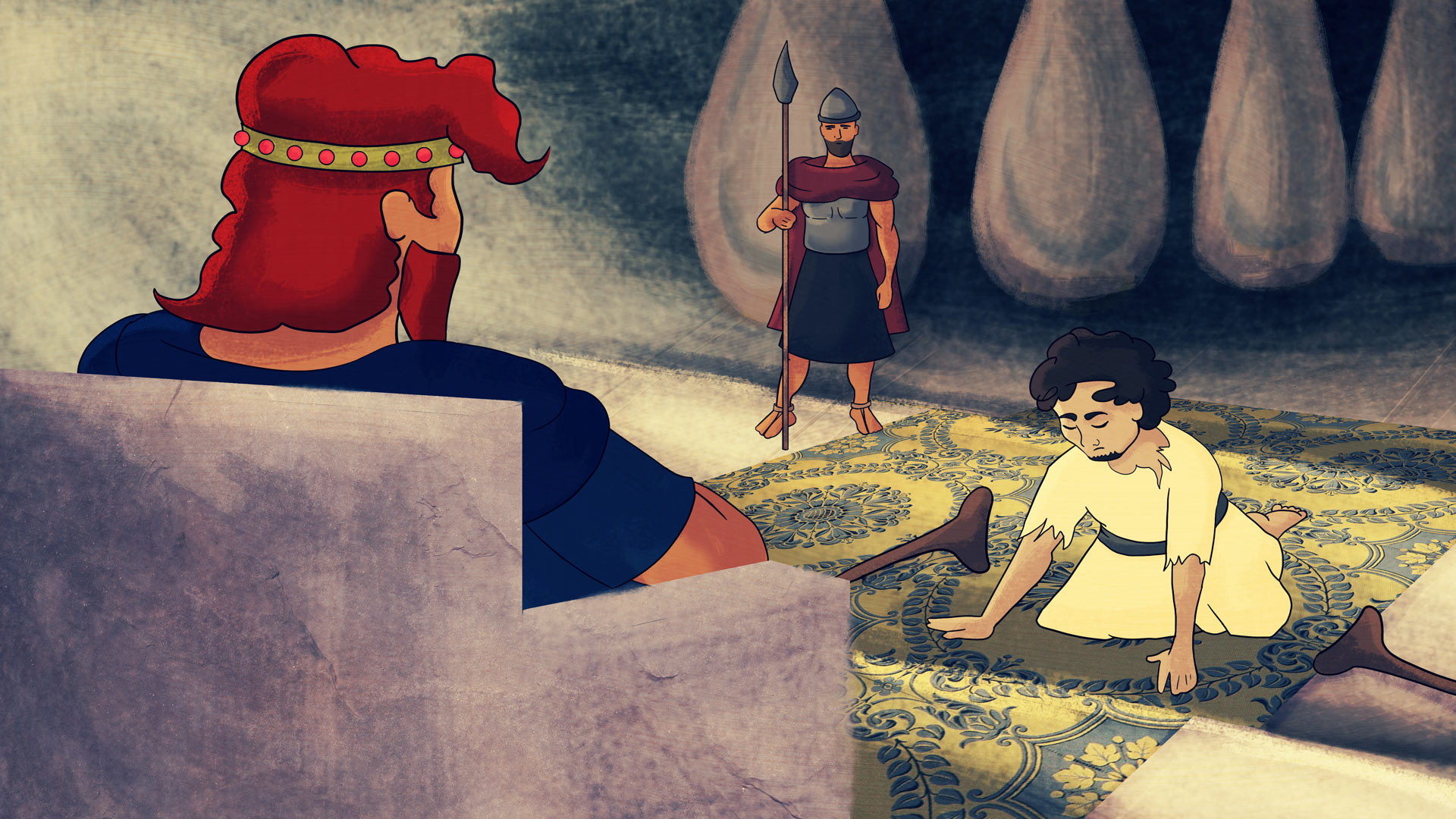
5 Then King David sentDD and broughtEE him from the house of Machir son of Ammiel, at Lo-debar. 6 MephiboshethFF son of Jonathan son of Saul cameGG to David
Notes on verses 5-6a
DD “sent” = shalach. This is to send out, away, send for, forsake. It can also mean to divorce or set a slave free.
EE “brought” = laqach. This is to take, accept, carry away, receive. It can also have the sense of take a wife or take in marriage.
FF “Mephibosheth” = Mephibosheth. 15x in OT. From paah (to cut in pieces, scatter, blow away) + bosheth (shame as a feeling and a thing that creates shame; humiliation, confusion, or an idol); {from bosh (properly, to be pale, which implies shame, disappointment, or confusion)}. This is Mephibosheth, meaning “dispeller of shame” (a reference to Baal) or “one who destroys shame” or “end of shame.” See https://www.abarim-publications.com/Meaning/Mephibosheth.html
GG “came” = bo. This is to enter, come in, advance, fulfill, bring offerings, enter to worship, attack. It can also have a sexual connotation.
and fellHH on his faceII and did obeisance.JJ David said, “Mephibosheth!”
He answered,KK “LLI am your servant.”
Notes on verse 6b
HH “fell” = naphal. This is to fall, whether by accident, to fall prostrate, or to fall in violent death. Figuratively, it can refer to personal ruin or calamity, a city falling, an attack or a falling away. It can also be a deep sleep or wasting away.
II “face” = paneh. From panah (to turn, face, appear). This is face in a literal or figurative sense. It could be face, presence, anger, respect. It can also be used of God to indicate divine favor or presence.
JJ “did obeisance” = shachah. This is to bow down, make a humble entreaty, to do homage to royalty or to God.
KK “answered” = amar. Same as “asked” in v1. See note B above.
LL {untranslated} = hinneh. Same as {untranslated} in v4. See note Z above.
7 David said to him, “Do not be afraid,MM for I will showNN you kindness for the sake of your fatherOO Jonathan;
Notes on verse 7a
MM “be afraid” = yare. This is to fear, be afraid, dreadful. It can also refer to fearful reverence – to fear in a moral sense is to say to revere, respect.
NN “show” = asah + asah. Same as “show” in v1. See note H above. The word is repeated twice – the first time as an Infinitive Absolute. The Infinitive Absolute serves to emphasize the sentiment of the word. It is rather like Foghorn Leghorn’s speech pattern, “I said, I said.”
OO “father” = ab. This is father, chief, or ancestor. It is father in a literal or figurative sense.
I will restorePP to you allQQ the landRR of your grandfatherSS Saul,
Notes on verse 7b
PP “restore” = shub. To turn back, return, turn away – literally or figuratively. Doesn’t necessarily imply going back to where you started from. This is also the root verb for the Hebrew word for repentance “teshubah.”
QQ “all” = kol. From kalal (to complete). This is all or every.
RR “land” = sadeh. From the same as shadday (almighty, field, land); from shadad (to devastate, ruin, destroy, oppress, be powerful). Or, it may be from a word that means to spread out. This is field, ground, soil, or land. It can be used to mean wild as in a wild animal.
SS “grandfather” = ab. Same as “father” in v7. See note OO above.
and you yourself shall eatTT at my tableUU always.”VV
Notes on verse 7c
TT “eat” = akal + lechem. Akal is to eat, devour, burn up, or otherwise consume. It can be eating in a literal or figurative sense. Lechem is from lacham (to eat, feed on). This is bread, food, loaf. It can refer to food more generally for people or for animals.
UU “table” = shulchan. Related to “sent” in v5. Perhaps from shalach (see note DD above). This is a table or meal.
VV “always” = tamid. May come from a word that means to stretch. This word means an indefinite period of time. So, it could be regular or daily. It could also be constantly, continually, always, or perpetually.
8 He did obeisance and said, “What is your servant, that you should lookWW upon a deadXX dogYY such as I?”
Notes on verse 8
WW “look” = panah. Related to “face” in v6. See note II above.
XX “dead” = mut. This is to die in a literal or figurative sense. It can also refer to being a dead body.
YY “dog” = keleb. This is yelping or attacking. It can also refer to a dog or it can be a term used for a male prostitute.
9 Then the king summoned Saul’s servantZZ Ziba and said to him, “All that belongedAAA to Saul and to all his house I have givenBBB to your master’sCCC grandson.DDD
Notes on verse 9
ZZ “servant” = naar. May be from na’ar (to shake, toss up and down, tumble around). This is a child or a servant. It is a child in their active years so they could be aged anywhere from infancy to adolescence.
AAA “belonged” = hayah. Related to “Jonathan’s” in v1. See note J above
BBB “given” = natan. Related to “Jonathan’s” in v1. See note J above.
CCC “master’s” = adon. From a root that means ruling or being sovereign. This is lord, master, or owner.
DDD “grandson” = ben. Same as “son” in v3. See note W above.
10 You and your sons and your servantsEEE shall tillFFF the landGGG for him and shall bring inHHH the produce, so that your master’s grandson may haveIII food to eat,JJJ but your master’s grandson Mephibosheth shall always eat at my table.”
Notes on verse 10a
EEE “servants” = ebed. Same as “servant” in v2. See note L above.
FFF “till” = abad. Related to “servant” in v2. See note L above.
GGG “land” = adamah. From the same as adam (man, humankind); perhaps from ‘adom (to be red). This is ground, earth, soil as red, or land.
HHH “bring in” = bo. Same as “came” in v6. See note GG above.
III “have” = hayah. Same as “belonged” in v9. See note AAA above.
JJJ “food to eat” = lechem + akal. Same as “eat” in v7. See note TT above.
Now Ziba had fifteenKKK sons and twentyLLL servants.MMM
11 Then Ziba said to the king, “According to all that my lordNNN the king commandsOOO his servant,PPP
Notes on verses 10b-11a
KKK “fifteen” = chamesh + asar. Chamesh is five. Asar is from the same as eser (ten). This is -teen or -teenth.
LLL “twenty” = esrim. Related to “fifteen” in v10. From the same as eser (see note KKK above). This is twenty or twentieth.
MMM “servants” = ebed. Same as “servant” in v2. See note L above.
NNN “lord” = adon. Same as “master’s” in v9. See note CCC above.
OOO “commands” = tsavah. This is to charge, command, order, appoint, or enjoin. This is the root that the Hebrew word for “commandment” comes from (mitsvah).
PPP “servant” = ebed. Same as “servant” in v2. See note L above.
soQQQ your servantRRR will do.”SSS
Mephibosheth ate at David’s table, like oneTTT of the king’s sons.
Notes on verse 11b
QQQ “so” = ken. Perhaps from kun (properly, in a perpendicular position; literally, to establish, fix, fasten, prepare; figuratively, it is certainty, to be firm, faithfulness, render sure or prosperous). This is to set upright. Generally used figuratively to mean thus, so, afterwards, rightly so.
RRR “servant” = ebed. Same as “servant” in v2. See note L above.
SSS “do” = asah. Same as “show” in v1. See note H above.
TTT “one” = echad. Perhaps from achad (to unify, continue on a path; figuratively, to gather one’s thoughts). This is the number one, first, united. It can also be alone, altogether, a certain, a few.
12 Mephibosheth had a youngUUU son whose name was Mica.VVV And all who livedWWW in Ziba’s house became Mephibosheth’s servants.XXX
Notes on verse 12
UUU “young” = qatan. From quwt (grieved, cut off, to detest). This is least, small, young, little one. It is literally smaller whether in amount or size. Figuratively it is smaller in the sense of younger or less important.
VVV “Mica” = Mika. Related to “Jonathan’s” in v1 & “belonged” in v9. 4x in OT. Drawn from Mikah (Micah or Micaiah, “who is like the Lord?”); from Mikayah (Micaiah, Micah; “who is like the Lord?”); {from mi (who, what, which, whoever) + ki (that, for, when, certainly) + Yah (the shortened form of the name of the God of Israel; God, Lord); {from YHVH (see note J above)}}. This is Mica or Micah, which means “who is like the Lord?.”
WWW “lived” = moshab. From yashab (to sit and so to remain and so to dwell; sitting for any reason – as a judge, in order to ambush, or just sitting quietly; can mean settling or marrying; continue, endure, or establish). This is dwelling, seat, assembly, settlement, population.
XXX “servants” = ebed. Same as “servant” in v2. See note L above.
13 Mephibosheth livedYYY in Jerusalem,ZZZ for he always ate at the king’s table. Now he was lameAAAA in bothBBBB his feet.
Notes on verse 13
YYY “lived” = yashab. Related to “lived” in v12. See note WWW above.
ZZZ “Jerusalem” = Yerushalaim. From yarah (to throw, shoot, be stunned; to flow as water so figuratively to instruct or teach) + shalam (to make amends, to be complete or sound). This is Jerusalem, dwelling of peace.
AAAA “lame” = pisseach. 13x in OT. From pasach (to limp, hesitate). This is lameness or someone who is lame.
BBBB “both” = shenayim. From sheni (double, again, another, second); from shanah (to fold, repeat, double, alter, or disguise). This is two, both, second, couple.
Image credit: “David’s Promise” by Amy & Carly of Fishnet Bible Stories.