
2 Samuel 21
1 Now there wasI a famineII in the daysIII of DavidIV
I “was” = hayah. This is to be or become, to happen.
II “famine” = raab. From raeb (to be hungry). This is hunger, death, or hunger from famine.
III “days” = yom. Root may mean being hot. This is the day in a literal or figurative sense. It can also mean birth, age, daylight, continually or other references to time.
IV “David” = David. From the same as dod (beloved, love, uncle); the root may mean to boil, which is used figuratively to describe love. So, this implies someone you love such as a friend, a lover, or a close family member like an uncle. David’s name likely means something like “beloved one.”
for threeV years,VI year afterVII year,
V “three” = shalosh. This is three, fork, three times.
VI “years” = shanah. From shana (to change, alter). This is a year, age, old. It can also mean yearly.
VII “after” = achar. From achar (to remain behind, linger, continue, be behind, or delay; can also imply procrastination). This is after or the last part, following.
and David inquiredVIII of theIX Lord.X
VIII “inquired” = baqash. This is to seek, ask, desire, or request. It can be any kind of searching. It can also mean to worship or pray – implies a striving for.
IX {untranslated} = paneh. From panah (to turn, face, appear). This is face in a literal or figurative sense. It could be face, presence, anger, respect. It can also be used of God to indicate divine favor or presence.
X “Lord” = YHVH. Related to “was” in v1. From havah (to be, become) or hayah (see note I above). This is the name of the God of Israel, the self-existent and eternal one, the tetragrammaton. This pronunciation has been lost to time so “Lord” is generally used in its place.
The Lord said,XI “There is bloodguiltXII on SaulXIII
XI “said” = amar. This is to speak, say, answer, command, promise, report.
XII “bloodguilt” = dam. Perhaps from damam (to cease, be or become mute, silent, still, cut off, hold peace, be astonished, die). This is blood, bloodshed, bloodguilt, lifeblood, and death. It is used for people and animals. More often blood from a wound or the blood of the innocent. Used figuratively for violence or for wine. Closely tied to life and death.
XIII “Saul” = Shaul. From shaal (to ask, inquire, beg, borrow, desire, request; can also mean demand). This is Saul or Shaul, meaning “asked of the Lord.”
and on his houseXIV because he put the GibeonitesXV to death.”XVI
XIV “house” = bayit. Probably from banah (to build, make, set up, obtain children; to build literally or figuratively). This is house, court, family, palace, temple.
XV “Gibeonites” = Giboni. 8x in OT. From Gibon (Gibeon or Gibon, meaning hilly); from the same as Geba (Geba or Gibeah; hillock); from the same as gabia (cup, bowl, flower; root might mean being convex). This is Gibeonite.
XVI “put…to death” = mut. This is to die in a literal or figurative sense. It can also refer to being a dead body.
2 So the kingXVII calledXVIII the Gibeonites and spokeXIX to them.
XVII “king” = melek. From malak (to be or become king or queen, to rise to the throne, to be crowned; by implication, to take counsel). This is king or royal.
XVIII “called” = qara. This is to call or call out – to call someone by name. Also used more broadly for calling forth.
XIX “spoke” = amar. Same as “said” in v1. See note XI above.
(Now the Gibeonites were not of the peopleXX of IsraelXXI but of the remnantXXII of the Amorites;XXIII
XX “people” = ben. Related to “house” in v1. Perhaps from banah (see note XIV above).This is son, age, child. It is son in a literal or figurative sense.
XXI “Israel” = Yisrael. From sarah (to persist, exert oneself, contend, persevere, wrestle, prevail) +El (God or god). This is Israel, meaning God strives or one who strives with God; new name for Jacob and for his offspring. This refers to the people and to the land.
XXII “remnant” = yether. From yathar (to jut over, remain behind, preserve, to excel). This is a remainder or excess. It can imply abundant or superiority. Additionally, it can be cord a free-hanging rope.
XXIII “Amorites” = Emori. Related to “said” in v1. From amar (see note XI above). This is Amorite or Emori, perhaps meaning talkers.
although the people of Israel had swornXXIV to spare them, Saul had triedXXV to wipe them outXXVI in his zealXXVII for the people of Israel and Judah.)XXVIII
XXIV “sworn” = shaba. Perhaps from sheba (seven – the number of perfection/sacred fullness). This is to swear, curse, vow, make a covenant. Properly, it can mean to be complete. This is to seven oneself – as in affirming something so strongly it is as though it were said seven times.
XXV “tried” = baqash. Same as “inquired” in v1. See note VIII above.
XXVI “wipe…out” = nakah. This is to hit whether lightly or severely. It can be used in a literal or figurative sense. So, this could be beat, punish, give wounds, kill, or slaughter.
XXVII “zeal” = qanah. From qinah (zeal, jealousy). This is to be zealous or to provoke to jealousy.
XXVIII “Judah” = Yehudah. Probably from yadah (to throw one’s hands into the air in a gesture of praise); from yad (hand). This is Judah, meaning “praised.”
3 David said to the Gibeonites, “What shall I doXXIX for you? How shall I make expiation,XXX that you may blessXXXI the heritageXXXII of the Lord?”
XXIX “do” = asah. This is to make, do, act, appoint, become in many senses.
XXX “make expiation” = kaphar. This is to appease, cover, pacify, cancel, make atonement, placate. Specifically, it can mean to cover with bitumen.
XXXI “bless” = barak. This is to kneel, to bless. It is blessing God as part of worship and adoration or blessing humans to help them. It can be used as a euphemism to say curse God.
XXXII “heritage” = nachalah. Related to nachal (to inherit, occupy, distribute, take as heritage). This is properly something that was inherited. It can mean occupancy generally or, more particularly, an heirloom or an estate. This can be an inheritance, gift, possession, or portion.
4 The Gibeonites said to him, “It is notXXXIII a matter of silverXXXIV or goldXXXV between us and Saul or his house; neitherXXXVI is it for us to put anyoneXXXVII to death in Israel.”
He said, “What do you say that I should do for you?”
XXXIII “not” = ayin. Perhaps from a word that means to be nothing. This means nothing, none, non-existent. It can also simply mean not or are not.
XXXIV “silver” = keseph. From kasaph (to long for, be greedy; to become pale). This is silver or money.
XXXV “gold” = zahab. Root may mean to shimmer. This is gold or something that has the color of gold like oil. It can also refer to a clear sky – to good weather.
XXXVI “neither” = ayin. Same as “not” in v4. See note XXXIII above.
XXXVII “anyone” = ish. Perhaps from enosh (human, humankind, mortal); from anash (to be weak, sick, or frail). This is man, husband, another, or humankind.
5 They said to the king, “The manXXXVIII who consumedXXXIX us and plannedXL to destroyXLI us
XXXVIII “man” = ish. Same as “anyone” in v4. See note XXXVII above.
XXXIX “consumed” = kalah. This is to end, be finished, complete, prepare, consume, spent, or completely destroyed.
XL “planned” = damah. This is to be like, resemble, devise. It can be to think using analogies.
XLI “destroy” = shamad. This is to demolish, destroy, perish, overthrow, pluck down.
so that we should have no placeXLII in allXLIII the territoryXLIV of Israel,
XLII “have…place” = yatsab. This is to set oneself, take a stand, remain, continue, to station or set something in place.
XLIII “all” = kol. From kalal (to complete). This is all or every.
XLIV “territory” = gebul. Perhaps from gabal (to border, twist like rope). This is boundary, limit, coast, space. Properly, it is a line that is twisted, which implies a boundary and, by extension, the boundaries of a territory or other enclosed space.
6 let sevenXLV, XLVI of his sonsXLVII be handed overXLVIII to us,
XLV “seven” = sheba. Related to “sworn” in v2. See note XXIV above.
XLVI {untranslated} = ish. Same as “anyone” in v4. See note XXXVII above.
XLVII “sons” = ben. Same as “people” in v2. See note XX above.
XLVIII“handed over” = natan. This is to give, put, set, offer. It is to give literally or figuratively.
and we will impaleXLIX them before the Lord at GibeonL on the mountainLI of the Lord.”
The king said, “I will hand them over.”
XLIX “impale” = yaqa. 8x in OT. This is dislocated, severed, alienated, or figuratively abandoned. It can also mean rotting, which causes pieces to drop off bit by bit.
L “Gibeon” = Gibah. Related to “Gibeonites” in v1. From the same as Geba (see note XV above). This is Gibeah, a city whose name means “hill.”
LI Some manuscripts add “of Saul, the chosen by the Lord” = Shaul + bachir + YHVH. Shaul is the same as “Saul” in v1. See note XIII above. Bachir is from bachar (to choose, appoint, try, excellent). This is chosen or choice. So, it implies excellence. YHVH is the same as “Lord” in v1. See note X above.
7 But the king sparedLII Mephibosheth,LIII the son of Saul’s son Jonathan,LIV
LII “spared” = chamal. This is to spare, commiserate, show compassion.
LIII “Mephibosheth” = Mephi–bosheth. 15x in OT. From paah (to cut in pieces, scatter, blow away) + bosheth (shame as a feeling and a thing that creates shame; humiliation, confusion, or an idol); {from bosh (properly, to be pale, which implies shame, disappointment, or confusion)}. This is Mephibosheth, meaning “dispeller of shame” (a reference to Baal) or “one who destroys shame” or “end of shame.” See https://www.abarim-publications.com/Meaning/Mephibosheth.html
LIV “Jonathan” = Yehonatan. Related to “was” and “Lord” in v1 & related to “handed over” in v6. From YHVH (see note X above)} + natan (see note XLVIII above). This is Jonathan or Jehonathan, meaning “the Lord has given.”
because of the oathLV of the Lord that was betweenLVI them, between David andLVII Jonathan son of Saul.
LV “oath” = shebuah. Related to “sworn” in v2 & “seven” in v6. From sheba (see note XXIV above). This is oath or curse.
LVI “between” = bayin. From bin (to discern, consider, attend to; distinguishing things in one’s mind or, more generally, to understand). This is among, between, interval.
LVII {untranslated} = bayin. Same as “between” in v7. See note LVI above.
8 The king tookLVIII the twoLIX sons of RizpahLX
LVIII “took” = laqach. This is to take, accept, carry away, receive. It can also have the sense of take a wife or take in marriage.
LIX “two” = shenayim. From sheni (double, again, another, second); from shanah (to fold, repeat, double, alter, or disguise). This is two, both, second, couple.
LX “Rizpah” = Ritspah. 4x in OT. From the same as ritspah (live coal, glowing stone, patterned pavement); from retseph (coal; baking stone); from resheph (a flame, thunderbolt, spark, arrow, fever, plague; earliest sense a burning coal and all other senses derive from that by analogy); perhaps from saraph (to burn or kindle). This is Rizpah or Ritspah, meaning “pieced together” or “cooking stone” or “glowing coal.” See https://www.abarim-publications.com/Meaning/Rizpah.html
daughterLXI of Aiah,LXII whom she boreLXIII to Saul,
LXI “daughter” = bat. Related to “house” in v1 & “people” in v2. From ben (see note XX above). This is daughter in a literal or figurative sense.
LXII “Aiah” = Ayyah. 6x in OT. From ayyah (a large predatory bird like a hawk, falcon, or vulture); perhaps from iy (alas, woe); from oy (alas, woe, oh!); from avah (to desire, crave, wish for, lust after). This is Aiah, a name meaning “falcon.”
LXIII “bore” = yalad. This is to bear or bring forth. It can mean to act as midwife or to show one’s lineage. This is often used for birth or begetting.
ArmoniLXIV and Mephibosheth; and the fiveLXV sons of MerabLXVI daughter of Saul,
LXIV “Armoni” = Armoni. 1x in OT. From the same as armon (any fortified building – castle, citadel, palace). This is Armoni, meaning “palatial.”
LXV “five” = chamesh. This is five, fifth.
LXVI “Merab” = Mikal. Related to “Israel” in v2. 18x in OT. Perhaps from the same as mikal (stream, container, brook); {from yakol (to be able, endure, overcome, prevail)} OR from mi (who) + k– (like) + El (see note XXI above). This is Michal, whose name may mean “rivulet” or “who is like God” or “what is like God?” See https://www.abarim-publications.com/Meaning/Michal.html
whom she bore to AdrielLXVII son of BarzillaiLXVIII the Meholathite;LXIX
LXVII “Adriel” = Adriel. Related to “Mikal” and “Israel” in v2. 2x in OT. From adar (to dig, help, keep rank; properly, to muster troops as for battle; to miss or lack since you can see who is missing following muster; to arrange like a vineyard and so to hoe) + El (see note XXI above) OR from eder (arrangement – of animals, a flock or herd); {from adar (see above)} + El (see note XXI above). This is Adriel, meaning “my help is God” or “flock of God.”
LXVIII “Barzillai” = Barzillay. 12x in OT. From barzel (iron as something used as a cutting implement; an ax head); from the same as Birzoth (a name meaning holes; root may mean to pierce). This is Barzillai or Barzillay, meaning “man of iron” or “iron-hearted” or “ironlike” or “Iron of the Lord.” See https://www.abarim-publications.com/Meaning/Barzillai.html
LXIX “Meholathite” = Mecholathi. 2x in OT. Perhaps from Abel Mecholah (Abel-meholah or Abel Mecholah, meaning “meadow of dancing”); {from abel (meadow, plain – grassy) + mecholah (a dance); {from machol (round dance); from chul (whirling around so dancing as in a circle or writhing in pain; used particularly for the pain of childbirth or from writhing due to fear; can also be falling in pain or waiting)} OR from machashabah (thought, scheme, imagination, purpose, or a plan either good or evil); from chashab (literally to weave; figuratively to think or plot something malicious). This is Meholathite, which is someone from Abel-meholah.
9 he gaveLXX them into the handsLXXI of the Gibeonites, and they impaled them on the mountainLXXII beforeLXXIII the Lord.
LXX “gave” = natan. Same as “handed over” in v6. See note XLVIII above.
LXXI “hands” = yad. This is hand, ability, power. Hand in a literal sense, but also what one can do or the means by which one does it.
LXXII “mountain” = har. From harar (hill or mountain). This is mountain, hill, hilly region.
LXXIII “before” = paneh. Same as {untranslated} in v1. See note IX above.
The seven of them perishedLXXIV together.LXXV They were put to death in the firstLXXVI
LXXIV “perished” = naphal. This is to fall, whether by accident, to fall prostrate, or to fall in violent death. Figuratively, it can refer to personal ruin or calamity, a city falling, an attack or a falling away. It can also be a deep sleep or wasting away.
LXXV “together” = yachad. From yachad (to join, be united). This is a unit, both, altogether, unitedness, alike.
LXXVI “first” = rishon. From rishah (beginning or early time); from rosh (head, captain, or chief; excellent or the forefront; first in position or in statue or in time). This is first, former, ancestor, beginning, ranked first.
days of harvest,LXXVII at the beginningLXXVIII of barleyLXXIX harvest.
LXXVII “harvest” = qatsiyr. From qatsar (to cut down, be short, reap, curtail; used especially for harvesting grass or grain; figuratively, to be discouraged or grieve). This is branch, harvest, one who harvests. Properly, this means severed, reaped. It is the crop being harvested, the time of harvest or the one who harvests. It can also be a bough.
LXXVIII “beginning” = techillah. From chalal (to pierce, which implies to wound; used figuratively for making someone or something profane or breaking your word; to begin as though one opened a wedge; to eat something as a common thing). This is beginning, first, previously.
LXXIX “barley” = seorah. From the same as sear (hair, hairy, rough); perhaps from sa’ar (to storm, scattered by a storm, blow away, rage, storm tossed; this is to toss in a literal or figurative sense). This is barley, perhaps as hairy.
10 Then Rizpah the daughter of Aiah took sackclothLXXX and spreadLXXXI it on a rockLXXXII for herself,
LXXX “sackcloth” = saq. Perhaps from shaqaq (to run, rush; to pursue like a predator; to search for with greed or appetite). This is sack or sackcloth. It is a mesh fabric used for bags or clothes. It is used as clothing for times of grief or humiliation. It is perhaps the same root that the word “sack” comes from.
LXXXI “spread” = natah. This is to stretch or spread out, to extend, or bend. In can also imply moral deflection.
LXXXII “rock” = tsur. From tsur (to confine, cramp, or bind in a literal or figurative sense; to besiege, assault, or distress). This is rock, stone, cliff, boulder, rocky. It can also be a refuge, a way to refer to God.
from the beginning of harvest until rainLXXXIII fellLXXXIV on them from the heavens;LXXXV
LXXXIII “rain” = mayim. This is water, waters, or waterway in a general sense. Figuratively, it can also mean juice, urine, or semen.
LXXXIV “fell” = nathak. This is to pour out, melt, flow out, liquify. It can be to pour in a literal or figurative sense.
LXXXV “heavens” = shamayim. Root may mean being lofty. This is sky, the air, or heaven. It is in a dual noun form so this might refer to the part of the sky where the clouds move on the one hand and the part beyond that where the sun, moon, and stars are on the other hand.
she did not allowLXXXVI the birdsLXXXVII of the airLXXXVIII to comeLXXXIX on the bodies
LXXXVI “allow” = natan. Same as “handed over” in v6. See note XLVIII above.
LXXXVII “birds” = oph. From uph (to fly, flee, shine, be weary, be faint). This is a flying creature.
LXXXVIII “air” = shamayim. Same as “heavens” in v10. See note LXXXV above.
LXXXIX “come” = nuach. This is to rest, calm, camp, free, place, remain, satisfy, settle, station, or wait. It is rest and so implies settling down in a literal or figurative sense. This is perhaps the root verb of the name “Noah.”
by dayXC or the wildXCI animalsXCII by night.XCIII
XC “by day” = yomam. Related to “days” in v1. From yom (see note III above). Root may mean to be hot. So, this is day as the hours that are hot. This can be daytime in a literal or figurative sense.
XCI “wild” = sadeh. From the same as shadday (almighty, field, land); from shadad (to devastate, ruin, destroy, oppress, be powerful). Or, it may be from a word that means to spread out. This is field, ground, soil, or land. It can be used to mean wild as in a wild animal.
XCII “animals” = chay. From chayah (to live or keep alive literally or figuratively). This is alive, living, lifetime. It can also be used to describe someone’s age. It can refer to animals, plants, water, or a company or congregation of people. It is life in a very broad sense.
XCIII “night” = layil. Properly, this refers to light twisting away. It is used for night or midnight. Figuratively, this can mean adversity.
11 When David was toldXCIV what Rizpah daughter of Aiah, the concubineXCV of Saul, had done, 12 David wentXCVI and took the bones of Saul and the bonesXCVII of his son Jonathan
XCIV “told” = nagad. This is to declare, make conspicuous, stand in front, manifest, predict, explain.
XCV “concubine” = pilegesh. This is concubine or paramour.
XCVI “went” = halak. This is go, come, walk. It is walk literally and figuratively and includes people and animals. It can be used figuratively for one’s moral life – how we walk according to God’s way or against it. It can also refer to the walk of life as in the course one’s life takes, the choices we make, etc.
XCVII “bones” = etsem. From atsam (vast, numerous, strong; to close one’s eyes, to make powerful; to break bones). This is self, life, strength, bone, or substance.
from the peopleXCVIII of Jabesh-gilead,XCIX who had stolenC them
XCVIII “people” = baal. From baal (to marry, have dominion, be master). This is lord, owner, ally, master, or archer, husband.
XCIX “Jabesh-gilead” = Yabesh + gilad. From Yabesh (Jabesh or Yabesh); {from yabesh (to be dry, withered, confused, or ashamed; to fail)} + gilad (Gilead, meaning “perpetual fountain” or “heap of testimony”); {from gala (to lay bare, quarrel, expose) OR from gal’ed (heap of testimony); {from gal (wave, billow, rock pile; something rolled; a spring of water); {from galal (to roll, roll away, wallow, commit, remove; rolling in a literal or figurative sense)} + ed (witness, testimony, recorder); from ud (to admonish, repeat, duplicate, testify, restore, record, relieve)}}}. This is Jabesh-gilead, meaning “dry” or “arid” and “perpetual fountain” or “heap of testimony.” See https://www.abarim-publications.com/Meaning/Gilead.html#.Xw_EFShKhPY. & https://www.abarim-publications.com/Meaning/Jabesh.html
C “stolen” = ganab. This is to steal in a stealthy way rather than through violence. It can also mean to deceive. There is a Yiddish word ganef that derives from this root. It means thief or scoundrel.
from the public squareCI of Beth-shan,CII where the Philistines had hung them up,CIII
CI “public square” = rechob. From rachab (to grow wide or enlarge in a literal or figurative sense; extend, relieve, rejoice, or speak boldly). This is a wide, open place like a plaza, square, or avenue.
CII “Beth-shan” = Beth Shean. Related to “house” in v1 & “people” in v2 & “daughter” in v8. 9x in OT. From bayit (see note XIV above) + shaan (to rest, be quiet, be peaceful). This is Beth-shean, a place whose name means “place of quiet” or “house of ease.
CIII “hung…up” = talah. This is to hang or suspend. It can also be used for hanging someone on gallows.
on the day the PhilistinesCIV killedCV Saul on Gilboa.CVI
CIV “Philistines” = Pelishti. From Pelesheth (Philistia); from palash (to mourn, wallow, maybe roll in). This is Philistines. Their name may mean “griever” or “burrower” or “weakener.” See https://www.abarim-publications.com/Meaning/Philistine.html.
CV “killed” = nakah. Same as “wipe…out” in v2. See note XXVI above.
CVI “Gilboa” = Gilboa. Related to “Gilead” in v12. 8x in OT. Perhaps from gal (see note XCIX above) + ba’ah (to inquire, search, boil, or swell out; figuratively, could be to sincerely desire). This is Gilboa, a mountain whose name may mean “fountain of ebullition.”
13 He brought upCVII from there the bones of Saul and the bones of his son Jonathan, and they gatheredCVIII the bones of those who had been impaled. 14 They buriedCIX the bones of Saul and of his son Jonathan in the landCX
CVII “brought up” = alah. This is to go up, approach, ascend, be high, be a priority; to arise in a literal or figurative sense.
CVIII “gathered” = asaph. This is to gather, assemble, or bring. It can also mean to take away, destroy, or remove.
CIX “buried” = qabar. This is to bury or inter. It could also refer to the person who does the burying.
CX “land” = erets. Root may mean to be firm. This is earth, ground, field land, or country.
of BenjaminCXI in Zela,CXII in the tombCXIII
CXI “Benjamin” = Binyamin. Related to “house” in v1 & “people” in v2 & “daughter” in v8 & “Beth-shan” in v12. From ben (see note XX above)} + from yamin (right hand or side; that which is stronger or more agile; the south); {perhaps yamam (to go or choose the right, use the right hand; to be physically fit or firm)}. This is Benjamin, meaning “son of the right hand.” It could refer to Benjamin himself, his offspring, their tribe, or their territory.
CXII “Zela” = Tsela. 2x in OT. From the same as tsela (rib, side, leaf, plank, side of a person or object; quarter of the sky); {perhaps from tsala (to limp, be lame)} OR from tsela (limping, stumbling, adversity); {from tsala (see above)}. This is Zela, a place.
CXIII “tomb” = qeber. Related to “buried” in v14. From qabar (see note CIX above). This is a place where one is buried such as a grave or tomb.
of his fatherCXIV Kish;CXV they did all that the king commanded.CXVI
CXIV “father” = ab. This is father, chief, or ancestor. It is father in a literal or figurative sense.
CXV “Kish” = Qish. Perhaps from qush (to set a trap, lure, ensnare); perhaps from yaqosh (to set a snare in a literal or figurative sense; a fowler). This is Kish or Qish, meaning “a bow” or “snaring” or “bird catcher.” See https://www.abarim-publications.com/Meaning/Kish.html
CXVI “commanded” = tsavah. This is to charge, command, order, appoint, or enjoin. This is the root that the Hebrew word for “commandment” comes from (mitsvah).
After that,CXVII GodCXVIII heeded supplicationsCXIX for the land.
CXVII “that” = ken. Perhaps from kun (properly, in a perpendicular position; literally, to establish, fix, fasten, prepare; figuratively, it is certainty, to be firm, faithfulness, render sure or prosperous). This is to set upright. Generally used figuratively to mean thus, so, afterwards, rightly so.
CXVIII “God” = Elohim. Related to “Israel” in v2. See note XXI above.
CXIX “heeded supplications” = athar. This is to pray or entreat. It could mean burning incense as one does as part of worship or to intercede. It could also mean listening to or being moved by prayer.
15 The Philistines wentCXX to warCXXI againCXXII with Israel,
CXX “went” = hayah. Same as “was” in v1. See note I above.
CXXI “war” = milchamah. From lacham (to eat or feed on; figuratively, to battle as a kind of consumption/destruction). This is battle, war, fighting, or one who fights (i.e. a warrior).
CXXII “again” = od. Related to “Jabesh-gilead” in v12. From ud (see note XCIX above). This is still, yet, again, more.
and David went downCXXIII together with his servants.CXXIV They foughtCXXV against the Philistines, and David grew weary.CXXVI
CXXIII “went down” = yarad. This is to go down, descend; going down in a literal or figurative sense. It can be going to the shore or a boundary, bringing down an enemy.
CXXIV “servants” = ebed. From abad (to work, serve, compel; any kind of work; used causatively, can mean to enslave or keep in bondage). This is a servant, slave, or bondservant.
CXXV “fought” = lacham. Related to “war” in v15. See note CXXI above.
CXXVI “grew weary” = uph. Related to “birds” in v10. See note LXXXVII above.
16 Ishbi-benob,CXXVII one of the descendantsCXXVIII of the giants,CXXIX
CXXVII “Ishbi-benob” = Yishbo benob. 1x in OT. From yashab (to sit and so to remain and so to dwell; sitting for any reason – as a judge, in order to ambush, or just sitting quietly; can mean settling or marrying; continue, endure, or establish) + Nob (Nob, meaning “fruit” or “height” or “high place”); {from naar (to abandon, reject)} OR from yashab (see above) + nob (fruit, praise; that which is generated in a literal or figurative sense); {from nub (to bear fruit, increase, flourish; also used for speaking words)}. This is Ishi-benob, which may mean “his dwelling is in Nob.” See https://www.abarim-publications.com/Meaning/Nob.html
CXXVIII “descendants” = yalid. Related to “bore” in v8. 13x in OT. From yalad (see note LXIII above). This is born, children, or otherwise referring to descendants.
CXXIX “giants” = Rapha. From raphah (to slacken in a literal or figurative sense. So, it could be to hang, be feeble, fail, drop, be helpless, relax, slink, subside, or wait) OR from rapha (properly, to repair by stitching – figuratively to heal or cure; to make whole). This is Rapha or Rephaim. It is someone who lived east of Jordan, a giant. It may mean “faded ones,” “healed ones,” or “what we’ve been healed from.” See https://www.abarim-publications.com/Meaning/Rephaim.html
whose spearCXXX weighedCXXXI three hundredCXXXII shekels
CXXX “spear” = qayin. 1x in OT. Perhaps from qun (to chant a lament, to play a musical note). This is a lance or spear.
CXXXI “weighed” = mishqal. From shaqal (to weigh, spend, trade). This is to weigh, or a unit of weight. It shares a root with the word “shekel.”
CXXXII “hundred” = meah. This is hundred or some number times one hundred (i.e. hundredfold or the base of two hundred, three hundred, etc.).
of bronzeCXXXIII and who was fitted outCXXXIV with newCXXXV weapons, said he would kill David.
CXXXIII “bronze” = nechosheth. Perhaps from nechushah (copper, bronze, brass – something made from this metal like a coin or fetter; something that is considered base in contrast to gold or silver.; from nachush (made of bronze or brass, coppery; figuratively, hard); from nachash (to divine, interpret omens, learn from experience, observe; to hiss). This is bronze, copper, steel, brass or something made from copper. So, it could be a coin or chains. It can also figuratively mean something considered lesser in contrast to gold or silver.
CXXXIV “fitted out” = chagar. This is to gird, bind, or arm. Generally, it is using a belt to gather up one’s garment so that it’s easier to run or move quickly.
CXXXV “new” = chadash. From chadash (to renew or restore, to repair or rebuild). This is something fresh or new.
17 But AbishaiCXXXVI son of ZeruiahCXXXVII came to his aidCXXXVIII
CXXXVI “Abishai” = Abishay. Related to “father” in v14. From ab (see note CXIV above) + shay (a gift or present; something given as an act of homage); {from shavah (to equalize, resemble, agree with, compare, adjust, compose, place, or yield)}. This is Abishai, meaning “father of a gift,” which could mean “generous.”
CXXXVII “Zeruiah”” = Tseruyah. Related to “was” and “Lord” in v1 & “handed over” in v6 & “Jonathan” in v7 and related to “rock” in v10. From the same as tsori (root might be to crack as under pressure, to leak; gum from the balsam tree – perhaps commiphora gileadensis) + Yah (the shortened form of the name of the God of Israel; God, Lord); {from YHVH (see note X above)} OR tsur (see note LXXXII above)} + Yah (see above). This is Zeruiah, meaning “wounded” or “balsam of the Lord” or “his rock is the Lord.” See https://www.abarim-publications.com/Meaning/Zeruiah.html & https://en.wikipedia.org/wiki/Balsam & https://en.wikipedia.org/wiki/Balm_of_Gilead.
CXXXVIII “came to…aid” = azar. This is to surround, which implies encircling to protect someone or help them out. It can also be help, ally, or support.
and attackedCXXXIX the Philistine and killedCXL him. ThenCXLI David’s men
CXXXIX “attacked” = nakah. Same as “wipe…out” in v2. See note XXVI above.
CXL “killed” = mut. Same as “put…to death” in v1. See note XVI above.
CXLI “then” = az. From azaz (to be strong, become fixed, be bold, prevail, be impudent; it means to be stout literally or figuratively; a Late Hebrew word). This is strong or mighty. It can also refer to power or vehemence or mean greedy.
swore to him,CXLII “You shall not go outCXLIII with us to battleCXLIV any longer,CXLV so that you do not quenchCXLVI the lampCXLVII of Israel.”
CXLII {untranslated} = amar. Same as “said” in v1. See note XI above.
CXLIII “go out” = yatsa. This is to go or come out, bring forth, appear. It is to go out in a literal or figurative sense.
CXLIV “battle” = milchamah. Same as “war” in v15. See note CXXI above.
CXLV “any longer” = od. Same as “again” in v15. See note CXXII above.
CXLVI “quench” = kabah. This is to quench or extinguish. It could refer to a fire or to anger.
CXLVII “lamp” = ner. This is to glisten. It is used for a lamp, candle, or light in a literal or figurative sense.
18 CXLVIIIAfter thisCXLIX, CL a battle took placeCLI with the Philistines at Gob;CLII
CXLVIII {untranslated} = hayah. Same as “was” in v1. See note I above.
CXLIX “this” = ken. Same as “that” in v14. See note CXVII above.
CL {untranslated} = od. Same as “again” in v15. See note CXXII above.
CLI “took place” = hayah. Same as “was” in v1. See note I above.
CLII “Gob” = Gob. 2x in OT. From gub (to dig) OR from the same as gab (root may mean to curve or hollow; a back, the brow of the eye, rim, a vault, higher place, or shrine.). This is God, which may mean “pit” or “trench” or “cistern.” See https://www.abarim-publications.com/Meaning/Gob.html
then SibbecaiCLIII the HushathiteCLIV killedCLV Saph,CLVI who was one of the descendants of the giants.
CLIII “Sibbecai” = Sibbekay. 4x in OT. From sabak (to tangle, entwine). This is Sibbecai, which means “copse-like.”
CLIV “Hushathite” = Chushathi. 5x in OT. From Chushah (Hushah; “haste”); from chush (to hurry, be eager). This is someone from Hushah.
CLV “killed” = nakah. Same as “wipe…out” in v2. See note XXVI above.
CLVI “Saph” = Saph. 1x in OT. From the same as saph (a basin or cup; a door post or threshold). This is Saph, which may mean “to attach” or “to gather” or “threshold” or “fence keeper” or “outer rim.” See see https://www.abarim-publications.com/Meaning/Saph.html
19 Then there was anotherCLVII battle with the Philistines at Gob, and ElhananCLVIII son of Jaare-oregimCLIX
CLVII “another” = od. Same as “again” in v15. See note CXXII above.
CLVIII “Elhanan” = Elchanan. Related to “Israel” in v2 & “God” in v14. 4x in OT. From El (see note XXI above) + chanan (beseech, show favor, be gracious; properly, to bend in kindness to someone with less status). This is Elhanan, which means “God is gracious.”
CLIX “Jaare-oregim” = Yaare Oregim. 1x in OT. From yaar (honeycomb, forest, thicket) + arag (to weave or plait; someone who weaves). This is Jaare-oregim, which means “woods of weavers.”
the BethlehemiteCLX killedCLXI GoliathCLXII the Gittite,CLXIII
CLX Bethlehemite” = Beth Hallachmi. Related to “house” in v1 & “people” in v2 & “daughter” in v8 & “Beth-shan” in v12 & “Benjamin in v14 and related to “war” and “fought” in v15. 4x in OT. From beth lechem (Bethlehem); {from bayit (see note XIV above) + lechem (bread, food, loaf; food for people or for animals); {from lacham (see note CXXI above)}. This is a resident of Bethlehem.
CLXI “killed” = nakah. Same as “wipe…out” in v2. See note XXVI above.
CLXII “Goliath” = Golayath. 6x in OT. From galah (to remove, bring, carry, lead, appear; to strip someone or something bare in a negative sense; captives were typically stripped before being sent into exile; figuratively, in a positive sense, to reveal, disclose, discover). This is Goliath, a name meaning “exposer,” “conspicuous,” or “exile.” See https://www.abarim-publications.com/Meaning/Goliath.html
CLXIII “Gittite” = Gitti. 10x in OT. From Gath (Gath, a Philistine city whose name means “wine press”); from the same as gath (wine press); probably from nagan (to strike a stringed instrument, to pluck or play it). This is Gittite or someone from Gath.
the shaftCLXIV of whose spearCLXV was like a weaver’sCLXVI beam.CLXVII
CLXIV “shaft” = ets. Perhaps from atsah (to shut, fasten, firm up, to close one’s eyes). This is tree or other things related to trees like wood, sticks, or stalks. It can also refer to wood products like a plank or staff or gallows. Additionally, this can refer to a carpenter.
CLXV “spear” = chanit. From chanah (to decline, bending down, or living in tents; can be camping to create a home or camping as a part of battle). This is a spear or lance as a weapon that is thrust in the same way one pitches a tent.
CLXVI “weaver’s” = arag. Related to “Jaare-oregim” in v19. 13x in OT. See note CLIX above.
CLXVII “beam” = manor. 4x in OT. This is a yoke that is used to plow or the beam used in a weaver’s loom. Each time, this word is used in the Old Testament as a comparison to the shaft of a spear.
20 There was again war at Gath,CLXVIII where there was a man of great sizeCLXIX who had sixCLXX fingersCLXXI on each hand and six toesCLXXII on each foot,CLXXIII
CLXVIII “Gath” = Gath. Related to “Gittite” in v19. See note CLXIII above.
CLXIX “great size” = madon. From madu (extent, measure, garment; may come from a word that refers to stretching). This is height or stature.
CLXX “six” = shesh. This is six. Figuratively, it can be a surplus since it is one more than the number of fingers on the hand.
CLXXI “fingers” = etsba. Perhaps from the same as tseba (dye, something dipped). This is finger or toe – something used to seize.
CLXXII “toes” = etsba. Same as “fingers” in v20. See note CLXX above.
CLXXIII “foot” = regel. This is foot, endurance, or journey. It is a foot as the means of walking and so it implies a step or a greater journey. It can be used euphemistically for private parts.
twenty-fourCLXXIV in number;CLXXV he, too,CLXXVI was descendedCLXXVII from the giants.
CLXXIV “twenty-four” = esrim + arba. Esrim is from the same as eser (ten, tenth). This is twenty or twentieth. Arba is from raba (to make square or be four-sided). This is four.
CLXXV “number” = mispar. From the same as sepher (writing itself or something that is written like a document, book, letter, evidence, bill, scroll, or register); from saphar (to tally or record something; to enumerate, recount, number, celebrate, or declare). This is a number, whether definite or symbolic – could be innumerable, few, abundance. It can also be a tally or account – or a narration.
CLXXVI “too” = gam. This is also, moreover, again.
CLXXVII “descended” = yalad. Same as “bore” in v8. See note LXIII above.
21 When he tauntedCLXXVIII Israel, Jonathan son of David’s brotherCLXXIX ShimeiCLXXX killedCLXXXI him. 22 These four were descendedCLXXXII from the giants in Gath; they fellCLXXXIII by the hands of David and his servants.
CLXXVIII “taunted” = charaph. This is to expose and so figuratively to reproach, defame, carp at, defy. It can also mean spend the winter or betroth.
CLXXIX “brother” = ach. This is brother, kindred, another, other, like. It is literally brother, but it can also be someone who is similar, resembling, or related to.
CLXXX “Shimei” = Shimi. From shama (hear, call, consent, or consider; implies listening intelligently, giving attention; obedience and action are often implied). This is Shmei or Shimeah.
CLXXXI “killed” = nakah. Same as “wipe…out” in v2. See note XXVI above.
CLXXXII “descended” = yalad. Same as “bore” in v8. See note LXIII above.
CLXXXIII “fell” = naphal. Same as “perished” in v9. See note LXXIV above.
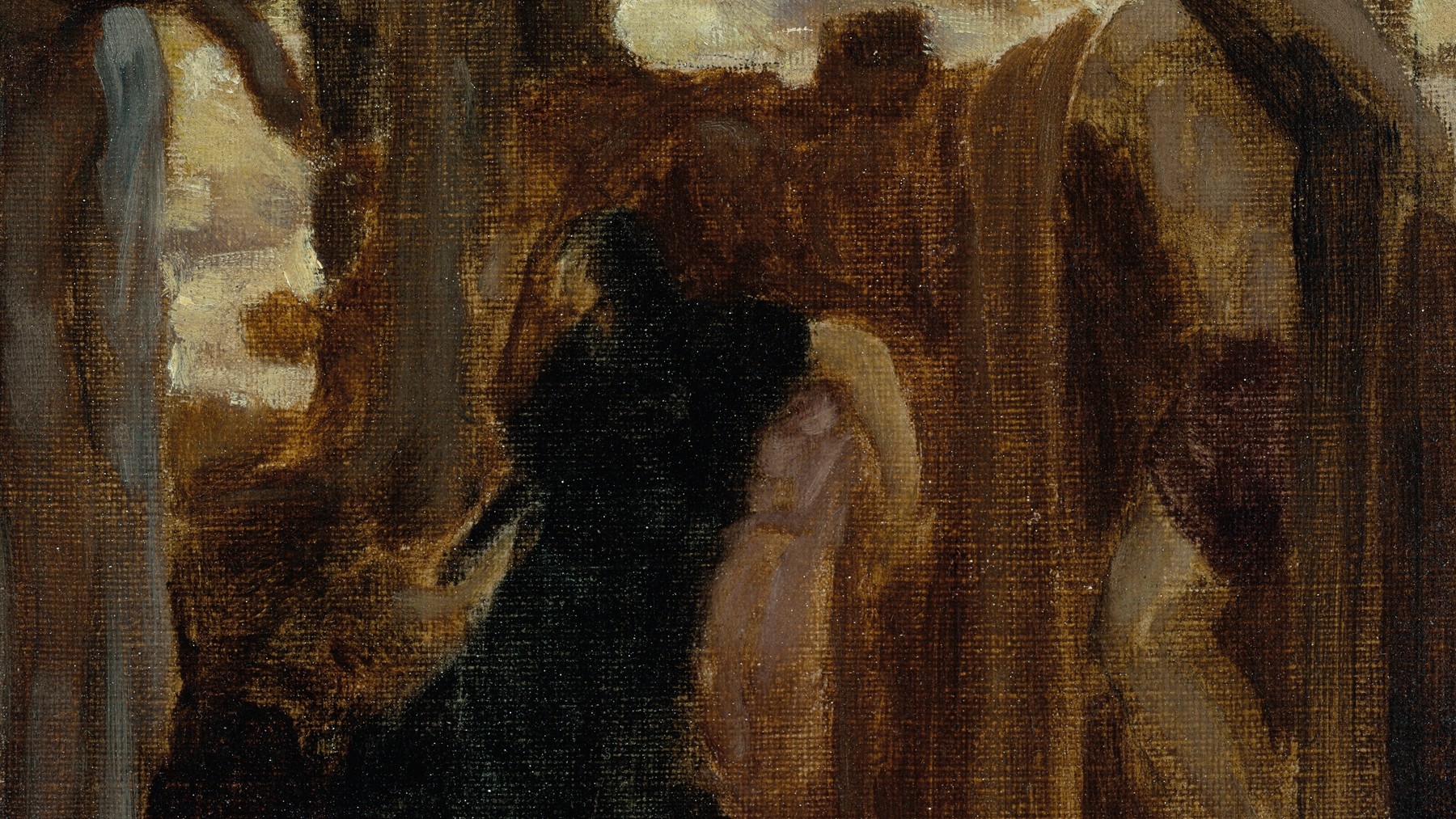
Image credit: Detail from “Rizpah, a Color Sketch” by Frederic Leighton.
