
1 Kings 4
I {untranslated} = hayah. This is to be or become, to happen.
II “King” = melek. From malak (to be or become king or queen, to rise to the throne, to be crowned; by implication, to take counsel). This is king or royal.
III “Solomon” = Shelomoh. From shalam (to be complete or sound; to have safety mentally, physically, or extending to one’s estate; so, if these things are safe and complete, the implication is that one would be friendly; and, if being friendly, one would make amends and that friendship would be reciprocated). This is Solomon or Shelomoh, meaning “peaceful.” It is the same word as the Hebrew word for peace – shalom.
over allIV Israel,V 2 and these were his high officials:VI
IV “all” = kol. From kalal (to complete). This is all or every.
V “Israel” = Yisrael. From sarah (to persist, exert oneself, contend, persevere, wrestle, prevail) + El (God or god). This is Israel, meaning God strives or one who strives with God; new name for Jacob and for his offspring. This refers to the people and to the land.
VI “high officials” = sar. This is chief, leader, ruler, lord, official, governor, prince, military leader. It refers to someone at the top of a rank or class.
AzariahVII sonVIII of ZadokIX was the priest;X
VII “Azariah” = Azaryahu. Related to {untranslated} in v1. From azar (to help, protect, support, ally; properly, to surround so as to provide aid) + Yah (God, the Lord; a shortening of the sacred name of the God of Israel); {from YHVH (the holy name of the God of Israel, generally designated Lord; the self-existent and eternal one; the tetragrammaton); from havah (to become); or from hayah (see note I above)}}. This is Azariah, which means “the Lord has helped.”
VIII “son” = ben. From banah (to build or obtain children). This is son, age, child. It is son in a literal or figurative sense.
IX “Zadok” = Tsadoq. From tsadaq (to be just or righteous, do justice); from tsedeq (rightness, righteousness, just cause, vindication; that which is right in a natural, moral, or legal sense; abstractly equity; figuratively prosperity). This is Zadok, a name meaning “just” or “righteous.” See https://www.abarim-publications.com/Meaning/Zadok.html
X “priest” = kohen. This is literally the one who officiates i.e. the priest. This is where the Jewish last name “Cohen” (and its variants) comes from.
3 ElihorephXI and AhijahXII sons of ShishaXIII were secretaries;XIV
XI “Elihoreph” = Elichoreph. Related to “Israel” in v1. 1x in OT. From El (see note V above) + choreph (autumn, winter – the time of ripeness or harvest, the prime, youth); {perhaps from charaph (to expose and so figuratively to reproach, defame, carp at, defy)}. This is Elihoreph, meaning “God of autumn” or “God of approach.” See https://www.abarim-publications.com/Meaning/Elihoreph.html
XII “Ahijah” = Achiyyah. Related to {untranslated} in v1 & “Azariah” in v2. From ach (brother, kindred, another, other, like) + Yah (see note VII above). This is Ahijah, which means “brother of the Lord” or “worshiper of the Lord” or “an ally [or brother or friend] is the Lord.” See https://www.abarim-publications.com/Meaning/Ahijah.html
XIII “Shisha” = Shisha. 1x in OT. From shayish (alabaster, white, crystal); perhaps related to shesh (byssus flax, a bleached fabric, white linen; figuratively, marble). This is Shisha, meaning “whiteness” or alabaster.” See https://www.abarim-publications.com/Meaning/Shisha.html
XIV “secretaries” = saphar. From sepher (writing, document, book, evidence). This is properly to tally or record something. It can be enumerate, recount, number, celebrate, or declare.
JehoshaphatXV son of AhiludXVI was recorder;XVII
XV “Jehoshaphat” = Yehoshaphat. Related to {untranslated} in v1 & “Azariah” in v2 & “Ahijah” in v3. From YHVH (see note VII above) + shaphat (to judge, defend, pronounce judgment, condemn, govern). This is Jehoshaphat, meaning “the Lord has judged.”
XVI “Ahilud” = Achilud. Related to “Ahijah” in v3. 5x in OT. From ach (see note XII above) + yalad (to bear, bring forth; can mean to act as midwife or to show one’s lineage). This is Ahilud, meaning “brother of one born” or “child’s brother” or “brother brings forth.” See https://www.abarim-publications.com/Meaning/Ahilud.html
XVII “recorder” = zakar. This is to remember, to mark something so that it can be recalled, to be mindful of, to mention.
4 BenaiahXVIII son of JehoiadaXIX was in command of the army;XX
XVIII “Benaiah” = Benayahu. Related to “son” in v2 and related to {untranslated} in v1 & “Azariah” in v2 & “Ahijah” and “Jehoshaphat” in v3. From banah (see note VIII above) + Yah (see note VII above). This is Benaiah, meaning “the Lord has built up” or “the Lord has built” or “built by the Lord” or “son of God.” See https://www.abarim-publications.com/Meaning/Benaiah.html
XIX “Jehoiada” = Yehoyada. Related to {untranslated} in v1 & “Azariah” in v2 & “Ahijah” and “Jehoshaphat” in v3 & “Benaiah” in v4. From YHVH (see note VII above) + yada (to know, be aware, see and so understand – includes observation, care, recognition; can also be used as a euphemism). This is Jehoiada, meaning “the Lord knows” or “Lord-known.”
XX “army” = tsaba. From tsaba (to wage war, serve, assemble, fight, perform, muster, wait on). This is a large group of persons (used figuratively for a group of things). It implies a campaign literally as with army, war, warfare, battle, company, soldiers. Can also be used figuratively for hardship or for worship.
Zadok and AbiatharXXI were priests; 5 Azariah son of NathanXXII was over the officials;XXIII
XXI “Abiathar” = Ebyathar. From ab (father, chief, or ancestor; father in a literal or figurative sense) + yathar (to jut over, remain behind, preserve, to excel). This is Abiathar, which means “the great one is father” or “father of abundance” i.e. liberal or “father of a remnant” or “father of preeminence” or “father of plenty.” See https://www.abarim-publications.com/Meaning/Abiathar.html
XXII “Nathan” = Nathan. From natan (to give, put, set, offer; to give literally or figuratively). This is Nathan, meaning “given” or “[God] gives.”
XXIII “officials” = natsab. This is to station, appoint, establish, take a stand.
ZabudXXIV son of Nathan was priest and king’s friend;XXV 6 AhisharXXVI was in charge of the palace;XXVII
XXIV “Zabud” = Zabud. 1x in OT. From zabad (to bestow, confer, endure). This is Zabud, meaning “given” or “bestowed.”
XXV “friend” = re’eh. 4x in OT– 2x in 2 Samuel, 1x in 1 Kings, and 1x in Proverbs 27. From ra’ah (to associate with someone). This is a companion or friend.
XXVI “Ahishar” = Achishar. Related to “Ahijah” and “Ahilud” in v3. 1x in OT. From ach (see note XII above) + shir (to sing; one who sings or leads the song); {from shir (song, singer)} OR from ach (see above) + yashar (to be straight, right, even, smooth, or agreeable; figuratively, to make something pleasant or prosperous). This is Ahishar, which may mean “brother of the singer” or “my brother has sung” or “brother of singing” or “brother of firmness” or “my brother is firm” or “my brother is upright” or “brother of uprightness” or “brother of the upright.” See https://www.abarim-publications.com/Meaning/Ahishar.html
XXVII “palace” = bayit. Related to “son” in v2 & “Benaiah” in v4. Probably from banah (see note VIII above). This is house, court, family, palace, temple.
and AdoniramXXVIII son of AbdaXXIX was in charge of the forced labor.XXX
XXVIII “Adoniram” = Adoniram. 2x in OT. From adon (lord, master, owner) + rum (rise, bring up, being high, extol, exalt, haughty; to raise in a literal or figurative sense). This is Adoniram, meaning “my Lord is exalted” or “lord of height.”
XXIX “Abda” = Abda. 2x in OT. From abad (to work, serve, compel; any kind of work; used causatively, can mean to enslave or keep in bondage). This is Abda, meaning “work” or servant.” See https://www.abarim-publications.com/Meaning/Abda.html
XXX “forced labor” = mas. Perhaps from masas (to melt, discourage, faint; to deteriorate from a sickness or weaken because of sleepiness or an emotional response). This is a burden that creates weariness and or exhaustion. It is forced labor, taskwork, or other levy.
7 Solomon had twelveXXXI officialsXXXII over all Israel who provided foodXXXIII for the king and his household;XXXIV
XXXI “twelve” = shenayim + asar. Shenayim is from sheni (double, again, another, second); from shanah (to fold, repeat, double, alter, or disguise). This is two, both, second, couple. Asar is from the same as eser (ten). This is -teen or -teenth.
XXXII “officials” = natsab. Same as “officials” in v5. See note XXIII above.
XXXIII “provided food” = kul. This is to hold in. So, it can be to contain, measure, guide, or feed. It can also mean to be able to or sustain.
XXXIV “household” = bayit. Same as “palace” in v6. See note XXVII above.
each oneXXXV had to makeXXXVI provisionXXXVII for one monthXXXVIII in the year.XXXIX
XXXV “each one” = echad. Perhaps from achad (to unify, continue on a path; figuratively, to gather one’s thoughts). This is the number one, first, united. It can also be alone, altogether, a certain, a few.
XXXVI “make” = hayah. Same as {untranslated} in v1. See note I above.
XXXVII “provision” = kul. Same as “provided food” in v7. See note XXXIII above.
XXXVIII “month” = chodesh. From chadash (to renew, repair). This refers to a new moon. It can also mean monthly.
XXXIX “year” = shanah. From shana (to change, alter). This is a year, age, old. It can also mean yearly.
8 These were their names:XL Ben-hur,XLI in the hill countryXLII of Ephraim;XLIII
XL “names” = shem. May be from sim (to put, place, set). This is name, fame, renown. A name was thought to indicate something essential about a person – something about their individuality. So, this word can also mean honor, authority, or character.
XLI “Ben-hur” = Ben-chur. Related to “son” in v2 & “Benaiah” in v4 & “palace” in v6. 1x in OT. From ben (see note VIII above) + Chur (Hur or Chur; meaning uncertain); {from chavar (to be or become white or pale)} OR from ben (see above) + the same as chur (white things, white, white linen); {from chavar (see above)} OR from ben (see above) + the same as chur (hole; a hole that was bored; a crevice where a snake lives; the cell of a prison) OR from ben (see above) + charar (to be hot, burn, glow, melt, be scorched; figuratively, to incite passion, be angry). This is Ben-hur, meaning “son of Hur” or “son of a free man” or “one of the burnings” or “one of the nobles” or “one of the holes” or “one of the whites;” see https://www.abarim-publications.com/Meaning/Ben-hur.html
XLII “hill country” = har. From harar (hill or mountain). This is mountain, hill, hilly region.
XLIII “Ephraim” = Ephrayim. From the same as epher (ashes or dust – properly something strewn) OR from parah (to grow, increase, be fruitful in a literal or figurative sense). This is Ephraim, one of Joseph’s sons, his descendants, and their land.
9 Ben-deker,XLIV in Makaz,XLV Shaalbim,XLVI
XLIV “Ben-deker” = Ben-deqer. Related to “son” in v2 & “Benaiah” in v4 & “palace” in v6 & “Ben-hur” in v8. 1x in OT. From ben (see note VIII above) + a derivative of daqar (to stab, pierce, wound; to starve or revile). This is Ben-deker, meaning “son of Deker” or “son of piercing” or “son of a lance.”
XLV “Makaz” = Maqats. 1x in OT. From qatsats (to cut or chop off in a literal or figurative sense). This is Makats, meaning “end” or “awake” or “arise.”
XLVI “Shaalbim” = Shaalbim. 3x in OT. From the same as shual (a fox or jackal; an animal that spends its time in ruins or wastelands and eats carrion) OR from shual (see above) + bin (to discern, consider, attend to; distinguishing things in one’s mind or, more generally, to understand). This is Shaalabbin, a city whose name may mean “haunt of foxes” or “fox-holes” or “sly fox” “vulpine cunning” or “understanding by ferreting.” See https://www.abarim-publications.com/Meaning/Shaalabbin.html
Beth-shemesh,XLVII and Elon-beth-hanan;XLVIII 10 Ben-hesed,XLIX in ArubbothL
XLVII “Beth-shemesh” = Beth-shemesh. Related to “son” in v2 & “Benaiah” in v4 & “palace” in v6 & “Ben-hur” in v8 & “Ben-deker” in v9. From bayit (see note XXVII above) + shemesh (sun or toward the east; root may mean being brilliant; figuratively, a ray or an arch). This is Beth-shemesh, meaning “sun temple” or “house of the sun.”
XLVIII “Elon-beth-hanan” = Elon-beth-chanan. Related to “son” in v2 & “Benaiah” in v4 & “palace” in v6 & “Ben-hur” in v8 & “Ben-deker” and “Beth-shemesh” in v9. 1x in OT. From Elon (Elon, a terebinth or oak.); {from ayil (oaks); from the same as ulam (porch, hall); from the same as ul (mighty, strength, body, belly; root may mean to twist and that implies strength and power) OR from alam (to bind or tie fast; to be silent or speechless, whether voluntary or involuntary)} + bayit (see note XXVII above) + chanan (beseech, show favor, be gracious; properly, to bend in kindness to someone with less status). This is Elon-beth-hanan, meaning “oak-grove of the house of favor” or “oak of the house of grace” or “oak of the house of Hanan.” See https://www.abarim-publications.com/Meaning/Elonbeth-hanan.html
XLIX “Ben-hesed” = Ben-chesed. Related to “son” in v2 & “Benaiah” in v4 & “palace” in v6 & “Ben-hur” in v8 & “Ben-deker” and “Beth-shemesh” and “Elon-beth-hanan” in v9. 1x in OT. From ben (see note VIII above) + chesed (favor, goodness, kindness, loving kindness, pity, reproach, or a good deed; when done by humanity to God, it is piety); {from chasad (being good, kind, merciful; may mean bowing one’s neck as is done in the presence of an equal for courtesy’s sake; so, if one in a superior position is treating you like an equal, that is what is captured here)}. This is Ben-hesed, meaning “son of kindness” or “son of mercy” or “mercy” or “son of fidelity;” see https://www.abarim-publications.com/Meaning/Ben-hesed.html
L “Arubboth” = Arubboth. 1x in OT. From arubbah (window, lattice, dove-cote, chimney, floodgates; can refer to floodgates in the sky that open when great rains come,as in the Great Flood); from arab (to ambush, lurk, lie in wait). This is Arubboth, meaning “windows” or “floodgates” or “lattices” or “escape hatches.” See https://www.abarim-publications.com/Meaning/Arubboth.html
(to him belonged SocohLI and all the landLII of Hepher);LIII
LI “Socoh” = Sokoh. 8x in OT. From the same as sok (lair, thicket, den, or hiding place; a den or pavilion as made of intertwined boughs); from suk (to make a hedge, entwine; to enclose in order to hold back or protect). This is Socoh or Soco, a place whose name means “hedge”, “thicket,” “thorn,” or “fence.” See https://www.abarim-publications.com/Meaning/Socoh.html
LII “land” = erets. Root may mean to be firm. This is earth, ground, field land, or country.
LIII “Hepher” = Chepher. 9x in OT. From chaphar (properly to pry into; to dig search for, sink, or explore) or chapher (to be ashamed, disgraced, embarrassed, confounded – to blush). This is Hepher or Chepher, meaning “pit of shame” or “dig” or “shame” or “well” or “pit.” See https://www.abarim-publications.com/Meaning/Hepher.html
11 Ben-abinadab,LIV in all Naphath-dorLV (he hadLVI
LIV “Ben-abinadab” = Ben-abinadab. Related to “son” in v2 & “Benaiah” in v4 & “palace” in v6 & “Ben-hur” in v8 & “Ben-deker” and “Beth-shemesh” and “Elon-beth-hanan” in v9 & “Ben-hesed” in v10. 1x in OT. From ben (see note VIII above) + Abinadab (Abinadab, meaning “my father is noble” or “father of generosity,” which is to say very generous);{from ab (father literal or figurative) + nadab (to offer voluntarily, incite, impel; to volunteer to be a soldier or offer freely)}. This is Ben-abinadab, meaning “son of Abinadab” or “son of a generous father.” See https://www.abarim-publications.com/Meaning/Ben-abinadab.html
LV “Naphath-dor” = Naphat + dor. Naphah is 4x in OT. From nuph (to rock back and forth, wave, sprinkle, quiver, beckon, offer, present). This is a height, border, coast, sieve. Dor is 7x in OT. From dor (a revolution of time, which is to say, an age or generation; a dwelling or one’s posterity); from dur (o move in a circle, which implies living somewhere or remaining there; it can also be the sense of piling or heaping up). This is Dor, meaning “dwelling” or “habitation.” See https://www.abarim-publications.com/Meaning/Dor.html
LVI “had” = hayah. Same as {untranslated} in v1. See note I above.
Taphath,LVII Solomon’s daughter,LVIII as his wife);LIX
LVII “Taphath” = Taphath. 1x in OT. Perhaps from nataph (to drip, ooze, or drop; the process of gradual distillation that causes liquid to fall drop by drop; figuratively, prophesying or inspired speech). This is Taphath., meaning “a dropping of ointment” or “a dripping” or “a drop.” See https://www.abarim-publications.com/Meaning/Taphath.html
LVIII “daughter” = bat. Related to “son” in v2 & “Benaiah” in v4 & “palace” in v6 & “Ben-hur” in v8 & “Ben-deker” and “Beth-shemesh” and “Elon-beth-hanan” in v9 & “Ben-hesed” in v10 & “Ben-abinadab” in v11. From ben (see note VIII above). This is daughter in a literal or figurative sense.
LIX “wife” = ishshah. From ish (man); perhaps from enosh (human, humankind, mortal); from anash (to be weak, sick, or frail). This is woman, wife, or female.
12 BaanaLX son of Ahilud, in Taanach,LXI Megiddo,LXII
LX “Baana” = Baana. Related to “son” in v2 & “Benaiah” in v4 & “palace” in v6 & “Ben-hur” in v8 & “Ben-deker” and “Beth-shemesh” and “Elon-beth-hanan” in v9 & “Ben-hesed” in v10 & “Ben-abinadab” and “daughter” in v11. 3x in OT. From the same as Baanah (Baanah, same meaning as “Baana”); perhaps from anah (to be bowed down; humility or being browbeaten, oppressed, afflicted, or depressed; literal or figurative – depressed in mood or circumstance) OR from ben (see note VIII above) + anah (to answer, respond, announce, sing, shout, or testify; to pay attention, which implies responding and, by extension, starting to talk; singing, shouting, testifying, etc.). This is Baanah, meaning “in affliction” or “son of response” or “son of affliction” or “son of distress” or “affliction.” See https://www.abarim-publications.com/Meaning/Baana.html
LXI “Taanach” = Tanak. 7x in OT. This is Taanach, Tanach, or Tanak. Its meaning is unclear. It may mean “wandering through” or “sandy.” See https://www.abarim-publications.com/Meaning/Taanach.html
LXII “Megiddo” = Mgiddon. 12x in OT. Perhaps from abdan (destruction, perishing); {from abad (to wander off, lose self; to perish, destroy, die, vanish, or be broken or corrupt)} OR from gadad (to cut, gather, assemble, crowd; also, to gash as pushing in). This is Megiddo or Megiddon. It may mean “tower” or “rendezvous” or “invading” or “Place of exposure” or “place of troops” or “place of multitudes.” See https://www.abarim-publications.com/Meaning/Megiddo.html
and all Beth-shean,LXIII which is besideLXIV ZarethanLXV
LXIII “Beth-shean” = Beth-shean. Related to “son” in v2 & “Benaiah” in v4 & “palace” in v6 & “Ben-hur” in v8 & “Ben-deker” and “Beth-shemesh” and “Elon-beth-hanan” in v9 & “Ben-hesed” in v10 & “Ben-abinadab” and “daughter” in v11 & “Baana” in v12. 9x in OT. From bayit (see note XXVII above) + shaan (to rest, be quiet, be peaceful). This is Beth-shean, meaning “place of quiet” or “house of ease” or “house of security” or “house of perpetuity.” See https://www.abarim-publications.com/Meaning/Beth-shean.html
LXIV “beside” = etsel. From atsal (to reserve, refuse, join, separate, keep). This is nearby, toward, joining.
LXV “Zarethan” = Tsarethan. 3x in OT. Perhaps from tsredah (Zereda or Tsredah; an Ephraimite city; root may mean pierce or puncture) OR form tsarar (to bind, restrict, narrow, be cramped, an adversary) OR form tsur (to confine, cramp, or bind in a literal or figurative sense; to besiege, assault, or distress, adversary). This is Zarethan or Tsarethan – it may mean “fortress,” “they vex,” or “place of oppression.” See https://www.abarim-publications.com/Meaning/Zarethan.html#.X1asA8hKhPY
belowLXVI Jezreel,LXVII and from Beth-shean to Abel-meholah,LXVIII
LXVI “below” = tachat. This is underneath, below, the bottom, instead of.
LXVII “Jezreel” = Yizreel. Related to “Israel” in v1 & “Elihoreph” in v2. From zara (to sow or scatter seed; conceive or yield) + El (see note V above). This is Jezreel or Yizreel. It means “God sows” or “God will sow.”
LXVIII “Abel-meholah” = Abel-mecholah. 3x in OT. From abel (meadow, plain – grassy) + mecholah (dancing, a company); {from machol (round dance); from chul (whirling around so dancing as in a circle or writhing in pain; used particularly for the pain of childbirth or from writhing due to fear; can also be falling in pain or waiting)} or {from machashabah (thought, scheme, imagination, purpose, or a plan either good or evil); from chashab (literally to weave; figuratively to think or plot something malicious)}. This is Abel-meholah or Abel Mecholah, meaning “meadow of dancing.”
as far as the other sideLXIX of Jokmeam;LXX 13 Ben-geber,LXXI in Ramoth-gileadLXXII
LXIX “other side” = eber. From abar (to pass over, pass through, or pass by; cross over or to alienate; used for transitions). This is the place across or beyond, by, from, other, the opposite side, against, over. It often refers to the other side of the Jordan river or toward the east.
LXX “Jokmean” = Yoqmeam. 2x in OT. From qum (arise, stand, accomplish, establish, abide; rising against, getting up after being sick or asleep, arising from one state to another, becoming powerful, or rising for action; standing in a figurative sense) + am (people or nation; a tribe, troops or armies, or figuratively to refer to a flock of animals); {from amam (to darken, hide, associate; creating shadows by huddling together)}. This is Jokmeam, meaning “the people will be raised” or “let the people arise” or “gathered of the people” or “let the people be established.” See https://www.abarim-publications.com/Meaning/Jokm el eam.html
LXXI “Ben-geber” = Ben-geber. Related to “son” in v2 & “Benaiah” in v4 & “palace” in v6 & “Ben-hur” in v8 & “Ben-deker” and “Beth-shemesh” and “Elon-beth-hanan” in v9 & “Ben-hesed” in v10 & “Ben-abinadab” and “daughter” in v11 & “Baana” and “Beth-shean” in v12. 1x in OT. From ben (see note VIII above) + geber (man, warrior, a person generally, or a valiant person); {from gabar (to be strong or mighty; to prevail or to be insolent)}. This is Ben-geber, meaning “son of the hero” or “son of Geber” or “son of a man.”
LXXII “Ramoth-gilead” = Ramoth Gilad. Related to “Adoniram” in v6. From ramah (height, high place; idol worship was often done on the heights); {from rum (see note XXVIII above)} + Gilad (Gilead, meaning “perpetual fountain” or “heap of testimony.”); {from gala (to lay bare, quarrel, expose) OR from gal’ed (heap of testimony); {from gal (wave, billow, rock pile; something rolled; a spring of water); {from galal (to roll, roll away, wallow, commit, remove; rolling in a literal or figurative sense)} + ed (witness, testimony, recorder); {from ud (to admonish, repeat, duplicate, testify, restore, record, relieve)}. This is Ramoth-gilead. “Ramoth” means “heights” or “high places” or “lofty places.” Gilead means “perpetual fountain” or “heap of testimony.” See https://www.abarim-publications.com/Meaning/Ramoth.html & https://www.abarim-publications.com/Meaning/Gilead.html#.Xw_EFShKhPY
(he had the villagesLXXIII of JairLXXIV son of Manasseh,LXXV which are in Gilead,LXXVI
LXXIII “villages” = chavvah. 4x in OT. Perhaps from the same as Chavvah (Eve or Chavvah, a name meaning “life” or “life-giver); from chavah (show, tell, live, declare). This is a place of living. So, it is a village of tents or a settlement.
LXXIV “Jair” = Yair. 9x in OT. From or (to be or become light). This is Jair or Yair, meaning “enlightens” or “enlightener” or “he will diffuse light” or “one giving light.” See https://www.abarim-publications.com/Meaning/Jair.html
LXXV “Manasseh” = Menashsheh. From nashah (to forget, neglect, remove, deprive). This is Manasseh, literally “causing to forget.” It is Manasseh, his tribe, or the lands of the tribe – meaning “to forget.”
LXXVI “Gilead” = Gilad. Related to “Ramoth-gilead” in v13. See note LXXII above.
and he had the regionLXXVII of Argob,LXXVIII which is in Bashan,LXXIX sixtyLXXX
LXXVII “region” = chebel. From chabal (to bind, pledge, or wind tight; figuratively, can refer to perverting or destroying something; can also be used of writhing in pain, particularly in reference to childbirth). This is a band, rope, measuring line, noose. It can be a company, territory, or country. It can also refer to a throe of labor or ruin.
LXXVIII “Argob” = Argob. 5x in OT. From the same as regeb (clump of dirt, clay; may be from a root that means pile together). This is Argob, meaning “stony.”
LXXIX “Bashan” = Bashan. Bashan is a place whose name may mean “smooth.”
LXXX “sixty” = shishshim. From shesh (six; figuratively, a surplus since it is one more than the number of fingers on the hand). This is sixty.
greatLXXXI citiesLXXXII with wallsLXXXIII
LXXXI “great” = gadol. From gadal (to grow up, become great, become wealthy – to advance. The root meaning may be to twist in the sense of the process of growing). This is great, high, bigger, noble, old, marvelous. It can also refer to someone who is powerful or distinguished.
LXXXII “cities” = iyr. From uwr (to awaken or wake oneself up). This can mean excitement in the sense of wakefulness or city. Properly, this is a place that is guarded. Guards kept schedules according to watches. This sense of the word would include cities as well as encampments or posts that were guarded.
LXXXIII “walls” = chomah. From the same as cham (father-in-law – one’s husband’s father; perhaps from a root meaning to join). This is a wall – a wall as used for protection.
and bronzeLXXXIV bars);LXXXV 14 AhinadabLXXXVI son of Iddo,LXXXVII
LXXXIV “bronze” = nechosheth. Perhaps from nechushah (copper, bronze, brass – something made from this metal like a coin or fetter; something that is considered base in contrast to gold or silver.; from nachush (made of bronze or brass, coppery; figuratively, hard); from nachash (to divine, interpret omens, learn from experience, observe; to hiss). This is bronze, copper, steel, brass or something made from copper. So, it could be a coin or chains. It can also figuratively mean something considered lesser in contrast to gold or silver.
LXXXV “bars” = beriach. From barach (to flee, drive away, hurry, to bolt). This is a bar or a bolt. It can also be used for a fugitive.
LXXXVI “Ahinadab” = Achinadab. Related to “Ahijah” and “Ahilud” in v3 & “Ahishar” in v6 and related to “Ben-abinadab” in v11. 1x in OT. From ach (see note XII above) + nadab (see note LIV above). This is Ahinadab, meaning “brother of liberality” or “my brother is noble” or “brother of nobility.” See https://www.abarim-publications.com/Meaning/Ahinadab.html
LXXXVII “Iddo” = Iddo. 10x in OT. From adah (to pass on, advance, decorate oneself). This is Iddo, meaning “timely” or “timely of him.” See https://www.abarim-publications.com/Meaning/Iddo.html
in Mahanaim;LXXXVIII 15 Ahimaaz,LXXXIX in NaphtaliXC
LXXXVIII “Mahanaim” = Machanayim. 13x in OT. From machaneh (an encampment, whether of people traveling together or soldiers; a camp band or company; an army of soldiers; other groups like animals, angels or stars.); from chanah (to decline, bending down, or living in tents; can be camping to create a home or camping as a part of battle). This is Mahanaim, a city whose name means “two camps” or “double camp.”
LXXXIX “Ahimaaz” = Achimaats. Related to “Ahijah” and “Ahilud” in v3 & “Ahishar” in v6 & “Ahinadab” in v14. 15x in OT. From ach (see note XII above) + Maats (Maats, a name meaning “closure”); {perhaps from atsah (to shut, fasten, firm up, to close one’s eyes)}. This is Ahimaaz, a name meaning “my brother is wrath” or “brother of anger.”
XC “Naphtali” = Naphtali. From pathal (to twist, twine, wrestle, struggle, behave in an unsavory way). This is Naphtali, meaning “my wrestling.” It can refer to Naphtali, his tribe, or the lands of the tribe.
XCI(he had takenXCII Basemath,XCIII Solomon’s daughter, as his wife);
XCI {untranslated} = gam. This is also, moreover, again.
XCII “taken” = laqach. This is to take, accept, carry away, receive. It can also have the sense of take a wife or take in marriage.
XCIII “Basemath” = Basemath. 7x in OT. From the same as bosem (balsam, spice, perfume, odor; the balsam tree); from the same as basam (spice, balsam tree). This is Basemath or Basmath. It may mean “perfume” or “fragrance.” It refers to one of Esau’s wives and one of Solomon’s daughters.
16 Baana son of Hushai,XCIV in AsherXCV and Bealoth;XCVI 17 Jehoshaphat son of Paruah,XCVII in Issachar;XCVIII
XCIV “Hushai” = Chushay. Related to {untranslated} in v1 & “Azariah” in v2 & “Ahijah” and “Jehoshaphat” in v3 & “Benaiah” and “Jehoiada” in v4. 14x in OT. From chush (to hurry, be eager) OR from chush (see above) + Yah (see note VII above)}. This is Hushai, meaning “hasty” or “hasting of the Lord.” See https://www.abarim-publications.com/Meaning/Hushai.html
XCV “Asher” = Asher. From ashar (to go straight, lead, guide; to be level and so to be right, blessed, honest, happy). This is Asher, one of Jacob’s children and his tribe. It means “happy one.”
XCVI “Bealoth” = Bealoth. 2x in OT. From ba’alah (mistress, woman); {from baal (owner, master, husband); from ba’al (to marry, have dominion over, to master)}. This is Bealoth, a city whose name means “in Aloth” or “mistresses.”
XCVII “Paruah” = Paruach. 1x in OT. From parach (to sprout, blossom, bloom, spread, flourish). This is Paruach, meaning “flourishing” or “sprouting” or “blossomed.”
XCVIII “Issachar” = Yissaskar. Related to “wife” in v11. Perhaps from nasa (to lift in a broad sense, literally and figuratively; to carry, take, or arise; to bring forth, advance, accept) + sakar (wages, payment, service, salary, worth, reward, or benefit); {from sakar (to hire, reward, earn)} OR ish (see note LIX above) + sakar (see above). This is Issachar, one of Jacob’s children and his tribe. It may mean “there is recompense,” “man of hire,” “he is wages,” or “he will bring a reward.” See https://www.abarim-publications.com/Meaning/Issachar.html
18 ShimeiXCIX son of Ela,C in Benjamin;CI
XCIX “Shimei” = Shimi. From shama (hear, call, consent, or consider; implies listening intelligently, giving attention; obedience and action are often implied). This is Shmei or Shimeah, meaning “renown” or “famous.” See https://www.abarim-publications.com/Meaning/Shimei.html
C “Ela” = Ela. Related to “Elon-beth-hanan” in v9. 1x in OT. Perhaps from elah (oak or terebinth; or some other kind of tree that is strong); from ayil (see note XLVIII above). This is Ela, meaning “oak” or “terebinth tree.”
CI “Benjamin” = Binyamin. Related to “son” in v2 & “Benaiah” in v4 & “palace” in v6 & “Ben-hur” in v8 & “Ben-deker” and “Beth-shemesh” and “Elon-beth-hanan” in v9 & “Ben-hesed” in v10 & “Ben-abinadab” and “daughter” in v11 & “Baana” and “Beth-shean” in v12 & “Ben-geber” in v13. From ben (see note VIII above) + from yamin (right hand or side; that which is stronger or more agile; the south); {perhaps yamam (to go or choose the right, use the right hand; to be physically fit or firm)}. This is Benjamin, meaning “son of the right hand.”
19 GeberCII son of Uri,CIII in the land of Gilead, the countryCIV of King SihonCV
CII “Geber” = Geber. Related to “Ben-geber” in v13. 1x in OT. From the same as geber (see note LXXI above). This is Geber, meaning “man” or “strong one” or “hero” or “mighty man.” See https://www.abarim-publications.com/Meaning/Geber.html
CIII “Uri” = Uri. Related to “Jair” in v13. 8x in OT. From or (see note LXXIV above). This is Uri, meaning “fiery” or “light” or “the Lord is light” or “flame of the Lord” or “my light is the Lord” or “my flame.” See https://www.abarim-publications.com/Meaning/Uri.html
CIV “country” = erets. Same as “land” in v10. See note LII above.
CV “Sihon” = Sichon. Perhaps from the same as suach (Suach, a name); from the same as suchah (something swept away, refuse). This is Sihon or Sichon, a name perhaps meaning “tempestuous.”
of the AmoritesCVI and of King OgCVII of Bashan. And there was one garrisonCVIII in the land.
CVI “Amorites” = Emori. From amar (to speak, say, answer, command, promise, report). This is Amorite or Emori, perhaps meaning “talkers.”
CVII “Og” = Og. From the same as uggah (bread cake, round ash cake); from ug (to gyrate, bake; baking a round cake). This is Og, a name perhaps meaning “round.”
CVIII “garrison” = netsib. Related to “officials” in v5. 12x in OT. From natsab (see note XXIII above). This is something that stands like a pillar, statute, or post. It could also be an officer, a garrison, or a military post.
[[20 JudahCIX and Israel were as numerousCX as the sandCXI by the sea;CXII
CIX “Judah” = Yehudah. Probably from yadah (to throw one’s hands into the air in a gesture of praise); from yad (hand). This is Judah, meaning “praised.”
CX “numerous” = rab…rob. Rab is from rabab (increasing in any aspect whether quantity, authority, size, quality, greatness, etc.). This is abundance, many, elder, exceedingly, great. It refers to abundance of amount, rank, or status. Rob is related to “numerous” in v20. From rabab (see note CX above). This is any kind of abundance.
CXI “sand” = chol. Related to “Abel-meholah” in v12. From chul (see note LXVIII above). This is sand, perhaps because of its roundness or the way that the grains can whirl.
CXII “sea” = yam. Root may mean to roar. This is the sea, often referring to the Mediterranean. It comes from the root in the sense of the roar of crashing surf. This word is sometimes used for rivers or other sources of water. It can mean to the west or to the south.
they ateCXIII and drankCXIV and were happy.CXV 21 Solomon wasCXVI sovereignCXVII
CXIII “ate” = akal. This is to eat, devour, burn up, or otherwise consume. It can be eating in a literal or figurative sense.
CXIV “drank” = shathah. This is to drink literally or figuratively. It could also be a drinker.
CXV “happy” = sameach. From samach (to rejoice, be glad; properly, to brighten up; also used figuratively). This is glad or joyful.
CXVI “was” = hayah. Same as {untranslated} in v1. See note I above.
CXVII “sovereign” = mashal. This is to rule, reign, govern, have authority, wield.
over all the kingdomsCXVIII from the EuphratesCXIX to the land of the Philistines,CXX even to the borderCXXI of Egypt;CXXII
CXVIII “kingdoms” = mamlakah. Related to “King” in v1. From the same as melek (see note II above). This is kingdom, dominion, sovereignty, rule. It can also refer to the realm.
CXIX “Euphrates” = nahar. From nahar (to flow, sparkle, be cheerful). This is a stream, river, or flood. Particularly used for the Nile or Euphrates. Figuratively, this can mean prosperity.
CXX “Philistines” = Pelishti. From Pelesheth (Philistia); from palash (to mourn, wallow, maybe roll in). This is Philistines. Their name may mean “griever” or “burrower” or “weakener.” See https://www.abarim-publications.com/Meaning/Philistine.html.
CXXI “border” = gebul. Perhaps from gabal (to border, twist like rope). This is boundary, limit, coast, space. Properly, it is a line that is twisted, which implies a boundary and, by extension, the boundaries of a territory or other enclosed space.
CXXII “Egypt” = Mitsrayim. Related to “Zarethan” in v12. Perhaps from matsor (besieged or fortified place, bulwark, entrenchment; something hemmed in; a siege or distress or fastness); from tsur (see note LXV above). This is Egypt.
they broughtCXXIII tributeCXXIV and servedCXXV Solomon all the daysCXXVI of his life.]]CXXVII
CXXIII “brought” = nagash. This is to draw, bring, or come near. It is approaching for any reason – as an attack on an enemy, in order to worship, to make an argument. It can also be used as a euphemism for sex.
CXXIV “tribute” = minchah. This is a gift or an offering, particularly a sacrificial one that is generally bloodless and given spontaneously (voluntarily).
CXXV “served” = abad. Related to “Abda” in v6. See note XXIX above.
CXXVI “days” = yom. Root may mean being hot. This is the day in a literal or figurative sense. It can also mean birth, age, daylight, continually or other references to time.
CXXVII “life” = chay. From chayah (to live or keep alive literally or figuratively). This is alive, living, lifetime. It can also be used to describe someone’s age. It can refer to animals, plants, water, or a company or congregation of people. It is life in a very broad sense.
22 CXXVIIISolomon’s provisionCXXIX for one day was thirtyCXXX corsCXXXI of choice flourCXXXII and sixty cors of meal,CXXXIII
CXXVIII {untranslated} = hayah. Same as {untranslated} in v1. See note I above.
CXXIX “provision” = lechem. From lacham (to eat, feed on). This is bread, food, loaf. It can refer to food more generally for people or for animals.
CXXX “thirty” = sheloshim. From the same as shalosh (three, fork, triad). This is thirty or thirtieth.
CXXXI “cors” = kor. 9x in OT. From the same as kur (furnace, smelting pot). This is a cor, which is a measurement used for dry goods. Literally, it’s a round vessel that is deep.
CXXXII “choice flour” = soleth. It may come from a word that means to strip. This is fine flour.
CXXXIII “meal” = qemach. 15x in OT. Root perhaps meaning to grind. This is something ground, such as flour, meal, or grain.
23 tenCXXXIV fatCXXXV oxenCXXXVI and twentyCXXXVII pasture-fedCXXXVIII cattle,CXXXIX
CXXXIV “ten” = eser. Related to “twelve” in v7. Perhaps from asar (see note XXI above). This is ten or -teen. While 7 is symbolically the number of perfection, ten is also symbolically a number of perfection (but to a lesser degree than 7 is).
CXXXV “fat” = bari. 14x in OT. From bara (to be fat); related to barah (to eat, choose, make clear). This is fat, firm, plenteous.
CXXXVI “oxen” = baqar. From baqar (to plow, break forth; figuratively, to inquire, inspect, consider). This is cattle – an animal used for plowing.
CXXXVII “twenty” = esrim. Related to “twelve” in v7 & “ten” in v23. From the same as eser (see note CXXXIV above). This is twenty or twentieth.
CXXXVIII “pasture-fed” = rei. 1x in OT. From ra’ah (to tend a flock, pasture, or graze; to rule or to associate with someone; figuratively, ruler or teacher); akin to rea (associate, companion, friend, neighbor, or other; close family or a lover). This is pasture-fed or companion.
CXXXIX “cattle” = baqar. Same as “oxen” in v23. See note CXXXVI above.
one hundredCXL sheep,CXLI besidesCXLII deer,CXLIII gazelles,CXLIV
CXL “hundred” = meah. This is hundred or some number times one hundred (i.e. hundredfold or the base of two hundred, three hundred, etc.).
CXLI “sheep” = tson. This is a flock of sheep and goats.
CXLII “besides” = bad. From badad (to divide or be separated; alone, solitary, lonely, isolated, straggler). This is apart, alone, separation, body part, tree branch, except. It can also be a city’s chief.
CXLIII “deer” = ayyal. Related to “Elon-beth-hanan” in v9 & “Ela” in v18. 11x in OT. From the same as ulam (see note XLVIII above). This is deer, hart. It can symbolize leaping, looking for pasture or sustenance. It can also be used to refer to princes.
CXLIV “gazelles” = tsbiy. From tsabah (to swell, amass like an army). This is beauty, honor, glorious, pleasant. It could refer to a decoration that is silver or gold. It can refer to a gazelle as something that is beautiful or splendor is being readily noticed.
roebucks,CXLV and fattedCXLVI fowl.CXLVII 24 For he had dominionCXLVIII over all the region westCXLIX
CXLV “roebucks” = yachmur. 2x in OT. From chamar (to be red, blush) OR from chamar (to boil up, ferment, be red befoul, trouble, daub). This is a fallow deer or roebuck.
CXVLI “fattened” = abas. 2x in OT. This is to feed or put in a stall (i.e., fatten up).
CXLVII “fowl” = barburim. 1x in OT. From bar (grain, wheat); from barar (to select, purify, cleanse, test, brighten, polish). This is poultry, like geese or capons, fattened with grain.
CXLVIII “had dominion” = radah. This is to step down, rule, dominate, have victory over, crumble.
CXLIX “region west” = eber. Same as “other side” in v12. See note LXIX above.
of the Euphrates,CL and he had peaceCLI on all sides.CLII
CL Some manuscripts add “from Tiphsah to Gaza, over all the kings west of the Euphrates.” Tiphsach is 2x in OT. from pasach (to stop, pass over, skip over, to spare). This is Tiphsah, meaning “ford” or “passage” or “crossing.” See https://www.abarim-publications.com/Meaning/Tiphsah.html Azzah is From az (strong or mighty; power, vehemence, greedy); from azaz (to be strong, become fixed, be bold, prevail, be impudent; it means to be stout literally or figuratively. A Late Hebrew word). This is Gaza or Azzah – a Philistine city. It means “strong.”
CLI “peace” = shalom. From shalam (to be complete or sound; to have safety mentally, physically, or extending to one’s estate; so, if these things are safe and complete, the implication is that one would be friendly; and, if being friendly, one would make amends and that friendship would be reciprocated). This is completeness, soundness, welfare, favor, friend, good health. It is to be safe and figuratively well, happy, at peace, friendly. Abstractly, it includes the ideas of welfare and prosperity (not in excessive wealth, but in having enough).
CLII “on all sides” = kol + eber + sabib. Eber is the same as “other side” in v12. See note LXIX above. Sabib is from sabab (turning around, going around; to surround, cast, walk, fetch; to revolve or border in a literal or figurative sense). This is a circuit or a circle. It could refer to an environment, one’s neighbors, or a circular path round about.
25 During Solomon’s lifetimeCLIII Judah and Israel livedCLIV in safety,CLV from DanCLVI
CLIII “lifetime” = kol + yom + Shelomoh. Literally, “all the days of Solomon.” Yom is the same as “days” in v21. See note CXXVI above. Shelomoh is the same as “Solomon” in v1. See note I above.
CLIV “lived” = yashab. This is to sit and so to remain and so to dwell. It is sitting for any reason – as a judge, in order to ambush, or just sitting quietly. Causatively, this can mean settling or marrying. This can also mean continue, endure, or establish.
CLV “safety” = betach. From batach (to hide for refuge, be secure or sure; figuratively, it refers to trust, being confident, or hoping). This is a place of refuge. So, abstractly, it can be confidence, security, hope, trust, or assurance.
CLVI “Dan” = Dan. From din (to judge, defend, dispute, govern, quarrel, plead). This is Dan or a Danite. It means “judge” and can refer to Dan, his tribe, or the lands of the tribe.
even to Beer-sheba,CLVII allCLVIII of them underCLIX their vinesCLX andCLXI fig trees.CLXII
CLVII “Beer-sheba” = Beerah shaba. From beer (a well or pit); {from baar (to make plain; to dig; can also mean to engrave or figuratively to explain)} + perhaps from shaba (to swear, curse, vow, make a covenant; properly, to be complete; this is to seven oneself – as in affirming something so strongly it is as though it were said seven times) {perhaps from sheba (seven – the number of perfection/sacred fullness)}. This is Beersheba – meaning either “well of seven” or “well of an oath.”
CLVIII “all” = ish. Related to “wife” in v11 & “Issachar” in v17. See note LIX above.
CLIX “under” = tachat. Same as “below” in v12. See note LXVI above.
CLX “vines” = gephen. Root may mean to twine or bend. So, it is a vine, particularly referring to grapes.
CLXI {untranslated} = tachat. Same as “below” in v12. See note LXVI above.
CLXII “fig trees” = teenah. This is fig tree. Its meaning is uncertain – it may come from another language.
26 Solomon also had fortyCLXIII thousandCLXIV stallsCLXV of horsesCLXVI for his chariotsCLXVII and twelve thousand horsemen.CLXVIII
CLXIII “forty” = arbaim. From the same as arba (four); from raba (to make square or be four-sided); perhaps from raba (to lie down flat; can be to lie for mating). This is forty.
CLXIV “thousand” = eleph. Perhaps from the same as eleph (herd, cattle); from alaph (to learn, speak, associate with). This is thousand.
CLXV “stalls” = urvah. 3x in OT. From arah (to gather, pluck). This is related to its root through the sense of gathering. This is a stall, which is a place of feeding or herding livestock.
CLXVI “horses” = sus. Root may mean to skip as in jump for joy. This is a crane or a swift bird. It is also a horse as leaping.
CLXVII “chariots” = merkab. 3x in OT. From rakab (to ride an animal or in some vehicle; also, bringing on a horse). This is a chariot, saddle, or covering.
CLXVIII “horsemen” = parash. From parash (to make distinct, separate, scatter). This is a horseman or a horse. It doesn’t refer to riding horseback, but with some kind of vehicle, a chariot-driver, cavalry.
27 Those officialsCLXIX supplied provisionsCLXX for King Solomon and for all who cameCLXXI to King Solomon’s table,CLXXII each oneCLXXIII in his month;
CLXIX “officials” = natsab. Same as “officials” in v5. See note XXIII above.
CLXX “supplied provisions” = kul. Same as “provided food” in v7. See note XXXIII above.
CLXXI “came” = qareb. 8x in OT. From qarab (to come near, offer, make ready). This is to come, approach, draw near.
CLXXII “table” = shulchan. Perhaps from shalach (to send, send for, forsake). This is a table or meal.
CLXXIII “each one” = ish. Same as “all” in v25. See note CLVIII above.
they let nothingCLXXIV be lacking.CLXXV 28 They also broughtCLXXVI to the requiredCLXXVII placeCLXXVIII
CLXXIV “nothing” = lo…dabar. Dabar is from dabar (to speak, declare, discuss). This is speech, a word, a matter, an affair, charge, command, message, promise, purpose, report, request. It is a word, which implies things that are spoken of in a wide sense.
CLXXV “be lacking” = adar. 10x in OT. This is to dig, help, keep rank. Properly, it is to muster troops as for battle. So, it could be to miss or lack since you can see who is missing following muster. Also, to arrange like a vineyard and so to hoe.
CLXXVI “brought” = bo. This is to enter, come in, advance, fulfill, bring offerings, enter to worship, attack. It can also have a sexual connotation.
CLXXVII “required” = hayah. Same as {untranslated} in v1. See note I above.
CLXXVIII “place” = maqom. Related to “Jokmeam” in v12. From qum (see note LXX above). This is a standing, which is to say a spot or space a place. It can also refer to a locality or a physical/mental condition. HaMaqom is also a Jewish name for God – the place, i.e. the Omnipresent One.
barleyCLXXIX and strawCLXXX for the horses and swift steeds,CLXXXI eachCLXXXII according to his charge.CLXXXIII
CLXXIX “barley” = seorah. From the same as sear (hair, hairy, rough); perhaps from sa’ar (to storm, scattered by a storm, blow away, rage, storm tossed; this is to toss in a literal or figurative sense). This is barley, perhaps as hairy.
CLXXX “straw” = teben. “son” in v2 & “Benaiah” in v4 & “palace” in v6 & “Ben-hur” in v8 & “Ben-deker” and “Beth-shemesh” and “Elon-beth-hanan” in v9 & “Ben-hesed” in v10 & “Ben-abinadab” and “daughter” in v11 & “Baana” and “Beth-shean” in v12 & “Ben-geber” in v13 & “Benjamin” in v18. 17x in OT. Perhaps from banah (see note VIII above). This is material like straw or stubble – refuse used as fodder.
CLXXXI “steeds” = rekesh. 4x in OT. Perhaps from rakash (to get, acquire property, collect). This is a horse, camel, or mule – a mount that is swift. Because of this, it was also associated with working animals that conveyed riders on the postal route.
CLXXXII “each” = ish. Same as “all” in v25. See note CLVIII above.
CLXXXIII “charge” = mishpat. Related to “Jehoshaphat” in v3. From shaphat (see note XV above). This is a verdict or formal sentence whether from humans or from God. It includes the act of judging as well as the place that judging takes place, the suit itself, and the penalty. Abstractly, this is justice, which includes the rights of the participants.
29 GodCLXXXIV gaveCLXXXV Solomon veryCLXXXVI greatCLXXXVII wisdom,CLXXXVIII
CLXXXIV “God” = Elohim. Related to “Israel” in v1 & “Elihoreph” in v2 & “Jezreel” in v12. See note V above.
CLXXXV “gave” = natan. Related to “Nathan” in v5. See note XXII above.
CLXXXVI “very” = meod. Perhaps from the same as uwd (firebrand, a poker). This is very, greatly, exceedingly. It can also mean vehemence, force, abundance.
CLXXXVII “great” = rabah. This is increasing in any aspect whether quantity, authority, size, quality, greatness, etc.
CLXXXVIII “wisdom” = chokmah. From chakam (to be wise or teach wisdom; this is wisdom in thought, word, or action). This is wisdom, wit, or skillfulness.
discernment,CLXXXIX and breadthCXC of understandingCXCI as vast as the sand on the seashore,CXCII
CLXXXIX “discernment” = tebunah. Related to “Shaalbim” in v9. From bin (see note XLVI above). This is understanding, discernment, discretion, intelligence, skill, fruit, an argument.
CXC “breadth” = rochab. From rachab (to grow wide or enlarge in a literal or figurative sense; extend, relieve, rejoice, or speak boldly). This is breadth, depth, thickness, expanse. It is width in a literal or figurative sense.
CXCI “understanding” = leb. From the same as lebab (the heart, courage, one’s inner self, the mind, the will; only used in a figurative sense in the Bible); may be related to labab (to encourage; properly, to be encased as with fat; used in a good sense, this means to transport someone with love; used in a bad sense, it can mean to dull one’s senses).. This is inner self, mind, will, feelings, the center.
CXCII “seashore” = saphah + yam. Saphah is lip, edge, border, bank – used for a boundary. It can also be speech or language. Yam is the same as “sea” in v20. See note CXII above.
30 so that Solomon’s wisdom surpassedCXCIII the wisdom of all the peopleCXCIV of the EastCXCV and all the wisdom of Egypt.31 He was wiserCXCVI than anyoneCXCVII else,
CXCIII “surpassed” = rabah. Same as “great” in v29. See note CLXXXVII above.
CXCIV “people” = ben. Same as “son” in v2. See note VIII above.
CXCV “East” = qedem. Perhaps from qadam (to come in front or be in front; to meet, anticipate, confront, receive, or rise; sometimes to meet for help). This is front, formerly, before, east, eternal, everlasting, antiquity.
CXCVI “was wiser” = chakam. Related to “wisdom” in v29. See note CLXXXVIII above.
CXCVII “anyone” = kol + adam. Kol is the same as “all” in v1. See note IV above. Adam is perhaps from adam (to be red, make ruddy); related to adamah (ground, dirt, earth). This is man, humankind, also Adam’s name. It refers to a human individual or humanity.
wiser than EthanCXCVIII the EzrahiteCXCIX and Heman,CC Calcol,CCI
CXCVIII “Ethan” = Ethan. 8x in OT. From the same as ethan (root might mean to continue; mighty, strong, ever-flowing, enduring, or permanence). This is Ethan, a name meaning “permanence” or “permanent” or “perpetuity” or “perennial” or “firmness.” See https://www.abarim-publications.com/Meaning/Ethan.html
CXCIX “Ezrahite” = Ezrachi. 3x in OT. From zarach (to rise, shine, or dawn; can also describe symptoms of leprosy). This is Ezrahite, one whose ancestor is Zerah. It may mean “born of the native” or “son of dawn” or “sprung up” or “of the family of Zerah.” See https://www.abarim-publications.com/Meaning/Ezrahite.html
CC “Heman” = Heman. 17x in OT. From aman (to believe, endure, fulfill, confirm, support, be faithful, put one’s trust in, be steadfast. Figuratively, this is to be firm, steadfast, or faithful, trusting, believing, being permanent, morally solid). This is Heman, a name meaning “faithful.”
CCI “Calcol” = Kalkol. Related to “provided food” in v7. 2x in OT. From kul (to hold in; to contain, measure, guide, or feed; to be able to or sustain). This is Calcol, meaning “sustenance.”
and Darda,CCII childrenCCIII of Mahol;CCIV his fameCCV spreadCCVI
CCII “Darda” = Darda. Related to “Jehoiada” in v4. 1x in OT. From dar (pear, mother of pearl, alabaster); {perhaps from the same as deror (flowing quickly – hence flowing free, release, and liberty; pure or clear)} + dea (knowledge, opinion); {from yada (see note XIX above)}. This is Darda, which may mean “pearl of knowledge.”
CCIII “children” = ben. Same as “son” in v2. See note VIII above.
CCIV “Mahol” = Machol. Related to “Abel-meholah” in v12 & “sand” in v20. 1x in OT. From the same as machol (see note LXVIII above). This is Mahol, meaning “dancing.”
CCV “fame” = shem. Same as “names” in v8. See note XL above.
CCVI “spread” = hayah. Same as {untranslated} in v1. See note I above.
throughout all the surroundingCCVII nations.CCVIII 32 He composedCCIX threeCCX thousand proverbs,CCXI
CCVII “surrounding” = sabib. Same as “on all sides” in v24. See note CLII above.
CCVIII “nations” = goy. From the same root as gevah (the back, person, or body); related to gev (among); related to gaah (to rise up). This is nation or people. Often used to refer to Gentiles or foreign nations. It can also be used figuratively for a group of animals. This is where the Yiddish “goy” comes from.
CCIX “composed” = dabar. Related to “nothing” in v27. See note CLXXIV above.
CCX “three” = shalosh. Related to “thirty” in v22. See note CXXX above.
CCXI “proverbs” = mashal. From mashal (to compare, speak in a proverb or riddle – to speak in allegory or liken). This is proverb, parable, taunt, discourse, maxim, adage, poem.
and his songsCCXII numberedCCXIII a thousand and five.CCXIV 33 He would speakCCXV of trees,CCXVI from the cedarCCXVII
CCXII “songs” = shir. Related to “Ahishar” in v6. See note XXVI above.
CCXIII “numbered” = hayah. Same as {untranslated} in v1. See note I above.
CCXIV “five” = chamesh. This is five.
CCXV “speak” = dabar. Same as “composed” in v32. See note CCIX above.
CCXVI “trees” = ets. Related to “Ahimaaz” in v15. Perhaps from atsah (see note LXXXIX above). This is tree or other things related to trees like wood, sticks, or stalks. It can also refer to wood products like a plank or staff or gallows. Additionally, this can refer to a carpenter.
CCXVII “cedar” = erez. Perhaps from araz (made from cedar; to be firm, strong). This is cedar or a cedar tree as strong.
that is in the LebanonCCXVIII to the hyssopCCXIX that grows inCCXX the wall;CCXXI he would speak of animals,CCXXII and birds,CCXXIII
CCXVIII “Lebanon” = Lebanon. Related to “understanding” in v29. From laben (to be white, make white, make bricks) OR form Aramaic lebab (heart); corresponding to Hebrew lebab (see note CXCI above). This is Lebanon. The sense of “white” comes from the snow on the top of its mountains. See https://en.wikipedia.org/wiki/Lebanon
CCXIX “hyssop” = ezob. 10x in OT. This is hyssop – it may derive from another language.
CCXX “grows in” = yatsa. This is to go or come out, bring forth, appear. It is to go out in a literal or figurative sense.
CCXXI “wall” = qir. Perhaps from qur (to dig, destroy, wall up). This is a wall, ceiling, surface, mason, or town.
CCXXXII “animals” = behemah. This is animal or cattle. It is often used of large quadrupeds.
CCXXXIII “birds” = oph. From uph (to fly, flee, shine, be weary, be faint). This is a flying creature.
and reptiles,CCXXIV and fish.CCXXV 34 People cameCCXXVI from all the nationsCCXXVII to hearCCXXVIII the wisdom of Solomon, from all the kings of the earthCCXXIX who had heard of his wisdom.
CCXXIV “reptiles” = remes. 17x in OT. From ramas (gliding swiftly, moving with quick steps or crawling; to swarm or prowl or move about). This is things that move rapidly or creep such as reptiles.
CCXXV “fish” = dag. 19x in OT. Perhaps from dagah (fish – perhaps as creatures that move by squirming) OR from da’ag (to fear, be worried, sorrow, be concerned, be anxious, be sorry). This is fish or fishing – fish a flipping, swift moving creatures.
CCXXVI “came” = bo. Same as “brought” in v28. See note CLXXVI above.
CCXXVII “nations” = am. Related to “Jokmeam” in v12. See note LXX above.
CCXXVIII “hear” = shama. Related to “Shimei” in v18. See note XCIX above.
CCXXIX “earth” = erets. Same as “land” in v10. See note LII above.
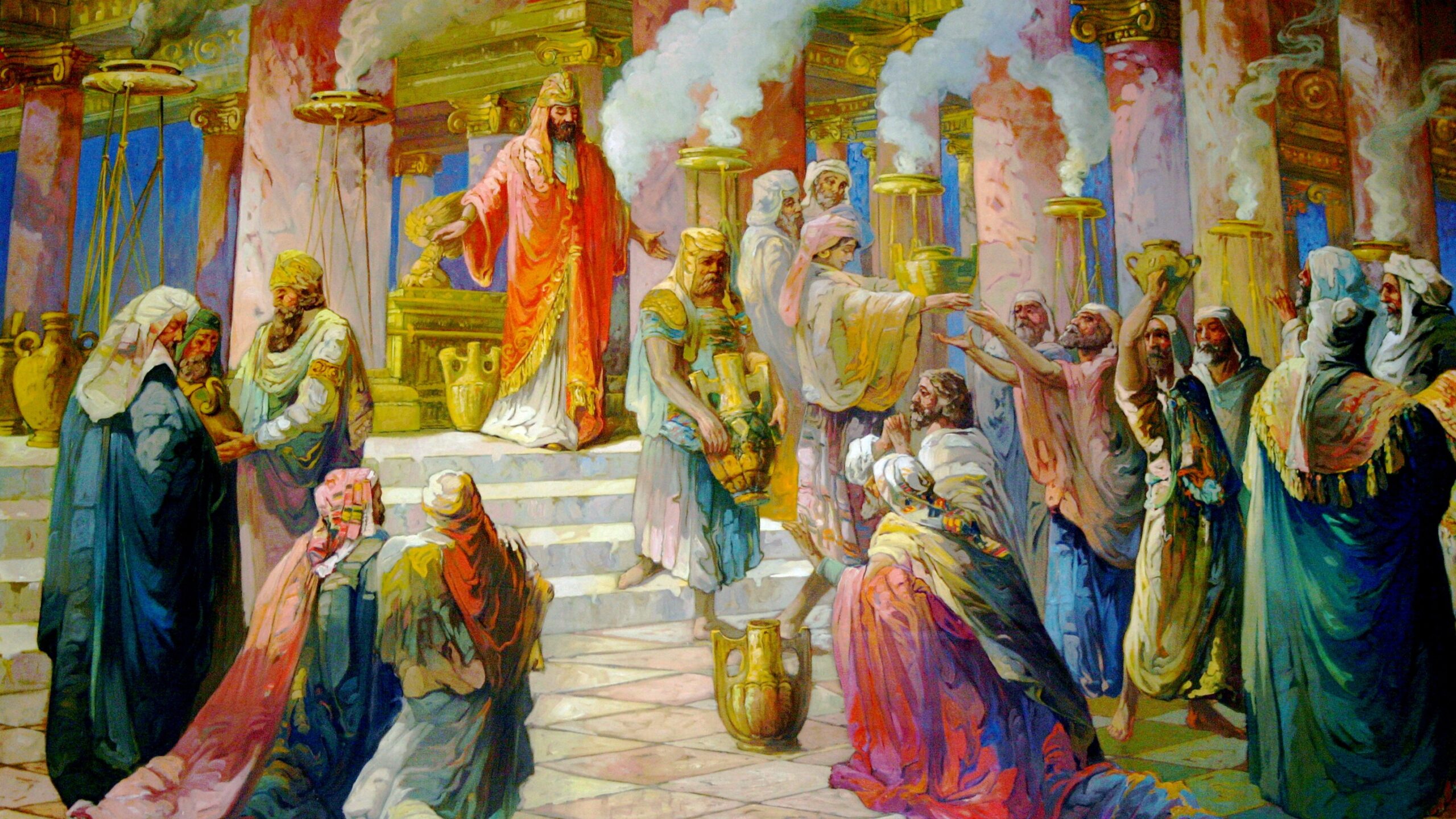
Image credit: Detail of “King Solomon Receives the Queen of Sheba” by Gustav Brand, early 20th century. Photo uploaded by Frumious Bander, 2023.
