
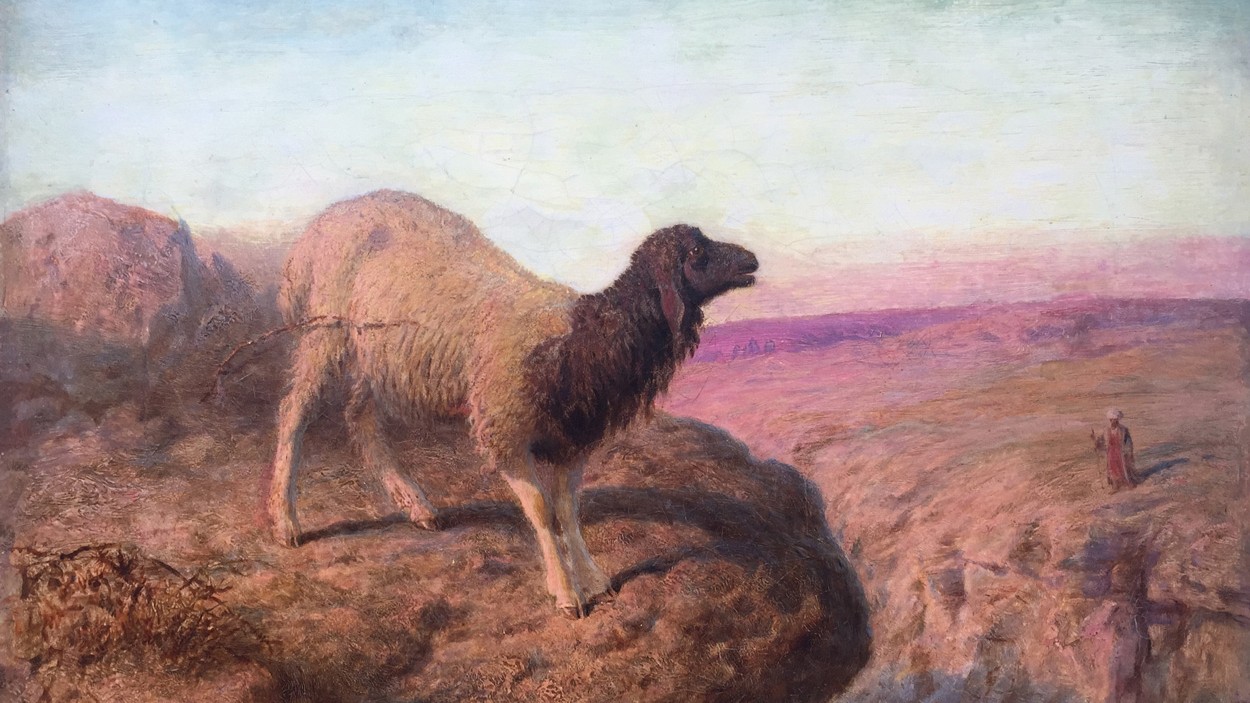
Luke 15:4-7
Narrative Lectionary
4 “Which oneA of you, havingB a hundredC sheepD
A “one” = anthropos. Probably from aner (man, male, husband) + ops (eye, face); {from optanomai (to appear, be seen); perhaps from horao (become, seem, appear)}. This is human, humankind. Used for all genders.
B “having” = echo. This is to have, hold, possess.
C “hundred” = hekaton. 17x in NT. This is hundred literal or figurative.
D “sheep” = probaton. Probably from probaino (to go forward literally or to advance in years); {from pro (before, ahead, earlier than, above) + the same as basis (a step, pace, foot); {from baino (to walk, to go)}}. This is literally easily led and so a sheep or another grazing animal. Also use figuratively of people who are led easily.
and losingE oneF of them, does not leaveG the ninety-nineH
E “losing” = apollumi. From apo (from, away from) + ollumi (to destroy or ruin; the loss that comes from a major ruination). This is to destroy, cut off, to perish – perhaps violently. It can also mean to cancel or remove.
F “one” = heis. This is one, a person, only, some.
G “leave” = kataleipo. From kata (down, against, throughout, among) + leipo (to leave behind, remain, lack, abandon, fall behind while racing). This is to leave or leave behind, abandon, forsake, leave in reserve.
H “ninety-nine” = ennenekontaennea + enea. Ennenekontannea is 4x in NT. From ennenekonta (ninety); {from ennea (nine) + deka (ten, -teen)}. This is ninety. Ennea is related to “ninety” in v4. 5x in NT. See above.
in the wildernessI and goJ after the one that is lost until he findsK it?
I “wilderness” = eremos. Properly, a place that is not settled or farmed, not populated. It could be a deserted area or a desert place. It could be seen as secluded, solitary, or lonesome. Any kind of vegetation is sparse, but so are people generally.
J “go” = poreuomai. From poros (ford, passageway). This is to go, travel, journey, or die. It refers to transporting things from one place to another and focuses on the personal significance of the destination.
K “finds” = heurisko. This is to find, learn, or obtain. It is to discover something, which generally implies a period of searching for it. This is to find in a literal or figurative sense. This is where the word “heuristic” comes from.
5 And when he has found it, he laysL it on his shouldersM and rejoices.N
L “lays” = epitithemi. From epi (on, upon, what is fitting) + tithemi (to put, place, set, fix, establish in a literal or figurative sense; properly, this is placing something in a passive or horizontal position). This is to lay on or place on, whether in a friendly or aggressive way.
M “shoulders” = omos. 2x in NT. Perhaps from phero (to bear, bring, lead, make known publicly; to carry in a literal or figurative sense). This is shoulder as a place to carry burdens.
N “rejoices” = chairo. From char– (to extend favor, lean towards, be inclined to be favorable towards). This is to rejoice, be glad or cheerful; a greeting. This is the root verb that the Greek word for “grace” comes from (charis).
6 And when he comesO home,P he calls togetherQ his friendsR
O “comes” = erchomai. This is to come or go.
P “home” = oikos. This is house – the building, the household, the family, descendants, the temple.
Q “calls together” = sugkaleo. 8x in NT. From sun (with, together with) + kaleo (to call by name, invite, to name, bid, summon, call aloud); {related to keleuo (to command, order, direct); from kelomai (to urge on)}. This is to summon or call together.
R “friends” = philos. This is dear, beloved, a friend, an associate; friendship with personal affection, a trusted confidante; love from personal experience with another person.
and neighbors,S sayingT to them, ‘Rejoice withU me, for I have found my lost sheep.’
S “neighbors” = geiton. 4x in NT. From ge (earth, land, soil, region, country, the inhabitants of an area). This is a neighbor as someone whose land is next door. It can also mean friend
T “saying” = lego. This is to speak, say, name, call, command. It is generally to convey verbally.
U “rejoice with” = sugchairo. Related to “rejoices” in v5. 7x in NT. From sun (with, together with) + chairo (see note N above). This is to share joy or rejoice together.
7 Just so, I tellV you, there will beW more joyX in heavenY
V “tell” = lego. Same as “saying” in v6. See note T above.
W “be” = eimi. This is to be, exist.
X “joy” = chara. Related to “rejoices” in v5 & “rejoice with” in v6. From chairo (see note N above). This is joy, delight, gladness. Can be understood as the feeling you get when you are aware of grace.
Y “heaven” = ouranos. May be related to oros (mountain, hill); probably related to airo (raise, take up, lift, remove). This is the air, the sky, the atmosphere, and heaven. It is the sky that is visible and the spiritual heaven where God dwells. Heaven implies happiness, power, and eternity.
over oneZ sinnerAA who repentsBB
Z “one” = heis. Same as “one” in v4. See note F above.
AA “sinner” = hamartolos. From hamartano (to miss the mark, do wrong, make a mistake, sin); {from a (not) + meros (a part or share)}. This is sinning, sinful, sinner. It referred to missing the mark or falling short. The term was also used in archery for missing the target.
BB “repents” = metanoeo. From meta (with, among, after, beyond) + noieo (to perceive, think, understand); {from nous (mind, understanding, reasoning faculty, intellect, capacity to reflect); perhaps from ginosko (know, recognize, learn from firsthand experience)}. This is to change how one thinks, to reconsider, to repent. It refers to a change of thinking, which means a change of purpose and behavior.
than over ninety-nine righteousCC persons who needDD no repentance.EE
CC “righteous” = dikaios. From dike (the principle of justice; that which is right in a way that is very clear; a decision or the execution of that decision; originally, this word was for custom or usage; evolved to include the process of law, judicial hearing, execution of sentence, penalty, and even vengeance; more commonly, it refers to what is right); may be from deiknumi (to show, point out, exhibit; figurative for teach, demonstrate, make known). This is correct, righteous, just, or a righteous person. It implies innocent or conforming to God’s standard of justice.
DD “need” = chreia + echo. Chreia is from chraomai (to use, make use of, give what is needed, act in a specific way, request); related to chre (what is proper, fitting, or necessary). This is the is task, business, or affair. It can also be need, want, or destitution. Echo is the same as “having” in v4. See note B above.
EE “repentance” = metanoia. Related to “repents” in v7. From meta (with, among, after, beyond) + noieo (see note BB above). This is literally to change one’s mind – to choose to think differently and so to act differently because of a moral compunction. It is an intentional change to the inner self. This word shares a root with the English “paranoia.”
Image credit: “The Lost Sheep” by William Webbe.
