
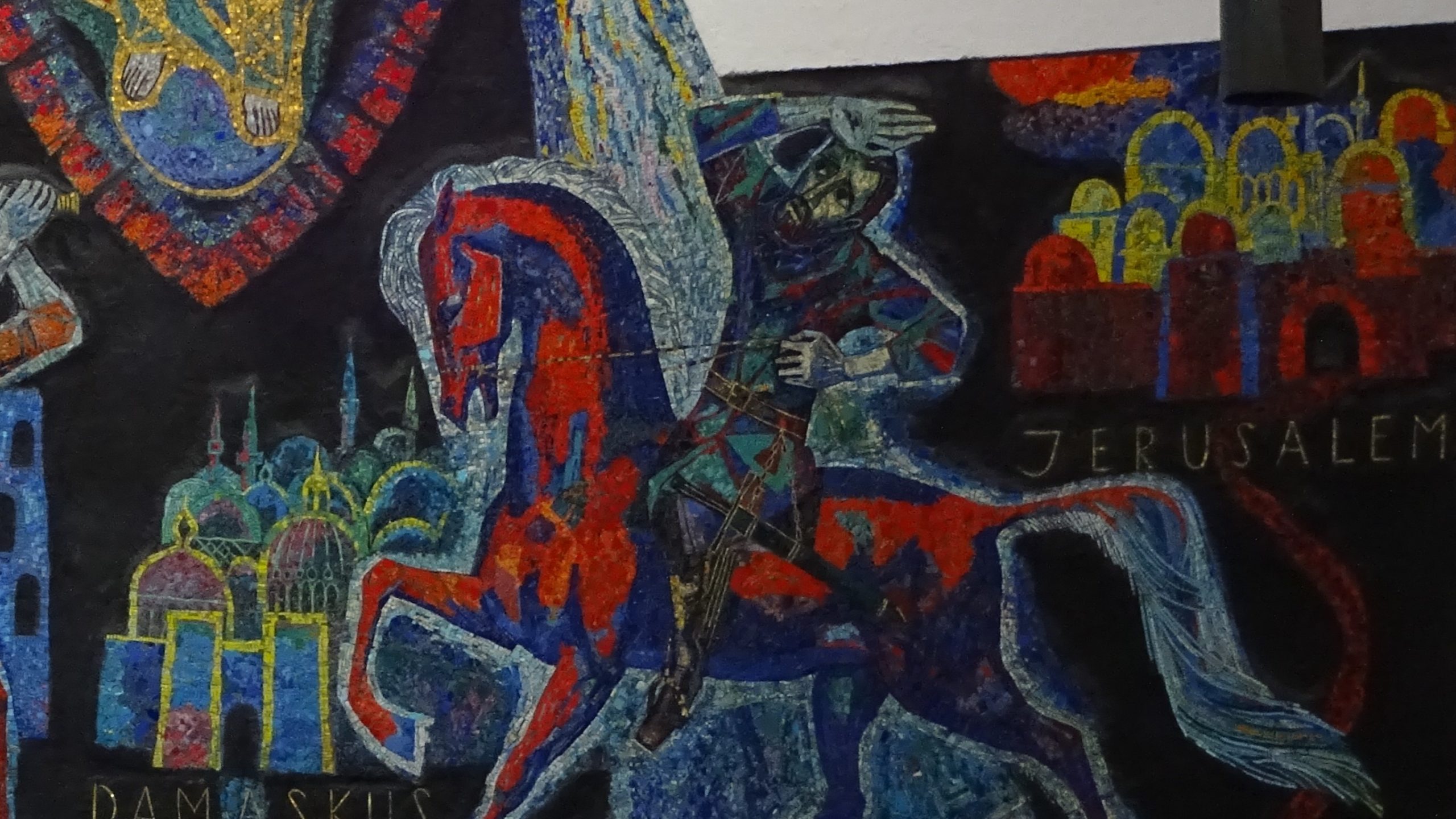
Acts 9:1-20
Third Sunday of Easter C
1 Meanwhile Saul,I still breathingII threatsIII
I “Saul” = Saulos. 15x in NT. From Saoul (Saul); from Hebrew shaal (to ask, inquire, beg, borrow, desire, request; can also mean demand). This is Saul or Shaul, meaning “asked of the Lord.”
II “breathing” = empneo. 1x in NT. From en (in, on, at, by, with) + pneo (to blow, breathe). This is to inhale or, figuratively, to be bent on something.
III “threats” = apeile. 3x in NT. Perhaps from apeileo (to threaten, warn). This is a threat or menacing.
and murderIV against the disciplesV of the Lord,VI
IV “murder” = phonos. 9x in NT. From pheno (to slay). This is killing, murder, or slaughter. It is one of the crimes that Barabbas and Saul are accused of.
V “disciples” = mathetes. From matheteuo (to make a disciple of); from manthano (to learn key facts, gain knowledge from experience; generally implies reflection as part of the learning process); from math– (thinking things through). This is a disciple, learner, or student. It is where we get “mathematics” from.
VI “Lord” = Kurios. From kuros (authority, supremacy). This is a respectful address meaning master or sir. It refers to one who has control or power greater than one’s own. So, it was also applied to God and Jesus as Master or Lord.
wentVII to the high priestVIII 2 and askedIX him for lettersX
VII “went” = proserchomai. From pros (for, at, towards) + erchomai (to come, go). This is to approach, draw near, come up to. It is also used figuratively to mean worship.
VIII “high priest” = archiereus. From archo (to rule, begin, have first rank or have political power) + hiereus (a priest literal or figurative – of any faith); {from hieros (sacred, something sacred, temple, holy, set apart; something consecrated to God or a god)} This is a high or chief priest.
IX “asked” = aiteo. This is to ask, demand, beg, desire.
X “letters” = epistole. From epistello (to write, communicate through letter); {from epi (on, upon, against, what is fitting) + stello (to send, set, arrange, prepare, gather up); from histemi (to make to stand, place, set up, establish, appoint, stand by, stand still, stand ready, stand firm, be steadfast)}. This is an epistle, letter, or other written message. This is where the word “epistle” comes from.
to the synagoguesXI at Damascus,XII so that if he foundXIII
XI “synagogues” = sunagoge. From sun (with, together with, closely associated) + ago (to lead, bring, carry, guide, go, drive). Literally, this is a bringing together, a place of assembly. The term can be used for the people or for the place where they assemble. It is also sometimes used of Christian churches in the New Testament. So, this is synagogue, assembly, congregation, or church. This is where the word “synagogue” comes from.
XII “Damascus” = Damaskos. 15x in NT. From Hebrew Dammeseq (Damascus is Aram/Syria – foreign origin unclear). This is Damascus in Syria.
XIII “found” = heurisko. This is to find, learn, or obtain. It is to discover something, which generally implies a period of searching for it. This is to find in a literal or figurative sense. This is where the word “heuristic” comes from.
any who belongedXIV to the Way,XV menXVI or women,XVII
XIV “belonged” = eimi. This is to be, exist.
XV “Way” = Hodos. This is way, road, path, or journey. It can imply progress along a route.
XVI “men” = aner. This is man, male, husband, or fellow. It can also refer to an individual.
XVII “women” = gune. Perhaps from ginomai (to come into being, to happen, become, be born; to emerge from one state or condition to another; this is coming into being with the sense of movement or growth). This is woman, wife, or bride. This is where the word “gynecologist” comes from.
he might bringXVIII them boundXIX to Jerusalem.XX
XVIII “bring” = ago. Related to “synagogues” in v2. See note XI above.
XIX “bound” = deo. To tie, bind, compel, put in chains. This is to bind in a literal or figurative sense. Can also mean declaring something unlawful.
XX “Jerusalem” = Ierousalem. From Hebrew Yerushalaim (probably foundation of peace); {from yarah (to throw, shoot, be stunned; to flow as water so figuratively to instruct or teach) + shalam (to make amends, to be complete or sound)}. This is Jerusalem, dwelling of peace.
3 Now as he was going alongXXI andXXII approachingXXIII Damascus,
XXI “going along” = poreuomai. From poros (ford, passageway). This is to go, travel, journey, or die. It refers to transporting things from one place to another and focuses on the personal significance of the destination.
XXII {untranslated} = ginomai. Related to “women” in v2. See note XVII above.
XXIII “approaching” = eggizo. From eggus (nearby or near in time). This is extremely close by – approaching, at hand, immediately imminent.
suddenlyXXIV a lightXXV from heavenXXVI flashed aroundXXVII him.
XXIV “suddenly” = exaiphnes. 5x in NT. From ek (from, from out of) + aiphnidios (literally not apparent so sudden or unexpected); {from aiphnes (suddenly); {from a (not, without) + phaino (to bring light, cause to appear, shine, become visible or clear); {perhaps from phos (light, radiance; light literal or figurative)}}}. This is suddenly or unexpectedly.
XXV “light” = phos. Related to “suddenly” in v3. See note XXIV above.
XXVI “heaven” = ouranos. May be related to oros (mountain, hill); probably related to airo (raise, take up, lift, remove). This is the air, the sky, the atmosphere, and heaven. It is the sky that is visible and the spiritual heaven where God dwells. Heaven implies happiness, power, and eternity.
XXVII “flashed around” = periastrapto. 2x in NT. From peri (about, concerning, all around, encompassing) + astrapto (to flash with or like lightning, be dazzling); {probably from aster (star literally or figuratively); probably from stronnumi or stronnuo (to spread, make a bed)}. This is to shine around or surround with light.
4 He fellXXVIII to the groundXXIX and heardXXX a voiceXXXI
XXVIII “fell” = pipto. This is to fall literally or figuratively.
XXIX “ground” = ge. This is earth, land, soil, region, country, the inhabitants of an area.
XXX “heard” = akouo. This is hear or listen, but it also means to understand by hearing. This is where the word “acoustics” comes from.
XXXI “voice” = phone. Related to “suddenly” and “light” in v3. Probably from phemi (to declare, say, use contrasts in speaking to shed light on one point of view); {from phao (to shine) or phaino (see note XXIV above). This is a voice, sound, tone or noise. It can also be a language or dialect.
sayingXXXII to him, “Saul,XXXIII Saul, why do you persecuteXXXIV me?”
XXXII “saying” = lego. This is to speak, say, name, call, command. It is generally to convey verbally.
XXXIII “Saul” = Saoul. Related to “Saul” in v1. 9x in NT. See note I above.
XXXIV “persecute” = dioko. From dio (put to flight). This is chase or pursue in an aggressive fashion. By implication, it is persecute. It can also be used positively for eagerly pursuing something.
5 He asked,XXXV “Who are you, Lord?”
The reply came, “I am Jesus,XXXVI whom you are persecuting.XXXVII
XXXV “asked” = eiron. This is to speak, answer, command.
XXXVI “Jesus” = Iesous. From Hebrew Yehoshua (Joshua, the Lord is salvation); {from YHVH (proper name of the God of Israel; the self-existent and eternal one); {from havah (to become) or from hayah (to come to pass, become, be)} + yasha (to deliver, defend, help, preserve, rescue; properly, to be open, wide or free, which implies being safe. So, in a causative sense, this is to free someone)}. This is Jesus or Joshua in Greek – the Lord saves or the Lord is salvation.
XXXVII Some manuscripts add “it is hard for you to kick against the goads. Trembling and astonished he said, “Lord, what do you want me to do?’” = skleros + su + pros + kentron + laktizo + tremo + te + kai + thambeo + lego + Kurios + tis + ego + thelo + poieo. Skleros is 6x in NT. From skello (to dry) OR from the base of skelos (leg); {perhaps from skello (to parch)}. This is hard because dried, rough, difficult, fierce, harsh. It can also be stubborn or unyielding – unyieldingly hard. This is where the word “sclera” comes from. Kentron is 5x in NT. From kenteo (to prick). This is a sting or sharp point. Figuratively, it could be poison or death. Laktizo is 2x in NT. From lax (heel-wise). This is to kick or recalcitrate. Tremo is 3x in NT. From treo (to dread or terrify). This is to tremble or shake, whether from fear or dread. Thambeo is 3x in NT. From thambos (amazement, wonder, being stunned or dumbfounded because something unusual happened; it can be positive or negative); akin to tapho (dumbfounded). This is astonish, amaze, be terrified or dumbfounded. It can denote wonder or terror – either way, as a surprise. Lego is the same as “saying” in v4. See note XXXII above. Kurios is the same as “Lord” in v1. See note VI above. Thelo is to wish, desire, will, or intend. It is to choose or prefer in a literal or figurative sense. It can also mean inclined toward or take delight in. It can have a sense of being ready to act on the impulse in question. Poieo is to make, do, act, construct, abide, or cause.
6 But get upXXXVIII and enterXXXIX the city,XL and you will be toldXLI what you areXLII to do.”XLIII
XXXVIII “get up” = anistemi. Related to “letters” in v2. From ana (upwards, up, again, back, anew) + histemi (see note X above). This is to raise up, rise, appear. It is to stand up literally or figuratively. Can also mean to resurrect.
XXXIX “enter” = eiserchomai. Related to “went” in v1. From eis (to, into, for, among) + erchomai (see note VII above). This is to go in in a literal or figurative sense.
XL “city” = polis. This is a city or its inhabitants. It is a town of variable size, but one that has walls. This is where “metropolis” and “police” come from.
XLI “told” = laleo. From lalos (talkative). This is to talk, say, or preach.
XLII “are” = dei. Related to “bound” in v2. From deo (see note XIX above). This is what is necessary or proper. It is what is needed or what one should do – a duty or something inevitable. This refers to something absolutely necessary.
XLIII “do” = poieo. Same as {untranslated} in v5. See note XXXVII above.
7 The men who were traveling withXLIV him stoodXLV speechlessXLVI because they heardXLVII the voice but sawXLVIII no one.
XLIV “travelling with” = sunodeuo. Related to “Way” in v2. 1x in NT. From sun (with, together with) + hodeuo (to travel or journey); {from hodos (see note XV above)}. This is to travel with or accompany.
XLV “stood” = histemi. Related to “letters” in v2 & “get up” in v6. See note X above.
XLVI “speechless” = enneos. 1x in NT. From eneos (speechless) OR from enneuo (to nod at, gesture, beckon); {from en (in, on, at, by, with, within) + neuo (to nod, to signal)}. This is speechless or one who is silent and makes signs to communicate. It can also be someone made silent from amazement.
XLVII {untranslated} = men. This is truly, indeed, even, in fact. Often, it is not translated, but used to emphasize affirmation.
XLVIII “saw” = theoreo. From theaomai (to behold, look upon, see, contemplate, visit); from thaomai (to gaze at a spectacle; to look at or contemplate as a spectator; to interpret something in efforts to grasp its significance); from theoros (a spectator or envoy). This is gazing, beholding, experiencing, discerning. It is looking at something to analyze it and concentrate on what it means. This is the root of the word “theatre” in that people concentrate on the action of the play to understand its meaning.
8 Saul got upXLIX from the ground, and though his eyesL were open,LI
XLIX “got up” = egeiro. This is to awake, raise up or lift up. It can be to get up from sitting or lying down, to get up from sleeping, to rise from a disease or from death. Figuratively, it can be rising from inactivity or from ruins.
L “eyes” = ophthalmos. From optanomai (to appear, be seen by); from horao (become, seem, appear). This is eye or sight. It is used figuratively for the mind’s eye, a vision, or for envy.
LI “were open” = anoigo. From ana (up, back, again, among, between, anew) + oigo (to open). This is to open in literal or figurative sense.
he could seeLII nothing; so they led him by the handLIII and broughtLIV him into Damascus.
LII “see” = blepo. This is literally to see – it is primarily used in the physical sense. However, figuratively it can be seeing, which includes attention and so to watchfulness, being observant, perceiving, and acting on the visual information. It can also mean beware.
LIII “led…by the hand” = cheiragogeo. Related to “synagogues” and “bring” in v2. 2x in NT. From cheiragogos (one who leads by the hand, someone who is blind or helpless); {from cheir (hand in a literal sense; figuratively, the means a person uses to accomplish things so it can mean power, means, or instrument); {perhaps from cheimon (winter, storm – winter as the rainy season); related to the base of chasma (chasm, gap, gulf); from chasko (to yawn) or cheo (to pour)} + ago (see note XI above)}. This is to lead by the hand as one leads someone who is blind.
LIV “brought” = eisago. Related to “synagogues” and “bring” in v2 & “led…by the hand” in v8. 11x in NT. From eis (to, into, for, among) + ago (see note XI above). This is to bring or lead in in a literal or figurative sense.
9 For threeLV daysLVI he was without sightLVII and neither ateLVIII nor drank.LIX
LV “three” = treis. This is three.
LVI “days” = hemera. Perhaps from hemai (to sit). This is day, time, or daybreak.
LVII “sight” = blepo. Same as “see” in v8. See note LII above.
LVIII “ate” = phago. This is to eat or figuratively to consume like rust does.
LIX “drank” = pino. This is to drink, literally or figuratively.
10 Now there was a disciple in Damascus namedLX Ananias.LXI The Lord said to him in a vision,LXII “Ananias.”
LX “named” = onoma. May be from ginosko (know, recognize, learn from firsthand experience). This is a name, authority, cause, character, fame, reputation. The name was thought to include something of the essence of the person so it was not thought to be separate from the person.
LXI “Ananias” = Ananias. Related to “Jesus” in v5. 11x in NT. From Hebrew Chananyah (Hannaniah; “the Lord has been gracious” or “the Lord has favored); {from chanan (beseech, show favor, be gracious; properly, to bend in kindness to someone with less status) Yah (the shortened form of the name of the God of Israel; God, Lord); {from YHVH (see note XXXVI above)}. This is Ananias, meaning “the Lord has been gracious” or “the Lord has favored.”
LXII “vision” = horama. Related to “eyes” in v8. 12x in NT. From horao (see note L above). This is a sight, something seen, a vision. In the New Testament, it is always a supernatural vision.
He answered,LXIII “HereLXIV I am, Lord.”
11 The Lord said to him, “Get upLXV and goLXVI to the streetLXVII
LXIII “answered” = eiron. Same as “asked” in v5. See note XXXV above.
LXIV “here” = idou. From eido (to be aware, see, know, remember, appreciate). This is see! Lo! Behold! Look! Used to express surprise and or draw attention to the statement.
LXV “get up” = anistemi. Same as “get up” in v6. See note XXXVIII above.
LXVI “go” = poreuomai. Same as “going along” in v3. See note XXI above.
LXVII “street” = rhume. 4x in NT. Probably related to rheuma (something that flows; a current); from rheo (to flow, to flow like water, overflow) OR from rhoumai (to pull to oneself, rescue from danger, snatch up, set free); from eruo (to draw, drag) This is a street or lane – a street alley as crowded.
calledLXVIII Straight,LXIX and at the houseLXX of JudasLXXI
LXVIII “called” = kaleo. Related to keleuo (to command, order, direct); from kelomai (to urge on). This is to call by name, invite, to name, bid, summon, call aloud.
LXIX “Straight” = Euthus. 8x in NT. Perhaps from eu (good, well, well done, rightly) + tithemi (to place, lay, set, establish). This is immediately, upright, straight and not crooked.
LXX “house” = oikia. From oikos (house – the building, the household, the family, descendants; the temple). This is a house, household, goods, property, family, or means.
LXXI “Judas” = Ioudas. From Hebrew Yehudah (Judah, son of Jacob, his tribal descendants, a name for the southern kingdom. Literally, it means praised); probably from yadah (to throw one’s hands into the air in a gesture of praise); from yad (hand). This is Judah or Judas, meaning praised.
look forLXXII a man of TarsusLXXIII named Saul. At this momentLXXIV he is praying,LXXV
LXXII “look for” = zeteo. This is to seek, search for, desire. It is searching for something by inquiring or investigation. It can be seek in a literal or figurative sense. There is a Hebrew figure of speech “to seek God’s face” so it can also mean to worship God. Alternately, you could seek someone’s life i.e. plot to kill them.
LXXIII “of Tarsus” = Tarseus. 2x in NT. From Tarsos (Tarsus); {perhaps from tarsos (basket) or Hebrew tirza (cypress) or Hebrew erez (cedar) or Hittite Tarsa (Tarsa); {perhaps from Tarhunz (a storm god)}}. This is from Tarsus. See https://www.abarim-publications.com/Meaning/Tarsus.html & https://en.wikipedia.org/wiki/Tarsus,_Mersin
LXXIV “at this moment” = idou. Same as “here” in v10. See note LXIV above.
LXXV “praying” = proseuchomai. From pros (advantageous for, at, toward) + euchomai (to wish, make a request, pray). This is to pray or pray for, to worship or supplicate. It is more literally exchanging one’s own wishes for God’s.
12 and he has seenLXXVI in a vision a man named Ananias come inLXXVII and layLXXVIII his handsLXXIX on him so that he might regain his sight.”LXXX
LXXVI “seen” = horao. Related to “eyes” in v8 & “vision” in v10. See note L above.
LXXVII “come in” = eiserchomai. Same as “enter” in v6. See note XXXIX above.
LXXVIII “lay” = epitithemi. Related to “Straight” in v11. From epi (on, upon, what is fitting) + tithemi (see note LXIX above). This is to lay on or place on, whether in a friendly or aggressive way.
LXXIX “hands” = cheir. Related to “led…by the hand” in v8. See note LIII above.
LXXX “regain…sight” = anablepo. Related to “see” in v8. From ana (up, back, again, among, between, anew) + blepo (see note LII above). This is to look up or regain sight.
13 But Ananias answered,LXXXI “Lord, I have heard from manyLXXXII about this man, how much evilLXXXIII he has done to your saintsLXXXIV in Jerusalem,
LXXXI “answered” = apokrinomai. From apo (from, away from) + krino (to judge, decide, think good, condemn, determine, pass judgment, stand trial, sue; judging whether in court or in a private setting; properly, mentally separating or distinguishing an issue – to come to a choice or decision, to judge positively or negatively in seeking what is right or wrong, who is innocent or guilty; can imply trying, condemning, punishing, or avenging). This is to reply or respond, to draw one’s own conclusions, to speak when one is expected to.
LXXXII “many” = polus. This is much, often, plenteous – a large number or a great extent.
LXXXIII “evil” = kakos. This is bad, evil, harm, ill. It is evil that is part of someone’s core character – intrinsic, rotted, worthless, depraved, causing harm. It refers to deep inner malice that comes from a rotten character. Can be contrasted with the Greek poneros, which is that which bears pain – a focus on the miseries and pains that come with evil. Also contrasting the Greek sapros, which deals with falling away from a previously embodied virtue.
LXXXIV “saints” = hagios. From hagnos (holy, sacred, pure ethically, ritually, or ceremonially; prepared for worship, chaste, unadulterated, pure to the core; undefiled by sin; figurative for innocent, modest, perfect). God is totally different from humanity and thus set apart. That which is consecrated to worship God (elements of worship) or to serve God (as the saints) are holy because they are now set apart for God’s purposes. Holy because important to God. This is sacred physically, pure. It can be morally blameless or ceremonially consecrated.
14 and here he hasLXXXV authorityLXXXVI from the chief priestsLXXXVII to bind allLXXXVIII who invokeLXXXIX your name.”
LXXXV “has” = echo. This is to have, hold, possess.
LXXXVI “authority” = exousia. Related to “belonged” in v2. From exesti (to be permitted or lawful); {from ek (out, out of) + eimi (see note XIV above)}. This is power to act or weight. It especially denotes moral authority or influence. It can mean domain, liberty, freedom, capacity, mastery, right, force, or strength.
LXXXVII “chief priests” = archiereus. Same as “high priest” in v1. See note VIII above.
LXXXVIII “all” = pas. This is all or every.
LXXXIX “invoke” = epikaleo. Related to “called” in v11. From epi (on, upon, among, what is fitting) + kaleo (see note LXVIII above). This is to call on, appeal to, worship, invoke for help.
15 But the Lord said to him, “Go,XC for he is an instrumentXCI whom I have chosenXCII
XC “go” = poreuomai. Same as “going along” in v3. See note XXI above.
XCI “instrument” = skeuos. This is a vessel, object, article, property, a tool. It is an implement or other equipment in a literal or figurative sense. It could also refer to a vessel of mercy or a wife.
XCII “chosen” = ekloge + eimi. Ekloge is related to “saying” in v4. 7x in NT. From eklego (to choose, select, elect); {from ek (from, from out of) + lego (see note XXXII above)}. This is properly a choosing out so it is a selection or choice. It is also used theologically to mean election i.e. God’s choice. Eimi is the same as “belonged” in v2. See note XIV above.
to bringXCIII my name beforeXCIV gentilesXCV
XCIII “bring” = bastazo. Perhaps from the base of basis (step, hence foot; a pace); from baino (to walk, to go). This is to lift in a literal of figurative sense. It can also mean take up, carry, bear, or remove. Figuratively, it can mean declare, endure, or sustain.
XCIV “before” = enopios. Related to “eyes” in v8 & “vision” in v10 & “seen” in v12. From en (in, on, at, by, with) + ops (eye, face); {from optanomai (see note L above)}. This is literally “in sight of.” It means before in a literal or figurative sense.
XCV “gentiles” = ethnos. Probably from etho (a custom or culture). This is people who are united by having similar customs or culture. Generally, it is used to refer to Gentiles. This is a tribe, race, nation, or Gentiles in general. This is where the term “ethnicity” comes from.
and kingsXCVI and before the peopleXCVII of Israel;XCVIII
XCVI “kings” = basileus. Related to “bring” in v15. Probably from basis (see note XCIII above). This is king, emperor, or sovereign.
XCVII “people” = huios. This is son, descendant – a son whether natural born or adopted. It can be used figuratively for other forms of kinship.
XCVIII “Israel” = Israel. From Hebrew Yisrael (God strives or one who strives with God; new name for Jacob and for his offspring); {from sarah (to persist, exert oneself, contend, persevere, wrestle, prevail) + El (God or god)}. This is Israel the people and the land.
16 I myself will showXCIX him how much he mustC sufferCI for the sake of my name.”
XCIX “show” = hupodeiknumi. 6x in NT. From hupo (by, under, about, under someone’s authority) + deiknumi (to show, demonstrate, teach, make known). This is to teach, indicate, suggest, prove, exhibit, to show secretly, admonish.
C “must” = dei. Same as “are” in v6. See note XLII above.
CI “suffer” = pascho. Akin to penthos (mourning, sorrow). This is to be acted on for good or ill. It is often used for negative treatment. Properly, it means feeling strong emotions – especially suffering. It can also be the ability to feel suffering.
17 So Ananias wentCII and entered the house. He laid his hands on Saul and said, “BrotherCIII Saul, the Lord Jesus, who appearedCIV to you on your wayCV here,
CII “went” = aperchomai. Related to “went” in v1 & “enter” in v6. From apo (from, away from) + erchomai (see note VII above). This is to depart, follow, or go off in a literal or figurative sense.
CIII “Brother” = adelphos. From a (with, community, fellowship) + delphus (womb). This is a brother in a literal or figurative sense. It is also used of another member of the Church.
CIV “appeared” = horao. Same as “seen” in v12. See note LXXVI above.
CV {untranslated} = erchomai. Related to “went” in v1 & “enter” in v6 & “went” in v17. See note VII above.
has sentCVI me so that you may regain your sight and be filledCVII with the HolyCVIII Spirit.”CIX
CVI “sent” = apostello. Related to “letters” in v2 & “get up” in v6 & “stood” in v7. From apo (from, away from) + stello (see note X above). This is to send forth, send away, dismiss, send as a messenger. It implies one that is sent for a particular mission or purpose rather than a quick errand. This is where “apostle” comes from.
CVII “be filled” = pleitho. This is to fill to the highest level possible – to accomplish, supply, or complete.
CVIII “Holy” = Hagios. Same as “saints” in v13. See note LXXXIV above.
CIX “Spirit” = Pneuma. Related to “breathing” in v1. From pneo (see note II above). This is wind, breath, or ghost. A breeze or a blast or air, a breath. Figuratively used for a spirit, the human soul or part of us that is rational. It is also used supernaturally for angels, demons, God, and the Holy Spirit. This is where pneumonia comes from.
18 And immediatelyCX something like scalesCXI fellCXII from his eyes, and his sight was restored.CXIII Then he got upCXIV and was baptized,CXV
CX “immediately” = eutheos. Related to “Straight” in v11 & “lay” in v12. From euthus (see note LXIX above). This is directly, soon, at once.
CXI “scales” = lepis. 1x in NT. From lepo (to peel). This is a scale or a flake.
CXII “fell” = apopipto. Related to “fell” in v4. 1x in NT. From apo (from, away from) + pipto (see note XXVIII above). This is to fall off or away from.
CXIII “sight was restored” = anablepo. Same as “regain…sight” in v12. See note LXXX above.
CXIV “got up” = anistemi. Same as “get up” in v6. See note XXXVIII above.
CXV “baptized” = baptizo. From bapto (to dip or dye; to entirely cover with liquid, to stain). This is to submerge, wash, or immerse. Used specially for baptism.
19 and after takingCXVI some food,CXVII he regained his strength.CXVIII
CXVI “taking” = lambano. It does not refer to passive receiving of something, but active acceptance or taking of something whether it is offered or simply nearby. It focuses on individual decision and action.
CXVII “food” = trophe. 16x in NT. Perhaps from trepho (to bring up, rear, nourish, fatten, nurse; properly, to enlarge through proper nourishment). This is nourishment in a literal or figurative sense. By implication, it can be ration or wages.
CXVIII “regained…strength” = enischuo. Related to “has” in v14. 2x in NT. From en (in, on, at, by, with) + ischuo (to be strong, healthy and vigorous, able, have power, prevail; strength that engages a resisting force); from ischus (strength, might, power, force, ability; power that engages immediate resistance); {perhaps from is (force) + echo (see note LXXXV above)}}. This is to strengthen or invigorate.
For several days he wasCXIX with the disciples in Damascus, 20 and immediately he began to proclaimCXX Jesus in the synagogues, saying, “He is the SonCXXI of God.”CXXII
CXIX “was” = ginomai. Same as {untranslated} in v3. See note XXII above.
CXX “proclaim” = kerusso. This is to proclaim, preach, publish. Properly, it is to act as a herald – announcing something publicly with confidence and/or to persuade.
CXXI “Son” = Huios. Same as “people” in v15. See note XCVII above.
CXXII “God” = Theos. From Proto-Indo-European origins, meaning do, put, place. This is God or a god in general.
Image credit: “Altar Mosaic with the Conversion and Execution of St. Paul” by Max Spielmann at St. Paul’s Church in Innsbruck-Reichenau, Austria. Photo by Luftschiffhafen, 2019.
