
Jeremiah 18:1, 4-14
NL
1 The wordA that cameB to JeremiahC from the Lord:D, E
A “word” = dabar. From dabar (to speak, declare, discuss). This is speech, a word, a matter, an affair, charge, command, message, promise, purpose, report, request. It is a word, which implies things that are spoken of in a wide sense.
B “came” = hayah. This is to be or become, to happen.
C “Jeremiah” = Yirmeyah. Related to “came” in v1. From the same as yirmeyah (Jeremiah, “the Lord loosens” or “the Lord will rise”); {from the same as remiyya (slack, idle, lazy, negligent) + Yah (a shortened form of the name of the God of Israel; God, Lord); {from YHVH (proper name of the God of Israel; God, Lord; the self-existent or eternal one); from havah (to become) or hayah (see note B above)}}. This is Jeremiah, meaning “the Lord loosens” or “the Lord will rise.” See https://www.abarim-publications.com/Meaning/Jeremiah.html
D “Lord” = YHVH. Related to “came” and “Jeremiah” in v1. See note C above.
E {untranslated} = amar. This is to speak, say, answer, command, promise, report.
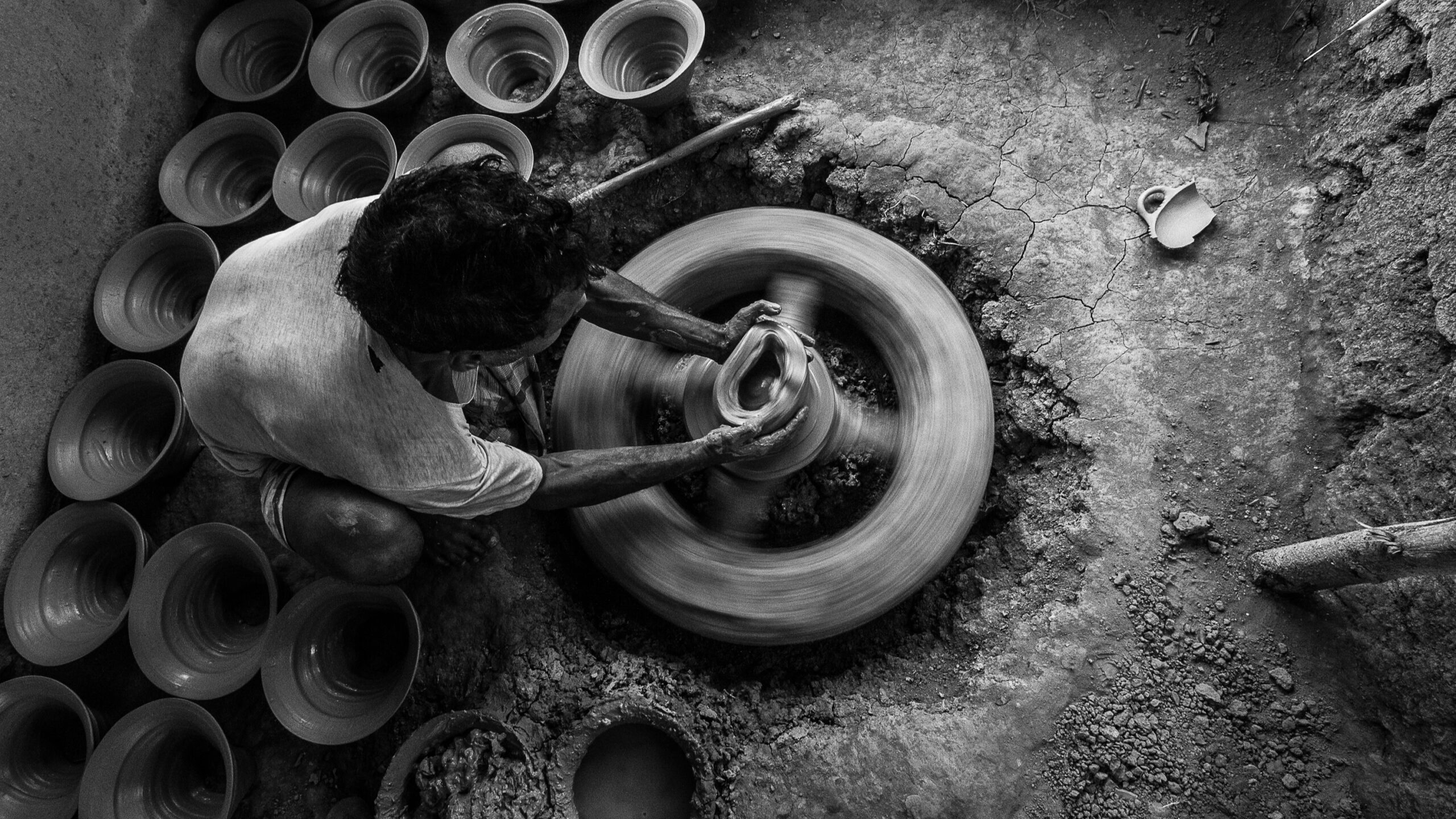
4 The vesselF he was makingG of clayH
F “vessel” = keli. From kalah (to end, be finished, complete, prepare, consume, spent, or completely destroyed). This is something that was prepared – any implement, utensil, article, vessel, weapon, or instrument. Also includes jewels, weapons, bags, carriages, and furniture.
G “making” = asah. This is to make, do, act, appoint, become in many senses.
H “clay” = chomer. From chamar (to boil up, ferment, be red befoul, trouble, daub). This is something that bubbles up like sea foam, mire, clay, a heap. It is also cement, mortar and a dry measure.
was spoiledI in the potter’sJ hand,K
I “was spoiled” = shachath. This is to go to ruin, perish, decay, batter, cast off, lose, one who destroys. This can be used in a literal or figurative sense.
J “potter’s” = yatsar. Perhaps related to yatsar (to be narrow, distressed, or vexed); perhaps related to tsarar (to bind, restrict, narrow, be cramped, an adversary). This is to fashion or form, perhaps by squeezing something into a shape or form. Particularly, it is to create as a potter does. Figuratively, it is to determine.
K “hand” = yad. This is hand, ability, power. Hand in a literal sense, but also what one can do or the means by which one does it.
and he reworkedL it into anotherM vessel, as seemed goodN to him.
L “reworked” = shub + asah. Shub is to turn back, return, turn away – literally or figuratively. Doesn’t necessarily imply going back to where you started from. This is also the root verb for the Hebrew word for repentance “teshubah.” Asah is the same as “making” in v4. See note G above.
M “another” = acher. From achar (to be behind, delay, be late, procrastinate, continue). This is following, next, strange, other.
N “seemed good” = yashar + ayin + yatsar + asah. Literally, “was good to the eyes of the potter to do.” Yashar is to be straight, right, even, smooth, or agreeable. Figuratively, it can be to make something pleasant or prosperous. Ayin is eye in a literal or figurative sense so eye, appearance, favor, or a fountain (the eye of the landscape). Yatsar is the same as “potter’s” in v4. See note J above. Asah is the same as “making” in v4. See note G above.
5 Then the word of the Lord came to me:O 6 CanP I not doQ with you, O houseR of Israel,S
O {untranslated} = amar. Same as {untranslated} in v1. See note E above.
P “can” = yakol. This is to be able, endure, overcome, prevail.
Q “do” = asah. Same as “making” in v4. See note G above.
R “house” = bayit. Probably from banah (to build, make, set up, obtain children; to build literally or figuratively). This is house, court, family, palace, temple.
S “Israel” = Yisrael. From sarah (to persist, exert oneself, contend, persevere, wrestle, prevail) + El (God or god). This is Israel, meaning God strives or one who strives with God; new name for Jacob and for his offspring. This refers to the people and to the land.
just as this potter has done? saysT the Lord. UJust like the clay in the potter’s hand, soV are you in my hand, O house of Israel.
T “says” = neum. From na’am (to speak a prophecy; properly, to whisper, which implies saying an oracle). This is an utterance or speaking an oracle.
U {untranslated} = hinneh. From hen (lo! Behold! If, though; an expression of surprise). This is to draw attention, show suddenness or surprise, or to emphasize the importance of the coming statement. See! Lo! Behold!
V “so” = ken. Perhaps from kun (properly, in a perpendicular position; literally, to establish, fix, fasten, prepare; figuratively, it is certainty, to be firm, faithfulness, render sure or prosperous). This is to set upright. Generally used figuratively to mean thus, so, afterwards, rightly so.
7 At one momentW I may declareX concerning a nationY
W “moment” = rega. From raga (to toss violently, break, or disturb; tossed about as on rough sea or the skin breaking out in skin disease; to shut the eyes and so to settle, east, rest, or quiet). This is an instant or moment – so suddenly. Properly, this is a wink of the eye, which is to say a brief moment.
X “declare” = dabar. Related to “word” in v1. See note A above.
Y “nation” = goy. From the same root as gevah (the back, person, or body); related to gev (among); related to gaah (to rise up). This is nation or people. Often used to refer to Gentiles or foreign nations. It can also be used figuratively for a group of animals. This is where the Yiddish “goy” comes from.
or a kingdomZ that I will pluck upAA and break downBB and destroyCC it,
Z “kingdom” = mamlakah. From the same as melek (king, royal). This is kingdom, dominion, sovereignty, rule. It can also refer to the realm.
AA “pluck up” = nathash– 13 in Jeremiah. It is to pull up or pluck out, destroy, or tear away.
BB “break down” = nathats. This is to pull down, demolish, break down, raze, overthrow.
CC “destroy” = abad. To wander off, lose self. This implies to perish, destroy, die, vanish, or be broken or corrupt.
8 but if that nation, concerning which I have spoken,DD turnsEE from its evil,FF
DD “spoken” = dabar. Same as “declare” in v7. See note X above.
EE “turns” = shub. Same as “reworked” in v4. See note L above.
FF “evil” = ra’. From ra’a’ (to be evil, bad, afflict; properly, to spoil – to destroy by breaking into pieces; figuratively, to cause something to be worthless; this is bad in a physical, social, or moral sense; that which displeases, to do harm or mischief, to punish or vex). This is bad, disagreeable, that which causes pain, misery, something having little or no value, something that is ethically bad, wicked, injury, calamity. This refers to anything that is not what it ought to be – a natural disaster, a disfigurement, an injury, a sin.
I will change my mindGG about the disasterHH that I intendedII to bringJJ on it.
GG “change…mind” = nacham. Properly, this is a strong breath or a sigh. This can be to be sorry, to pity, console. Comfort, or repent. But, one can also comfort oneself with less righteous thoughts, so this can also mean to avenge oneself.
HH “disaster” = ra’. Same as “evil” in v8. See note FF above.
II “intended” = chashab. This is properly to braid or interpenetrate. Literally it is to create or to wear. Figuratively, it can mean plotting – generally in a negative sense. More broadly, this can also mean think, consider, or make account of.
JJ “bring” = asah. Same as “making” in v4. See note G above.
9 And at another moment I may declare concerning a nation or a kingdom that I will buildKK and plantLL it, 10 but if it does evil in my sight,MM notNN listeningOO
KK “build” = banah. Related to “house” in v6. See note R above.
LL “plant” = nata. To fix or fasten, establish or plant. This is planting in a literal or figurative sense.
MM “sight” = ayin. Same as “seemed good” in v4. See note N above.
NN “not” = bilti. From balah (to grow old, wear out, consume, waste, enjoy, fail, decay). This is nothing, not, lest, or except. From its root, it means “a failure of” – used for negative particles.
OO “listening” = shama. This is to hear, call, consent, or consider. It implies listening intelligently, giving attention, and, because of these two factors, obedience and action are often implied.
to my voice,PP then I will change my mind about the good that I had intendedQQ to doRR to it.
PP “voice” = qol. This is a sound, used often for human voices. Also used when God speaks or angels, animals or instruments. It can be a cry or a noise, thunder or earthquakes and so on.
QQ “intended” = amar…yatab. Amar is the same as {untranslated} in v1. See note E above. Yatab is to be good or pleasing, joyful. It can also mean doing good in an ethical sense or be beautiful, happy, successful, or right.
RR “good…to do” = tob. From tob (to be pleasing, to be good). This is good, beautiful, pleasant, agreeable, bountiful, at ease. This word is used for goodness as a concept, a good thing, a good person. This can refer to prosperity and welfare as well as joy, kindness, sweetness, and graciousness. So, this is ethically good, but also enjoyably good.
11 Now, therefore,SS sayTT, UU to the peopleVV
SS “now, therefore” = attah. Perhaps from et (a period or season; whenever or continually); probably from anah (to answer, sing, announce); from ad (forever, all, old); from adah (to pass on, advance, decorate oneself). This is now, from now on.
TT “say” = amar. Same as {untranslated} in v1. See note E above.
UU {untranslated} = na. This particle is used for requests or for urging. It can be we pray, now, I ask you, oh. This is the same “na” in “hosanna.”
VV “people” = ish. Perhaps from enosh (human, humankind, mortal); from anash (to be weak, sick, or frail). This is man, husband, another, or humankind.
of JudahWW and the inhabitantsXX of Jerusalem:YY, ZZ
WW “Judah” = Yehudah. Probably from yadah (to throw one’s hands into the air in a gesture of praise); from yad (hand). This is Judah, meaning “praised.”
XX “inhabitants” = yashab. This is to sit and so to remain and so to dwell. It is sitting for any reason – as a judge, in order to ambush, or just sitting quietly. Causatively, this can mean settling or marrying. This can also mean continue, endure, or establish.
YY “Jerusalem” = Yerushalaim. From yarah (to throw, shoot, be stunned; to flow as water so figuratively to instruct or teach) + shalam (to make amends, to be complete or sound). This is Jerusalem, dwelling of peace.
ZZ {untranslated} = amar. Same as {untranslated} in v1. See note E above.
ThusAAA saysBBB the Lord: Look,CCC I am a potter shapingDDD evil against you and devisingEEE a planFFF against you.
AAA “thus” = koh. Perhaps from ki (that, for when, certainly) + hu (he, she, it). This is like this, thus, here, now.
BBB “says” = amar. Same as {untranslated} in v1. See note E above.
CCC “look” = hinneh. Same as {untranslated} in v6. See note U above.
DDD “potter shaping” = yatsar. Same as “potter’s” in v4. See note J above.
EEE “devising” = chashab. Same as “intended” in v8. See note II above.
FFF “plan” = machashabah. Related to “intended” in v8. From chashab (see note II above). This is thought, scheme, imagination, purpose, or a plan either good or evil.
Turn now,GGG allHHH of you, from your evil way,III and amendJJJ your ways and your doings.KKK
GGG “now” = na. Same as {untranslated} in v11. See note UU above.
HHH “all” = ish. Same as “people” in v11. See note VV above.
III “way” = derek. From darak (to tread, march, to walk. Can also mean affixing a string to a box since one needs to step on it to bend it in the process; so also an archer). This is a road as a thing that is walked on. Can be used figuratively for the path that one’s life takes or how one chooses to live one’s life.
JJJ “amend” = yatab. Same as “good…to do” in v10. See note QQ above.
KKK “doings” = maalal. From alal (to affect, do, practice, mock, overdo, glean, abuse, pain). This is some kind of deed, action, invention or practice whether good or bad.
12 But they say,LLL “It is no use!MMM We will followNNN our own plans, and eachOOO of us
LLL “say” = amar. Same as {untranslated} in v1. See note E above.
MMM “is no use” = yaash. 6x in OT. This is to be desperate, be of no use, be hopeless.
NNN “follow” = achar…halak. Achar is related to “another” in v4. From achar (see note M above). This is after or the last part, following. Halak is go, come, walk. It is walk literally and figuratively and includes people and animals. It can be used figuratively for one’s moral life – how we walk according to God’s way or against it. It can also refer to the walk of life as in the course one’s life takes, the choices we make, etc.
OOO “each” = ish. Same as “people” in v11. See note VV above.
will actPPP according to the stubbornnessQQQ of our evil will.”RRR
PPP “act” = asah. Same as “making” in v4. See note G above.
QQQ “stubbornness” = sheriruth. 10x in OT. From the same as shor (body, umbilical cord, core of strength); from sharar (enemy or watcher); see shorer (foe, a treacherous watcher); from shur (to behold, see, watch, perceive; to spy out, lie in wait, lurk for; can also be to care for). This is stubbornness or lust.
RRR “will” = leb. From the same as lebab (the heart, courage, one’s inner self, the mind, the will; only used in a figurative sense in the Bible); may be related to labab (to encourage; properly, to be encased as with fat; used in a good sense, this means to transport someone with love; used in a bad sense, it can mean to dull one’s senses). This is inner self, mind, will, feelings, the center.
13 ThereforeSSS thus saysTTT the Lord:
AskUUU, VVV among the nations:
Who has heardWWW the like of this?
SSS “therefore” = ken. Same as “so” in v6. See note V above.
TTT “says” = amar. Same as {untranslated} in v1. See note E above.
UUU “ask” = shaal. This is to ask, inquire, beg, borrow, desire, request. It can also mean to demand.
VVV {untranslated} = na. Same as {untranslated} in v11. See note UU above.
WWW “heard” = shama. Same as “listening” in v10. See note OO above.
The virginXXX Israel has done
a mostYYY horrible thing.ZZZ
XXX “virgin” = bethulah. This is virgin, maiden, or bride. Can also be used figuratively for a place.
YYY “most” = meod. Perhaps from the same as uwd (firebrand, a poker). This is very, greatly, exceedingly. It can also mean vehemence, force, abundance.
ZZZ “horrible thing” = sha’aruwrah. 4x in OT. From saar (to storm, scattered by a storm, blow away, rage, storm tossed; this is to toss in a literal or figurative sense). This is something fearful, an atrocity, or something shocking.
14 Does the snowAAAA of LebanonBBBB leaveCCCC
the cragsDDDD of Sirion?EEEE
AAAA “snow” = sheleg. 19x in OT. Perhaps from shalag (to snow, to be white). This is snow or snowy.
BBBB “Lebanon” = Lebanon. Related to “will” in v12. From laben (to be white, make white, make bricks) OR from Aramaic lebab (heart); corresponding to Hebrew lebab (see note RRR above). This is Lebanon. The sense of “white” comes from the snow on the top of its mountains. See https://en.wikipedia.org/wiki/Lebanon
CCCC “leave” = azab. To loosen, relinquish, permit, forsake, fail, leave destitute.
DDDD “crags” = tsur. From tsur (to confine, cramp, or bind in a literal or figurative sense; to besiege, assault, or distress). This is rock, stone, cliff, boulder, rocky. It can also be a refuge, a way to refer to God.
EEEE “Sirion” = sadeh. From the same as shadday (almighty, field, land); from shadad (to devastate, ruin, destroy, oppress, be powerful). Or, it may be from a word that means to spread out. This is field, ground, soil, or land. It can be used to mean wild as in a wild animal.
Do the mountainFFFF watersGGGG run dry,HHHH
the coldIIII flowingJJJJ streams?
FFFF “mountain” = zur. This is to come from somewhere else – a stranger. It is to stop for lodging. Figuratively, it can also mean to profane or commit adultery.
GGGG “waters” = mayim. This is water, waters, or waterway in a general sense. Figuratively, it can also mean juice, urine, or semen.
HHHH “run dry” = nathash. Same as “pluck up” in v7. See note AA above.
IIII “cold” = qar. 4x in OT. From qarar (being cold; remaining fresh). This is cold, cool, excellent, or quiet.
JJJJ “flowing” = nazal. 16x in OT. This is to drip or flow, pour down, flood, distill, or melt.
Image credit: “Play with a Wheel” at Banshkhali, Bangladesh. Photo by Arjit Chowdhury, 2017.
