
2 Samuel 17
1 Moreover AhithophelI saidII to Absalom,III
I “Ahithophel” = Achithophel. From ach (brother, kindred, another, other, like) + taphel (root means to smear; something that is tasteless, unseasoned, or whitewashed; figuratively, frivolous, foolish, or unsavory). This is Ahithophel, which means “brother of folly” or “my brother is folly.” See https://www.abarim-publications.com/Meaning/Ahithophel.html
II “said” = amar. This is to speak, say, answer, command, promise, report.
III“Absalom” = Abshalom. From ab (father, chief, ancestor; father in a literal or figurative sense) + shalom (completeness, soundness, welfare, favor, friend, good health; to be safe and figuratively well, happy, at peace, friendly; abstractly, includes the ideas of welfare and prosperity – not in excessive wealth, but in having enough); {from shalam (to be complete or sound; to have safety mentally, physically, or extending to one’s estate; so, if these things are safe and complete, the implication is that one would be friendly; and, if being friendly, one would make amends and that friendship would be reciprocated)}. This is Absalom or Abishalom, which means “my father is peace” or “father of peace” or “friendly.”
IV “choose” = bachar. This is to choose, appoint, try, excellent.
V {untranslated} = na. This particle is used for requests or for urging. It can be we pray, now, I ask you, oh. This is the same “na” in “hosanna.”
VI “twelve” = shenayim + asar. Shenayim is from sheni (double, again, another, second); from shanah (to fold, repeat, double, alter, or disguise). This is two, both, second, couple. Asar isfrom the same as eser (ten). This is -teen or -teenth.
thousandVII men,VIII and I will set outIX
VII “thousand” = eleph. Perhaps from the same as eleph (herd, cattle); from alaph (to learn, speak, associate with). This is thousand.
VIII “men” = ish. Perhaps from enosh (human, humankind, mortal); from anash (to be weak, sick, or frail). This is man, husband, another, or humankind.
IX “set out” = qum. To arise, stand, accomplish, establish, abide. This is rising as in rising against, getting up after being sick or asleep, arising from one state to another, becoming powerful, or rising for action. It can also be standing in a figurative sense.
and pursueX DavidXI tonight.XII
X “pursue” = radaph + achar. Radaph is to chase after, pursue, hunt, or persecute. It is running after someone or something, generally with hostile motives. Achar is from achar (to remain behind, linger, continue, be behind, or delay; can also imply procrastination). This is after or the last part, following.
XI “David” = David. From the same as dod (beloved, love, uncle); the root may mean to boil, which is used figuratively to describe love. So, this implies someone you love such as a friend, a lover, or a close family member like an uncle. David’s name likely means something like “beloved one.”
XII “tonight” = layil. Properly, this refers to light twisting away. It is used for night or midnight. Figuratively, this can mean adversity.
2 I will comeXIII upon him while he is wearyXIV and discouragedXV and throw him into a panic,XVI
XIII “come” = bo. This is to enter, come in, advance, fulfill, bring offerings, enter to worship, attack. It can also have a sexual connotation.
XIV “weary” = yagea. 3x in OT. From yaga (to work, become weary, to gasp or be exhausted). This is weary – tired from working.
XV “discouraged” = raphah + yad. Literally “weak-handed.” Raphah is 4x in OT. From raphah (to slacken in a literal or figurative sense; to hang, be feeble, fail, drop, be helpless, relax, slink, subside, or wait). This is weak or slack. Yad is hand, ability, power. Hand in a literal sense, but also what one can do or the means by which one does it.
XVI “throw…into a panic” = charad. This is trembling, being afraid, or being terrified. It can also refer to moving quickly due to anxiety.
and allXVII the peopleXVIII who are with him will flee.XIX
XVII “all” = kol. From kalal (to complete). This is all or every.
XVIII “people” = am. From amam (to darken, hide, associate; creating shadows by huddling together). This is people or nation. It can be used specifically for a tribe, collectively of troops or armies, or figuratively to refer to a flock of animals.
XIX “flee” = nus. This is to flee, vanish away, hide, escape, be displayed.
I will strike downXX onlyXXI the king,XXII
XX “strike down” = nakah. This is to hit whether lightly or severely. It can be used in a literal or figurative sense. So, this could be beat, punish, give wounds, kill, or slaughter.
XXI “only” = bad. From badad (to divide or be separated; alone, solitary, lonely, isolated, straggler). This is apart, alone, separation, body part, tree branch, except. It can also be a city’s chief.
XXII “king” = melek. From malak (to be or become king or queen, to rise to the throne, to be crowned; by implication, to take counsel). This is king or royal.
3 and I will bring all the people backXXIII to you as a bride comes homeXXIV XXVto her husband.XXVI
XXIII “bring…back” = shub. To turn back, return, turn away – literally or figuratively. Doesn’t necessarily imply going back to where you started from. This is also the root verb for the Hebrew word for repentance “teshubah.”
XXIV “comes home” = shub. Same as “bring…back” in v3. See note XXIII above.
XXV {untranslated} = kol. Same as “all” in v2. See note XVII above.
XXVI “husband” = ish. Same as “men” in v1. See note VIII above.
You seekXXVII the life of only one man, and all the people will beXXVIII at peace.”XXIX
4 The adviceXXX pleasedXXXI Absalom
XXVII “seek” = baqash. This is to seek, ask, desire, or request. It can be any kind of searching. It can also mean to worship or pray – implies a striving for.
XXVIII “be” = hayah. This is to be or become, to happen.
XXIX “peace” = shalom. Related to “Absalom” in v1. See note III above.
XXX “advice” = dabar. From dabar (to speak, declare, discuss). This is speech, a word, a matter, an affair, charge, command, message, promise, purpose, report, request. It is a word, which implies things that are spoken of in a wide sense.
XXXI “pleased” = yashar…ayin. Lit “good in the eye of.” Yashar is to be straight, right, even, smooth, or agreeable. Figuratively, it can be to make something pleasant or prosperous. Ayin is eye in a literal or figurative sense so eye, appearance, favor, or a fountain (the eye of the landscape).
and XXXIIall the eldersXXXIII of Israel.XXXIV
XXXII {untranslated} = ayin. Same as “pleased” in v4. See note XXXI above.
XXXIII “elders” = zaqen. From the same as zaqan (beard or chin – the beard represents old age). This is old, aged, or elder.
XXXIV “Israel” = Yisrael. From sarah (to persist, exert oneself, contend, persevere, wrestle, prevail) +El (God or god). This is Israel, meaning God strives or one who strives with God; new name for Jacob and for his offspring. This refers to the people and to the land.
5 Then Absalom said, “CallXXXV, XXXVI HushaiXXXVII the ArchiteXXXVIII
XXXV “call” = qara. This is to call or call out – to call someone by name. Also used more broadly for calling forth.
XXXVI {untranslated} = na. Same as {untranslated} in v1. See note V above.
XXXVII “Hushai” = Chushay. Related to “be” in v3. 14x in OT. From chush (to hurry, be eager) OR from chush (see above) + Yah (the shortened form of the name of the God of Israel; God, Lord); {from YHVH (proper name of the God of Israel; God, Lord; the self-existent or eternal one); from havah (to become) or hayah (see note XXVIII above)}. This is Hushai, meaning “hasty” or “hasting of the Lord.” See https://www.abarim-publications.com/Meaning/Hushai.html
XXXVIII “Archite” = Arki. 6x in OT. Perhaps akin to Erek (Erech or Erek); perhaps from arak (to be long in a literal or figurative sense, to continue, defer, draw out, endure, delay). This is Archite, which is someone from that place.
also,XXXIX and let us hearXL tooXLI what he has to say.”XLII
XXXIX “also” = gam. This is also, moreover, again.
XL “hear” = shama. This is to hear, call, consent, or consider. It implies listening intelligently, giving attention, and, because of these two factors, obedience and action are often implied.
XLI “too” = gam. Same as “also” in v5. See note XXXIX above.
XLII “say” = peh. This is mouth in a literal or figurative sense. So, more literally, it can be beak or jaws. More figuratively, it refers to speech, commands, or promises.
6 When Hushai cameXLIII to Absalom, Absalom said XLIVto him, “This is what Ahithophel has said;XLV shall we doXLVI as he advises?XLVII If not,XLVIII you tellXLIX us.”
XLIII “came” = bo. Same as “come” in v2. See note XIII above.
XLIV {untranslated} = amar + dabar. Amar is the same as “said” in v1. See note II above. Dabar is the same as “advice” in v4. See note XXX above.
XLV “said” = dabar. Same as “advice” in v4. See note XXX above.
XLVI “do” = asah. This is to make, do, act, appoint, become in many senses.
XLVII “advises” = dabar. Same as “advice” in v4. See note XXX above.
XLVIII “not” = ayin. Perhaps from a word that means to be nothing. This means nothing, none, non-existent. It can also simply mean not or are not.
XLIX “tell” = dabar. Related to “advice” in v4. See note XXX above.
7 Then Hushai saidL to Absalom, “This timeLI the counselLII that Ahithophel has givenLIII is not good.”LIV
L “said” = amar. Same as “said” in v1. See note II above.
LI “time” = paam. From paam (to move, trouble; to tap in a regular rhythm; to agitate). This is a beat, stroke, footstep, or occurrence.
LII “counsel” = etsah. From yaats (to counsel, advise, determine). This is advice, purpose, plan, prudence, or counselor.
LIII “given” = yaats. Related to “counsel” in v7. See note LII above.
LIV “good” = tob. From tob (to be pleasing, to be good). This is good, beautiful, pleasant, agreeable, bountiful, at ease. This word is used for goodness as a concept, a good thing, a good person. This can refer to prosperity and welfare as well as joy, kindness, sweetness, and graciousness. So, this is ethically good, but also enjoyably good.
8 Hushai continued,LV “You knowLVI that your fatherLVII and his men are warriorsLVIII
LV “continued” = amar. Same as “said” in v1. See note II above.
LVI “know” = yada. This is to know, acknowledge, advise, answer, be aware, be acquainted with. Properly, this is to figure something out by seeing. It includes ideas of observation, recognition, and care about something. It can be used causatively for instruction, designation, and punishment.
LVII “father” = ab. Related to “Absalom” in v1. See note III above.
LVIII “warriors” = gibbor. From gabar (to be strong or mighty; to prevail or be insolent). This is strong, mighty, or powerful. This can imply a warrior, hero, or tyrant.
and that they are enraged,LIX like a bearLX robbed of her cubsLXI in the field.LXII
LIX “enraged” = mar + nephesh. Lit. “bitter in spirit.” Mar is from marar (to be bitter, embittered, weep, troubled). This is bitterness literal or figurative. It could be fierce, angry, or discontented. Nephesh is related to naphash (to refresh or be refreshed). This is soul, self, person, emotion. It is a breathing creature. Can also refer to appetites and desires.
LX “bear” = dob. 12x in OT. From dabab (to glide, flow gently, speak, move slowly). This is a bear, perhaps as a slow moving creature.
LXI “robbed of…cubs” = shakkul. 6x in OT. From shakol (to be bereaved, childless, miscarry, unfruitful, deprive, destroy; to bereave literally or figuratively). This is barren, bereaved, or robbed of whelps.
LXII “field” = sadeh. From the same as shadday (almighty, field, land); from shadad (to devastate, ruin, destroy, oppress, be powerful). Or, it may be from a word that means to spread out. This is field, ground, soil, or land. It can be used to mean wild as in a wild animal.
Besides, your father is expertLXIII in war;LXIV he will not spend the nightLXV with the troops.LXVI
LXIII “expert” = ish. Same as “men” in v1. See note VIII above.
LXIV “war” = milchamah. From lacham (to eat or feed on; figuratively, to battle as a kind of consumption/destruction). This is battle, war, fighting, or one who fights (i.e. a warrior).
LXV “spend the night” = lun. This is to stop – usually to lodge for the night. It can imply dwelling, enduring, or staying permanently. Figuratively, it can mean being obstinate, particularly with one’s words – to complain.
LXVI “troops” = am. Same as “people” in v2. See note XVIII above.
9 EvenLXVII nowLXVIII he has hiddenLXIX himself
LXVII “even” = hinneh. From hen (lo! Behold! If, though; an expression of surprise). This is to draw attention, show suddenness or surprise, or to emphasize the importance of the coming statement. See! Lo! Behold!
LXVIII “now” = attah. Perhaps from et (a period or season; whenever or continually); probably from anah (to answer, sing, announce); from ad (forever, all, old); from adah (to pass on, advance, decorate oneself). This is now, from now on.
LXIX “hidden” = chaba. This is to hide, hush, harden (like water freezing), or secret.
in oneLXX of the pitsLXXI or in some otherLXXII place.LXXIII
LXX “one” = echad. Perhaps from achad (to unify, continue on a path; figuratively, to gather one’s thoughts). This is the number one, first, united. It can also be alone, altogether, a certain, a few.
LXXI “pits” = pachath. 10x in OT. May come from a word meaning digging. This is a pit, cave, or trap. It’s often used to describe a hole used for trapping animals.
LXXII “some other” = echad. Same as “one” in v9. See note LXX above.
LXXIII “place” = maqom. Related to “set out” in v1.From qum (see note IX above). This is a standing, which is to say a spot or space a place. It can also refer to a locality or a physical/mental condition. HaMaqom is also a Jewish name for God – the place, i.e. the Omnipresent One.
AndLXXIV when some of our troops fallLXXV at the firstLXXVI attack, whoever hears it will say,LXXVII
LXXIV {untranslated} = hayah. Same as “be” in v3. See note XXVIII above.
LXXV “fall” = naphal. This is to fall, whether by accident, to fall prostrate, or to fall in violent death. Figuratively, it can refer to personal ruin or calamity, a city falling, an attack or a falling away. It can also be a deep sleep or wasting away.
LXXVI “first” = techillah. From chalal (to pierce, which implies to wound; used figuratively for making someone or something profane or breaking your word; to begin as though one opened a wedge; to eat something as a common thing). This is beginning, first, previously.
LXXVII “say” = amar. Same as “said” in v1. See note II above.
‘There has been a slaughterLXXVIII among the troops who followLXXIX Absalom.’ 10 Then evenLXXX the valiant warriorLXXXI
LXXVIII “slaughter” = maggephah. From nagaph (to strike, beat, hurt, stumble, defeat, inflict disease). This is a blow, calamity, plague, or defeat.
LXXIX “follow” = achar. Same as “pursue” in v1. See note X above.
LXXX “even” = gam. Same as “also” in v5. See note XXXIX above.
LXXXI “valiant warrior” = ben + chayil. Ben is from banah (to build or obtain children). This is son, age, child. It is son in a literal or figurative sense. Chayil is from chul (to be firm, strong, prosperous; to endure). This is strength, wealth, ability, activity. It can refer to soldier or a company of soldiers as well as goods. It is a force of people, means, or goods. It can speak of valor, virtue, or strength.
whose heartLXXXII is like the heart of a lionLXXXIII will utterly melt with fear,LXXXIV
LXXXII “heart” = leb. From the same as lebab (the heart, courage, one’s inner self, the mind, the will; only used in a figurative sense in the Bible); may be related to labab (to encourage; properly, to be encased as with fat; used in a good sense, this means to transport someone with love; used in a bad sense, it can mean to dull one’s senses).. This is inner self, mind, will, feelings, the center.
LXXXIII “lion” = ari. From arah (to gather or pluck). This is a young lion.
LXXXIV “utterly melt with fear” = masas + masas. This is to melt, discourage, faint. It can be to deteriorate from a sickness or weaken because of sleepiness or an emotional response. The word is repeated twice – the first time as an Infinitive Absolute. The Infinitive Absolute serves to emphasize the sentiment of the word. It is rather like Foghorn Leghorn’s speech pattern, “I said, I said.”
for all Israel knows that your father is a warriorLXXXV and that those who are with him are valiant warriors.LXXXVI 11 But my counsel isLXXXVII that all Israel be gatheredLXXXVIII to you,
LXXXV “warrior” = gibbor. Same as “warriors” in v8. See note LVIII above.
LXXXVI “valiant warriors” = ben + chayil. Same as “valiant warrior” in v10. See note LXXXI above.
LXXXVII “counsel is” = yaats. Same as “given” in v7. See note LIII above.
LXXXVIII “gathered” = asaph + asaph. This is to gather, assemble, or bring. It can also mean to take away, destroy, or remove. The word is repeated twice – the first time as an Infinitive Absolute. The Infinitive Absolute serves to emphasize the sentiment of the word. It is rather like Foghorn Leghorn’s speech pattern, “I said, I said.”
from DanLXXXIX to Beer-sheba,XC like the sandXCI
LXXXIX “Dan” = Dan. From din (to judge, defend, dispute, govern, quarrel, plead). This is Dan or a Danite. It means “judge” and can refer to Dan, his tribe, or the lands of the tribe.
XC “Beer-sheba” = Beerah shaba. From beer (a well or pit); {from baar (to make plain; to dig; can also mean to engrave or figuratively to explain)} + perhaps from shaba (to swear, curse, vow, make a covenant; properly, to be complete; this is to seven oneself – as in affirming something so strongly it is as though it were said seven times) {perhaps from sheba (seven – the number of perfection/sacred fullness)}. This is Beersheba – meaning either “well of seven” or “well of an oath.”
XCI “sand” = chol. From chul (whirling around so dancing as in a circle or writhing in pain; used particularly for the pain of childbirth or from writhing due to fear; can also be falling in pain or waiting). This is sand, perhaps because of its roundness or the way that the grains can whirl.
by the seaXCII for multitude,XCIII and that you goXCIV
XCII “sea” = yam. Root may mean to roar. This is the sea, often referring to the Mediterranean. It comes from the root in the sense of the roar of crashing surf. This word is sometimes used for rivers or other sources of water. It can mean to the west or to the south.
XCIII “multitude” = rob. From rabab (to be or become much or many, multiply). This is any kind of abundance.
XCIV “go” = halak. This is go, come, walk. It is walk literally and figuratively and includes people and animals. It can be used figuratively for one’s moral life – how we walk according to God’s way or against it. It can also refer to the walk of life as in the course one’s life takes, the choices we make, etc.
to battleXCV in person.XCVI 12 So we shall comeXCVII upon him in whateverXCVIII place he may be found,XCIX
XCV “battle” = qerab. 9x in OT. From qarab (to come near, approach). This is a battle or other violent encounter.
XCVI “person” = paneh. From panah (to turn, face, appear). This is face in a literal or figurative sense. It could be face, presence, anger, respect. It can also be used of God to indicate divine favor or presence.
XCVII “come” = bo. Same as “come” in v2. See note XIII above.
XCVIII “whatever” = echad. Same as “one” in v9. See note LXX above.
XCIX “found” = matsa. This is to find, catch or acquire. It can also mean to come forth or appear. Figuratively, this can mean to meet or be together with.
and we shall lightC on him as the dewCI falls on the ground,CII
C “light” = nuach. This is to rest, calm, camp, free, place, remain, satisfy, settle, station, or wait. It is rest and so implies settling down in a literal or figurative sense. This is perhaps the root verb of the name “Noah.”
CI “dew” = tal. Perhaps from talal (to cover, roof, strew). This is dew or mist as something that covers plants.
CII “ground” = adamah. From the same as adam (man, humankind); perhaps from ‘adom (to be red). This is ground, earth, soil as red, or land.
and he will not survive,CIII nor will anyCIV of thoseCV with him.CVI
CIII “survive” = yathar. This is to jut over, remain behind, preserve, to excel. It can be to leave or to be in abundance.
CIV “any” = kol…echad. Kol is the same as “all” in v2. See note XVII above. Echad is the same as “one” in v9. See note LXX above.
CV “those” = enosh. Related to “men” in v1. See note VIII above.
CVI {untranslated} = gam. Same as “also” in v5. See note XXXIX above.
13 If he withdrawsCVII into a city,CVIII then all Israel will bringCIX ropesCX to that city,
CVII “withdraws” = asaph. Same as “gathered” in v11. See note LXXXVIII above.
CVIII “city” = iyr. From uwr (to awaken or wake oneself up). This can mean excitement in the sense of wakefulness or city. Properly, this is a place that is guarded. Guards kept schedules according to watches. This sense of the word would include cities as well as encampments or posts that were guarded.
CIX “bring” = nasa. This is to lift in a broad sense, literally and figuratively. So it could be to carry, take, or arise. It could also be bring forth, advance, accept.
CX “ropes” = chebel. From chabal (to bind, pledge, or wind tight; figuratively, can refer to perverting or destroying something; can also be used of writhing in pain, particularly in reference to childbirth). This is a band, rope, measuring line, noose. It can be a company, territory, or country. It can also refer to a throe of labor or ruin.
and we shall dragCXI it into the valleyCXII until not evenCXIII a pebbleCXIV is to be found there.”
CXI “drag” = sachab. 5x in OT. This is to lie down, rest, drag, drag away.
CXII “valley” = nachal. From nachal (to take as heritage, inherit, or distribute). This is a river or stream. It could be a wadi or arroyo – sometimes a narrow valley with no water at all, but in strong rains or when winter snow melts, it swells or floods with water.
CXIII “even” = gam. Same as “also” in v5. See note XXXIX above.
CXIV “pebble” = tsror. 10x in OT. From tsarar (to bind, restrict, narrow, be cramped, an adversary). This is a bag, bundle, pebble, kernel of grain. It’s also a name – Zeror.
14 Absalom and all the men of Israel said,CXV “The counselCXVI of Hushai the Archite is betterCXVII than the counselCXVIII of Ahithophel.”
For the LordCXIX had ordainedCXX to defeatCXXI the good counselCXXII of Ahithophel,
CXIX “Lord” = YHVH. Related to “be” in v3 & “Hushai” in v5. See note XXXVII above.
CXX “ordained” = tsavah. This is to charge, command, order, appoint, or enjoin. This is the root that the Hebrew word for “commandment” comes from (mitsvah).
CXXI “defeat” = parar. This is to break, defeat, frustrate, cast off, clean, cease.
CXXII “counsel” = etsah. Same as “counsel” in v7. See note LII above.
so thatCXXIII the Lord might bringCXXIV ruinCXXV on Absalom.
CXXIII “so that” = abur. From abar (to pass over, pass through, or pass by; cross over or to alienate; used for transitions). This is for, so that, on account of. Properly, it means crossed.
CXXIV “bring” = bo. Same as “come” in v2. See note XIII above.
CXXV “ruin” = ra’. From ra’a’ (to be evil, bad, afflict; properly, to spoil – to destroy by breaking into pieces; figuratively, to cause something to be worthless; this is bad in a physical, social, or moral sense; that which displeases, to do harm or mischief, to punish or vex). This is bad, disagreeable, that which causes pain, misery, something having little or no value, something that is ethically bad, wicked, injury, calamity. This refers to anything that is not what it ought to be – a natural disaster, a disfigurement, an injury, a sin.
15 Then Hushai saidCXXVI to the priestsCXXVII ZadokCXXVIII
CXXVI “said” = amar. Same as “said” in v1. See note II above.
CXXVII “priests” = kohen. This is literally the one who officiates i.e. the priest. This is where the Jewish last name “Cohen” (and its variants) comes from.
CXXVIII “Zadok” = Tsadoq. From tsadaq (to be just or righteous, do justice); from tsedeq (rightness, righteousness, just cause, vindication; that which is right in a natural, moral, or legal sense; abstractly equity; figuratively prosperity). This is Zadok, a name meaning “just” or “righteous.” See https://www.abarim-publications.com/Meaning/Zadok.html
and Abiathar,CXXIX “Thus and so did Ahithophel counselCXXX Absalom and the elders of Israel, and thus and so I have counseled.CXXXI
CXXIX “Abiathar” = Ebyathar. Related to “Absalom” in v1 & “father” in v8 and to “survive” in v12. From ab (see note III above) + yathar (see note CIII above). This is Abiathar, which means “the great one is father” or “father of abundance” i.e. liberal or “father of a remnant” or “father of preeminence” or “father of plenty.” See https://www.abarim-publications.com/Meaning/Abiathar.html
CXXX “counsel” = yaats. Same as “given” in v7. See note LIII above.
CXXXI “counseled” = yaats. Same as “given” in v7. See note LIII above.
16 ThereforeCXXXII sendCXXXIII quicklyCXXXIV and tellCXXXV David,CXXXVI
CXXXII “therefore” = attah. Same as “now” in v9. See note LXVIII above.
CXXXIII “send” = shalach. This is to send out, away, send for, forsake. It can also mean to divorce or set a slave free.
CXXXIV “quickly” = meherah. From mahar (being liquid, which implies flowing; hurrying forward, whether in a positive or negative sense). This is speed, quickly, shortly, promptly.
CXXXV “tell” = nagad. This is to declare, make conspicuous, stand in front, manifest, predict, explain.
CXXXVI {untranslated} = amar. Same as “said” in v1. See note II above.
‘Do notCXXXVII lodgeCXXXVIII tonight at the fordsCXXXIX of the wilderness,CXL
CXXXVII “not” = al. This is not, neither, nothing.
CXXXVIII “lodge” = lun. Same as “spend the night” in v8. See note LXV above.
CXXXIX “fords” = arabah. From the same as arab (desert plateau, Arabia) OR from arab (to become evening); {from ereb (evening) or from arab (to exchange, give or take on pledge, braid, intermix)}. This is a desert valley or plain, wilderness. It can refer to a ford. Also, the name of a place Arabah.
CXL “wilderness” = midbar. Related to “advice” in v4 & “tell” in v6. From dabar (see note XXX above). This is mouth or speech. It can also be desert or wilderness. Additionally, it can be used for a pasture to which one drives cattle.
butCXLI by all means cross over,CXLII lestCXLIII the king and all the people who are with him be swallowed up.’”CXLIV
CXLI “but” = gam. Same as “also” in v5. See note XXXIX above.
CXLII “by all means cross over” = abar + abar. Related to “so that” in v14. Se note CXXIII above. The word is repeated twice – the first time as an Infinitive Absolute. The Infinitive Absolute serves to emphasize the sentiment of the word. It is rather like Foghorn Leghorn’s speech pattern, “I said, I said.”
CXLIII “lest” = pen. Related to “person” in v11. Perhaps from panah (see note XCVI above). This is lest, if, or.
CXLIV “swallowed up” = bala. This is to swallow, engulf, cover, or destroy.
17 JonathanCXLV and AhimaazCXLVI were waitingCXLVII at En-rogel;CXLVIII
CXLV “Jonathan” = Yehonathan. Related to “be” in v3 & “Hushai” in v5 & “Lord” in v14. From YHVH (see note XXXVII above) + natan (to give, put, set, offer; to give literally or figuratively). This is Jonathan or Jehonathan, meaning “the Lord has given.”
CXLVI “Ahimaaz” = Achimaats. Related to “Ahithophel” in v1. 15x in OT. From ach (see note I above) + Maats (Maats, a name meaning “closure”); {perhaps from atsah (to shut, fasten, firm up, to close one’s eyes)}. This is Ahimaaz, a name meaning “my brother is wrath” or “brother of anger.”
CXLVII “waiting” = amad. This is to stand up in a literal or figurative sense. So it can be establish, continue, endure, take a stand, act, be a servant, stand still, remain, stand against an enemy.
CXLVIII “En-rogel” = En rogel. Related to “pleased” in v4. 4x in OT. From Ayin (Ain; a place whose name means “spring” or “fountain”); {from the same as ayin (see note XXXI above)} + ragal (to walk along, spy out, slander); {from regel (foot, endurance, or journey; a foot as the means of walking and so it implies a step or a greater journey; can euphemistically mean private parts)}. This is En-rogel, a place whose name means “fountain of a traveler” or “eye and foot” or “fuller’s fountain.” See https://www.abarim-publications.com/Meaning/En-rogel.html
a female slave used to goCXLIX and tellCL them, and they would go and tell King David, for they could not riskCLI being seenCLII enteringCLIII the city.
CXLIX “go” = halak. Same as “go” in v11. See note XCIV above.
CL “tell” = nagad. Same as “tell” in v16. See note CXXXV above.
CLI “risk” = yakol. This is to be able, endure, overcome, prevail.
CLII “seen” = raah. This is to see in a literal or figurative sense so stare, advise, think, view.
CLIII “entering” = bo. Same as “come” in v2. See note XIII above.
18 But a young manCLIV saw them and toldCLV Absalom, so bothCLVI of them went awayCLVII quickly and cameCLVIII to the houseCLIX
CLIV “young man” = naar. May be from na’ar (to shake, toss up and down, tumble around). This is a child or a servant. It is a child in their active years so they could be aged anywhere from infancy to adolescence.
CLV “told” = nagad. Same as “tell” in v16. See note CXXXV above.
CLVI “both” = shenayim. Same as “twelve” in v1. See note VI above.
CLVII “went away” = halak. Same as “go” in v11. See note XCIV above.
CLVIII “came” = bo. Same as “come” in v2. See note XIII above.
CLIX “house” = bayit. Related to “warrior” in v10. Probably from banah (see note LXXXI above). This is house, court, family, palace, temple.
of a man at BahurimCLX who had a wellCLXI in his courtyard,CLXII and they went downCLXIII into it.
CLX “Bahurim” = Bachurim. Related to “choose” in v1. 5x in OT. From bachur (choice, chosen, selected; a youth or young man); from bachar (see note IV above). This is Bahurim or Bachurim, meaning “young men” or “young men’s village” or “the preferred ones” or “village of young men.” See https://www.abarim-publications.com/Meaning/Bahurim.html
CLXI “well” = beer. Related to “Beer-sheba” in v7. See note XC above.
CLXII “courtyard” = chatser. From chatsar (to blow a trumpet, trumpeter, to surround); from chatsotsrah (trumpet). This is an enclosure or court – a yard that is fenced in. It could also be a village or hamlet that is walled in.
CLXIII “went down” = yarad. This is to go down, descend; going down in a literal or figurative sense. It can be going to the shore or a boundary, bringing down an enemy.
19 The man’s wifeCLXIV tookCLXV a covering,CLXVI
CLXIV “wife” = ishshah. Related to “men” in v1 & “those” in v12. From ish (see note VIII above). This is woman, wife, or female.
CLXV “took” = laqach. This is to take, accept, carry away, receive. It can also have the sense of take a wife or take in marriage.
CLXVI “covering” = masak. From sakak (to cover or overshadow; to hedge or fence in; figuratively, to defend, protect, or join together). This is a covering, screen, or curtain. It could also refer to some kind of defense.
stretchedCLXVII it over the well’s mouth,CLXVIII and spread outCLXIX grainCLXX on it, and nothing was known of it.CLXXI
CLXVII “stretched” = paras. This is to spread or stretch out, extend, break up, chop to pieces, disperse, display.
CLXVIII “mouth” = paneh. Same as “person” in v11. See note XCVI above.
CLXIX “spread out” = shatach. 6x in OT. This is to expand, spread out, scatter.
CLXX “grain” = riphah. 2x in OT. From ruph (to tremble, to grind into powder in a mortar). This is something that has been pounded or agitated – like crushed grain.
CLXXI “it” = dabar. Same as “advice” in v4. See note XXX above.
20 When Absalom’s servantsCLXXII cameCLXXIII to the womanCLXXIV at the house, they said,CLXXV “Where are Ahimaaz and Jonathan?”
CLXXII “servants” = ebed. From abad (to work, serve, compel; any kind of work; used causatively, can mean to enslave or keep in bondage). This is a servant, slave, or bondservant.
CLXXIII “came” = bo. Same as “come” in v2. See note XIII above.
CLXXIV “woman” = ishshah. Same as “wife” in v19. See note CLXIV above.
CLXXV “said” = amar. Same as “said” in v1. See note II above.
The woman saidCLXXVI to them, “They have crossed over the brookCLXXVII of water.”CLXXVIII
CLXXVI “said” = amar. Same as “said” in v1. See note II above.
CLXXVII “brook” = mikal. Related to “risk” in v17. 1x in OT. Perhaps from yakol (see note CLI above). This is a brook or streamlet.
CLXXVIII “water” = mayim. This is water, waters, or waterway in a general sense. Figuratively, it can also mean juice, urine, or semen.
And when they had searchedCLXXIX and could not find them, they returnedCLXXX to Jerusalem.CLXXXI
CLXXIX “searched” = baqash. Same as “seek” in v3. See note XXVII above.
CLXXX “returned” = shub. Same as “bring…back” in v3. See note XXIII above.
CLXXXI “Jerusalem” = Yerushalaim. Related to “Absalom” in v1 & “peace” in v3. From yarah (to throw, shoot, be stunned; to flow as water so figuratively to instruct or teach) +shalam (see note III above). This is Jerusalem, dwelling of peace.
21 CLXXXIIAfterCLXXXIII they had gone,CLXXXIV the men came upCLXXXV out of the well and wentCLXXXVI and toldCLXXXVII King David.
CLXXXII {untranslated} = hayah. Same as “be” in v3. See note XXVIII above.
CLXXXIII “after” = achar. Same as “pursue” in v1. See note X above.
CLXXXIV “gone” = halak. Same as “go” in v11. See note XCIV above.
CLXXXV “came up” = alah. This is to go up, approach, ascend, be high, be a priority; to arise in a literal or figurative sense.
CLXXXVI “went” = halak. Same as “go” in v11. See note XCIV above.
CLXXXVII “told” = nagad. Same as “tell” in v16. See note CXXXV above.
They saidCLXXXVIII to David, “GoCLXXXIX and cross the water quickly, for thusCXC and so has Ahithophel counseledCXCI against you.”
CLXXXVIII “said” = amar. Same as “said” in v1. See note II above.
CLXXXIX “go” = qum. Same as “set out” in v1. See note IX above.
CXC “thus” = kakah. From koh (like this, thus, here, now) + ki (that, for when, certainly) + hu (he, she, it). This is even so, like this, thus.
CXCI “counseled” = yaats. Same as “given” in v7. See note LIII above.
22 So David and all the people who were with him set out and crossed the Jordan;CXCII by daybreakCXCIII not one was leftCXCIV who had not crossed the Jordan.
CXCII “Jordan” = Yarden. Related to “went down” in v18. From yarad (see note CLXIII above). This is the Jordan River, meaning “descending.”
CXCIII “daybreak” = or + boqer. Lit. “light of the morning.” Or is from or (to be or become light). This is light, sun, sunshine, dawn, or daylight. Figuratively, it can refer to light from instruction, light of a face (that is to say one that is cheerful or finds favor). It can refer to prosperity or salvation; a light that guides, a light eternal from Zion. Boqer is from baqar (to seek, plow, break forth, admire, care for). This refers to the break of day. So it is dawn, early, morning, or morrow.
CXCIV “was left” = adar. 10x in OT. This is to dig, help, keep rank. Properly, it is to muster troops as for battle. So, it could be to miss or lack since you can see who is missing following muster. Also, to arrange like a vineyard and so to hoe.
23 When Ahithophel saw that his counselCXCV was not followed,CXCVI he saddledCXCVII his donkeyCXCVIII
CXCV “counsel” = etsah. Same as “counsel” in v7. See note LII above.
CXCVI “followed” = asah. Same as “do” in v6. See note XLVI above.
CXCVII “saddled” = chabash. This is to wrap tightly or bind, to bandage, or heal. It can be to saddle an animal or wrap a turban. Figuratively, it can mean to stop or to govern.
CXCVIII “donkey” = chamor. From chamar (to be red, blush). This is a male donkey.
and went offCXCIX homeCC to his own city. He set his house in orderCCI and hangedCCII himself; he diedCCIII and was buriedCCIV in the tombCCV of his father.
CXCIX “went off” = qum + halak. Qum is the same as “set out” in v1. See note IX above. Halak is the same as “go” in v11. See note XCIV above.
CC “home” = bayit. Same as “house” in v18. See note CLIX above.
CCI “set…in order” = tsavah. Same as “ordained” in v14. See note CXX above.
CCII “hanged” = chanaq. 2x in OT. This is being narrow, which implies strangling, choking, or hanging.
CCIII “died” = mut. This is to die in a literal or figurative sense. It can also refer to being a dead body.
CCIV “buried” = qabar. This is to bury or inter. It could also refer to the person who does the burying.
CCV “tomb” = qeber. Related to “buried” in v23. From qabar (see note CCIV above). This is a place where one is buried such as a grave or tomb.
24 Then David cameCCVI to Mahanaim,CCVII while Absalom crossed the Jordan with all the men of Israel. 25 Now Absalom had setCCVIII AmasaCCIX
CCVI “came” = bo. Same as “come” in v2. See note XIII above.
CCVII “Mahanaim” = Machanayim. 13x in OT. From machaneh (an encampment, whether of people traveling together or soldiers; a camp band or company; an army of soldiers; other groups like animals, angels or stars.); from chanah (to decline, bending down, or living in tents; can be camping to create a home or camping as a part of battle). This is Mahanaim, a city whose name means “two camps” or “double camp.”
CCVIII “set” = sim. This is to put or place in a literal or figurative sense. It can be appoint, care, change, make, and may other things.
CCIX “Amasa” = Amasa. 16x in OT. From amas (to carry a load, to load, lift; figuratively, infliction). This is Amasa, which means “burden.”
overCCX the armyCCXI in the place of Joab.CCXII
CCX “over” = tachat. This is underneath, below, the bottom, instead of.
CCXI “army” = tsaba. From tsaba (to wage war, serve, assemble, fight, perform, muster, wait on). This is a large group of persons (used figuratively for a group of things). It implies a campaign literally as with army, war, warfare, battle, company, soldiers. Can also be used figuratively for hardship or for worship.
CCXII “Joab” = Yoab. Related to “be” in v3 & “Hushai” in v5 & “Lord” in v14 & “Jonathan” in v17 and to “Absalom” in v1 & “father” in v8 & “Abiathar” in v15. From YHVH (see note XXXVII above) + ab (see note III above). This is Joab or Yoab, meaning “the Lord is father.”
Amasa was the sonCCXIII of a man namedCCXIV IthraCCXV the Ishmaelite,CCXVI
CCXIII “son” = ben. Same as “valiant warrior” in v10. See note LXXXI above.
CCXIV “named” = shem. Related to “set” in v25. May be from sim (see note CCVIII above). This is name, fame, renown. A name was thought to indicate something essential about a person – something about their individuality. So, this word can also mean honor, authority, or character.
CCXV “Ithra” = Yithra. Related to “survive” in v12 & “Abiathar” in v15. 1x in OT. A variation of yithrah (abundance, excellence, wealth); from yether (a remainder or excess; abundant, superiority; a cord a free-hanging rope); from yathar (see note CIII above). This is Ithra or Jether, which may mean “excellence” or “abundance.” See https://www.abarim-publications.com/Meaning/Ithra.html
CCXVI “Ishmaelite” = Yisreeli. Related to “Israel” in v4. 2x in OT. From Yisrael (see note XXXIV above). This is Israel or Israelite.
who had marriedCCXVII AbigalCCXVIII daughterCCXIX of Nahash,CCXX
CCXVII “married” = bo. Same as “come” in v2. See note XIII above.
CCXVIII “Abigail” = Abigayil. Related to “Absalom” in v1 & “father” in v8 & “Abiathar” in v15 & “Joab” in v25. 17x in OT. From ab (see note III above) + gil (circle, rejoicing, or age); {from gil (properly, twirling around because of a strong feeling – whether of rejoicing or from fear; to rejoice, be glad or joyful, to cry)}. This is Abigail, meaning “my father is joy” or “the father is joyful” or “father of exultation” or “source of joy.” See https://www.abarim-publications.com/Meaning/Abigail.html
CCXIX “daughter” = bat. Related to “valiant warrior” in v10 & “house” in v18. From ben (see note LXXXI above). This is daughter in a literal or figurative sense.
CCXX “Nahash” = Nachash. 9x in OT. From the same as nachash (serpent, snake); from nachash (to divine, interpret omens, learn from experience, observe; to hiss). This is Nahash or Nachash, meaning “serpent” or “bronze” or “oracle.” See https://www.abarim-publications.com/Meaning/Nahash.html
sisterCCXXI of Zeruiah,CCXXII Joab’s mother.CCXXIII
CCXXI “sister” = achot. From the same as ach (brother, kindred, another, other, like). This is sister in a literal or figurative sense. It can also mean another or together.
CCXXII “Zeruiah” = Tseruyah. Related to “be” in v3 & “Hushai” in v5 & “Lord” in v14 & “Jonathan” in v17 & “Joab” in v25. From the same as tsori (root might be to crack as under pressure, to leak; gum from the balsam tree – perhaps commiphora gileadensis) + Yah (see note XXXVII above) OR tsur (rock, stone, cliff, boulder, rocky; a refuge, God); {from tsur (to confine, cramp, or bind in a literal or figurative sense; to besiege, assault, or distress)} + Yah (see above). This is Zeruiah, meaning “wounded” or “balsam of the Lord” or “his rock is the Lord.” See https://www.abarim-publications.com/Meaning/Zeruiah.html & https://en.wikipedia.org/wiki/Balsam & https://en.wikipedia.org/wiki/Balm_of_Gilead.
CCXXIII “mother” = em. This is a mother as binding a family together or a breeding female animal. It could be mother in a literal or figurative sense.
26 The IsraelitesCCXXIV and Absalom encampedCCXXV in the landCCXXVI of Gilead.CCXXVII
CCXXIV “Israelites” = Yisrael. Same as “Israel” in v4. See note XXXIV above.
CCXXV “encamped” = chanah. Related to “Mahanaim” in v24. See note CCVII above.
CCXXVI “land” = erets. Root may mean to be firm. This is earth, ground, field land, or country.
CCXXVII “Gilead” = Gilad. From gala (to lay bare, quarrel, expose) OR from gal’ed (heap of testimony); {from gal (wave, billow, rock pile; something rolled; a spring of water); {from galal (to roll, roll away, wallow, commit, remove; rolling in a literal or figurative sense)} + ed (witness, testimony, recorder); from ud (to admonish, repeat, duplicate, testify, restore, record, relieve)}}. This is Gilead, meaning “perpetual fountain” or “heap of testimony.” See https://www.abarim-publications.com/Meaning/Gilead.html#.Xw_EFShKhPY.
27 CCXXVIIIWhen David cameCCXXIX to Mahanaim, ShobiCCXXX son of Nahash from RabbahCCXXXI
CCXXVIII {untranslated} = hayah. Same as “be” in v3. See note XXVIII above.
CCXXIX “came” = bo. Same as “come” in v2. See note XIII above.
CCXXX “Shobi” = Shobi. 1x in OT. From shabah (to take captive, keep, a captor). This is Shobi, which may mean “captor,” “captive,” or “returnee.” See https://www.abarim-publications.com/Meaning/Shobai.html
CCXXXI “Rabbah” = Rabbah. Related to “multitude” in v11. 15x in OT. From rab (abundance, many, elder, exceedingly, great; abundance of amount, rank, or status); from rabab (increasing in any aspect whether quantity, authority, size, quality, greatness, etc.). This is Rabbah, a place whose name means “great,” “great city,” or “populous.” See https://www.abarim-publications.com/Meaning/Rabbah.html
of the Ammonites,CCXXXII and MachirCCXXXIII son of AmmielCCXXXIV from Lo-debar,CCXXXV
CCXXXII “Ammonites” = ben + Ammon. Lit. “children of Ammon.” Ben is the same as “valiant warrior” in v10. See note LXXXI above. Ammon is related to “people” in v2. Perhaps from amam (see note XVIII above)} OR from am (people or nation; a tribe, troops or armies, or figuratively to refer to a flock of animals); {from amam (see above)}. This is Ammon or Ammonite, which may mean “tribal.”
CCXXXIII “Machir” = Makir. From makar (to sell – could be commerce/trade, a daughter to be married, someone into slavery; figuratively, to surrender). This is Machir or Makir, it is a name meaning “salesman.”
CCXXXIV “Ammiel” = Ammiel. Related to “people” in v2 & “Ammonites” in v27 and to “Israel” in v4 & “Ishmaelite” in v25. 6x in OT. From am (see note CCXXXII above) + El (see note XXXIV above). This is Ammiel, which means “my kinsman is God” or “people of God.”
CCXXXV “Lo-debar” = Lo debar. Related to “advice” in v4 & “tell” in v6 & “wilderness” in v16. 3x in OT. From lo (not, else, except) + dober (word, thing, folk, pasture); {from dabar (see note XXX above)}. This is Lo-debar, which means “pasture-less” or “no word” or “without a place to feed.” See https://www.abarim-publications.com/Meaning/LoDebar.html.
and BarzillaiCCXXXVI the GileaditeCCXXXVII from RogelimCCXXXVIII
CCXXXVI “Barzillai” = Barzillay. 12x in OT. From barzel (iron as something used as a cutting implement; an ax head); from the same as Birzoth (a name meaning holes; root may mean to pierce). This is Barzillai or Barzillay, meaning “man of iron” or “iron-hearted” or “ironlike” or “Iron of the Lord.” See https://www.abarim-publications.com/Meaning/Barzillai.html
CCXXXVII “Gileadite” = Giladi. Related to “Gilead” in v26. 11x in OT. From Gilad (see note CCXXVII above). This is a Gileadite, someone descended from Gilead or who lives in Gilead. See https://www.abarim-publications.com/Meaning/Gilead.html#.Xw_EFShKhPY.
CCXXXVIII “Rogelim” = Rogelim. Related to En-rogel” in v17. 2x in OT. From ragal (see note CXLVIII above). This is Rogelim, which is “a place of fullers” or “feet.” See https://www.abarim-publications.com/Meaning/Rogelim.html
28 broughtCCXXXIX beds,CCXL basins,CCXLI
CCXXXIX “brought” = nagash. This is to draw, bring, or come near. It is approaching for any reason – as an attack on an enemy, in order to worship, to make an argument. It can also be used as a euphemism for sex.
CCXL “beds” = mishkab. From shakab (to lie down, lodge; lying for sleep, sex, or other reasons). This is a place where one lies down i.e. a bed, couch, or bedchamber. It can also be used in an abstract sense to refer to sleep or euphemistically for sex.
CCXLI “basins” = saph. From saphaph (to guard an entry, be a doorkeeper, snatch). This is a basin or cup. It can also be a door post or threshold.
and earthenCCXLII vessels,CCXLIII wheat,CCXLIV
CCXLII “earthen” = yatsar. Related to “pebble” in v13. Perhaps related to yatsar (to be narrow, distressed, or vexed); perhaps related to tsarar (see note CXIV above). This is to fashion or form, perhaps by squeezing something into a shape or form. Particularly, it is to create as a potter does. Figuratively, it is to determine.
CCXLIII “vessels” = keli. From kalah (to end, be finished, complete, prepare, consume, spent, or completely destroyed). This is something that was prepared – any implement, utensil, article, vessel, weapon, or instrument. Also includes jewels, weapons, bags, carriages, and furniture.
CCXLIV “wheat” = chittah. Perhaps from chanat (to spice, ripen, embalm). This is wheat, referring to the plant or its product.
barley,CCXLV meal,CCXLVI parchedCCXLVII grain,
CCXLV “barley” = seorah. From the same as sear (hair, hairy, rough); perhaps from sa’ar (to storm, scattered by a storm, blow away, rage, storm tossed; this is to toss in a literal or figurative sense). This is barley, perhaps as hairy.
CCXLVI “meal” = qemach. 15x in OT. Root perhaps meaning to grind. This is something ground, such as flour, meal, or grain.
CCXLVII “parched” = qali. 6x in OT. From qalah (to roast, toast or parch – to dry or scorch in part). This is parched or roasted – used to refer to grain.
beansCCXLVIII and lentils,CCXLIX, CCL 29 honeyCCLI and curds,CCLII
CCXLVIII “beans” = pol. 2x in OT. May come from a word that means being thick. This is a bean.
CCXLIX “lentils” = adashah. 4x in OT. This is lentils – same word used in Esau’s lentil stew.
CCL {untranslated} = qali. Same as “parched” in v28. See note CCXLVII above.
CCLI “honey” = debash. Root may mean being gummy. This is honey or honeycomb because it is so sticky. It can also refer to syrup.
CCLII “curds” = chemah. 10x in OT. Perhaps from the same as chomah (a wall for protection); from the same as cham (father-in-law – one’s husband’s father; perhaps from a root meaning to join). This is milk products like curds, butter, or cheese.
sheep,CCLIII and cheeseCCLIV from the herd,CCLV for David and the people with him to eat,CCLVI
CCLIII “sheep” = tson. This is a flock of sheep and goats.
CCLIV “cheese” = shaphah. 1x in OT. From shaphah (to sweep bare, abrade). This is cheese or maybe cream. It is related to the verb because it was separated from whey.
CCLV “herd” = baqar. Related to “daybreak” in v22. From baqar (see note CXCIII above). This is cattle – an animal used for plowing.
CCLVI “eat” = akal. This is to eat, devour, burn up, or otherwise consume. It can be eating in a literal or figurative sense.
for they said,CCLVII “The troops are hungryCCLVIII and wearyCCLIX and thirstyCCLX in the wilderness.”
CCLVII “said” = amar. Same as “said” in v1. See note II above.
CCLVIII “hungry” = raeb. 16x in OT. From raeb (to be hungry or famished). This is hungry, a person who is hungry.
CCLIX “weary” = ayeph. 17x in OT. From iph (to be faint or weary, to languish). This is faint, languid, weary, or thirsty.
CCLX “thirsty” = tsame. 9x in OT. From tsame (to thirst in a literal or figurative sense). This is dry, thirsty, or someone who is thirsty in a literal or figurative sense.
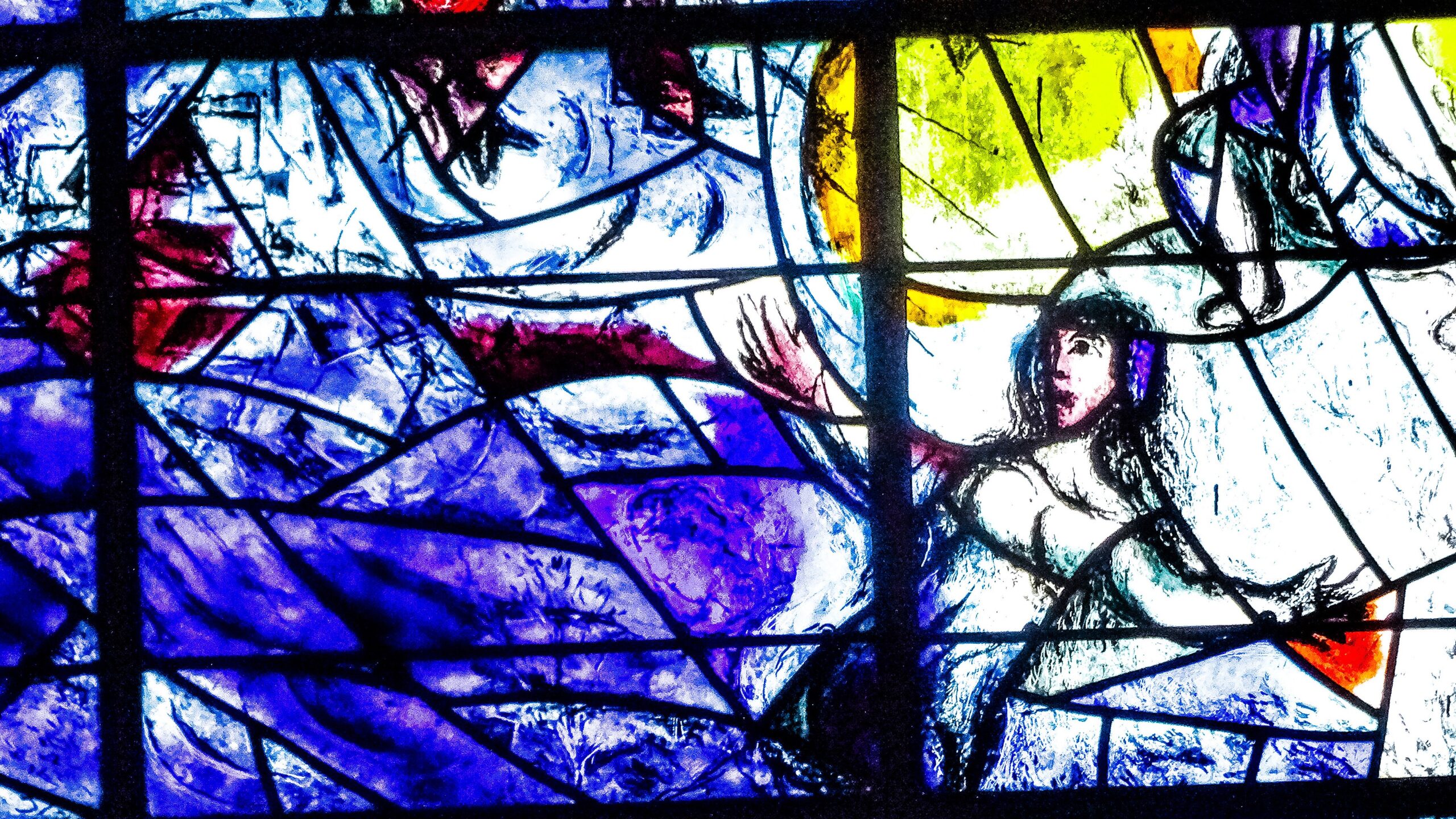
Image credit: Detail of a stained glass window by Marc Chagall at All Saints’ Church in Tudeley, UK. Photo by John K Thorne
