
1 Kings 5
1 Now KingI HiramII of TyreIII
I “King” = melek. From malak (to be or become king or queen, to rise to the throne, to be crowned; by implication, to take counsel). This is king or royal.
II “Hiram” = Chiram. From Churam (Huram, a name); from Achiram (Ahiram; “brother of the lofty” or “brother of height”); {from ach (brother, kindred, another, other, like) + rum (to be high, rise, exalt self, extol, be haughty; to rise literally or figuratively)} OR from hor (noblemen) + rum (see above). This is Hiram or Chiram, a name that means “most noble,” “high born,” “brother of the lofty.” See https://www.abarim-publications.com/Meaning/Hiram.html
III “Tyre” = Tsor. “From Phoenician “𐤑𐤓 (ṣr /Ṣur/, “rock”)”” OR from the same as tsor (flint, stone, knife, edge); from the same as tsar (pebble, flint) or tsur (to confine, cramp, or bind in a literal or figurative sense; to besiege, assault, or distress). This is Tyre, the Phoenician city. Its name may mean “rock.” See https://en.wiktionary.org/wiki/Tyre
sentIV his servantsV to SolomonVI when he heardVII
IV “sent” = shalach. This is to send out, away, send for, forsake. It can also mean to divorce or set a slave free.
V “servants” = ebed. From abad (to work, serve, compel; any kind of work; used causatively, can mean to enslave or keep in bondage). This is a servant, slave, or bondservant.
VI “Solomon” = Shelomoh. From shalam (to be complete or sound; to have safety mentally, physically, or extending to one’s estate; so, if these things are safe and complete, the implication is that one would be friendly; and, if being friendly, one would make amends and that friendship would be reciprocated). This is Solomon or Shelomoh, meaning “peaceful.” It is the same word as the Hebrew word for peace – shalom.
VII “heard” = shama. This is to hear, call, consent, or consider. It implies listening intelligently, giving attention, and, because of these two factors, obedience and action are often implied.
that they had anointedVIII him king in place ofIX his father,X for Hiram had alwaysXI
VIII “anointed” = mashach. This is smear, paint, spread, or paint. It can also be to rub with oil or, otherwise stated, to anoint. This implies a consecration. This root verb is where the word “messiah” comes from.
IX “in place of” = tachat. This is underneath, below, the bottom, instead of.
X “father” = ab. This is father, chief, or ancestor. It is father in a literal or figurative sense.
XI “always” = kol + yom. Literally, “all of the days.” Kol is from kalal (to complete). This is all or every. Yom has a root that may mean being hot. This is the day in a literal or figurative sense. It can also mean birth, age, daylight, continually or other references to time.
been a friendXII to David.XIII 2 Solomon sent word to Hiram, saying,XIV 3 “You knowXV that my father David couldXVI not
XII “been a friend” = aheb + hayah. Aheb is to love, beloved, friend. It is to have affection for sexually or otherwise. Hayah is to be or become, to happen.
XIII “David” = David. From the same as dod (beloved, love, uncle); the root may mean to boil, which is used figuratively to describe love. So, this implies someone you love such as a friend, a lover, or a close family member like an uncle. David’s name likely means something like “beloved one.”
XIV “saying” = amar. This is to speak, say, answer, command, promise, report.
XV “know” = yada. This is to know, acknowledge, advise, answer, be aware, be acquainted with. Properly, this is to figure something out by seeing. It includes ideas of observation, recognition, and care about something. It can be used causatively for instruction, designation, and punishment.
XVI “could” = yakol. This is to be able, endure, overcome, prevail.
buildXVII a houseXVIII for the nameXIX of the LordXX his GodXXI
XVII “build” = banah. This is to build, make, set up, restore, repair, or obtain children. It is to build literally or figuratively.
XVIII “house” = bayit. Related to “build” in v3. From banah (see note XVII above). This is house, court, family, palace, temple.
XIX “name” = shem. May be from sim (to put, place, set). This is name, fame, renown. A name was thought to indicate something essential about a person – something about their individuality. So, this word can also mean honor, authority, or character.
XX “Lord” = YHVH. Related to “been a friend” in v1. From havah (to be, become) or hayah (see note XII above). This is the name of the God of Israel, the self-existent and eternal one, the tetragrammaton. This pronunciation has been lost to time so “Lord” is generally used in its place.
XXI “God” = Elohim.
becauseXXII of the warfareXXIII with which his enemies surroundedXXIV him, until he putXXV them
XXII “because” = paneh. From panah (to turn, face, appear). This is face in a literal or figurative sense. It could be face, presence, anger, respect. It can also be used of God to indicate divine favor or presence.
XXIII “warfare” = milchamah. From lacham (to eat or feed on; figuratively, to battle as a kind of consumption/destruction). This is battle, war, fighting, or one who fights (i.e. a warrior).
XXIV “surrounded” = sabab. This is turning around, going around; to surround, cast, walk, fetch. It is to revolve or border in a literal or figurative sense.
XXV “put” = natan. This is to give, put, set, offer. It is to give literally or figuratively.
underXXVI the solesXXVII of his feet.XXVIII 4 But nowXXIX the Lord my God has given me restXXX on every side;XXXI
XXVI “under” = tachat. Same as “in place of” in v1. See note IX above.
XXVII “soles” = kaph. From kaphaph (to bend – from a root meaning curve or bend down). This is palm of the hand or sole of the foot, footstep, grasp. Figuratively, it can also mean power.
XXVIII “feet” = regel. This is foot, endurance, or journey. It is a foot as the means of walking and so it implies a step or a greater journey. It can be used euphemistically for private parts.
XXIX “now” = attah. Perhaps from et (a period or season; whenever or continually); probably from anah (to answer, sing, announce); from ad (forever, all, old); from adah (to pass on, advance, decorate oneself). This is now, from now on.
XXX “given…rest” = nuach. This is to rest, calm, camp, free, place, remain, satisfy, settle, station, or wait. It is rest and so implies settling down in a literal or figurative sense. This is perhaps the root verb of the name “Noah.”
XXXI “on every side” = sabib. Related to “surrounded” in v3. From sabab (see note XXIV above). This is a circuit or a circle. It could refer to an environment, one’s neighbors, or a circular path round about.
there is neitherXXXII adversaryXXXIII norXXXIV misfortune.XXXV
XXXII “neither” = ayin. Perhaps from a word that means to be nothing. This means nothing, none, non-existent. It can also simply mean not or are not.
XXXIII “adversary” = satan. Perhaps from satan (to be an adversary, attack, accuse, resist). This is adversary. It could be personal, in reference to political enemies, or refer to Satan.
XXXIV “nor” = ayin. Same as “neither” in v4. See note XXXII above.
XXXV “misfortune” = pega + ra’. Literally, “evil occurrence.” Pega is 2x in OT. From paga (to meet or happen, whether unintentionally or of violence; to plead, spare, reach, or intercede). This is occurrence or chance. Ra’ is from ra’a’ (to be evil, bad, afflict; properly, to spoil – to destroy by breaking into pieces; figuratively, to cause something to be worthless; this is bad in a physical, social, or moral sense; that which displeases, to do harm or mischief, to punish or vex). This is bad, disagreeable, that which causes pain, misery, something having little or no value, something that is ethically bad, wicked, injury, calamity. This refers to anything that is not what it ought to be – a natural disaster, a disfigurement, an injury, a sin.
5 SoXXXVI I intendXXXVII to build a house for the name of the Lord my God, as the Lord saidXXXVIII to my father David,XXXIX ‘Your son,XL whom I will setXLI
XXXVI {untranslated} = hen. This is a remark of surprise or excitement: lo! Behold! It can also mean if or though.
XXXVII “intend” = amar. Same as “saying” in v2. See note XIV above.
XXXVIII “said” = dabar. This is generally to speak, answer, declare, or command. It might mean to arrange and so to speak in a figurative sense as arranging words.
XXXIX {untranslated} = amar. Same as “saying” in v2. See note XIV above.
XL “son” = ben. Related to “build” and “house” in v3. From banah (see note XVII above). This is son, age, child. It is son in a literal or figurative sense.
XLI “set” = natan. Same as “put” in v3. See note XXV above.
on your throneXLII in your place,XLIII shall build the house for my name.’ 6 ThereforeXLIV commandXLV that cedarsXLVI
XLII “throne” = kisse. From the same as kese (full moon); perhaps from kasah (to cover, conceal, overwhelm; to cover as clothes do or to hide a secret). This is throne – a seat that is covered or has a canopy. Thus, it is a seat that conveys authority.
XLIII “in…place” = tachat. Same as “in place of” in v1. See note IX above.
XLIV “therefore” = attah. Same as “now” in v4. See note XXIX above.
XLV “command” = tsavah. This is to charge, command, order, appoint, or enjoin. This is the root that the Hebrew word for “commandment” comes from (mitsvah).
XLVI “cedars” = erez. Perhaps from araz (made from cedar; to be firm, strong). This is cedar or a cedar tree as strong.
from the LebanonXLVII be cutXLVIII for me. My servants will joinXLIX your servants, and I will giveL you whateverLI wagesLII
XLVII “Lebanon” = Lebanon. From laben (to be white, make white, make bricks) OR form Aramaic lebab (heart); corresponding to Hebrew lebab (heart, courage, one’s inner self, the mind, or the will). This is Lebanon. The sense of “white” comes from the snow on the top of its mountains. See https://en.wikipedia.org/wiki/Lebanon
XLVIII “cut” = karat. This is to cut down, cut off, or make a covenant (idiom for making a covenant is “to cut a covenant”). It can also mean to destroy, fail, or consume.
XLIX “join” = hayah. Same as “been a friend” in v1. See note XII above.
L “give” = natan. Same as “put” in v3. See note XXV above.
LI “whatever” = kol. Same as “always” in v1. See note XI above.
LII “wages” = sakar. From sakar (to hire, reward, earn). This is wages, payment, service, salary, worth, reward, or benefit.
you setLIII for your servants, for you know that there is noLIV oneLV among us who knows how to cut timberLVI like the Sidonians.”LVII
LIII “set” = amar. Same as “saying” in v2. See note XIV above.
LIV “no” = ayin. Same as “neither” in v4. See note XXXII above.
LV “one” = ish. Perhaps from enosh (human, humankind, mortal); from anash (to be weak, sick, or frail). This is man, husband, another, or humankind.
LVI “timber” = ets. Perhaps from atsah (to shut, fasten, firm up, to close one’s eyes). This is tree or other things related to trees like wood, sticks, or stalks. It can also refer to wood products like a plank or staff or gallows. Additionally, this can refer to a carpenter.
LVII “Sidonians” = Tsidoni. 16x in OT. From Tsidon (Sidon – a city in Phoenicia); from Phoenician tsydon (Sidon; probably meaning fishery or fishing town). This is Sidonian or Zidonian. See https://en.wiktionary.org/wiki/Sidon & https://en.wikipedia.org/wiki/Sidon
7 WhenLVIII Hiram heard the wordsLIX of Solomon, he rejoicedLX greatlyLXI and said,LXII
LVIII {untranslated} = hayah. Same as “been a friend” in v1. See note XII above.
LIX “words” = dabar. Related to “said” in v5. From dabar (see note XXXVIII above). This is speech, a word, a matter, an affair, charge, command, message, promise, purpose, report, request. It is a word, which implies things that are spoken of in a wide sense.
LX “rejoiced” = samach. This is to rejoice or be glad. Properly, it is to brighten up in a literal or figurative sense.
LXI “greatly” = meod. Perhaps from the same as uwd (firebrand, a poker). This is very, greatly, exceedingly. It can also mean vehemence, force, abundance.
LXII “said” = amar. Same as “saying” in v2. See note XIV above.
“Blessed beLXIII the Lord today,LXIV who has given to David a wiseLXV son to be over this greatLXVI people.”LXVII
LXIII “blessed be” = barak. This is to kneel, to bless. It is blessing God as part of worship and adoration or blessing humans to help them. It can be used as a euphemism to say curse God.
LXIV “today” = yom. Same as “always” in v1. See note XI above.
LXV “wise” = chakam. From chakam (to be wise or teach wisdom; this is wisdom in thought, word, or action). This is wise, skillful, cunning, or artful.
LXVI “great” = rab. From rabab (increasing in any aspect whether quantity, authority, size, quality, greatness, etc.). This is abundance, many, elder, exceedingly, great. It refers to abundance of amount, rank, or status.
LXVII “people” = am. From amam (to darken, hide, associate; creating shadows by huddling together). This is people or nation. It can be used specifically for a tribe, collectively of troops or armies, or figuratively to refer to a flock of animals.
8 Hiram sent word to Solomon,LXVIII “I have heard the message that you have sent to me; I will fulfillLXIX allLXX your needsLXXI in the matter of cedar and cypressLXXII timber.
LXVIII {untranslated} = amar. Same as “saying” in v2. See note XIV above.
LXIX “fulfill” = asah. This is to make, do, act, appoint, become in many senses.
LXX “all” = kol. Same as “always” in v1. See note XI above.
LXXI “needs” = chephets. From chaphets (properly, inclined towards or bending to; figuratively, to desire, delight in, or be pleased with). This is a delight, care, or pleasure. It is what you desire or what is acceptable. It can also be used concretely for a precious thing or something that one is thinking about.
LXXII “cypress” = berosh. This is a cypress, fir, or juniper. It can be something made of this wood like a lance of musical instrument.
9 My servants shall bring it downLXXIII to the seaLXXIV from the Lebanon; I will makeLXXV it into raftsLXXVI to go by sea
LXXIII “bring…down” = yarad. This is to go down, descend; going down in a literal or figurative sense. It can be going to the shore or a boundary, bringing down an enemy.
LXXIV “sea” = yam. Root may mean to roar. This is the sea, often referring to the Mediterranean. It comes from the root in the sense of the roar of crashing surf. This word is sometimes used for rivers or other sources of water. It can mean to the west or to the south.
LXXV “make” = sim. Related to “name” in v3. See note XIX above.
LXXVI “rafts” = doberah. Related to “said” in v5 & “words” in v7. 1x in OT. From dabar (see note XXXVIII above). This is a float, raft.
to the placeLXXVII you indicate.LXXVIII I will have them broken upLXXIX there for you to take away.LXXX
LXXVII “place” = maqom. From qum (to arise, stand, accomplish, establish, abide; rising against, getting up after being sick or asleep, arising from one state to another, becoming powerful, or rising for action; standing in a figurative sense). This is a standing, which is to say a spot or space a place. It can also refer to a locality or a physical/mental condition. HaMaqom is also a Jewish name for God – the place, i.e. the Omnipresent One.
LXXVIII “indicate” = shalach. Same as “sent” in v1. See note IV above.
LXXIX “broken up” = naphats. This is to shatter, break, scatter, dash in pieces.
LXXX “take away” = nasa. This is to lift in a broad sense, literally and figuratively. So it could be to carry, take, or arise. It could also be bring forth, advance, accept.
And you shall meetLXXXI my needs by providingLXXXII foodLXXXIII for my household.”LXXXIV
LXXXI “meet” = asah. Same as “fulfill” in v8. See note LXIX above.
LXXXII “providing” = natan. Same as “put” in v3. See note XXV above.
LXXXIII “food” = lechem. Related to “warfare” in v3. From lacham (see note XXIII above). This is bread, food, loaf. It can refer to food more generally for people or for animals.
LXXXIV “household” = bayit. Same as “house” in v3. See note XVIII above.
10 SoLXXXV Hiram suppliedLXXXVI Solomon’s everyLXXXVII need for timber of cedar andLXXXVIII cypress. 11 Solomon, in turn, gaveLXXXIX Hiram twentyXC thousandXCI
LXXXV {untranslated} = hayah. Same as “been a friend” in v1. See note XII above.
LXXXVI “supplied” = natan. Same as “put” in v3. See note XXV above.
LXXXVII “every” = kol. Same as “always” in v1. See note XI above.
LXXXVIII {untranslated} = ets. Same as “timber” in v6. See note LVI above.
LXXXIX “gave” = natan. Same as “put” in v3. See note XXV above.
XC “twenty” = esrim. From the same as eser (ten, tenth). This is twenty or twentieth.
XCI “thousand” = eleph. Perhaps from the same as eleph (herd, cattle); from alaph (to learn, speak, associate with). This is thousand.
corsXCII of wheatXCIII as foodXCIV for his household and twenty cors of fineXCV oil.XCVI
XCII “cors” = kor. 9x in OT. From the same as kur (furnace, smelting pot). This is a cor, which is a measurement used for dry goods. Literally, it’s a round vessel that is deep.
XCIII “wheat” = chittah. Perhaps from chanat (to spice, ripen, embalm). This is wheat, referring to the plant or its product.
XCIV “food” = makkoleth. 1x in OT. From akal (to eat, consume, burn up; eat in a literal or figurative sense). This is food, provision, or nourishment.
XCV “fine” = kathith. 5x in OT. From kathath (to crush into pieces, to beat with a hammer, smash, bruise). This is beaten – a reference to pure oil.
XCVI “oil” = shemen. From shamen (to shine, which implies being oily, growing fat). This is fat, oil, grease, olive oil – often with perfume. Used figuratively for fertile, lavish, rich.
Solomon gaveXCVII this to Hiram yearXCVIII by year. 12 So the Lord gaveXCIX Solomon wisdom,C as he had promisedCI him. There wasCII
XCVII “gave” = natan. Same as “put” in v3. See note XXV above.
XCVIII “year” = shanah. From shana (to change, alter). This is a year, age, old. It can also mean yearly.
XCIX “gave” = natan. Same as “put” in v3. See note XXV above.
C “wisdom” = chokmah. Related to “wise” in v7. From chakam (see note LXV above). This is wisdom, wit, or skillfulness.
CI “promised” = dabar. Same as “said” in v5. See note XXXVIII above.
CII “was” = hayah. Same as “been a friend” in v1. See note XII above.
peaceCIII betweenCIV Hiram andCV Solomon, and the twoCVI of them madeCVII a treaty.CVIII
CIII “peace” = shalom. Related to “Solomon” in v1. From shalam (see note VI above). This is completeness, soundness, welfare, favor, friend, good health. It is to be safe and figuratively well, happy, at peace, friendly. Abstractly, it includes the ideas of welfare and prosperity (not in excessive wealth, but in having enough).
CIV “between” = bayin. From bin (to discern, consider, attend to; distinguishing things in one’s mind or, more generally, to understand). This is among, between, interval.
CV {untranslated} = bayin. Same as “between” in v12. See note CIV above.
CVI “two” = shenayim. From sheni (double, again, another, second); from shanah (to fold, repeat, double, alter, or disguise). This is two, both, second, couple.
CVII “made” = karat. Same as “cut” in v6. See note XLVIII above.
CVIII “treaty” = berit. Perhaps from barah (to eat, choose, make clear); perhaps from bar (grain, wheat); from barar (to select, purify, cleanse, test, brighten, polish). This is a compact, covenant, alliance, treaty, or league.
13 King Solomon conscriptedCIX forced laborCX out of all Israel;CXI the levyCXII
CIX “conscripted” = alah. This is to go up, approach, ascend, be high, be a priority; to arise in a literal or figurative sense.
CX “forced labor” = mas. Perhaps from masas (to melt, discourage, faint; to deteriorate from a sickness or weaken because of sleepiness or an emotional response). This is a burden that creates weariness and or exhaustion. It is forced labor, taskwork, or other levy.
CXI “Israel” = Yisrael. Related to “God” in v3. From sarah (to persist, exert oneself, contend, persevere, wrestle, prevail) + El (see note XXI above). This is Israel, meaning God strives or one who strives with God; new name for Jacob and for his offspring. This refers to the people and to the land.
CXII “levy” = mas. Same as “forced labor” in v13. See note CX above.
numberedCXIII thirtyCXIV thousand men.CXV 14 He sent them to the Lebanon, tenCXVI thousand a monthCXVII in shifts;CXVIII
CXIII “numbered” = hayah. Same as “been a friend” in v1. See note XII above.
CXIV “thirty” = sheloshim. From the same as shalosh (three, fork, triad). This is thirty or thirtieth.
CXV “men” = ish. Same as “one” in v6. See note LV above.
CXVI “ten” = eser. Related to “twenty” in v11. See note XC above.
CXVII “month” = chodesh. From chadash (to renew, repair). This refers to a new moon. It can also mean monthly.
CXVIII “shifts” = chaliphah. 12x in OT. From chalaph (to slide by or rush like a flood; to pass through, change, sprout, renew, break a promise, pierce, or violate). This is a change, alternation, release, shift, change of clothing.
they would be a month in the Lebanon and two months at home;CXIX AdoniramCXX was in charge of the forced labor. 15 Solomon also hadCXXI seventyCXXII thousand laborersCXXIII
CXIX “home” = bayit. Same as “house” in v3. See note XVIII above.
CXX “Adoniram” = Adoniram. Related to “Hiram” in v1. 2x in OT. From adon (lord, master, owner) + rum (see note II above). This is Adoniram, meaning “my Lord is exalted” or “lord of height.”
CXXI “had” = hayah. Same as “been a friend” in v1. See note XII above.
CXXII “seventy” = shibim. From sheba (seven – the number of perfection/sacred fullness). This is seventy.
CXXIII “laborers” = nasa + sabbal. Literally, “who lift a burden.” Nasa is the same as “take away” in v9. See note LXXX above. Sabbal is 5x in OT. From sabal (to carry a heavy load, do strong labor, be a burden; specially, to be pregnant). This is one who carries a burden, a porter or laborer.
and eightyCXXIV thousand stonecuttersCXXV in the hill country,CXXVI 16 besidesCXXVII Solomon’s threeCXXVIII thousand three hundredCXXIX
CXXIV “eighty” = shemonim. Related to “oil” in v11. From the same as shemoneh (eight; can be figurative for surplus); perhaps from shamen (see note XCVI above). This is eighty.
CXXV “stonecutters” = chatsab. This is to hew or cut material like wood or stone. It can also be to dig, quarry, split, or engrave.
CXXVI “hill country” = har. From harar (hill or mountain). This is mountain, hill, hilly region.
CXXVII “besides” = bad. From badad (to divide or be separated; alone, solitary, lonely, isolated, straggler). This is apart, alone, separation, body part, tree branch, except. It can also be a city’s chief.
CXXVIII “three” = shalosh. Related to “thirty” in v13. See note CXIV above.
CXXIX “hundred” = meah. This is hundred or some number times one hundred (i.e. hundredfold or the base of two hundred, three hundred, etc.).
supervisorsCXXX who were over the work,CXXXI having chargeCXXXII of the people who didCXXXIII the work.
CXXX “supervisors” = sar + natsab. Sar is chief, leader, ruler, lord, official, governor, prince, military leader. It refers to someone at the top of a rank or class. Natsab is to station, appoint, establish, take a stand.
CXXXI “work” = melakah. From the same as malak (messenger, an angel, or a deputy; human messengers literally or for prophets, priests, or teachers as messengers of God; also supernatural messengers i.e. angels). Properly, this is a deputyship or some kind of work. It can also be the product that comes from labor.
CXXXII “having charge” = radah. This is to step down, rule, dominate, have victory over, crumble.
CXXXIII “did” = asah. Same as “fulfill” in v8. See note LXIX above.
17 At the king’s command, they quarried outCXXXIV great,CXXXV costlyCXXXVI CXXXVIIstonesCXXXVIII
CXXXIV “quarried out” = nasa. This is properly pulling up as when one pulls up tent pegs or stakes. This would imply striking tents in order to start a journey. So this could be bring, pullout, set out, journey, or cause to go away.
CXXXV “great” = gadol. From gadal (to grow up, become great, become wealthy – to advance. The root meaning may be to twist in the sense of the process of growing). This is great, high, bigger, noble, old, marvelous. It can also refer to someone who is powerful or distinguished.
CXXXVI “costly” = yaqar. From yaqar (to be precious, costly, rare, valued; properly, to be heavy; figuratively, valuable or inhibit). This is precious, splendid, noble, weighty, or rare. It is valuable in a subjective or objective sense.
CXXXVII {untranslated} = eben. Same as “stones” in v17. See note CXXXVIII below.
CXXXVIII “stones” = eben. This is a stone, weight, or mason. It is part of the word “Ebenezer.”
in order to lay the foundationCXXXIX of the house with dressedCXL stones. 18 So Solomon’s buildersCXLI and Hiram’s builders and the GebalitesCXLII did the stonecuttingCXLIII and preparedCXLIV the timber and the stone to build the house.
CXXXIX “lay the foundation” = yasad. This is to establish, appoint, instruct. It is to set in a literal or figurative sense. Also means to sit down together and so to consult or take counsel.
CXL “dressed” = gazit. 11x in OT. This is something cut like a smooth or hewn stone.
CXLI “builders” = banah. Same as “build” in v3. See note XVII above.
CXLII “Gebalites” = Gibli. 2x in OT – 1x in Joshua & 1x in 1 Kings. From Gebal (Gebal, a place whose name means “stone-square”); from the same as gebul (boundary, limit, coast, space; properly, a line that is twisted, which implies a boundary and, by extension, the boundaries of a territory or other enclosed space); perhaps from gabal (to border, twist like rope). This is Gebalite – someone who lives in Gebal.
CXLIII “did the stonecutting” = pasal. 6x in OT. This is to hew or carve. It can refer to either wood or stone.
CXLIV “prepared” = kun. Properly, this means in a perpendicular position. So, it is set up in a literal sense – establish, fix, fasten, prepare. In a figurative sense, it is certainty, to be firm, faithfulness, render sure or prosperous.
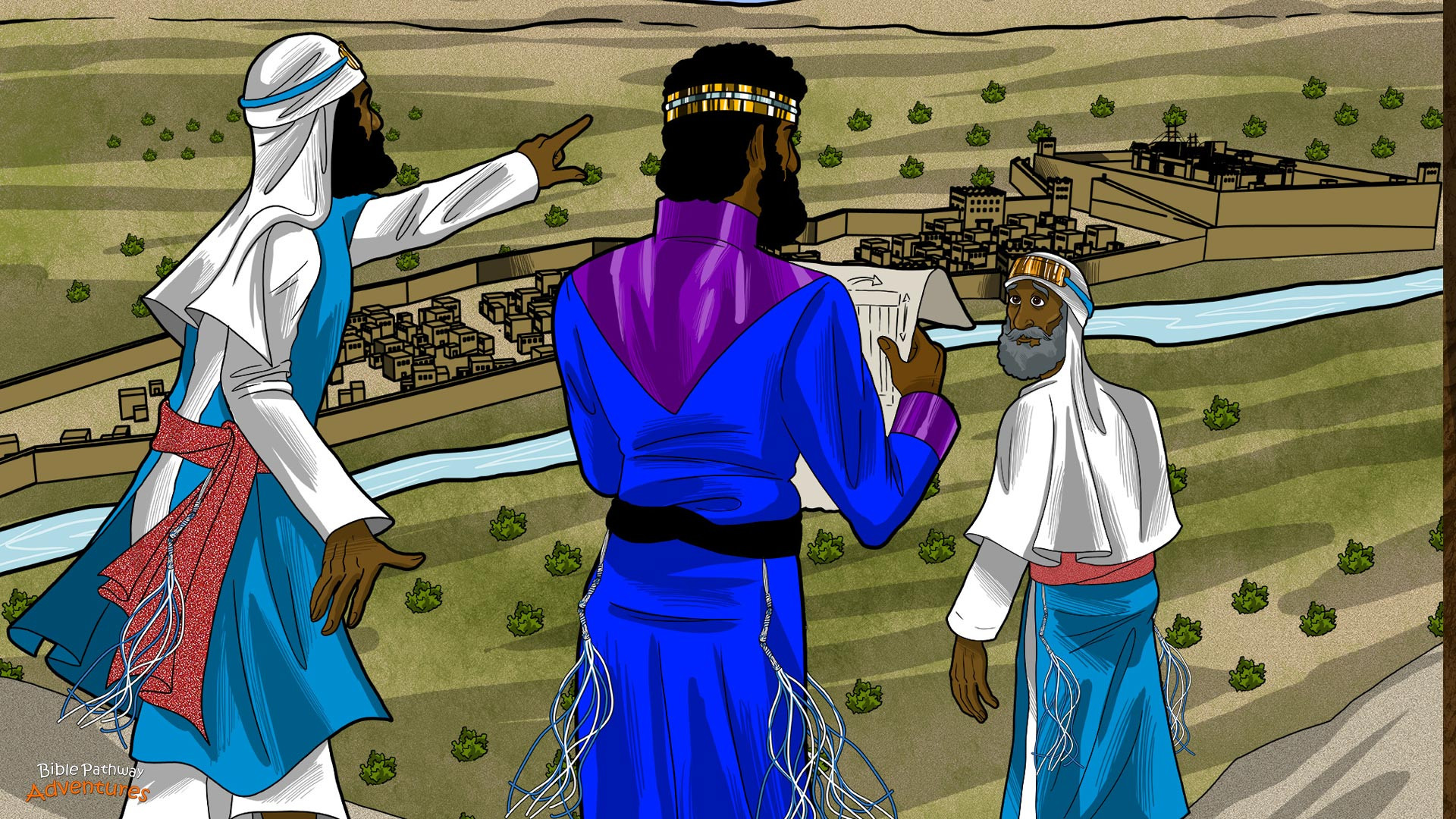
Image credit: “Solomon the Temple Builder” by Curtis and Pip Reid of Bible Pathway Adventures
