1 Kings 6
BibleHub
1 IIn the fourII hundredIII, IV eightiethV yearVI
Notes on verse 1a
I {untranslated} = hayah. This is to be or become, to happen.
II “four” = arba. From raba (to make square or be four-sided). This is four.
III “hundred” = meah. This is hundred or some number times one hundred (i.e. hundredfold or the base of two hundred, three hundred, etc.).
IV {untranslated} = shanah. Same as “year” in v1. See note VI below.
V “eightieth” = shemonim. From the same as shemoneh (eight or eighth; abundance as being more than 7, the number of sacred fullness); perhaps from shamen (to shine, which implies being oily, growing fat); from shaman (to grow fat, shine, be oily). This is eighty.
VI “year” = shanah. From shana (to change, alter). This is a year, age, old. It can also mean yearly.
after the IsraelitesVII came outVIII of the landIX of Egypt,X
Notes on verse 1b
VII “Israelites” = ben + Yisrael. Literally, “children of Israel.” Ben is from banah (to build or obtain children). This is son, age, child. It is son in a literal or figurative sense. Yisrael is from sarah (to persist, exert oneself, contend, persevere, wrestle, prevail) + El (God or god). This is Israel, meaning God strives or one who strives with God; new name for Jacob and for his offspring. This refers to the people and to the land.
VIII “came out” = yatsa. This is to go or come out, bring forth, appear. It is to go out in a literal or figurative sense.
IX “land” = erets. Root may mean to be firm. This is earth, ground, field land, or country.
X “Egypt” = Mitsrayim. Perhaps from matsor (besieged or fortified place, bulwark, entrenchment; something hemmed in; a siege or distress or fastness); from tsur (to confine, besiege, to cramp). This is Egypt.
in the fourthXI year of Solomon’sXII reignXIII over Israel,XIV
Notes on verse 1c
XI “fourth” = rebii. Related to “four” in v1. From the same as arba (see note II above). This is fourth or square-shaped.
XII “Solomon’s” = Shelomoh. From shalam (to be complete or sound; to have safety mentally, physically, or extending to one’s estate; so, if these things are safe and complete, the implication is that one would be friendly; and, if being friendly, one would make amends and that friendship would be reciprocated). This is Solomon or Shelomoh, meaning “peaceful.” It is the same word as the Hebrew word for peace – shalom.
XIII “reign” = malak. To be or become king or queen, to rise to the throne, to be crowned. By implication, to take counsel. This word may be from the Hebrew word for king “melek” or vice versa.
XIV “Israel” = Yisrael. Same as “Israelites” in v1. See note VII above.
in the monthXV of Ziv,XVI which is the secondXVII month, he began to buildXVIII the houseXIX of the Lord.XX
Notes on verse 1d
XV “month” = chodesh. From chadash (to renew, repair). This refers to a new moon. It can also mean monthly.
XVI “Ziv” = Ziv. 2x in OT. Perhaps from ziv (brigtness, freshness, thrive, proud, glory; may come from a word that means prominence or brightness). This is Ziv, which would be the month of April/May – when flowers bloom. It’s the second month in the Jewish calendar.
XVII “second” = sheni. From shanah (to fold, repeat, double, alter, or disguise). This is double, again, another, second.
XVIII “build” = banah. Related to “Israelites” in v1. See note VII above.
XIX “house” = bayit. Related to “Israelites” and “build” in v1. From banah (see note VII above). This is house, court, family, palace, temple.
XX “Lord” = YHVH. Related to {untranslated} in v1. From havah (to be, become) or hayah (see note I above). This is the name of the God of Israel, the self-existent and eternal one, the tetragrammaton. This pronunciation has been lost to time so “Lord” is generally used in its place.
2 The house that KingXXI Solomon built for the Lord was sixtyXXII cubitsXXIII long,XXIV
Notes on verse 2a
XXI “King” = melek. Related to “reign” in v1. From malak (see note XIII above). This is king or royal.
XXII “sixty” = shishshim. From shesh (six; figuratively, a surplus since it is one more than the number of fingers on the hand). This is sixty.
XXIII “cubits” = ammah. From the same as em (mother). This is a cubit, post, threshold, pivot. It is mother as the basic measure (the length of the forearm). It is also mother as the which bonds an entryway i.e. the base of the door.
XXIV “long” = orek. From arak (to be long in a literal or figurative sense, to continue, defer, draw out). This is length, long, or forever.
twentyXXV cubits wide,XXVI and thirtyXXVII cubits high.XXVIII
Notes on verse 2b
XXV “twenty” = esrim. From the same as eser (ten, tenth). This is twenty or twentieth.
XXVI “wide” = rochab. From rachab (to grow wide or enlarge in a literal or figurative sense; extend, relieve, rejoice, or speak boldly). This is breadth, depth, thickness, expanse. It is width in a literal or figurative sense.
XXVII “thirty” = sheloshim. From the same as shalosh (three, fork, triad). This is thirty or thirtieth.
XXVIII “high” = qomah. From qum (to arise, stand, accomplish, establish, abide; rising against, getting up after being sick or asleep, arising from one state to another, becoming powerful, or rising for action; standing in a figurative sense). This is tall, high, length, or height.
3 The vestibuleXXIX in frontXXX of the naveXXXI of the house was twenty cubits wide,XXXII
Notes on verse 3a
XXIX “vestibule” = ulam. From the same as ul (mighty, strength, body, belly; root may mean to twist and that implies strength and power); from alam (to bind or tie fast; to be silent or speechless, whether voluntary or involuntary) or from ayil (strength; things that are strong or powerful: political chiefs, rams, posts, trees, oaks). This is porch or hall.
XXX “front” = paneh. From panah (to turn, face, appear). This is face in a literal or figurative sense. It could be face, presence, anger, respect. It can also be used of God to indicate divine favor or presence.
XXXI “nave” = hekal. Perhaps from yakol (to be able, endure, overcome, prevail). This is a large building with public access such as a palace or temple.
XXXII “wide” = orek. Same as “long” in v2. See note XXIV above.
acrossXXXIII the widthXXXIV of the house. Its depthXXXV was tenXXXVI cubits in front of the house.
Notes on verse 3b
XXXIII “across” = paneh. Same as “front” in v3. See note XXX above.
XXXIV “width” = rochab. Same as “wide” in v2. See note XXVI above.
XXXV “depth” = rochab. Same as “wide” in v2. See note XXVI above.
XXXVI “ten” = eser. Related to “twenty” in v2. See note XXV above.
4 For the house he madeXXXVII windowsXXXVIII with recessedXXXIX frames.XL
Notes on verse 4
XXXVII “made” = asah. This is to make, do, act, appoint, become in many senses.
XXXVIII “windows” = challon. From chalal (to pierce, which implies to wound; used figuratively for making someone or something profane or breaking your word; to begin as though one opened a wedge; to eat something as a common thing). This is window.
XXXIX “recessed” = atam. 8x in OT– 4x of windows, 4x of closing lips or ears. This is to close, shutter, stop, contract. By analogy, it can refer to a recessed or beveled window.
XL “frames” = shaquph. From sheqeph (lattice, window, framework); from shaqaph (to look down or look out; properly, looking by leaning out a window; peeping or gazing). This is overhanging, frame, casing.
5 He also built a structureXLI against the wallXLII of the house, running aroundXLIII the walls of the house, bothXLIV the nave and the inner sanctuary,XLV
Notes on verse 5a
XLI “structure” = yatsua. 8x in OT. From yatsa (to go or come out, bring forth, appear; to go out in a literal or figurative sense). This is couch (i.e. bed), chamber, or, in architecture, a wing.
XLII “wall” = qir. Perhaps from qur (to dig, destroy, wall up). This is a wall, ceiling, surface, mason, or town.
XLIII “running around” = sabib. From sabab (turning around, going around; to surround, cast, walk, fetch; to revolve or border in a literal or figurative sense). This is a circuit or a circle. It could refer to an environment, one’s neighbors, or a circular path round about.
XLIV {untranslated} = sabib. Same as “running around” in v5. See note XLIII above.
XLV “inner sanctuary” = debir. 16x in OT. Perhaps from dabar (to speak, declare, discuss). May mean a place of speaking like an oracle. It is the inner sanctuary of Solomon’s Temple.
and he made side chambersXLVI all around.XLVII 6 The lowestXLVIII storyXLIX was fiveL cubits wide,LI
Notes on verses 5b-6a
XLVI “side chambers” = tsela. Perhaps from tsala (to limp, be lame). This is rib, side, leaf, plank, side of a person or object; quarter of the sky.
XLVII “all around” = sabib. Same as “running around” in v5. See note XLIII above.
XLVIII “lowest” = tachton. 13x in OT. From tachat (underneath, below, the bottom, instead of). This is lower, lowest, or bottommost.
XLIX “story” = yatsua. Same as “structure” in v5. See note XLI above.
L “five” = chamesh. This is five.
LI “wide” = rochab. Same as “wide” in v2. See note XXVI above.
the middle oneLII was sixLIII cubits wide,LIV and the thirdLV was sevenLVI cubits wide,LVII
Notes on verse 6b
LII “middle one” = tikon. 11x in OT. From the same as tavek (among, middle, in the midst, center; perhaps properly to sever). This is middle, lowest, midst, or central.
LIII “six” = shesh. Related to “sixty” in v2. See note XXII above.
LIV “wide” = rochab. Same as “wide” in v2. See note XXVI above.
LV “third” = shelishi. Related to “thirty” in v2. From shalosh (see note XXVII above). This is third or one-third of something.
LVI “seven” = sheba. This is seven or by sevenfold. It can also be used to imply a week or an indefinite number. Symbolically, this is the number of fullness, sacredness, perfection.
LVII “wide” = rochab. Same as “wide” in v2. See note XXVI above.
for aroundLVIII the outsideLIX of the house he madeLX offsetsLXI on the wall in order that the supporting beams should notLXII be insertedLXIII into the walls of the house.
Notes on verse 6c
LVIII “around” = sabib. Same as “running around” in v5. See note XLIII above
LIX “outside” = chuts. Root may mean to sever. So, this is something that is separated by a wall – the outside, the street, a field, highway, or abroad.
LX “made” = natan. This is to give, put, set, offer. It is to give literally or figuratively.
LXI “offsets” = migraah. 1x in OT. From gara (to remove, restrain, cut off, take away, shave, limit). This is ledge, projection, recess.
LXII “in order that…not” = bilti. From balah (to grow old, wear out, consume, waste, enjoy, fail, decay). This is nothing, not, lest, or except. From its root, it means “a failure of” – used for negative particles.
LXIII “supporting beams…be inserted” = achaz. This is to grasp, catch, seize, take and hold in possession. It can also be to be afraid or hold back.
7 The house was built with stoneLXIV finishedLXV at the quarryLXVI, LXVII so that neither hammerLXVIII nor axLXIX
Notes on verse 7a
LXIV “stone” = eben. This is a stone, weight, or mason. It is part of the word “Ebenezer.”
LXV “finished” = shalem. Related to “Solomon’s” in v1. From shalam (see note XII above). This is safe, blameless, perfect, at peace, whole, friendly. It is complete in a literal or a figurative sense.
LXVI “quarry” = massa’. 2x in OT. From nasa (properly pulling up as when one pulls up tent pegs or stakes; striking tents in order to start a journey; to bring, pull out, set out, journey, or cause to go away). This is journey, march, departure, quarry.
LXVII {untranslated} = banah. Same as “build” in v1. See note XVIII above.
LXVIII “hammer” = maqqebeth. 3x in OT. From naqab (to pierce, bore holes, puncture; to make a hole more or less forcefully; also to curse or libel). This is a hammer as a tool that pierces.
LXIX “ax” = garzen. 4x in OT. From garaz (to cut off). This is an ax.
nor anyLXX toolLXXI of ironLXXII was heardLXXIII in the templeLXXIV while it was being built.
Notes on verse 7b
LXX “any” = kol. From kalal (to complete). This is all or every.
LXXI “tool” = keli. From kalah (to end, be finished, complete, prepare, consume, spent, or completely destroyed). This is something that was prepared – any implement, utensil, article, vessel, weapon, or instrument. Also includes jewels, weapons, bags, carriages, and furniture.
LXXII “iron” = barzel. From the same as Birzoth (a name meaning holes). Root may mean to pierce. This is iron as something used as a cutting implement. It can also specifically mean ax head.
LXXIII “heard” = shama. This is to hear, call, consent, or consider. It implies listening intelligently, giving attention, and, because of these two factors, obedience and action are often implied.
LXXIV “temple” = bayit. Same as “house” in v1. See note XIX above.
8 The entranceLXXV for the lowerLXXVI storyLXXVII was on the southLXXVIII sideLXXIX of the house:
Notes on verse 8a
LXXV “entrance” = petach. From patach (to open wide in a literal or figurative sense, loosen, plow, carve). This is opening, door, gate, entrance.
LXXVI “lower” = tikon. Same as “middle one” in v6. See note LII above.
LXXVII “story” = tsela. Same as “side chambers” in v5. See note XLVI above.
LXXVIII “south” = yemani. From the same as yamin (right hand or side; that which is stronger or more agile; the south); {perhaps yamam (to go or choose the right, use the right hand; to be physically fit or firm)}. This is right, right side, or south.
LXXIX “side” = kateph. Root may mean to clothe. This is shoulder, side, corner.
one went upLXXX by winding stairsLXXXI to the middle storyLXXXII and from the middle storyLXXXIII to the third. 9 So he built the house and finishedLXXXIV it; he roofedLXXXV the house
Notes on verses 8b-9a
LXXX “went up” = alah. This is to go up, approach, ascend, be high, be a priority; to arise in a literal or figurative sense.
LXXXI “winding stairs” = lul. 1x in OT. Perhaps related to lulaah (a loop). This is an enclosed area that has stairs or a ladder.
LXXXII “middle story” = tikon. Same as “middle one” in v6. See note LII above.
LXXXIII “middle story” = tikon. Same as “middle one” in v6. See note LII above.
LXXXIV “finished” = kalah. Related to “tool” in v7. See note LXXI above.
LXXXV “roofed” = saphan. 6x in OT. This is to hide, hoard, reserve. It can mean to cover over or figuratively to deny. In other places, it can mean to lurk.
with beamsLXXXVI and planksLXXXVII of cedar.LXXXVIII 10 He built the structure against the wholeLXXXIX house, each story five cubits high, and it was joinedXC to the house with timbersXCI of cedar.
Notes on verses 9b-10
LXXXVI “beam” = geb. 4x in OT. From gub (pit, cistern, to dig); akin to yagab (to dig, plow, till). This is a cistern, pit, or reservoir.
LXXXVII “planks” = sederah. 4x in OT. Perhaps from the same as seder (arrangement, order). This is order, arrangement, board, plank.
LXXXVIII “cedar” = erez. Perhaps from araz (made from cedar; to be firm, strong). This is cedar or a cedar tree as strong.
LXXXIX “whole” = kol. Same as “any” in v7. See note LXX above.
XC “joined” = achaz. Same as “supporting beams…be inserted” in v6. See note LXIII above.
XCI “timbers” = ets. Perhaps from atsah (to shut, fasten, firm up, to close one’s eyes). This is tree or other things related to trees like wood, sticks, or stalks. It can also refer to wood products like a plank or staff or gallows. Additionally, this can refer to a carpenter.
11 Now the wordXCII of the Lord cameXCIII to Solomon,XCIV 12 “Concerning this house that you are building, if you will walkXCV in my statutes,XCVI
Notes on verses 11-12a
XCII “word” = dabar. Related to “inner sanctuary” in v5. From dabar (see note XLV above). This is speech, a word, a matter, an affair, charge, command, message, promise, purpose, report, request. It is a word, which implies things that are spoken of in a wide sense.
XCIII “came” = hayah. Same as {untranslated} in v1. See note I above.
XCIV {untranslated} = amar. This is to speak, say, answer, command, promise, report.
XCV “walk” = halak. This is go, come, walk. It is walk literally and figuratively and includes people and animals. It can be used figuratively for one’s moral life – how we walk according to God’s way or against it. It can also refer to the walk of life as in the course one’s life takes, the choices we make, etc.
XCVI “statutes” = chuqqah. From choq (statute, boundary, condition, custom, limit, ordinance; something that is prescribed or something that is owed); from chaqaq (to inscribe, carve, or decree; a lawmaker; literally, this is engraving, but it implies enacting a law because laws were carved into stone or metal). This is something prescribed such as a statue, custom, or ordinance.
obeyXCVII my ordinances,XCVIII and keepXCIX allC my commandmentsCI by walking in them,
Notes on verse 12b
XCVII “obey” = asah. Same as “made” in v4. See note XXXVII above.
XCVIII “ordinances” = mishpat. From shaphat (to judge, defend, pronounce judgment, condemn, govern). This is a verdict or formal sentence whether from humans or from God. It includes the act of judging as well as the place that judging takes place, the suit itself, and the penalty. Abstractly, this is justice, which includes the rights of the participants.
XCIX “keep” = shamar. This is to keep, watch, or preserve. It means to guard something or to protect it as a thorny hedge protects something.
C “all” = kol. Same as “any” in v7. See note LXX above.
CI “commandments” = mitsvah. From tsavah (to charge, command, order, enjoin). This is a commandment, law, ordinance obligation, or tradition. It is something commanded whether by God or by a human authority. This term is sometimes used collectively to refer to the Law.
then I will establishCII my promiseCIII with you that I madeCIV to your fatherCV David.CVI
Notes on verse 12c
CII “establish” = qum. Related to “high” in v2. See note XXVIII above.
CIII “promise” = dabar. Same as “word” in v11. See note XCII above.
CIV “made” = dabar. Related to “inner sanctuary” in v5 & “word” in v11. See note XLV above.
CV “father” = ab. This is father, chief, or ancestor. It is father in a literal or figurative sense.
CVI “David” = David. From the same as dod (beloved, love, uncle); the root may mean to boil, which is used figuratively to describe love. So, this implies someone you love such as a friend, a lover, or a close family member like an uncle. David’s name likely means something like “beloved one.”
13 I will dwellCVII amongCVIII the Israelites and will not forsakeCIX my peopleCX Israel.”
Notes on verse 13
CVII “dwell” = shakan. This is to settle down in the sense of residing somewhere or staying there permanently. It can mean abide or continue. “Mishkan,” taken from this verb, is the Hebrew word for the Tabernacle (as a place where God abided).
CVIII “among” = tavek. Related to “middle one” in v6. See note LII above.
CIX “forsake” = azab. To loosen, relinquish, permit, forsake, fail, leave destitute.
CX “people” = am. From amam (to darken, hide, associate; creating shadows by huddling together). This is people or nation. It can be used specifically for a tribe, collectively of troops or armies, or figuratively to refer to a flock of animals.
14 So Solomon built the house and finishedCXI it. 15 He linedCXII the walls of the house on the insideCXIII with boardsCXIV of cedar; from the floorCXV of the house
Notes on verses 14-15a
CXI “finished” = kalah. Same as “finished” in v9. See note LXXXIV above.
CXII “lined” = banah. Same as “build” in v1. See note XVIII above.
CXIII “inside” = bayit. Same as “house” in v1. See note XIX above.
CXIV “boards” = tsela. Same as “side chambers” in v5. See note XLVI above.
CXV “floor” = qarqa. 8x in OT. Perhaps from qara (to tear or cut out in a literal or figurative sense; to revile or to apply eye make up – as though they are made to look larger). This is floor or bottom (as in the bottom of the sea).
to the raftersCXVI of the ceiling,CXVII he coveredCXVIII them on the inside with wood,CXIX and he covered the floor of the house with boards of cypress.CXX
Notes on verse 15b
CXVI “rafters” = qir. Same as “wall” in v5. See note XLII above.
CXVII “ceiling” = sippun. Related to “roofed” in v9. 1x in OT. From saphan (see note LXXXV above). This is covering, paneling, ceiling.
CXVIII “covered” = tsaphah. This is to spread, to cover with sheets (as with metal).
CXIX “wood” = ets. Same as “timbers” in v10. See note XCI above.
CXX “cypress” = berosh. This is a cypress, fir, or juniper. It can be something made of this wood like a lance of musical instrument.
16 He built twenty cubits of the rearCXXI of the house with boards of cedar from the floor to the rafters, and he built this withinCXXII as an inner sanctuary, as the most holy place.CXXIII 17 The house, that is, the nave in front of the inner sanctuary, wasCXXIV fortyCXXV cubits long.
Notes on verses 16-17
CXXI “rear” = yerekah. From yarek (thigh, side, body, shank; can be figurative for genitalia). This is flank, side, recesses, border, quarter, extreme parts.
CXXII “within” = bayit. Same as “house” in v1. See note XIX above.
CXXIII “most holy place” = qodesh + qodesh. Literally, “holy of holies.” This is set apart and so sacred. God is different from us and so God is holy/set apart. Things we dedicate to God’s service are set apart for God and so they, too, are holy, etc.
CXXIV “was” = hayah. Same as {untranslated} in v1. See note I above.
CXXV “forty” = arbaim. Related to “four” and “fourth” in v1. From the same as arba (see note II above). This is forty.
18 The cedar withinCXXVI the house had carvingsCXXVII of gourdsCXXVIII and openCXXIX flowers;CXXX
Notes on verse 18a
CXXVI “within” = penimah. Related to “in front of” in v3. 13x in OT. From panah (see note XXX above). This is within, inside, indoors, to the side.
CXXVII “carvings” = miqlaath. 4x in OT. From qala (to sling, carve). This is covering, shelter, carving, sculpture.
CXXVIII “gourds” = peqaim. 3x in OT. Akin to paqquoth (gourds, wild cucumber). This is a bud or gourd. Used architecturally, it is ornamentation in the shape of a globe.
CXXIX “open” = patur. 5x in OT. From patar (to open, interpret). This is literally open. It can refer to something that is opened like a bud or an interpretation.
CXXX “flowers” = tsiyts. 15x in OT. From tsuts (to twinkle, shine, blossom; figuratively to flourish). This is a blossom or flower. In the sense of glistening, it could also be a polished plate or the wing of a bird.
all was cedar; noCXXXI stone was seen.CXXXII 19 The inner sanctuary he preparedCXXXIII in the innermost partCXXXIV of the house, to setCXXXV there
Notes on verses 18b-19a
CXXXI “no” = ayin. Perhaps from a word that means to be nothing. This means nothing, none, non-existent. It can also simply mean not or are not.
CXXXII “seen” = raah. This is to see in a literal or figurative sense so stare, advise, think, view.
CXXXIII “prepared” = kun. Properly, this means in a perpendicular position. So, it is set up in a literal sense – establish, fix, fasten, prepare. In a figurative sense, it is certainty, to be firm, faithfulness, render sure or prosperous.
CXXXIV “innermost part” = tavek + penimah. Tavek is the same as “among” in v13. See note CVIII above. Penimah is the same as “within” in v18. See note CXXVI above.
CXXXV “set” = natan. Same as “made” in v6. See note LX above.
the arkCXXXVI of the covenantCXXXVII of the Lord. 20 The interiorCXXXVIII of the inner sanctuary was twenty cubits long, twenty cubits wide,CXXXIX and twenty cubits high; he overlaidCXL it
Notes on verses 19b-20a
CXXXVI “ark” = aron. Perhaps from arah (to gather or pluck). This is a chest, box, or coffin. It is used for the Ark of the Covenant.
CXXXVII “covenant” = berit. Perhaps from barah (to eat, choose, make clear); perhaps from bar (grain, wheat); from barar (to select, purify, cleanse, test, brighten, polish). This is a compact, covenant, alliance, treaty, or league.
CXXXVIII “interior” = paneh. Same as “front” in v3. See note XXX above.
CXXXIX “wide” = rochab. Same as “wide” in v2. See note XXVI above.
CXL “overlaid” = tsaphah. Same as “covered” in v15. See note CXVIII above.
with pureCXLI gold.CXLII He also overlaid the altarCXLIII with cedar. 21 Solomon overlaid the insideCXLIV of the house with pure gold, then he drew chainsCXLV of gold across,CXLVI in front of the inner sanctuary, and overlaid it with gold. 22 Next he overlaid the whole house with gold, in order that the whole house might be perfect;CXLVII even the whole altar that belonged to the inner sanctuary he overlaid with gold.
Notes on verses 20b-22
CXLI “pure” = sagar. This is to shut up, imprison, lock, hand over, or figuratively surrender.
CXLII “gold” = zahab. Root may mean to shimmer. This is gold or something that has the color of gold like oil. It can also refer to a clear sky – to good weather.
CXLIII “altar” = mizbeach. From zabach (to kill, slay, offer; slaughtering an animal to offer as a sacrifice). This is an altar.
CXLIV “inside” = penimah. Same as “within” in v18. See note CXXVI above.
CXLV “chains” = rattiqah. 1x in OT. From rathaq (to bind, chain, fasten). This is bond, tie, chain.
CXLVI “drew…across” = abar. This is to pass over or cross over. It is used for transitions, whether literal or figurative. It can also mean to escape, alienate, or fail. This is the root verb from which “Hebrew” is drawn.
CXLVII “be perfect” = tamam. This is to finish or accomplish. It is to make perfect, demonstrate that you are upright, consume or cease. It is to complete in a literal or figurative sense, positive or negative.
23 In the inner sanctuary he madeCXLVIII twoCXLIX cherubimCL of olivewood,CLI each ten cubits high.
Notes on verse 23
CXLVIII “made” = asah. Same as “made” in v4. See note XXXVII above.
CXLIX “two” = shenayim. Related to “second” in v1. From sheni (see note XVII above). This is two, both, second, couple.
CL “cherubim” = kerub. Perhaps related to Akkadian (“to bless” or “one who blesses”). This is a cherub – perhaps a class of angels. See https://en.wiktionary.org/wiki/%D7%9B%D7%A8%D7%95%D7%91#Hebrew
CLI “olivewood” = ets + shemen. Ets is the same as “timbers” in v10. See note XCI above. Shemen is from shamen (to shine, which implies being oily, growing fat). This is fat, oil, grease, olive oil – often with perfume. Used figuratively for fertile, lavish, rich.
24 Five cubits was the length of oneCLII wingCLIII of the cherub and five cubits the length of the otherCLIV wing of the cherub; it was ten cubits from the tipCLV of one wing to the tip of the other.CLVI
Notes on verse 24
CLII “one” = echad. Perhaps from achad (to unify, continue on a path; figuratively, to gather one’s thoughts). This is the number one, first, united. It can also be alone, altogether, a certain, a few.
CLIII “wing” = kanaph. This is wing, edge, corner, extremity. It can also be a flap or fold of a garment or the pinnacle of a building.
CLIV “other” = sheni. Same as “second” in v1. See note XVII above.
CLV “tip” = qatsah. From qatseh (end, brink, border, edge, frontier; that which is within set boundaries); from qatsah (to cut off, cut short; figuratively, to destroy). This is an end, corner, outer limit, coast, corner, fringe.
CLVI “other” = kanaph. Same as “wing” in v24. See note CLIII above.
25 The otherCLVII cherub also measured ten cubits; bothCLVIII cherubim had the sameCLIX measureCLX and the same form.CLXI
Notes on verse 25
CLVII “other” = sheni. Same as “second” in v1. See note XVII above.
CLVIII “both” = shenayim. Same as “two” in v23. See note CXLIX above.
CLIX “same” = echad. Same as “one” in v24. See note CLII above.
CLX “measure” = middah. From mad (measure, cloth, cloak, armor, stature, height); from madad (to measure, stretch, be extended, continue). This is a measure, size, garment, height, width, or tribute.
CLXI “form” = qetseb. 3x in OT. From qatsab (to cut, clip, chop, shape). This is size, form, base, roots.
26 The heightCLXII of one cherub was ten cubits, and soCLXIII was that of the otherCLXIV cherub. 27 He putCLXV the cherubim inCLXVI the innermost partCLXVII of the house;
Notes on verses 26-27a
CLXII “height” = qomah. Same as “high” in v2. See note XXVIII above.
CLXIII “so” = ken. Related to “prepared” in v19. Perhaps from kun (see note CXXXIII above). This is to set upright. Generally used figuratively to mean thus, so, afterwards, rightly so.
CLXIV “other” = sheni. Same as “second” in v1. See note XVII above.
CLXV “put” = natan. Same as “made” in v6. See note LX above.
CLXVI “in” = tavek. Same as “among” in v13. See note CVIII above.
CLXVII “innermost part” = penimi. Related to “front” in v3 & “within” in v18. From panah (see note XXX above). This is inner, inside, interior.
the wings of the cherubim were spread outCLXVIII so that a wing of one was touchingCLXIX the one wall and a wing of the otherCLXX cherub was touching the otherCLXXI wall; their otherCLXXII wings toward the centerCLXXIII of the house were touching wing to wing. 28 He also overlaid the cherubim with gold.
Notes on verses 27b-28
CLXVIII “spread out” = paras. This is to spread or stretch out, extend, break up, chop to pieces, disperse, display.
CLXIX “touching” = naga. This is touch, reach, arrive, come near, strike. This is touching for any reason including sexual or violent.
CLXX “other” = sheni. Same as “second” in v1. See note XVII above.
CLXXI “other” = sheni. Same as “second” in v1. See note XVII above.
CLXXII “other” = sheni. Same as “second” in v1. See note XVII above.
CLXXIII “center” = tavek. Same as “among” in v13. See note CVIII above.
29 He carvedCLXXIV the walls of the house all around aboutCLXXV with carved engravingsCLXXVI of cherubim, palm trees,CLXXVII
Notes on verse 29a
CLXXIV “carved” = qala. Related to “carvings” in v18. 7x in OT. See note CXXVII above.
CLXXV “around about” = mesab. Related to “running around” in v5. 5x in OT. From sabab (see note XLIII above). This is around, surround, couch, change direction, table.
CLXXVI “engravings” = pittuach + miqlaath. Pittuach is related to “entrance” in v8. 10x in OT. From patach (see note LXXV above). This is a sculpture or inscription. Miqlaath is the same as “carvings” in v18. See note CXXVII above.
CLXXVII “palm trees” = timorah. 19x in OT. From the same as tamar (root may mean being erect; a date palm or other palm tree; the root of Tamar’s name); from the same as tomer (palm tree, the trunk of that tree, a post). This is palm tree, column, or pillar.
and open flowers, in the innerCLXXVIII and outerCLXXIX rooms. 30 The floor of the house he overlaid with gold, in the innerCLXXX and outer rooms.CLXXXI
Notes on verses 29b-30
CLXXVIII “inner” = paneh. Same as “front” in v3. See note XXX above.
CLXXIX “outer” = chitson. Related to “outside” in v6. From chayits (wall, partition, barrier); from chuts (see note LIX above). This is outer, external, outside. It can also mean secular, rather than sacred.
CLXXX “inner” = penimah. Same as “within” in v18. See note CXXVI above.
CLXXXI “outer rooms” = chitson. Same as “outer” in v29. See note CLXXIX above.
31 For the entrance to the inner sanctuary he madeCLXXXII doorsCLXXXIII of olivewood; the lintelCLXXXIV and the doorpostsCLXXXV were five-sided.CLXXXVI
Notes on verse 31
CLXXXII “made” = asah. Same as “made” in v4. See note XXXVII above.
CLXXXIII “doors” = delet. From dalah (to draw, lift up; properly, to dangle; draw water; figuratively, to deliver). This is something that swings like a door, gate, leaf, lid, or other opening.
CLXXXIV “lintel” = ayil. Related to “vestibule” in v3. See note XXIX above.
CLXXXV “doorposts” = mezuzah. 19x in OT. From the same as ziz (moving things like animals, abundance). This is a door or gate post. In modern Judaism, a mezuzah adorns the doorpost of many Jewish homes in reference to Deuteronomy 6:9. See https://en.wiktionary.org/wiki/mezuzah
CLXXXVI “five-sided” = chamishi. Related to “five” in v6. From chamesh (see note L above). This is fifth or one-fifth.
32 He coveredCLXXXVII the two doors of olivewood with carvings of cherubim, palm trees, and open flowers; he overlaid them with gold and spreadCLXXXVIII gold on the cherubim and on the palm trees.
33 So alsoCLXXXIX he madeCXC for the entrance to the nave doorposts of olivewood, four-sidedCXCI each,
Notes on verses 32-33
CLXXXVII “covered” = qala. Same as “carved” in v29. See note CLXXIV above.
CLXXXVIII “spread” = radad. 4x in OT. This is to beat down in pieces, spread, subdue. Figuratively, this could be to conquer or it could be to cover something with gold (i.e. overlay).
CLXXXIX “also” = ken. Same as “so” in v26. See note CLXIII above.
CXC “made” = asah. Same as “made” in v4. See note XXXVII above.
CXCI “four-sided” = rebii. Same as “fourth” in v1. See note XI above.
34 and two doors of cypress wood; the two leavesCXCII of the one door were folding,CXCIII and the two leavesCXCIV of the otherCXCV door were folding. 35 He carvedCXCVI cherubim, palm trees, and open flowers,
Notes on verses 34-35a
CXCII “leaves” = tsela. Same as “side chambers” in v5. See note XLVI above.
CXCIII “folding” = galil. 4x in OT. From galal (to roll in a literal or figurative sense, roll away, roll down, wallow, remove, trust). This is folding, ring, rounded.
CXCIV “leaves” = qela. Related to “carvings” in v18 & “carved” in v29. From qala (see note CXXVII above). This is something that hangs like a door screen, a door, a leaf or a sling.
CXCV “other” = sheni. Same as “second” in v1. See note XVII above.
CXCVI “carved” = qala. Same as “carved” in v29. See note CLXXIV above.
overlaying them with gold evenly appliedCXCVII upon the carved work.CXCVIII 36 He built the innerCXCIX courtCC
Notes on verses 35b-36a
CXCVII “evenly applied” = yashar. This is to be straight, right, even, smooth, or agreeable. Figuratively, it can be to make something pleasant or prosperous.
CXCVIII “carved work” = chaqah. 4x in OT. This is to carve, engrave, or a work that is carved. It can also mean to delineate or entrench.
CXCIX “inner” = penimi. Same as “innermost part” in v27. See note CLXVII above.
CC “court” = chatser. From chatsar (to blow a trumpet, trumpeter, to surround); from chatsotsrah (trumpet). This is an enclosure or court – a yard that is fenced in. It could also be a village or hamlet that is walled in.
with threeCCI coursesCCII of dressed stoneCCIII to one course of cedar beams.CCIV
37 In the fourth year the foundation of the house of the Lord was laid,CCV in the monthCCVI of Ziv.
Notes on verses 36b-37
CCI “three” = shalosh. Related to “thirty” in v2 & “third” in v6. See note XXVII above.
CCII “courses” = tur. May come from a word that means to arrange in an evenly spaced way. So, it can be row or wall.
CCIII “dressed stone” = gazit. 11x in OT. This is something cut like a smooth or hewn stone.
CCIV “beams” = karuthah. 3x in OT. From karat (to cut down, cut off, or make a covenant; there is an idiom for making a covenant, which is “to cut a covenant”). This is cut off, which is to say timber that has been cut or a beam.
CCV “foundation…was laid” = yasad. This is to establish, appoint, instruct. It is to set in a literal or figurative sense. Also means to sit down together and so to consult or take counsel.
CCVI “month” = yerach. 13x in OT. From the same as yareach (moon). This is month.
38 In the eleventhCCVII year, in the monthCCVIII of Bul,CCIX
Notes on verse 38a
CCVII “eleventh” = echad + asar. Echad is the same as “one” in v24. See note CLII above. Asar is related to “twenty” in v2 & “ten” in v3. From the same as eser (see note XXV above). This is -teen or -teenth.
CCVIII “month” = yerach. Same as “month” in v37. See note CCVI above.
CCIX “Bul” = Bul. 1x in OT. Perhaps from the same as bul (food, produce, outgrowth); from yebul (yield, produce; literally, it refers to crops and figuratively to wealth); from yabal (to lead, bring, carry, conduct; properly, to flow; to bring or lead with fanfare). This is Bul, a month in which it rains, the eighth Hebrew month.
which is the eighthCCX month,CCXI the house was finishedCCXII in all its partsCCXIII and according to all its specifications.CCXIV He was seven years in building it.
Notes on verse 38b
CCX “eighth” = shemini. Related to “eightieth” in v1 & “olivewood” in v23. From the same as shemoneh (see note V above). This is eighth or sheminith.
CCXI “month” = chodesh. Same as “month” in v1. See note XV above.
CCXII “finished” = kalah. Same as “finished” in v9. See note LXXXIV above.
CCXIII “parts” = dabar. Same as “word” in v11. See note XCII above.
CCXIV “specifications” = mishpat. Same as “ordinances” in v12. See note XCVIII above.
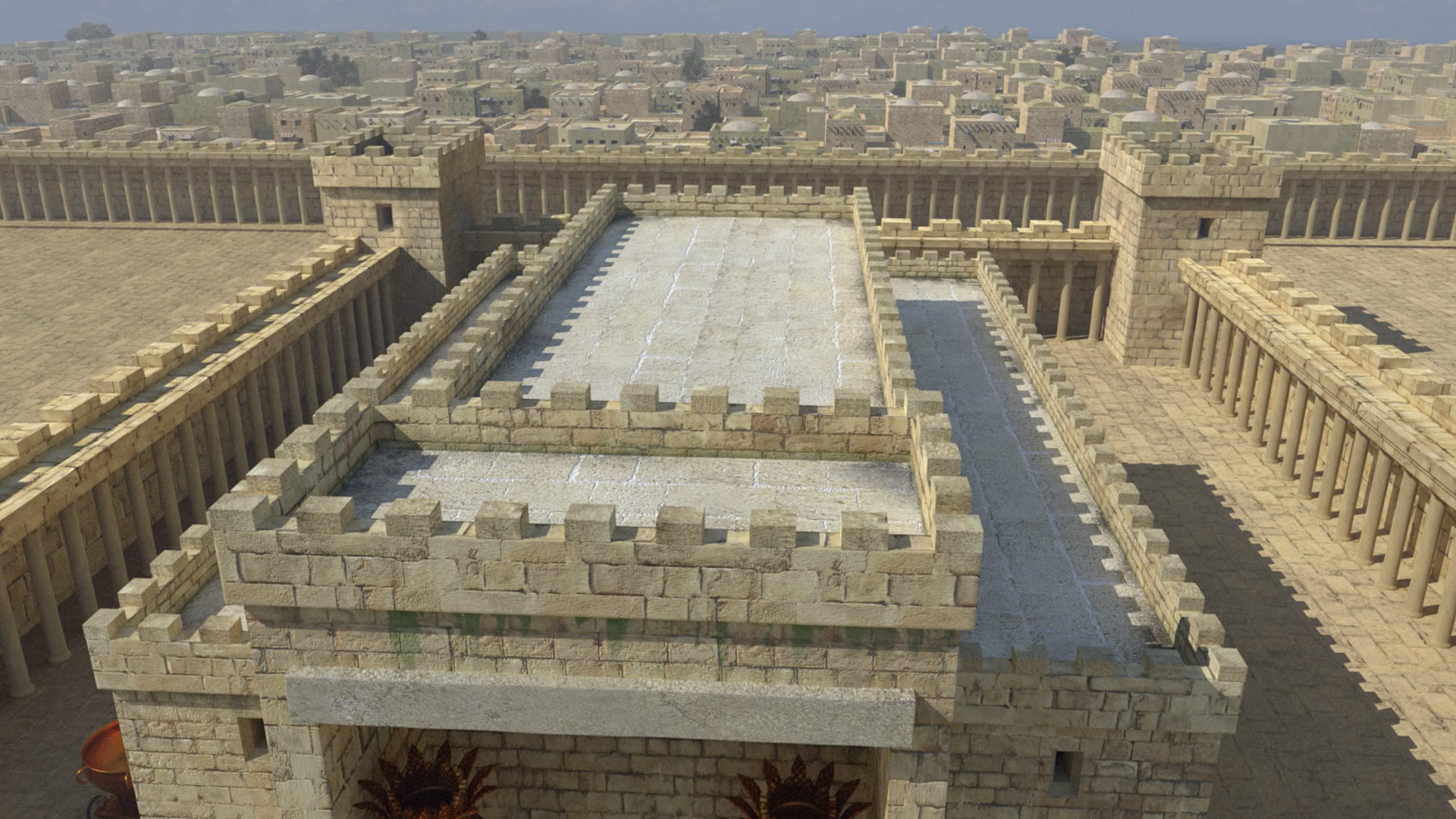
Image credit: “Solomon’s Temple (Outer)” by Jeremy Park of Bible Scenes.