
Luke 18:6-8
Narrative Lectionary
6 And the LordA said,B “ListenC
A “Lord” = Kurios. From kuros (authority, supremacy). This is a respectful address meaning master or sir. It refers to one who has control or power greater than one’s own. So, it was also applied to God and Jesus as Master or Lord.
B “said” = eiron. This is to speak say, answer, command.
C “listen” = akouo. This is hear or listen, but it also means to understand by hearing. This is where the word “acoustics” comes from.
to what the unjustD judgeE says.F
D “unjust” = adikia. From adikos (unjust, unrighteous, wicked, treacherous); {from a (not, without) + dike (the principle of justice; that which is right in a way that is very clear; a decision or the execution of that decision; originally, this word was for custom or usage; evolved to include the process of law, judicial hearing, execution of sentence, penalty, and even vengeance; more commonly, it refers to what is right); may be from deiknumi (to show, point out, exhibit; figurative for teach, demonstrate, make known)}. This is injustice, unrighteousness, of some other kind of harm or wrong. It is justice in a legal setting or a morally wrong action or character.
E “judge” = krites. 19x in NT. From krino (to judge, decide, think good, condemn, determine, pass judgment, stand trial, sue; judging whether in court or in a private setting; properly, mentally separating or distinguishing an issue – to come to a choice or decision, to judge positively or negatively in seeking what is right or wrong, who is innocent or guilty; can imply trying, condemning, punishing, or avenging). This is judge or ruler.
F “says” = lego. This is to speak, say, name, call, command. It is generally to convey verbally.
7 And will not GodG grantH justiceI to his chosenJ ones who cryK to him
G “God” = Theos. From Proto-Indo-European origins, meaning do, put, place. This is God or a god in general.
H “grant” = poieo. This is to make, do, act, construct, abide, or cause.
I “justice” = ekdikesis. Related to “unjust” in v6. 9x in NT. From ekdikeo (to defend, vindicate, dole out justice, avenge; to retaliate); from ekdikos (to avenge, enact a just punishment or judgment); {from ek (from, from out of) + dike (see note D above). This is vengeance, vindication, or punishment.
J “chosen” = eklektos. Related to “says” in v6. From eklego (to choose, select, elect); {from ek (from, from out of) + lego (see note F above)}. This is to select or choose. It is making a personal choice – a favorite.
K “cry” = boao. 12x in NT. From boe (a cry or shout). This is cry out, make a distress call, ask for desperately need assistance.
dayL and night?M Will he delay longN in helping them? 8 I tellO you, he will quicklyP grant justice to them.
L “day” = hemera. Perhaps from hemai (to sit). This is day, time, or daybreak.
M “night” = nux. This is night in a literal or figurative sense.
N “delay long” = makrothumeo. 10x in NT. From makros (long, long lasting) {from mekos (length); probably related to megas (great or large)} + thumos (passion, wrath; actions emerging from passion or impulse) {from thuo (to rush along, breathe violently, offer sacrifice)}. This is properly long tempered. It refers to one who delays anger, perseveres, or is patient. One could also say longsuffering or forbearing.
O “tell” = lego. Same as “says” in v6. See note F above.
P “quickly” = tachos. 8x in NT. From tachus (quickly, promptly; without unreasonable delay). This is quickly or immediately. It is not rushed, but as fast as is reasonable.
And yet,Q when the SonR of ManS comes,T
Q “and yet” = plen. From pleion (many, more, great, having a greater value, more excellent); from polus (much, many, abundant). This is yet, nevertheless.
R “Son” = Huios. This is son, descendant – a son whether natural born or adopted. It can be used figuratively for other forms of kinship.
S “man” = anthropos. Probably from aner (man, male, husband) + ops (eye, face); {from optanomai (to appear, be seen); perhaps from horao (become, seem, appear)}. This is human, humankind. Used for all genders.
T “comes” = erchomai. This is to come or go.
willU he findV faithW on earth?”X
U {untranslated} = ara. 18x in NT. From ara (then, since); {perhaps related to aro (to join) or from airo (raise, take up, lift, remove)}. This is a word that cannot be translated. However, it implies a question made from one who is worried or impatient. It can also be surprise or an urgent need for an answer.
V “find” = heurisko. This is to find, learn, or obtain. It is to discover something, which generally implies a period of searching for it. This is to find in a literal or figurative sense. This is where the word “heuristic” comes from.
W “faith” = pistis. From peitho (to have confidence, urge, be persuaded, agree, assure, believe, have confidence, trust). This is less about knowing, believing, and repeating a list of doctrines then it is about trusting God. Faith means listening to God and seeking to live a holy life even (and especially) when we don’t understand how everything works or fits together. Faith is about being faithful (trusting and doing) rather than being all knowing.
X “earth” = ge. This is earth, land, soil, region, country, the inhabitants of an area.
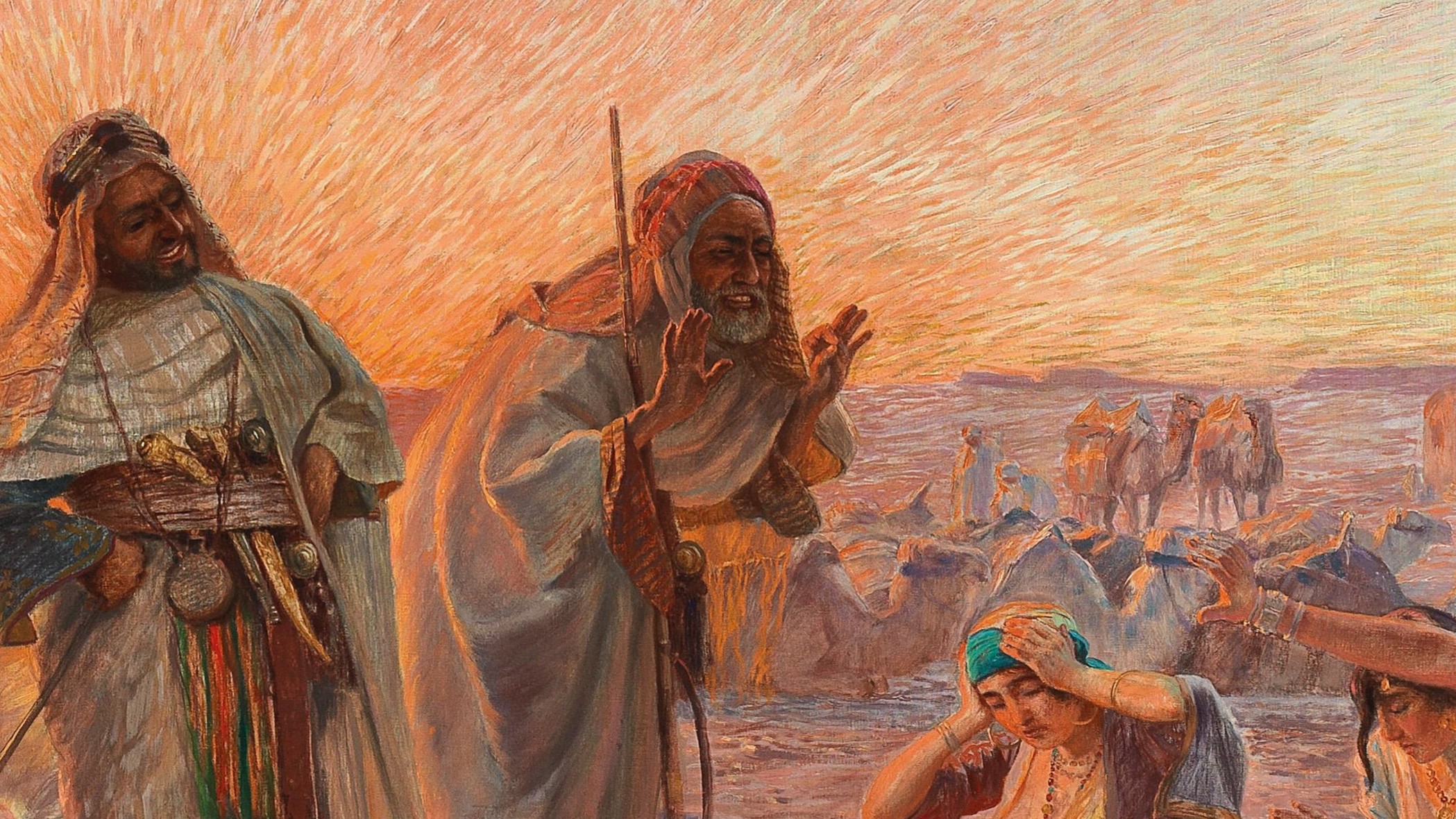
Image credit: “The Caravan Resting” by Otto Pilny, 1926.
