1 Kings 13
BibleHub
1 IA manII of GodIII cameIV out
Notes on verse 1a
I {untranslated} = hinneh. From hen (lo! Behold! If, though; an expression of surprise). This is to draw attention, show suddenness or surprise, or to emphasize the importance of the coming statement. See! Lo! Behold!
II “man” = ish. Perhaps from enosh (human, humankind, mortal); from anash (to be weak, sick, or frail). This is man, husband, another, or humankind.
III “God” = Elohim.
IV “came” = bo. This is to enter, come in, advance, fulfill, bring offerings, enter to worship, attack. It can also have a sexual connotation.
of JudahV by the wordVI of the LordVII
Notes on verse 1b
V “Judah” = Yehudah. Probably from yadah (to throw one’s hands into the air in a gesture of praise); from yad (hand). This is Judah, meaning “praised.”
VI “word” = dabar. From dabar (to speak, declare, discuss). This is speech, a word, a matter, an affair, charge, command, message, promise, purpose, report, request. It is a word, which implies things that are spoken of in a wide sense.
VII “Lord” = YHVH. From havah (to be, become) or hayah (to come to pass, become, be). This is the name of the God of Israel, the self-existent and eternal one, the tetragrammaton. This pronunciation has been lost to time so “Lord” is generally used in its place.
to Bethel,VIII while JeroboamIX was standingX
Notes on verse 1c
VIII “Bethel” = Bethel. Related to “God” in v1. From bayit (house, household, palace, dungeon); {from banah (to build, make, set up, obtain children; to build literally or figuratively)} + El (see note III above). This is Bethel, literally meaning “house of God.”
IX “Jeroboam” = Yarobam. From rabab (to be or become much or many, multiply) + am (people or nation; a tribe, troops or armies, or figuratively to refer to a flock of animals); {from amam (to darken, hide, associate; creating shadows by huddling together)} OR from rib (properly to toss or grapple; used figuratively to mean wrangling and so for arguments, complaints, or disputes; used in a legal setting for pleading or defending a case) + am (see above). This is Jeroboam, a name meaning “the people increase” or “the people will contend” or “whose people are countless.” See https://www.abarim-publications.com/Meaning/Jeroboam.html
X “standing” = amad. This is to stand up in a literal or figurative sense. So it can be establish, continue, endure, take a stand, act, be a servant, stand still, remain, stand against an enemy.
by the altarXI to offer incense.XII 2 And he cried outXIII against the altar by the word of the Lord and said,XIV
Notes on verses 1d-2a
XI “altar” = mizbeach. From zabach (to kill, slay, offer; slaughtering an animal to offer as a sacrifice). This is an altar.
XII “offer incense” = qatar. Perhaps from qetoreth (smoke, incense, the scent of the sacrifice as it burned); from the same as qitor (thick smoke, vapor). This is to make an offering, particular one of burned incense. It focuses on the fragrance made from the sacrificial fire. This is generally used to refer to worship.
XIII “cried out” = qara. This is to call or call out – to call someone by name. Also used more broadly for calling forth.
XIV “said” = amar. This is to speak, say, answer, command, promise, report.
“O altar, altar, thusXV says the Lord: XVI A sonXVII shall be bornXVIII to the houseXIX
Notes on verse 2b
XV “thus” = koh. Perhaps from ki (that, for when, certainly) + hu (he, she, it). This is like this, thus, here, now.
XVI {untranslated} = hinneh. Same as {untranslated} in v1. See note I above.
XVII “son” = ben. Related to “Bethel” in v1. From banah (see note VIII above). This is son, age, child. It is son in a literal or figurative sense.
XVIII “born” = yalad. This is to bear or bring forth. It can mean to act as midwife or to show one’s lineage. This is often used for birth or begetting.
XIX “house” = bayit. Related to “Bethel” in v1 & “son” in v2. See note VIII above.
of David,XX JosiahXXI by name,XXII
Notes on verse 2c
XX “David” = David. From the same as dod (beloved, love, uncle); the root may mean to boil, which is used figuratively to describe love. So, this implies someone you love such as a friend, a lover, or a close family member like an uncle. David’s name likely means something like “beloved one.”
XXI “Josiah” = Yoshiyyah. Related to “Lord” in v1 & related to “man” in v1. From Yah (the shortened form of the name of the God of Israel; God, Lord); {from YHVH (see note VII above)} + asheyah (buttress, pillar) OR ashuyah (foundation); {related to asheyah (see above)} + Yah (see above) OR from yaash (to be desperate, be of no use, be hopeless) + Yah (see above) OR from ashah (to support) + Yah (see above) OR from ish (see note II above) + Yah (see above) OR from ishsheh (offering by fire, burnt offering; can be any sacrifice); {from eshshah (a fire); from esh (fire, burning, flaming, hot; fire in a literal or figurative sense)} + Yah (see above). This is Josiah, meaning “the Lord supports;” “despair of the Lord,” “support of the Lord,” “woman of the Lord,” “fire offering of the Lord,” “given of the Lord,” “the Lord heals,” “the one who the Lord heals,” or “fire made by the Lord.” See https://www.abarim-publications.com/Meaning/Josiah.html
XXII “name” = shem. May be from sim (to put, place, set). This is name, fame, renown. A name was thought to indicate something essential about a person – something about their individuality. So, this word can also mean honor, authority, or character.
and he shall sacrificeXXIII on you the priestsXXIV of the high placesXXV who offer incense on you, and humanXXVI bonesXXVII shall be burnedXXVIII on you.”
Notes on verse 2d
XXIII “sacrifice” = zabach. Related to “altar” in v1. See note XI above.
XXIV “priests” = kohen. This is literally the one who officiates i.e. the priest. This is where the Jewish last name “Cohen” (and its variants) comes from.
XXV “high places” = bamah. The root might mean being high. This is height, wave, or elevation.
XXVI “human” = adam. Perhaps from adam (to be red, make ruddy); related to adamah (ground, dirt, earth). This is man, humankind, also Adam’s name. It refers to a human individual or humanity.
XXVII “bones” = etsem. From atsam (vast, numerous, strong; to close one’s eyes, to make powerful; to break bones). This is self, life, strength, bone, or substance.
XXVIII “burned” = saraph. This is to burn or kindle. This is the root that “seraphim” comes from.
3 He gaveXXIX a signXXX the same day,XXXI saying, “This is the sign that the Lord has spoken:XXXII
Notes on verse 3a
XXIX “gave” = natan. This is to give, put, set, offer. It is to give literally or figuratively.
XXX “sign” = mophet. Perhaps from yaphah (to be beautiful, decorate; root means being bright, which implies being beautiful). This is a wonder, miracle, symbol, sign, or omen.
XXXI “day” = yom. Root may mean being hot. This is the day in a literal or figurative sense. It can also mean birth, age, daylight, continually or other references to time.
XXXII “spoken” = dabar. Related to “word” in v1. See note VI above.
XXXIIIThe altar shall be torn down,XXXIV and the ashesXXXV that are on it shall be poured out.”XXXVI
Notes on verse 3b
XXXIII {untranslated} = hinneh. Same as {untranslated} in v1. See note I above.
XXXIV “torn down” = qara. This is to tear or cut out in a literal or figurative sense. It can also be to revile or to apply eye make up – as though they are made to look larger.
XXXV “ashes” = deshen. 15x in OT. From dashen (to be fat, become greasy, be anointed or prosperous; can also mean to remove ashes from the fat offered for sacrifice). This is the ashes from that fat, fatness more broadly speaking, or, figuratively abundance.
XXXVI “poured out” = shaphak. This is to pour out, gust, or slip. It can be to pour as blood, a drink offering, or molten metal. It can also mean to create a mound. Figuratively, it can refer to killing, or spending money.
4 XXXVIIWhen the kingXXXVIII heardXXXIX whatXL the man of God cried out against the altar at Bethel, Jeroboam stretched outXLI his handXLII from the altar,
Notes on verse 4a
XXXVII {untranslated} = hayah. Related to “Lord” in v1 & “Josiah” in v2. See note VII above.
XXXVIII “king” = melek. From malak (to be or become king or queen, to rise to the throne, to be crowned; by implication, to take counsel). This is king or royal.
XXXIX “heard” = shama. This is to hear, call, consent, or consider. It implies listening intelligently, giving attention, and, because of these two factors, obedience and action are often implied.
XL “what” = dabar. Same as “word” in v1. See note VI above.
XLI “stretched out” = shalach. This is to send out, away, send for, forsake. It can also mean to divorce or set a slave free.
XLII “hand” = yad. This is hand, ability, power. Hand in a literal sense, but also what one can do or the means by which one does it.
saying, “SeizeXLIII him!”
But the hand that he stretched out against him witheredXLIV so that he couldXLV not draw it backXLVI to himself. 5 The altar also was torn down, and the ashes poured out from the altar, according to the sign that the man of God had given by the word of the Lord.
Notes on verses 4b-5
XLIII “seize” = taphas. This is to catch, seize, wield, capture. It can also mean to use unwarrantably.
XLIV “withered” = yabesh. This is to be dry, withered, confused, or ashamed. It can also be to fail.
XLV “could” = yakol. This is to be able, endure, overcome, prevail.
XLVI “draw…back” = shub. To turn back, return, turn away – literally or figuratively. Doesn’t necessarily imply going back to where you started from. This is also the root verb for the Hebrew word for repentance “teshubah.”
6 The king saidXLVII to the man of God,XLVIII “EntreatXLIX nowL
Notes on verse 6a
XLVII “said” = anah. This is answer, respond, announce, sing, shout, or testify. It means to pay attention, which implies responding and, by extension, starting to talk. Used in a specific sense for singing, shouting, testifying, etc.
XLVIII {untranslated} = amar. Same as “said” in v2. See note XIV above.
XLIX “entreat” = chalah. Properly, this is to be worn; hence, being weak, sick, or afflicted. It can also mean to grieve or, positively, to flatter or entreat.
L “now” = na. This particle is used for requests or for urging. It can be we pray, now, I ask you, oh. This is the same “na” in “hosanna.”
the favorLI of the Lord your God, and prayLII forLIII me, so that my hand may be restoredLIV to me.”
Notes on verse 6b
LI “favor” = paneh. From panah (to turn, face, appear). This is face in a literal or figurative sense. It could be face, presence, anger, respect. It can also be used of God to indicate divine favor or presence.
LII “pray” = palal. This is to judge for oneself or in an official capacity. It can also mean to pray or make supplication, to entreat.
LIII “for” = baad. Perhaps from ad (up to, while); from adah (to pass on, advance, decorate oneself). This is up to, behind, over, among.
LIV “restored” = shub. Same as “draw…back” in v4. See note XLVI above.
So the man of God entreated theLV Lord, and the king’s hand was restored to him and becameLVI as it was before.LVII
7 Then the king saidLVIII to the man of God, “Come homeLIX with me and dine,LX and I will give you a gift.”LXI
Notes on verses 6c-7
LV {untranslated} = paneh. Same as “favor” in v6. See note LI above.
LVI “became” = hayah. Same as {untranslated} in v4. See note XXXVII above.
LVII “before” = rishon. From rishah (beginning or early time); from rosh (head, captain, or chief; excellent or the forefront; first in position or in statue or in time). This is first, former, ancestor, beginning, ranked first.
LVIII “said” = dabar. Same as “spoken” in v3. See note XXXII above.
LIX “home” = bayit. Same as “house” in v2. See note XIX above.
LX “dine” = saad. 12x in OT. This is to support – usually used in a figurative sense. So it is sustain, hold, refresh, comfort, establish.
LXI “gift” = mattath. Related to “gave” in v3. 6x in OT. From mattan (gift, reward; to give); from natan (see note XXIX above). This is gift, reward, present.
8 But the man of God saidLXII to the king, “If you give me halfLXIII your kingdom,LXIV I will not go inLXV with you, nor will I eatLXVI foodLXVII
Notes on verse 8a
LXII “said” = amar. Same as “said” in v2. See note XIV above.
LXIII “half” = chatsi. From chatsah (to halve, divide, reach, participate). This is half, middle, midnight, midst.
LXIV “kingdom” = bayit. Same as “house” in v2. See note XIX above.
LXV “go in” = bo. Same as “came” in v1. See note IV above.
LXVI “eat” = akal. This is to eat, devour, burn up, or otherwise consume. It can be eating in a literal or figurative sense.
LXVII “food” = lechem. From lacham (to eat, feed on). This is bread, food, loaf. It can refer to food more generally for people or for animals.
or drinkLXVIII waterLXIX in this place.LXX
Notes on verse 8b
LXVIII “drink” = shathah. This is to drink literally or figuratively. It could also be a drinker.
LXIX “water” = mayim. This is water, waters, or waterway in a general sense. Figuratively, it can also mean juice, urine, or semen.
LXX “place” = maqom. From qum (to arise, stand, accomplish, establish, abide; rising against, getting up after being sick or asleep, arising from one state to another, becoming powerful, or rising for action; standing in a figurative sense). This is a standing, which is to say a spot or space a place. It can also refer to a locality or a physical/mental condition. HaMaqom is also a Jewish name for God – the place, i.e. the Omnipresent One.
9 For thusLXXI I was commandedLXXII by the word of the Lord:LXXIII
Notes on verse 9a
LXXI “thus” = ken. Perhaps from kun (properly, in a perpendicular position; literally, to establish, fix, fasten, prepare; figuratively, it is certainty, to be firm, faithfulness, render sure or prosperous). This is to set upright. Generally used figuratively to mean thus, so, afterwards, rightly so.
LXXII “commanded” = tsavah. This is to charge, command, order, appoint, or enjoin. This is the root that the Hebrew word for “commandment” comes from (mitsvah).
LXXIII {untranslated} = amar. Same as “said” in v2. See note XIV above.
‘You shall not eat food, or drink water, or returnLXXIV by the wayLXXV that you came.’”LXXVI
10 So he wentLXXVII anotherLXXVIII way and did not return by the way that he had comeLXXIX to Bethel.
Notes on verses 9b-10
LXXIV “return” = shub. Same as “draw…back” in v4. See note XLVI above.
LXXV “way” = derek. From darak (to tread, march, to walk. Can also mean affixing a string to a box since one needs to step on it to bend it in the process; so also an archer). This is a road as a thing that is walked on. Can be used figuratively for the path that one’s life takes or how one chooses to live one’s life.
LXXVI “came” = halak. This is go, come, walk. It is walk literally and figuratively and includes people and animals. It can be used figuratively for one’s moral life – how we walk according to God’s way or against it. It can also refer to the walk of life as in the course one’s life takes, the choices we make, etc.
LXXVII “went” = halak. Same as “came” in v9. See note LXXVI above.
LXXVIII “another” = acher. From achar (to be behind, delay, be late, procrastinate, continue). This is following, next, strange, other.
LXXIX “come” = bo. Same as “came” in v1. See note IV above.
11 Now there livedLXXX anLXXXI oldLXXXII prophetLXXXIII in Bethel.
Notes on verse 11a
LXXX “lived” = yashab. This is to sit and so to remain and so to dwell. It is sitting for any reason – as a judge, in order to ambush, or just sitting quietly. Causatively, this can mean settling or marrying. This can also mean continue, endure, or establish.
LXXXI “an” = echad. Perhaps from achad (to unify, continue on a path; figuratively, to gather one’s thoughts). This is the number one, first, united. It can also be alone, altogether, a certain, a few.
LXXXII “old” = zaqen. From the same as zaqan (beard or chin – the beard represents old age). This is old, aged, or elder.
LXXXIII “prophet” = nabi. This is prophet, prophecy, speaker, or someone inspired.
One of his sons cameLXXXIV and toldLXXXV him allLXXXVI LXXXVIIthat the man of God had doneLXXXVIII that day in Bethel; the words also that he had spoken to the king, they told to their father.LXXXIX
Notes on verse 11b
LXXXIV “came” = bo. Same as “came” in v1. See note IV above.
LXXXV “told” = saphar. From sepher (writing, document, book, evidence). This is properly to tally or record something. It can be enumerate, recount, number, celebrate, or declare.
LXXXVI “all” = kol. From kalal (to complete). This is all or every.
LXXXVII {untranslated} = maaseh. From asah (to do, make, accomplish, become). This is a work – any action whether positive or negative. It can also be a transaction, construction, activity, property, or something that is produced.
LXXXVIII “done” = asah. Related to {untranslated} in v11. See note LXXXVII above.
LXXXIX “father” = ab. This is father, chief, or ancestor. It is father in a literal or figurative sense.
12 Their father saidXC to them, “Which way did he go?”XCI And his sons showedXCII him the way that the man of God who cameXCIII from Judah had gone.XCIV
Notes on verse 12
XC “said” = dabar. Same as “spoken” in v3. See note XXXII above.
XCI “go” = halak. Same as “came” in v9. See note LXXVI above.
XCII “showed” = raah. This is to see in a literal or figurative sense so stare, advise, think, view.
XCIII “came” = bo. Same as “came” in v1. See note IV above.
XCIV “gone” = halak. Same as “came” in v9. See note LXXVI above.
13 Then he saidXCV to his sons, “SaddleXCVI a donkeyXCVII for me.” So they saddled a donkey for him, and he mountedXCVIII it.
Notes on verse 13
XCV “said” = amar. Same as “said” in v2. See note XIV above.
XCVI “saddle” = chabash. This is to wrap tightly or bind, to bandage, or heal. It can be to saddle an animal or wrap a turban. Figuratively, it can mean to stop or to govern.
XCVII “donkey” = chamor. From chamar (to be red, blush). This is a male donkey.
XCVIII “mounted” = rakab. This is to ride an animal or in some vehicle. It can also mean bringing on a horse.
14 He wentXCIX afterC the man of God and foundCI him sittingCII
Notes on verse 14a
XCIX “went” = halak. Same as “came” in v9. See note LXXVI above.
C “after” = achar. Related to “another” in v10. From achar (see note LXXVIII above). This is after or the last part, following.
CI “found” = matsa. This is to find, catch or acquire. It can also mean to come forth or appear. Figuratively, this can mean to meet or be together with.
CII “sitting” = yashab. Same as “lived” in v11. See note LXXX above.
underCIII an oak tree.CIV He saidCV to him, “Are you the man of God who cameCVI from Judah?”
He answered,CVII “I am.”
Notes on verse 14b
CIII “under” = tachat. This is underneath, below, the bottom, instead of.
CIV “oak tree” = elah. 13x in OT. From ayil (terebinth, oak); from the same as ulam (porch, hall); from the same as ul (mighty, strength, body, belly; root may mean to twist and that implies strength and power). This is an oak or terebinth. It could some other kind of tree that is strong.
CV “said” = amar. Same as “said” in v2. See note XIV above.
CVI “came” = bo. Same as “came” in v1. See note IV above.
CVII “answered” = amar. Same as “said” in v2. See note XIV above.
15 Then he saidCVIII to him, “ComeCIX home with me and eat some food.”
16 But he said,CX “I cannotCXI return with you or go inCXII with you, nor will I eat food or drink water with you in this place,
Notes on verses 15-16
CVIII “said” = amar. Same as “said” in v2. See note XIV above.
CIX “come” = halak. Same as “came” in v9. See note LXXVI above.
CX “said” = amar. Same as “said” in v2. See note XIV above.
CXI “cannot” = lo + yakol. Yakol is the same as “could” in v4. See note XLV above.
CXII “go in” = bo. Same as “came” in v1. See note IV above.
17 for it was saidCXIII to me by the word of the Lord, ‘You shall not eat food or drink water there or return CXIVby the way that you came.’”CXV
18 Then the otherCXVI saidCXVII to him, “I also am a prophet as you are,
Notes on verses 17-18a
CXIII “said” = dabar. Same as “spoken” in v3. See note XXXII above.
CXIV {untranslated} = halak. Same as “came” in v9. See note LXXVI above.
CXV “came” = halak. Same as “came” in v9. See note LXXVI above.
CXVI “other” = gam. This is also, moreover, again.
CXVII “said” = amar. Same as “said” in v2. See note XIV above.
and an angelCXVIII spoke to me by the word of the Lord,CXIX ‘Bring him backCXX with you into your house so that he may eat food and drink water.’” But he was deceivingCXXI him. 19 Then the man of God went backCXXII with him and ate food and drank water in his house.
Notes on verses 18b-19
CXVIII “angel” = malak. This is a messenger, an angel, or a deputy of some kind. Can be used for human messengers literally or for prophets, priests, or teachers as messengers of God. Also used for supernatural messengers i.e. angels.
CXIX {untranslated} = amar. Same as “said” in v2. See note XIV above.
CXX “bring…back” = shub. Same as “draw…back” in v4. See note XLVI above.
CXXI “deceiving” = kachash. This is deceive, fail, or deny. It can be lying or disappointing. It can also mean becoming lean or cringe.
CXXII “went back” = shub. Same as “draw…back” in v4. See note XLVI above.
20 CXXIIIAs they were sitting at the table,CXXIV the word of the Lord cameCXXV to the prophet who had brought him back, 21 and he cried out to the man of God who cameCXXVI from Judah,CXXVII “ThusCXXVIII saysCXXIX the Lord:
Notes on verses 20-21a
CXXIII {untranslated} = hayah. Same as {untranslated} in v4. See note XXXVII above.
CXXIV “table” = shulchan. Related to “stretched out” in v4. Perhaps from shalach (see note XLI above). This is a table or meal.
CXXV “came” = hayah. Same as {untranslated} in v4. See note XXXVII above.
CXXVI “came” = bo. Same as “came” in v1. See note IV above.
CXXVII {untranslated} = amar. Same as “said” in v2. See note XIV above.
CXXVIII “thus” = koh. Same as “thus” in v2. See note XV above.
CXXIX “says” = amar. Same as “said” in v2. See note XIV above.
BecauseCXXX you have disobeyedCXXXI the wordCXXXII of the Lord and have not keptCXXXIII the commandmentCXXXIV that the Lord your God commanded you
Notes on verse 21b
CXXX “because” = yaan. Related to “said” in v6. From anah (see note XLVII above). This is because, since, for the sake of, giving a reason.
CXXXI “disobeyed” = marah. This is to be contentious, rebellious, bitter, provoking, disobedient. It can be to be or make bitter or unpleasant. Figuratively, it is to rebel or resist and causatively to provoke. This is the root of “Miriam.”
CXXXII “word” = peh. This is mouth in a literal or figurative sense. So, more literally, it can be beak or jaws. More figuratively, it refers to speech, commands, or promises.
CXXXIII “kept” = shamar. This is to keep, watch, or preserve. It means to guard something or to protect it as a thorny hedge protects something.
CXXXIV “commandment” = mitsvah. Related to “commanded” in v9. From tsavah (see note LXXII above). This is a commandment, law, ordinance obligation, or tradition. It is something commanded whether by God or by a human authority. This term is sometimes used collectively to refer to the Law.
22 but have come backCXXXV and have eaten food and drunk water in the place of which he saidCXXXVI to you, ‘Eat no food, and drink no water,’ your bodyCXXXVII shall not comeCXXXVIII to your ancestralCXXXIX tomb.”CXL
Notes on verse 22
CXXXV “come back” = shub. Same as “draw…back” in v4. See note XLVI above.
CXXXVI “said” = dabar. Same as “spoken” in v3. See note XXXII above.
CXXXVII “body” = nebelah. From nabel (to fall away, faint, wither, languish, sink; figuratively, being senseless, foolish, or wicked; to despise, disgrace, or fall to nothing, to be seen with contempt). This is a body, whether human or animal. It can also refer to an idol.
CXXXVIII “come” = bo. Same as “came” in v1. See note IV above.
CXXXIX “ancestral” = ab. Same as “father” in v11. See note LXXXIX above.
CXL “tomb” = qeber. From qabar (to bury). This is a place where one is buried such as a grave or tomb.
23 CXLIAfter the man of God had eaten food andCXLII had drunk, they saddled for him a donkey belonging to the prophet who had brought him back. 24 Then as he went away,CXLIII a lionCXLIV metCXLV him
Notes on verses 23-24a
CXLI {untranslated} = hayah. Same as {untranslated} in v4. See note XXXVII above.
CXLII {untranslated} = achar. Same as “after” in v14. See note C above.
CXLIII “went away” = halak. Same as “came” in v9. See note LXXVI above.
CXLIV “lion” = ari. From arah (to gather or pluck). This is a young lion.
CXLV “met” = matsa. Same as “found” in v14. See note CI above.
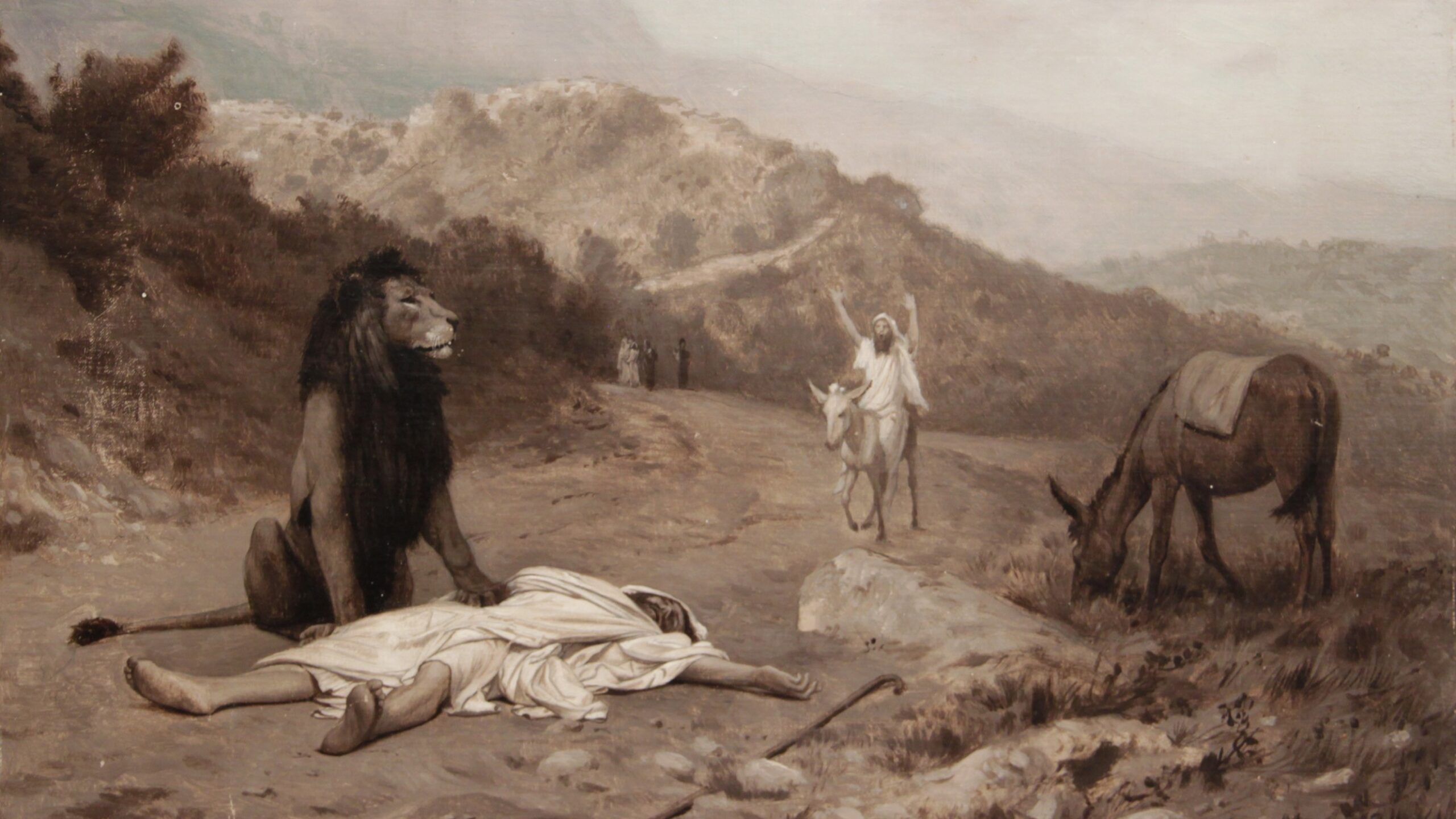
on the roadCXLVI and killedCXLVII him. His body wasCXLVIII thrownCXLIX in the road, and the donkey stood besideCL it; the lion also stood beside the body.
Notes on verse 24b
CXLVI “road” = derek. Same as “way” in v9. See note LXXV above.
CXLVII “killed” = mut. This is to die in a literal or figurative sense. It can also refer to being a dead body.
CXLVIII “was” = hayah. Same as {untranslated} in v4. See note XXXVII above.
CXLIX “thrown” = shalak. This is to throw, fling, or hurl. It can also be to throw away in a literal or figurative sense.
CL “beside” = etsel. From atsal (to reserve, refuse, join, separate, keep). This is nearby, toward, joining.
25 CLIPeopleCLII passed byCLIII and sawCLIV the body thrown in the road,
Notes on verse 25a
CLI {untranslated} = hinneh. Same as {untranslated} in v1. See note I above.
CLII “people” = ish. Same as “man” in v1. See note II above.
CLIII “passed by” = abar. This is to pass over or cross over. It is used for transitions, whether literal or figurative. It can also mean to escape, alienate, or fail. This is the root verb from which “Hebrew” is drawn.
CLIV “saw” = raah. Same as “showed” in v12. See note XCII above.
with the lion standing byCLV the body. And they cameCLVI and toldCLVII it in the townCLVIII where the old prophet lived.
Notes on verse 25b
CLV “by” = etsel. Same as “beside” in v24. See note CL above.
CLVI “came” = bo. Same as “came” in v1. See note IV above.
CLVII “told” = dabar. Same as “spoken” in v3. See note XXXII above.
CLVIII “town” = iyr. From uwr (to awaken or wake oneself up). This can mean excitement in the sense of wakefulness or city. Properly, this is a place that is guarded. Guards kept schedules according to watches. This sense of the word would include cities as well as encampments or posts that were guarded.
26 When the prophet who had brought him back from the way heard of it, he said,CLIX “It is the man of God who disobeyed the wordCLX of the Lord; therefore the Lord has given him to the lion, which has tornCLXI him and killed him according to the wordCLXII that the Lord spokeCLXIII to him.”
27 Then he saidCLXIV to his sons,CLXV “Saddle a donkey for me.” So they saddled one,
Notes on verses 26-27
CLIX “said” = amar. Same as “said” in v2. See note XIV above.
CLX “word” = peh. Same as “word” in v21. See note CXXXII above.
CLXI “torn” = shabar. This is break, collapse, destroy, break in pieces, tear. It is bursting in a literal or figurative sense.
CLXII “word” = dabar. Same as “word” in v1. See note VI above.
CLXIII “spoke” = dabar. Same as “spoken” in v3. See note XXXII above.
CLXIV “said” = dabar. Same as “spoken” in v3. See note XXXII above.
CLXV {untranslated} = amar. Same as “said” in v2. See note XIV above.
28 and he wentCLXVI and found the body thrown in the road, with the donkey and the lion standing beside the body. The lion had not eaten the body or attackedCLXVII the donkey. 29 The prophet took upCLXVIII the body of the man of God, laidCLXIX it on the donkey,
Notes on verses 28-29a
CLXVI “went” = halak. Same as “came” in v9. See note LXXVI above.
CLXVII “attacked” = shabar. Same as “torn” in v26. See note CLXI above.
CLXVIII “took up” = nasa. This is to lift in a broad sense, literally and figuratively. So it could be to carry, take, or arise. It could also be bring forth, advance, accept.
CLXIX “laid” = nuach. This is to rest, calm, camp, free, place, remain, satisfy, settle, station, or wait. It is rest and so implies settling down in a literal or figurative sense. This is perhaps the root verb of the name “Noah.”
and brought it back toCLXX the cityCLXXI, CLXXII to mournCLXXIII and to buryCLXXIV him.
Notes on verse 29b
CLXX {untranslated} = bo. Same as “came” in v1. See note IV above.
CLXXI “city” = iyr. Same as “town” in v25. See note CLVIII above.
CLXXII {untranslated} = nabi + zaqen. Literally, “old prophet.” Nabi is the same as “prophet” in v11. See note LXXXIII above. Zaqen is the same as “old” in v11. See note LXXXII above.
CLXXIII “mourn” = saphad. This is to wail, mourn. Properly, it is lamenting by tearing one’s hair and beating one’s chest. It implies wailing.
CLXXIV “bury” = qabar. Related to “tomb” in v22. See note CXL above.
30 He laid the body in his own grave,CLXXV and they mourned over him, saying, “Alas,CLXXVI my brother!”CLXXVII
Notes on verse 30
CLXXV “grave” = qeber. Same as “tomb” in v22. See note CXL above.
CLXXVI “alas” = hoy. Perhaps from ho (ah, alas); from hahh (alas, used for grief or woe); from ahahh (alas or ah, used to express pain). This is meant to be onomatopoeia – ah, O, alas, woe. Perhaps where the Yiddish “oy” comes from.
CLXXVII “brother” = ach. This is brother, kindred, another, other, like. It is literally brother, but it can also be someone who is similar, resembling, or related to.
31 CLXXVIIIAfter he had buried him, he saidCLXXIX to his sons,CLXXX “When I die,CLXXXI bury me in the grave in which the man of God is buried; lay my bones beside his bones.
Notes on verse 31
CLXXVIII {untranslated} = hayah. Same as {untranslated} in v4. See note XXXVII above.
CLXXIX “said” = amar. Same as “said” in v2. See note XIV above.
CLXXX {untranslated} = amar. Same as “said” in v2. See note XIV above.
CLXXXI “die” = mut. Same as “killed” in v24. See note CXLVII above.
32 For the saying that he proclaimedCLXXXII by the wordCLXXXIII of the Lord against the altar in Bethel and against all the houses of the high places that are in the cities of SamariaCLXXXIV shall surely come to pass.”CLXXXV
Notes on verse 32
CLXXXII “proclaimed” = qara + dabar. Qara is the same as “cried out” in v2. See note XIII above. Dabar is the same as “word” in v1. See note VI above.
CLXXXIII “word” = dabar. Same as “word” in v1. See note VI above.
CLXXXIV “Samaria” = Shomron. Related to “kept” in v21. From shamar (see note CXXXIII above). This is Samaria, meaning watch station.
CLXXXV “surely come to pass” = hayah + hayah. Same as {untranslated} in v4. See note XXXVII above. The word is repeated twice – the first time as an Infinitive Absolute. The Infinitive Absolute serves to emphasize the sentiment of the word. It is rather like Foghorn Leghorn’s speech pattern, “I said, I said.”
33 Even after this eventCLXXXVI Jeroboam did not turnCLXXXVII from his evilCLXXXVIII way
Notes on verse 33a
CLXXXVI “event” = dabar. Same as “word” in v1. See note VI above.
CLXXXVII “turn” = shub. Same as “draw…back” in v4. See note XLVI above.
CLXXXVIII “evil” = ra’. From ra’a’ (to be evil, bad, afflict; properly, to spoil – to destroy by breaking into pieces; figuratively, to cause something to be worthless; this is bad in a physical, social, or moral sense; that which displeases, to do harm or mischief, to punish or vex). This is bad, disagreeable, that which causes pain, misery, something having little or no value, something that is ethically bad, wicked, injury, calamity. This refers to anything that is not what it ought to be – a natural disaster, a disfigurement, an injury, a sin.
butCLXXXIX madeCXC priests for the high places again from amongCXCI all the people;CXCII
Notes on verse 33b
CLXXXIX {untranslated} = shub. Same as “draw…back” in v4. See note XLVI above.
CXC “made” = asah. Same as “done” in v11. See note LXXXVIII above.
CXCI “among” = qatsah. From qatseh (end, brink, border, edge, frontier; that which is within set boundaries); from qatsah (to cut off, cut short; figuratively, to destroy). This is an end, corner, outer limit, coast, corner, fringe.
CXCII “people”” = am. Related to “Jeroboam” in v1. See note IX above.
any who wantedCXCIII to be priests he consecratedCXCIV for the high places. 34 This matterCXCV became sinCXCVI to the house of Jeroboam,
Notes on verses 33c-34a
CXCIII “any who wanted” = chaphets. 11x in OT. From chaphets (properly, inclined towards or bending to; figuratively, to desire, delight in, or be pleased with). This is to delight in, desire, or show favor.
CXCIV “consecrated” = male + et + yad. Male is fill, satisfy, replenish, accomplish, fulfill, confirm, or consecrate. It is fill in a literal or figurative sense. Yad is the same as “hand” in v4. See note XLII above.
CXCV “matter” = dabar. Same as “word” in v1. See note VI above.
CXCVI “sin” = chatta’ah. From chata’ (to miss or go wrong and so to sin, bear the blame; it can also include the sense of forfeiting or lacking). This is sin itself as well as punishment for sin. It is sometimes used specifically to refer to sin that is habitual.
so as to cut it offCXCVII and to destroyCXCVIII it from the faceCXCIX of the earth.CC
Notes on verse 34b
CXCVII “cut…off” = kachad. This is to hide or conceal or destroy. It can also refer to doing secret actions or secret speech.
CXCVIII “destroy” = shamad. This is to demolish, destroy, perish, overthrow, pluck down.
CXCIX “face” = paneh. Same as “favor” in v6. See note LI above.
CC “earth” = adamah. Related to “human” in v2. See note XXVI above.
Image credit: “The Disobedient Prophet” by Jean-Léon Gérôme, c. 1895.