
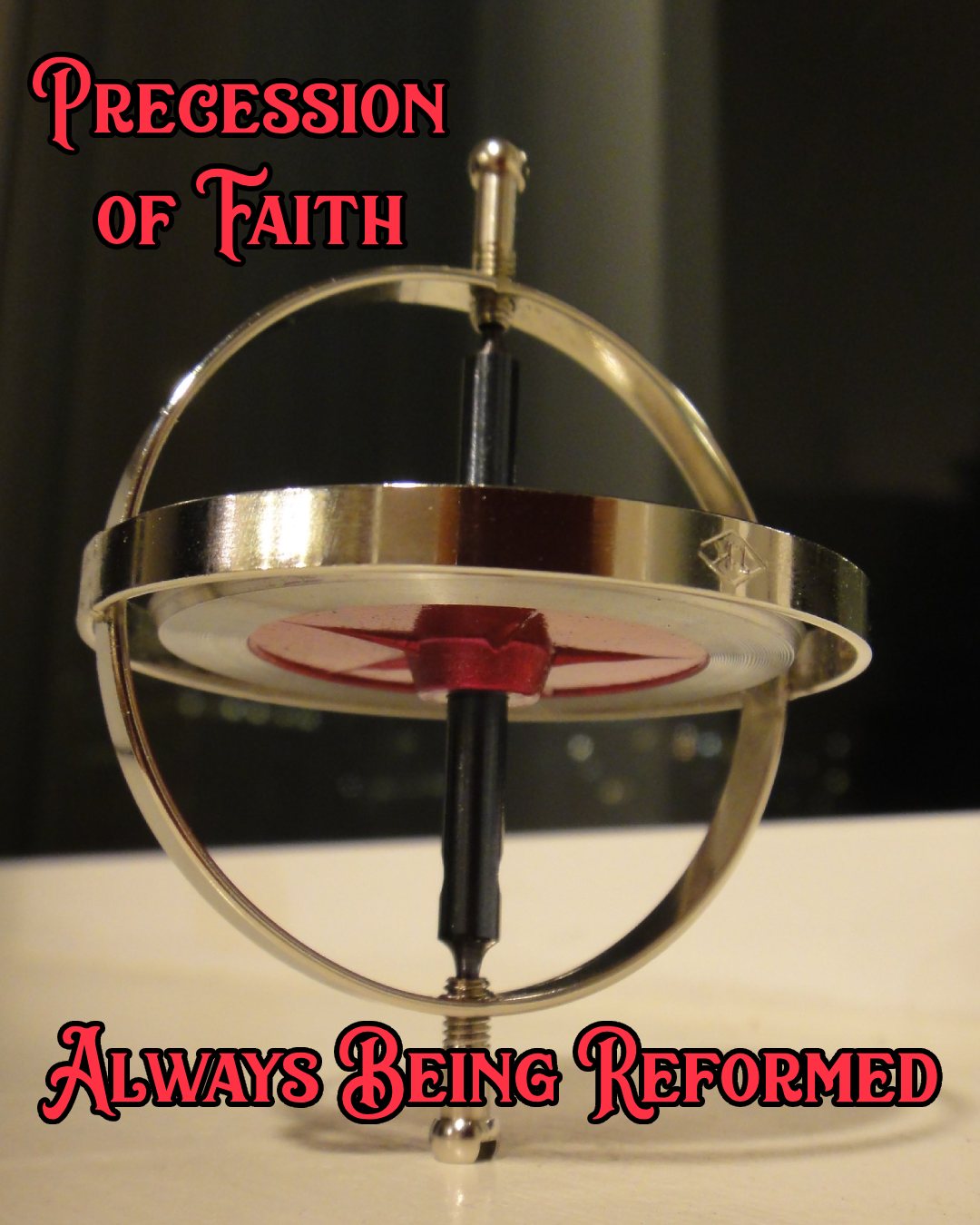
A gyroscope is a neat tool to demonstrate some physical properties that we don’t often think about. When we spin things, whether tops, dreidels, or bicycle wheels, that spinning creates angular momentum — a sort of inertia, constantly turning around an axis. Because of that angular momentum, if you push a spinning gyroscope, it doesn’t fall over. Instead, it turns at a right angle to the push, and its axis slowly sweeps around in a circle.
https://www.instagram.com/reel/DWZPUs0ApTh
(Of course, if you forget to push it, or it runs into a wall, it looks more like this:)
The slow, sweeping turn is called “precession.” (Aha! You see, I did not misspell the title of this post!) But what does precession have to do with faith? That’s what we’re going to unpack today. But first, a little history!
Every year, on the last Sunday in October, many Protestant churches celebrate Reformation Sunday. On October 31, 1517, Martin Luther nailed his 95 statements (“theses”) to the door of the Wittenberg Cathedral. Nailing statements to the door was not common practice, but it was a great way to get people to read them and talk about them in an era before gyroscope videos were shared online.
Always Being Reformed
In the Reformed tradition (of which Presbyterians are a major part!), we honor and remember the process of reformation as an ongoing process. One of the mottos that guide us is based on a sermon by the Dutch pastor, Jodocus van Lodenstein, who wrote that he wished the church would not be called reformata (reformed) but reformanda (being reformed). From this emerged ecclesia reformata, semper reformanda, secundum verbum Dei – “The church reformed and always being reformed, according to the word of God.”
It’s that always being reformed bit that often gets lost in the shuffle. For a few centuries, people like Hus, Luther, Calvin, Knox, Zwingli, and Bullinger wrote and debated theology, shaping the way the Evangelical (Lutheran) and Reformed (Calvinist) churches would take form. Reformation was messy, it was exciting, and it was alive with possibility. But once the Scots and Westminster Confessions took form, the energy around always being reformed cooled off for a while. Presbyterians in the newly-minted United States advocated for subscription to the Westminster Confession as a way of maintaining theological orthodoxy and purity. Verbal and written battles between subscriptionists and anti-subscriptionists were fierce, with ministers caught in the middle forced to admit to “scruples” with phrases in the Westminster Confession in order to be accepted into ministry. By the late 1800s, some pastors had more scruples than they did subscriptions!
Fortunately, the 20th century brought a great deal of reformation, both in the church and in the world. We discovered that trying to remain rigid in theological interpretation could not work in the rapidly changing world.
This is because faith is not a static, unchanging thing, but is best understood as being constantly in motion.
God Keeps us Spinning
The early church had a word for the life of God: perichoresis, the persons of the Trinity making room for one another, moving in and through one another. Some described it as a dance. (The Greek is closer to choreo, to move around than to choreuo, to dance. But they’re close enough for either image to work). This movement, this life of the Trinity can be thought of as what keeps us alive, too – a bit like the spinning center of the gyroscope.
If you think that’s a stretch, let’s take a look at some scriptural and traditional precedents!
In the traditional reading of the Apostles’ Creed, we say that Jesus “will come to judge the quick and the dead.” Quick (and quickening) were older English words for life, because movement was understood to be evidence of life. In Ezekiel’s vision of the valley of dry bones, God provides flesh and structure to the bones, but it isn’t until God breathes on them that they move and have life. The last verse of the book of Psalms (150:6) reads “Let all that has breath praise the Lord! Praise the Lord!” in most older translations, while newer ones say “Let all living things praise the Lord!”
Movement is life. Breath is movement. Let all that breathes, all that lives, praise the Lord!
At our core, then, is the spinning of life. Breathing in, breathing out. Inspiration and… well, we’ll deal with expiration later. But an interesting facet of spinning is that, if you want a clear view of the thing that is spinning, you have to join the spin yourself. Likewise, the movement of the Trinity, the life of God, Christ, and Spirit, is what lives and breathes and moves within us. It is the core of our life, the core of our faith, the very center of our being. When we follow that movement, we are ever more stable, and when we try to resist it, we find ourselves wobbling — but never falling away.
One way to think of this is like spinning a top. If you just drop a top without spinning it, what happens? Unless your dropping it onto something soft, it will just fall over. It needs the spin in order to stay upright. We’re the same way. If we stop moving completely, it is a form of death. Fortunately, some good news: we’re not the ones keeping the spin going! God is. And even when we rest, the Spirit keeps turning within us!
A gyroscope is like a top spinning inside a cage. If that spin stops, it can be twisted and turned by whatever outside force is acting on it. But say you want to keep a spinless gyroscope steady. What could you do to keep it standing upright? Well, you could weld or bolt it in place. Then, yes, it will certainly resist outside forces, but it may reach a breaking point, and cease to work at all!
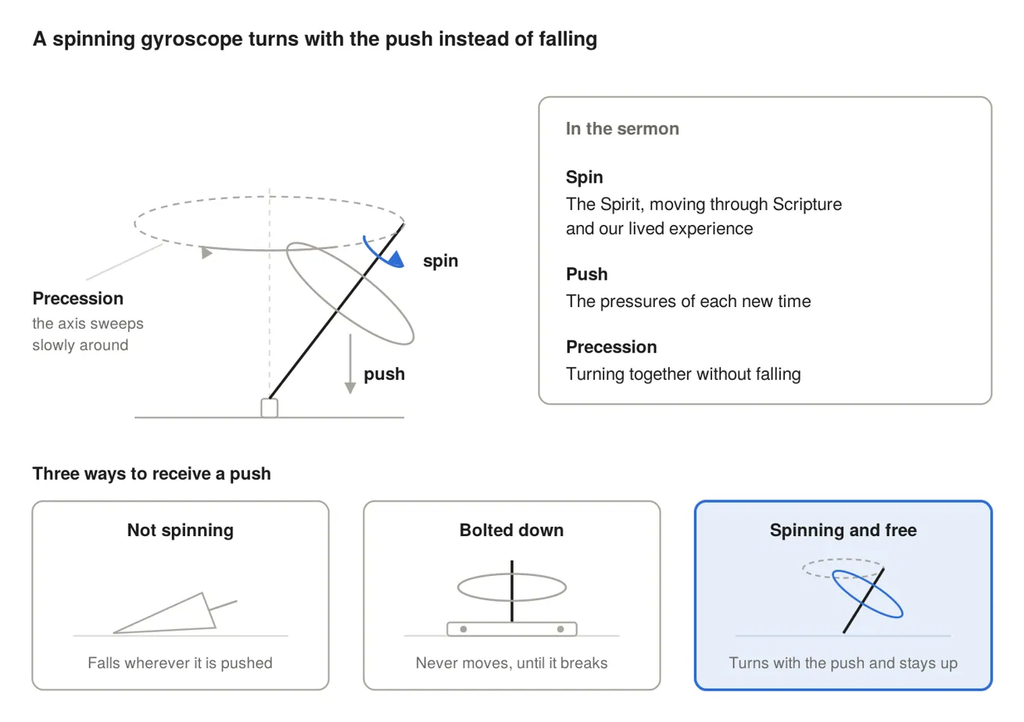
Only when a gyroscope is spinning and free is it able to flow with the changes and find a new balance in precession.
Holy Like God
Shirley Guthrie Jr., whose book Christian Doctrine is probably directly responsible for my going to seminary, also wrote a book on the struggles the Reformed church faced in the late 20th century. Its title is Always Being Reformed: Faith for a Fragmented World. Guthrie describes the church caught between two crises at once, drawing on work by Juergen Moltmann: chase relevance, and we risk losing our identity. Guard our identity, and we risk losing our relevance. That’s the spinless top that falls wherever it’s pushed, and the bolted gyroscope that never moves – until it deconstructs catastrophically.
Guthrie also cites Benjamin Reist, reminding us that there are three components of Reformed theology: a basis in the Bible, a confessional tradition, and the historical-social context. These three aren’t weights that we have to keep in balance, but are instead the way the Spirit keeps the church turning: a connection to God, the church’s long memory, and our experience of life here and now. If we try to hold on to only one of them, it’s like we’re trying to stop the spin.
While the 20th century gave us lots of places to explore how to hold these three pieces, it’s certainly not a new concept. If we go all the way back to Leviticus 19, we see a community of faithful people trying to set the order by which their society would function. Reformations that help the community remain anchored in God’s love and care, precessing around that axis of stability as they are pushed by the challenges of being God’s people together.
God said to Moses, “You must be holy, because I, the Lord your God, am holy.” (Leviticus 19:2) In this, we see the Biblical-theological basis: our holiness begins with who God is. Then we hear, “Each of you must respect your mother and father, and keep my sabbaths.” (Leviticus 19:3) This is historical knowledge, passed on to us from our ancestors, our mothers and fathers. (Notice, too, that the Hebrew names the mother first, which is unusual. The Ten Commandments put the father first.)
And then we get the specific historical context: “Do not turn to idols or make gods of cast metal for yourselves… do not withhold a laborers’ pay overnight.” (Leviticus 19:4, 13) There aren’t a whole lot of people running around today casting idols out of metal, but that certainly was a going concern in Moses’ era! And likewise, with withholding pay – we pay people today on a biweekly or monthly basis. But in that era, a day’s wage might need to be spent that night, on food and shelter. If the laborer didn’t receive their pay at the end of the day, their entire family might go hungry!
That’s not all that’s going on in Leviticus 19, but it shows us the idea fairly clearly. The “Thou Shalt Nots” are about shaping community practice and living together in harmony with each other and God. And over and over, each command ends with the same refrain: “I am the LORD” The commands rest on who God is.
There’s one more pair of verses worth sitting with. Leviticus 19:1-18 tells us not to hate our neighbors in our hearts, but to speak honestly with them, and not to take revenge or hold a grudge. Instead, we are to “love our neighbors as ourselves.” Torah commands honest disagreement as a form of love! Hold on to that thought; we’ll certainly return to it.
Gentle Under Pressure
By Paul’s day, the establishment of Christian churches was coming with an additional problem: people were showing up and claiming all sorts of wild things. In his first letter to the Thessalonians, one of the earliest of Paul’s letters, we see him working to establish what a Christian community should be about.
Paul reminds them that he arrived after being mistreated in Philippi, and spoke the good news anyway, in spite of a lot of opposition (I Thess. 2:2). He didn’t flatter, and he didn’t harden his heart toward them. Instead, he and his companions shared “not only the good news of God, but also our own selves,” because the people of Thessaloniki had become dear to them (I Thess. 2:8).
That’s the historical tradition at its new beginning, making it clear that pastors shouldn’t be lording it over the people, but instead working alongside them. The Biblical basis is seen in Paul being approved by God to be entrusted with the message of the gospel, speaking to please God instead of people (I Thess. 2:4). And the contemporary context is evident in the nursing language: “We were gentle among you, like a nurse maid caring for her children.” (I Thess. 2:7).
You see, the “gentle nurse” was a familiar image among the popular philosophers of Paul’s day, who used it to describe how a good teacher should treat students. It also was likely comfortable theological language to the people of Thessaloniki who were mostly used to feminine imagery in their worship experience. Paul is borrowing familiar words to help comfort the people. (It’s also noteworthy that a few verses later, he calls himself a father with his children, too. Like Leviticus, he named the mother first!)
There’s a small treasure in verse 4. When Paul says he has been “approved” by God, the Greek word is derived from dokimazo, the word an assayer used for testing metal in the fire. It’s the same verb that Paul uses elsewhere for discernment (i.e. Romans 12:2). And here, it’s in the passive voice – we have been approved (dedokimasmetha).
Ultimately, Paul reminds us that, before we are asked to discern anything, God has looked into us and found us trustworthy. It is God’s action that moves us, and it is God’s love that flows through us. Yet Paul’s understanding of God is different from ours. Because our context changes, our gyroscopes of faith are pointing in slightly different directions, but it is the same whirling center that strengthens us at our core.
Three Generations
Remember the motto from earlier? The Church Reformed and Always Being Reformed, According to the Word of God. “Always Being Reformed” is passive voice for a reason — the church doesn’t reform itself. The Spirit does the reforming!
We see that reforming in action through snapshots of faith, which are traditionally called confessions. Really, these are statements of faith that reveal how we have understood God in the lenses of our historical moments. After the static centuries of Westminster subscriptionism, the 20th and 21st centuries have seen a boom in confessional writings. And as we look at the historical circumstances that led to their writing, we see that same precession of faith at work in all of them, reforming and being reformed!
1934. The Barmen Declaration was the work of the Swiss Reformed theologian Karl Barth and many others who resisted the “German Christians,” a movement that wanted the church to serve the Nazi state, with Hitler at its center. The resistance to this Christian Nationalism called themselves “the Confessing Church.” Barth revised the draft in a Frankfurt hotel while his two Lutheran colleagues took a long nap, producing a confession that was fueled, as he put it later, by strong coffee and a Brazilian cigar or two. The Barmen Declaration ended up being a series of affirmations and rejections that reminded the whole church that Jesus Christ is the one Word of God. Yet, in so doing, it also ignored the plight of Jewish people, speaking only about matters that affected the Christian Church. Barth wrote in his later years that he regretted that lack.
1977. A Declaration of Faith was written by a committee of the Southern branch of the Presbyterian Church, chaired by Al Winn of Louisville Seminary. But, as Winn himself wrote after Shirley Guthrie’s death, “Shirley Guthrie’s stamp was on it everywhere.” Guthrie had studied under Karl Barth. The Declaration fell short of the votes needed to enter the Book of Confessions, and the united church later declined to add it to the Book of Confessions as well, though it did endorse it for study, worship, and discussion. It speaks beautiful words about the Spirit overcoming the lines of race and class that divide us. Guthrie remained proud of it, even though the church did not adopt it in his lifetime. Yet, he did express regret that the language in the Declaration leaned heavily on masculine pronouns for God.
2017. The Sarasota Statement, written by eight ministers, professors, and ruling elders who gathered in Florida, spoke into the reality of racism, sexism, and homophobia that had become incredibly visible in the United States. They openly invited the church to study it, argue with it, and borrow from it. And just three years later, the writers reconvened. Rather than edit their original words, they left them standing and added a new prologue, confessing that they had not spoken as boldly as they should have.
Do you see the pattern? The people who held the steadiest were also the ones willing to be changed. Each confession was reformed by its own authors’ later conscience.
You see, so long as the Trinity spins us, we keep in motion. We recognize the changes, the reformation that is needed, and also that it is fully grounded in the leading of the holy Trinity.
Our Turn
So here we are, the fourth generation in this story. This past summer, the General Assembly of the Presbyterian Church (USA) received a proposed new confession. Instead of rushing it into the Book of Confessions, they voted 382 to 39 to send it out to the whole church: every session, every presbytery, every congregation, and every one of us, inviting us to study it, talk about it, and even argue with it, with a report back by 2028. The church isn’t asking a committee somewhere to do our reforming for us. The push is coming to us!
And how do we take that push, in a purple congregation, where we don’t all see things the same way? Leviticus already told us. Don’t hate your neighbor in your heart; speak honestly with them. Don’t take revenge or hold a grudge; love your neighbor as yourself. Honest words instead of quiet resentment. That’s precession at work: taking the push, turning together, without falling apart.
We don’t stay upright by all leaning the same direction. We stay upright because something at the center is moving, and it holds all of us.
Before we are asked to figure anything out, God has already looked into us and found us trustworthy. And Paul says God is calling us — present tense — calling us, right now, into God’s own kingdom and glory. The Church reformed and always being reformed. Not by our own effort, but by the God who never stops turning toward us.
A Blessing
May the Holy God make room for you, as God makes room within God’s own life.
May Christ, who shared not only good news, but his very self, hold you steady.
And may the Spirit keep you turning, through every push, every storm, every change, until all of creation is made one.
Amen.
Read the Confessions for Yourself
- The Theological Declaration of Barmen (1934)
- A Declaration of Faith (1977)
- The Sarasota Statement (2017)
Thanks to Bailey James, for the use of the gyroscope in worship and in the video here!
