
[Scripture text: Matthew 25:14-30 VOICE]
My friends, what is a talent?
We tend to think of a “talent” as a gift, whether natural or from God. A talent for the piano. A talent for art. A talent for calculating large sums in your head. Talents of this sort can be improved with practice or might degrade with neglect.
Let me give you an example — I once had a talent for replaying the last few moments of ambient audio, even if I hadn’t been directly paying attention. That’s a very specific talent, and it suited my very specific circumstances, of being a kid, bored in class, who stacked a fantasy novel inside my textbook, so that it would appear I was reading for the class. You know how you perk up whenever you hear someone say something even remotely close to your name? When I heard my name, I would look up, and silently replay the audio to hear the question I had been asked. Then, usually, I would know the answer, or something that seemed close enough to an answer to satisfy the teacher.
I’d like to say this talent of mine got very little practice, but sadly, I leaned on it far too long. But once my grades started slipping, I started paying greater attention; by college, I’d stopped using the talent at all. Now, I still have some facility for swift recall, but nowhere near what I once did.
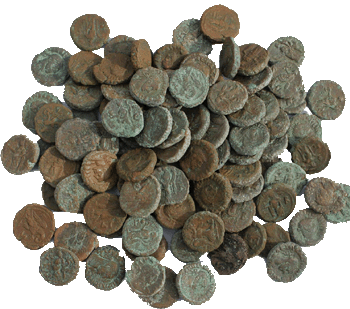
This kind of talent, though, is a corruption of what the word originally meant! In the ancient world, a talent was not a skill, but a weight, of approximately sixty pounds – the weight of seven gallons of milk. A talent of silver was the equivalent of 6,000 days wage, or roughly seventeen to twenty years of work. Though silver was the working currency, if someone were actually given a “talent of silver,” it is likely that it would have been transferred in gold coins. The Romans counted a gold Aureus as 25 denarii – making the 6000 denarii of a talent of silver equivalent to 240 Aurei. That’s still a lot of coins, don’t get me wrong, but at least we can imagine carrying a sack of coins that size.
Image from Duns Scotus Bible Centre
So, how did we get from talent of weight to talent as skill? In Matthew’s parable of the talents, a master gives his slaves a varied number of talents to use in his absence. Medieval scholars in England started writing about the gifts that God gives us as similar to these talents – gifts from a master – and the concept of your skills being a weight in your soul towards those abilities. A weight in your soul – that’s the talent!
With that all out of the way, let’s take a closer look at the parable of the talents. This story has been read in so many different ways that it can, sometimes, provide almost a spiritual whiplash in interpretations. New Testament Professor Carla Works even calls this passage “among the most abused texts in the New Testament.” So many times, the master in the parable is associated with Jesus. But, as we talked about a few weeks ago in the parable of the wedding banquet, the comparison is likely meant to be “if even a human, fallible, terrible person can be right, how much more so must Jesus?” We’ll come back to that interpretation in a bit – but overly comparing the master in this parable to God or Jesus has led to some pretty egregious misunderstandings.
Preachers of the so-called “Prosperity Gospel” use it as a an encouragement to “invest” all that you have been given, often in their own ministry schemes. They frame it as, faithfulness goes in, multiplication comes out. In this reading, taken to the extreme, poverty exists because poor people are faithless. That cannot be the message that Jesus intended from this parable!
A gentler version of this is the use-it-or-lose-it stewardship sermon. In fact, that’s kind of the model I set up with my discussion of personal talent earlier! But, as people who believe in the grace of God, this model of the parable doesn’t sit well, either. God’s grace is given to us regardless of how we use it – and God loves us all beyond our understanding. The use-it-or-lose-it model isn’t right for the parable, either.
A third misunderstanding of this parable is, frankly, anti-Judaistic. In that version, the third servant who buries the talent he was given is erroneously compared to the Jews, hoarding the Torah for themselves. That’s such a terrible allegorical reading of the text that it’s hard to believe it lasted for any length of time. (And, yet, I saw it proffered on a Presbyterian Facebook group for preachers this week. No good!)
Let’s look at a few other points before continuing on. The master in this parable gives unbelievable sums of money to his slaves to handle on his behalf. Five talents is around a hundred years of wages! Even the last slave is given a full talent. And that they are slaves is particularly important here, too. You see, in Greek and Roman context, slaves could and would earn money by doing work – either as a bonus from their master for doing work well, or from side jobs for others. When a slave earned enough, with their master’s permission, they could buy out their contract. Their former master would become their patron, to whom they would owe respect and duty (obseqium), but they would be free. What do you suppose the buyout of their contract was? Usually, for unskilled laborers, it was no more than 500 denarii. Each talent, then, was worth the buyout price of about twelve slaves!
So, five talents, two talents, one talent – each of them a fortune, each of them enough to set at least a dozen people free. And the first two slaves go to work and come back with double. Then the master says something remarkable to each of them: “Come join my great feast and celebration.” (The Greek here can mean both “great joy” and “great feast.”) In that world, a slave seated at the master’s table wasn’t really a slave anymore. They were “manumitted at the table,” shown to be the equal of those who had invited them there.
I think there’s a good tie to communion there — when we come to the Table, we remember that God is explicitly setting us free. Calling us worthy, loving us, lifting us up. But unlike the slaves of the cruel master in the parable, we didn’t have to earn our place there. Christ broke bread and shared the cup with his friends and the one who would betray him. God invites us all to be set free of the burdens that weigh us down.
But then, there’s a third slave. Listen to what he says: “Master, I know you are a hard man… so I was afraid.” He’s not lazy, he’s terrified. He looks at the one who just handed him twenty years of wages, and all he can see is a threat. And the master doesn’t argue with that depiction – instead, he turns out to be exactly the master this slave expected.
That’s the real weight of a talent; not sixty pounds of silver, but the weight of fear. When we believe the giver is mean, every gift they give becomes a burden, something to bury before it can be used against us.
Talents may weigh on you, but fear is what makes them heavy.
At this point, the story starts to break down. We talked in a previous sermon about the “outer darkness” being the streets outside the villa, where the lanterns were unlit. Many have compared this to being in sheol, the place of the dead, which the Greeks called hades. And if that were the ending, it would be terrible indeed.
But, if we turn the page of Matthew’s Gospel, beyond the scope of the parable, we see something interesting. The next thing Jesus says is, “I was hungry… I was a stranger… I was in prison… whatever you did for the least of these, you did for me.” [Matthew 25:35] And who is more “least” than the one who was given least, and then lost even that?
Turn a few more pages, and we see Jesus get arrested in the garden. In chapter 27 of Matthew’s gospel, the fears of religious leaders have led to Jesus being bound and handed over to the empire, who tries him and hangs him on a cross, their practice for dealing with their own fear of insurrection. Matthew tells us that at noon, darkness covered the whole land.
Christ was bound, cast out, in the dark. Jesus has gone to be where the third slave was thrown.
The Apostle’s Creed reminds us that, at this point, Jesus “descended into hell” — or hades, sheol. There is no darkness so far removed that Jesus hasn’t been to. If that third slave thought himself alone in the dark with his fear, he was wrong. The one who comes looking for him there is the God that he, and we, should have known all along: the God who, as Isaac the Syrian put it, “can only give faithful love.”
So where does that leave us? It leaves us with a God who doesn’t stay inside the villa. In the parable, all the lanterns were lit for the feast, and the streets outside were dark. But Jesus walked out into those streets, and he is still out there. In worship this week, we heard about the Tulsa nonprofit called City Lights, which began by people carrying food and light out to others living under a bridge downtown. That’s what it looks like to follow the third servant out the door.
We also had elders renew their vows of service to God and this congregation. They are being handed something weighty, a responsibility and a joy in one go. That weight does not come from a difficult master, but from the One who has already gone out into the dark to bring everyone home to the table. Talents may weigh on you, but you will never carry them alone, and no one is beyond the reach of the heavenly banquet!
May the gifts God has placed in your hands feel less like a burden and more like an invitation. May you know the Giver as generous, and so be free to give. May you never fear the dark, for Christ has already gone there ahead of you. And may you find, at the end of every road, a place waiting for you at God’s table, where all are welcome, and all are free. Amen.
