Luke 16:27-30
Narrative Lectionary

BibleHub

27 He said,A ‘Then I begB you, father,C to sendD him to my father’s houseE— 

Notes on verse 27

A “said” = eiron. This is to speak say, answer, command.
B “beg” = erotao. From eromai (to ask) OR from ereo (to say, tell, call, speak of). This is asking a question or making an earnest request. It is used between someone with whom the asker is close in some sense. So, they anticipate special consideration for their request.
C “father” = pater. This is father in a literal or figurative sense. Could be elder, senior, ancestor, originator, or patriarch.
D “send” = pempo. This is to send, put forth, or dispatch. This often refers to a temporary errand. It is sending someone with a focus on the place they departed from. By contrast, another Greek word, hiemi, emphasizes the destination and yet another word, stello, focuses on the motion that goes with the sending.
E “house” = oikos. This is house – the building, the household, the family, descendants, the temple.

28 for I haveF fiveG brothersH—that he may warnI them,

Notes on verse 28a

F “have” = echo. This is to have, hold, possess.
G “five” = pente. This is five. It may be symbolically associated with the Temple or redemption.
H “brothers” = adelphos. From a (with, community, fellowship) + delphus (womb). This is a brother in a literal or figurative sense. It is also used of another member of the Church.
I “warn” = diamarturomai. 15x in NT. From dia (through, across to the other side, thoroughly) + marturomai (to witness, testify, call as a witness, affirm, charge, protest); {from martus (a witness whether having heard or seen something; witness literally, judicially, or figuratively; by analogy, a martyr)}. This is to affirm, give evidence, testify thoroughly. It is giving full testimony.

so that they will not also comeJ into this placeK of torment.’L 

Notes on verse 28b

J “come” = erchomai. This is to come or go.
K “place” = topos. This is a place or region. It is a smaller space that can only hold a limited number of people whereas chora is a larger place. Figuratively it could be an opportunity.
L “torment” = basanos. 3x in NT. From basis (step, hence foot; a pace); from baino (to walk, to go). This is to torture or torment or afflict. Properly, it refers to a touchstone – used to test how pure gold or silver are by what mark they leave behind.

29 AbrahamM replied,N ‘They have MosesO and the prophets;P they should listenQ to them.’ 

Notes on verse 29

M “Abraham” = Abraam. From Hebrew Abraham (exalted father); from the same as Abiram (exalted father, a high father – lofty) {from ab (father literal or figurative) + rum (rise, bring up, being high, extol, exalt, haughty; to raise in a literal or figurative sense)}. This is Abraham, father of many nations or father of a multitude.
N “replied” = lego. This is to speak, say, name, call, command. It is generally to convey verbally.
O “Moses” = Mouses. From Hebrew Mosheh (Moses); from mashah (to pull out in a literal or figurative sense, to draw out) OR from Egyptian mes or mesu (child, son i.e. child of…). This is Moses – the one drawn out from the water, which is to say, rescued. If derived from the Egyptian, his name would share a root with Rameses and Thutmose.
P “prophets” = prophetes. From pro (before, in front of, earlier than) + phemi (to declare, say, use contrasts in speaking to shed light on one point of view); {from phao (to shine) or phaino (to bring light, cause to appear, shine, become visible or clear)}. This is a prophet or poet – one who speaks with inspiration from God.
Q “listen” = akouo. This is hear or listen, but it also means to understand by hearing. This is where the word “acoustics” comes from.

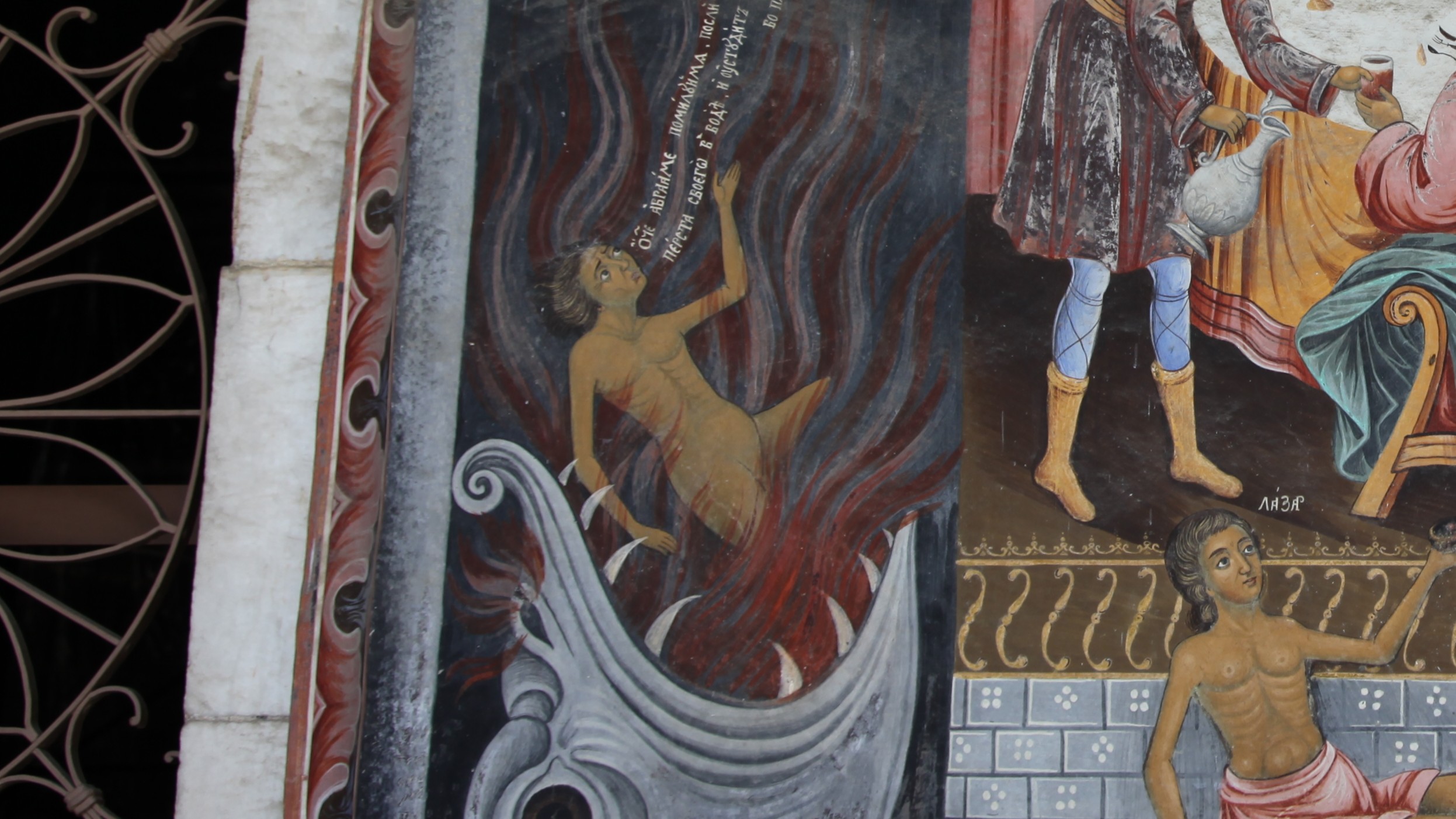
30 He said, ‘No,R father Abraham, but if someone from the deadS goesT to them, they will repent.’U

Notes on verse 30

R “no” = ouchi. From ou (no, not; saying something is not true) + xi (adds emphasis). This is an emphatic negative – not at all, by no means, out of the question.
S “dead” = nekros. Perhaps from nekus (corpse). This is dead or lifeless, mortal, corpse. It can also be used figuratively for powerless or ineffective. It is where the word “necrotic” comes from.
T “goes” = poreuomai. From poros (ford, passageway). This is to go, travel, journey, or die. It refers to transporting things from one place to another and focuses on the personal significance of the destination.
U “repent” = metanoeo. From meta (with, among, after, beyond) + noieo (to perceive, think, understand); {from nous (mind, understanding, reasoning faculty, intellect, capacity to reflect)}. This is to change how one thinks, to reconsider, to repent. It refers to a change of thinking, which means a change of purpose and behavior.


Image credit: Detail of an Image of the Rich Man and Lazarus at the Nativity of Mary Church at the Rila Monastery in Bulgaria. Photo by Hans A. Rosbach, 2011.