1 Kings 10
BibleHub
1 When the queenI of ShebaII heardIII
Notes on verse 1a
I “queen” = malkah. From melek (king, royal). This is queen.
II “Sheba” = Sheba. From Ethiopic (man) OR from Hebrew saba (to imbibe) OR from shaba (to capture (like a captive) OR from sheba (seven – the number of perfection/sacred fullness); {from shaba (to swear, curse, vow, make a covenant; properly, to be complete; this is to seven oneself – as in affirming something so strongly it is as though it were said seven times)}. This is Sheba or Sabean. It is somewhere in Africa or southwest Arabia as well as a personal name. It may mean “man,” “drunk,” “captive,” “splinter,” “seven,” or “oath.” See https://www.abarim-publications.com/Meaning/Sheba.html
III “heard” = shama. This is to hear, call, consent, or consider. It implies listening intelligently, giving attention, and, because of these two factors, obedience and action are often implied.
of the fameIV of SolomonV (fame due to the nameVI of the Lord),VII
Notes on verse 1b
IV “fame” = shema. Related to “heard” in v1. 18x in OT. From shama (see note III above). This is something that is heart like a report, speech, fame, rumor, or fame.
V “Solomon” = Shelomoh. From shalam (to be complete or sound; to have safety mentally, physically, or extending to one’s estate; so, if these things are safe and complete, the implication is that one would be friendly; and, if being friendly, one would make amends and that friendship would be reciprocated). This is Solomon or Shelomoh, meaning “peaceful.” It is the same word as the Hebrew word for peace – shalom.
VI “name” = shem. May be from sim (to put, place, set). This is name, fame, renown. A name was thought to indicate something essential about a person – something about their individuality. So, this word can also mean honor, authority, or character.
VII “Lord” = YHVH. From havah (to be, become) or hayah (to come to pass, become, be). This is the name of the God of Israel, the self-existent and eternal one, the tetragrammaton. This pronunciation has been lost to time so “Lord” is generally used in its place.
she cameVIII to testIX him with riddles.X
Notes on verse 1c
VIII “came” = bo. This is to enter, come in, advance, fulfill, bring offerings, enter to worship, attack. It can also have a sexual connotation.
IX “test” = nasah. This is to test, prove, try, tempt, or attempt.
X “riddles” = chidah. 17x in OT– including the riddle of Samson’s marriage in Judges 14 and “hard questions” posed by the Queen of Sheba in 1 Kings 10. Perhaps from chud (to tie a knot, offer a riddle). This is a riddle, proverb, question, puzzle, intrigue, dark saying.
2 She came to JerusalemXI with a veryXII greatXIII retinue,XIV
Notes on verse 2a
XI “Jerusalem” = Yerushalaim. Related to “Solomon” in v1. From yarah (to throw, shoot, be stunned; to flow as water so figuratively to instruct or teach) + shalam (see note V above). This is Jerusalem, dwelling of peace.
XII “very” = meod. Perhaps from the same as uwd (firebrand, a poker). This is very, greatly, exceedingly. It can also mean vehemence, force, abundance.
XIII “great” = kabed. From kabad (to be heavy, weighty, burdensome). This is heavy, grievous, sore. It can also be weighty in the sense of gravitas. The word for “glory” in Hebrew comes from this root (kabod).
XIV “retinue” = chayil. From chul (to be firm, strong, prosperous; to endure). This is strength, wealth, ability, activity. It can refer to soldier or a company of soldiers as well as goods. It is a force of people, means, or goods. It can speak of valor, virtue, or strength.
with camelsXV bearingXVI spicesXVII
Notes on verse 2b
XV “camels” = gamal. From gamal (how one deals with someone whether positively or negatively – so to reward, requite; to wean or the work that goes into something ripening). This is a camel as an animal of labor or one that bears burdens. The English word “camel” is from a Semitic source, perhaps Hebrew or others.
XVI “bearing” = nasa. This is to lift in a broad sense, literally and figuratively. So it could be to carry, take, or arise. It could also be bring forth, advance, accept.
XVII “spices” = bosem. From the same as basam (spice, balsam tree). This is balsam, spice, perfume, odor, the balsam tree.
and very muchXVIII goldXIX and preciousXX stones,XXI
Notes on verse 2c
XVIII “much” = rab. From rabab (increasing in any aspect whether quantity, authority, size, quality, greatness, etc.). This is abundance, many, elder, exceedingly, great. It refers to abundance of amount, rank, or status.
XIX “gold” = zahab. Root may mean to shimmer. This is gold or something that has the color of gold like oil. It can also refer to a clear sky – to good weather.
XX “precious” = yaqar. From yaqar (to be precious, costly, rare, valued; properly, to be heavy; figuratively, valuable or inhibit). This is precious, splendid, noble, weighty, or rare. It is valuable in a subjective or objective sense.
XXI “stones” = eben. This is a stone, weight, or mason. It is part of the word “Ebenezer.”
and when she came to Solomon, she toldXXII him allXXIII that wasXXIV on her mind.XXV
Notes on verse 2d
XXII “told” = dabar. This is generally to speak, answer, declare, or command. It might mean to arrange and so to speak in a figurative sense as arranging words.
XXIII “all” = kol. From kalal (to complete). This is all or every.
XXIV “was” = hayah. Related to “Lord” in v1. See note VII above.
XXV “mind” = lebab. May be related to labab (to encourage; properly, to be encased as with fat; used in a good sense, this means to transport someone with love; used in a bad sense, it can mean to dull one’s senses). This is the heart, courage, one’s inner self, the mind, or the will. Heart is only used in a figurative sense in the Old and New Testaments.
3 Solomon answeredXXVI all her questions;XXVII there was nothingXXVIII hiddenXXIX from the kingXXX that he could not explainXXXI to her.
Notes on verse 3
XXVI “answered” = nagad. This is to declare, make conspicuous, stand in front, manifest, predict, explain.
XXVII “questions” = dabar. Related to “told” in v2. From dabar (see note XXII above). This is speech, a word, a matter, an affair, charge, command, message, promise, purpose, report, request. It is a word, which implies things that are spoken of in a wide sense.
XXVIII “nothing” = lo…dabar. Dabar is the same as “questions” in v3. See note XXVII above.
XXIX “hidden” = alam. This is to conceal, cover from sight in a literal or figurative sense. Could be to escape, liar, neglect, or secret thing.
XXX “king” = melek. Related to “queen” in v1. See note I above.
XXXI “explain” = nagad. Same as “answered” in v3. See note XXVI above.
4 When the queen of Sheba had observedXXXII all the wisdomXXXIII of Solomon, the houseXXXIV that he had built,XXXV
Notes on verse 4
XXXII “observed” = raah. This is to see in a literal or figurative sense so stare, advise, think, view.
XXXIII “wisdom” = chokmah. From chakam (to be wise or teach wisdom; this is wisdom in thought, word, or action). This is wisdom, wit, or skillfulness.
XXXIV “house” = bayit. Probably from banah (to build, make, set up, obtain children; to build literally or figuratively). This is house, court, family, palace, temple.
XXXV “built” = banah. Related to “house” in v4. See note XXXIV above.
5 the foodXXXVI of his table,XXXVII the seatingXXXVIII of his officials,XXXIX
Notes on verse 5a
XXXVI “food” = maakal. From akal (to eat, devour, burn up, or otherwise consume; eating in a literal or figurative sense). This is food, something edible.
XXXVII “table” = shulchan. Perhaps from shalach (to send, send for, forsake). This is a table or meal.
XXXVIII “seating” = moshab. From yashab (to sit and so to remain and so to dwell; sitting for any reason – as a judge, in order to ambush, or just sitting quietly; can mean settling or marrying; continue, endure, or establish). This is dwelling, seat, assembly, settlement, population.
XXXIX “officials” = ebed. From abad (to work, serve, compel; any kind of work; used causatively, can mean to enslave or keep in bondage). This is a servant, slave, or bondservant.
and the attendanceXL of his servants,XLI their clothing,XLII
Notes on verse 5b
XL “attendance” = maamad. 5x in OT. From amad (to stand up in a literal or figurative sense; to establish, continue, endure, take a stand, act, be a servant, stand still, remain, stand against an enemy). This is a place where one stands so it could be a position, office, function, or attendance.
XLI “servants” = sharat. This is ministering, serving, or waiting on. It can refer to one offering service as a worshipper or one serving as a servant.
XLII “clothing” = malbush. 8x in OT. From labash (to wrap around, which implies clothing oneself or someone else; wrapping around in a literal or figurative way). This is garment, clothing, robes, or vestment.
his valets,XLIII and his burnt offeringsXLIV that he offeredXLV at the house of the Lord,
Notes on verse 5c
XLIII “valets” = mashqeh. 19x in OT. From shaqah (to give water to, to cause to drink – to irrigate, drown; watering plants or giving water to flocks). This is drinking, a drink, cupbearer, or a place that is well irrigated.
XLIV “burnt offerings” = olah. From alah (to go up, climb, approach, bring; to be high or actively climb; can be literal or figurative). This is a step, stairs, or some kind of ascent. It is also used for whole burnt offerings, being the offering in which the whole thing is burned and rises as smoke. Burnt offerings were the least common of the offerings: most were eaten, shared with the priest and the one bringing the offering.
XLV “offered” = alah. Related to “burnt offerings” in v5. See note XLIV above.
it took her breathXLVI away.XLVII, XLVIII
Notes on verse 5d
XLVI “breath” = ruach. From ruach (smell, breathe, perceive, anticipate, accept, enjoy). This is breath, wind, air, cool, spirit. This is wind, which resembles the breath and so this can be used figuratively for life itself or being frail/mortal/impermanent. It can refer to the air of the sky or the spirit.
XLVII “took…away” = lo + hayah + od. Hayah is the same as “was” in v2. See note XXIV above. Od is from ud (to admonish, repeat, duplicate, testify, restore, record, relieve). This is still, yet, again, more.
XLVIII Literally, “there was not breath in her anymore.”
6 So she saidXLIX to the king, “The reportL was trueLI that I heard in my own landLII of your accomplishmentsLIII and of your wisdom,
Notes on verse 6
XLIX “said” = amar. This is to speak, say, answer, command, promise, report.
L “report” = dabar. Same as “questions” in v3. See note XXVII above.
LI “true” = emet. From aman (to believe, endure, fulfill, confirm, support, be faithful, put one’s trust in, be steadfast. Figuratively, this is to be firm, steadfast, or faithful, trusting, believing, being permanent, morally solid). This is firmness or stability. Figuratively, it is faithfulness, truth, or trustworthiness. This is the same root that “amen” comes from.
LII “land” = erets. Root may mean to be firm. This is earth, ground, field land, or country.
LIII “accomplishments” = dabar. Same as “questions” in v3. See note XXVII above.
7 but I did not believeLIV the reports until I came and my own eyesLV sawLVI it. Not evenLVII halfLVIII had been toldLIX me;
Notes on verse 7a
LIV “believe” = aman. Related to “true” in v6. See note LI above.
LV “eyes” = ayin. This is eye in a literal or figurative sense so eye, appearance, favor, or a fountain (the eye of the landscape).
LVI “saw” = raah. Same as “observed” in v4. See note XXXII above.
LVII “even” = hinneh. From hen (lo! Behold! If, though; an expression of surprise). This is to draw attention, show suddenness or surprise, or to emphasize the importance of the coming statement. See! Lo! Behold!
LVIII “half” = chatsi. From chatsah (to halve, divide, reach, participate). This is half, middle, midnight, midst.
LIX “told” = nagad. Same as “answered” in v3. See note XXVI above.
your wisdom and prosperityLX far surpassLXI the reportLXII that I had heard.
Notes on verse 7b
LX “prosperity” = tob. From tob (to be pleasing, to be good). This is good, beautiful, pleasant, agreeable, bountiful, at ease. This word is used for goodness as a concept, a good thing, a good person. This can refer to prosperity and welfare as well as joy, kindness, sweetness, and graciousness. So, this is ethically good, but also enjoyably good.
LXI “surpass” = yasaph. This is to add, increase, continue, exceed.
LXII “report” = shemuah. Related to “heard” and “fame” in v1. From shama (see note III above). This is something heard – news, a rumor, fame, announcement.
8 HappyLXIII are your wives!LXIV Happy are these your servantsLXV who continuallyLXVI attendLXVII LXVIIIyou and hear your wisdom!
Notes on verse 8
LXIII “happy” = esher. From ashar (to go straight, lead, guide; to be level and so to be right, blessed, honest, happy). This is happy or blessedness.
LXIV “wives” = ish. Here, “men.” Perhaps from enosh (human, humankind, mortal); from anash (to be weak, sick, or frail). This is man, husband, another, or humankind.
LXV “servants” = ebed. Same as “officials” in v5. See note XXXIX above.
LXVI “continually” = tamid. May come from a word that means to stretch. This word means an indefinite period of time. So, it could be regular or daily. It could also be constantly, continually, always, or perpetually.
LXVII “attend” = amad. Related to “attendance” in v5. See note XL above.
LXVIII {untranslated} = paneh. From panah (to turn, face, appear). This is face in a literal or figurative sense. It could be face, presence, anger, respect. It can also be used of God to indicate divine favor or presence.
9 BlessedLXIX be the Lord your God,LXX who has delightedLXXI in you and setLXXII you
Notes on verse 9a
LXIX “blessed” = barak. This is to kneel, to bless. It is blessing God as part of worship and adoration or blessing humans to help them. It can be used as a euphemism to say curse God.
LXX “God” = Elohim.
LXXI “delighted” = chaphets. Properly, this means inclined towards or bending to. Figuratively, it means to desire, delight in, or be pleased with.
LXXII “set” = natan. This is to give, put, set, offer. It is to give literally or figuratively.
on the throneLXXIII of Israel!LXXIV Because the Lord loved Israel forever,LXXV he has madeLXXVI you king
Notes on verse 9b
LXXIII “throne” = kisse. From the same as kese (full moon); perhaps from kasah (to cover, conceal, overwhelm; to cover as clothes do or to hide a secret). This is throne – a seat that is covered or has a canopy. Thus, it is a seat that conveys authority.
LXXIV “Israel” = Yisrael. Related to “God” in v9 See note LXX above.
LXXV “forever” = olam. Related to “hidden” in v3. Perhaps from alam (see note XXIX above). This is a long scope of time whether in the past (antiquity, ancient time) or in the future (eternal, everlasting).
LXXVI “made” = sim. Related to “name” in v1. See note VI above.
to executeLXXVII justiceLXXVIII and righteousness.”LXXIX
Notes on verse 9c
LXXVII “execute” = asah. This is to make, do, act, appoint, become in many senses.
LXXVIII “justice” = mishpat. From shaphat (to judge, defend, pronounce judgment, condemn, govern). This is a verdict or formal sentence whether from humans or from God. It includes the act of judging as well as the place that judging takes place, the suit itself, and the penalty. Abstractly, this is justice, which includes the rights of the participants.
LXXIX “righteousness” = tsedaqah. From the same as tsedeq (rightness, righteousness, vindication. It is everything that is just or ethical. That which is right in a natural, moral, or legal sense. It also includes just weights (i.e. true weights). Figuratively, this is justice, righteousness, equity – even prosperity). This is righteousness, justice, righteous acts, and moral virtue.
10 Then she gaveLXXX the king one hundredLXXXI twentyLXXXII talentsLXXXIII of gold,
Notes on verse 10a
LXXX “gave” = natan. Same as “set” in v9. See note LXXII above.
LXXXI “hundred” = meah. This is hundred or some number times one hundred (i.e. hundredfold or the base of two hundred, three hundred, etc.).
LXXXII “twenty” = esrim. From the same as eser (ten, tenth). This is twenty or twentieth.
LXXXIII “talents” = kikkar. From karar (to dance or whirl). This is round so it can refer to a circle, a circular region, a weight used for measurement, money, a loaf of bread that is round, a cover, a plain, or a valley in the Jordan.
a greatLXXXIV quantityLXXXV of spices, and precious stones; never againLXXXVI did spices come in such quantityLXXXVII as that which the queen of Sheba gave to King Solomon.
Notes on verse 10b
LXXXIV “great” = meod. Same as “very” in v2. See note XII above.
LXXXV “quantity” = rabah. This is increasing in any aspect whether quantity, authority, size, quality, greatness, etc.
LXXXVI “again” = od. Same as “took…away” in v5. See note XLVII above.
LXXXVII “quantity” = rob. Related to “much” in v2. From rabab (see note XVIII above). This is any kind of abundance.
11 Moreover,LXXXVIII the fleetLXXXIX of Hiram,XC which carriedXCI gold from Ophir,XCII
Notes on verse 11a
LXXXVIII “moreover” = gam. This is also, moreover, again.
LXXXIX “fleet” = oni. 7x in OT. Pobably from anah (to meet, happen, approach). This is galley, fleet of ships.
XC “Hiram” = Chiram. From Churam (Huram, a name); from Achiram (Ahiram; “brother of the lofty” or “brother of height”); {from ach (brother, kindred, another, other, like) + rum (to be high, rise, exalt self, extol, be haughty; to rise literally or figuratively)} OR from hor (noblemen) + rum (see above). This is Hiram or Chiram, a name that means “most noble,” “high born,” “brother of the lofty.” See https://www.abarim-publications.com/Meaning/Hiram.html
XCI “carried” = nasa. Same as “bearing” in v2. See note XVI above.
XCII “Ophir” = Ophir. 13x in OT. This is Ophir, a son of Joktan, his lineage, and a place where there is gold.
brought from Ophir a greatXCIII quantityXCIV of almugXCV woodXCVI and precious stones.
Notes on verse 11b
XCIII “great” = meod. Same as “very” in v2. See note XII above.
XCIV “quantity” = rabah. Same as “quantity” in v10. See note LXXXV above.
XCV “almug” = almuggim. 3x in OT – all in 1 Kings 10. Probably of foreign derivation. This is Almug tree or wood. It may refer to sandalwood.
XCVI “wood” = ets. Perhaps from atsah (to shut, fasten, firm up, to close one’s eyes). This is tree or other things related to trees like wood, sticks, or stalks. It can also refer to wood products like a plank or staff or gallows. Additionally, this can refer to a carpenter.
12 From the almug wood the king madeXCVII supportsXCVIII for the house of the Lord and for the king’s house, lyresXCIX also and harpsC
Notes on verse 12a
XCVII “made” = asah. Same as “execute” in v9. See note LXXVII above.
XCVIII “supports” = misad. 1x in OT. From saad (to support, uphold, or sustain; refresh or comfort). This is a support or pillar.
XCIX “lyres” = kinnor. Root may be to twang. This is a lyre or harp.
C “harps” = nebel. From nabel (to fall away, faint, wither, languish, sink; figuratively, being senseless, foolish, or wicked; to despise, disgrace, or fall to nothing, to be seen with contempt). This is a vessel, perhaps made of skins for holding liquids. It could be a skin, vase, or lyre as having a similar shape.
for the singers;CI no suchCII almug wood has come or been seen to this day.CIII
Notes on verse 12b
CI “singers” = shir. From shir (to sing; one who is singing or leading others in song). This is song or singer.
CII “such” = ken. Perhaps from kun (properly, in a perpendicular position; literally, to establish, fix, fasten, prepare; figuratively, it is certainty, to be firm, faithfulness, render sure or prosperous). This is to set upright. Generally used figuratively to mean thus, so, afterwards, rightly so.
CIII “day” = yom. Root may mean being hot. This is the day in a literal or figurative sense. It can also mean birth, age, daylight, continually or other references to time.
13 Meanwhile, King Solomon gave to the queen of Sheba everyCIV desireCV that she expressed,CVI as well asCVII what he gave her
Notes on verse 13a
CIV “every” = kol. Same as “all” in v2. See note XXIII above.
CV “desire” = chephets. Related to “delighted” in v9. From chaphets (see note LXXI above). This is a delight, care, or pleasure. It is what you desire or what is acceptable. It can also be used concretely for a precious thing or something that one is thinking about.
CVI “expressed” = shaal. This is to ask, inquire, beg, borrow, desire, request. It can also mean to demand.
CVII “as well as” = bad. From badad (to divide or be separated; alone, solitary, lonely, isolated, straggler). This is apart, alone, separation, body part, tree branch, except. It can also be a city’s chief.
out of Solomon’s royalCVIII bounty.CIX Then she returnedCX to her own land with her servants.CXI
Notes on verse 13b
CVIII “royal” = melek. Same as “king” in v3. See note XXX above.
CIX “bounty” = yad. This is hand, ability, power. Hand in a literal sense, but also what one can do or the means by which one does it.
CX “returned” = panah. Related to {untranslated} in v8. See note LXVIII above.
CXI “servants” = ebed. Same as “officials” in v5. See note XXXIX above.
14 CXIIThe weightCXIII of gold that came to Solomon in oneCXIV yearCXV
Notes on verse 14a
CXII {untranslated} = hayah. Same as “was” in v2. See note XXIV above.
CXIII “weight” = mishqal. From shaqal (to weigh, spend, trade). This is to weigh, or a unit of weight. It shares a root with the word “shekel.”
CXIV “one” = echad. Perhaps from achad (to unify, continue on a path; figuratively, to gather one’s thoughts). This is the number one, first, united. It can also be alone, altogether, a certain, a few.
CXV “year” = shanah. From shana (to change, alter). This is a year, age, old. It can also mean yearly.
was sixCXVI hundred sixtyCXVII-six talents of gold, 15 besidesCXVIII that which came from the tradersCXIX
Notes on verses 14b-15a
CXVI “six” = shesh. This is six. Figuratively, it can be a surplus since it is one more than the number of fingers on the hand.
CXVII “sixty” = shishshim. Related to “six” in v14. From shesh (see note CXVI above). This is sixty.
CXVIII “besides” = bad. Same as “as well as” in v13. See note CVII above.
CXIX “traders” = ish + tur. Ish is the same as “wives” in v8. See note LXIV above. Tur is to seek out, explore, investigate. It is often used of trading or spying.
and from the businessCXX of the merchantsCXXI and from all the kings of ArabiaCXXII and the governorsCXXIII of the land.
Notes on verse 15b
CXX “business” = mischar. 1x in OT. From sachar (to travel, go around; to travel like a peddler, to trade, to be a merchant; to palpitate). This is merchandise, trade, or commerce.
CXXI “merchants” = rakal. 17x in OT. This is to travel around, especially to trade. It could refer to a merchant or trader as well as trade itself.
CXXII “Arabia” = Arab. 6x in OT. From arab (to become evening); {from ereb (evening)} OR from Arabic ‘arab (to declare, Arabicize); {from ‘-r-b (ot do business, declare)}. This is Arab or Arabia. See https://en.wiktionary.org/wiki/%D8%B9%D8%B1%D8%A8#Arabic
CXXIII “governors” = pechah. It is a foreign word. It means governor or official.
16 King Solomon madeCXXIV two hundred large shieldsCXXV of beatenCXXVI gold; six hundred shekels of gold wentCXXVII into eachCXXVIII large shield.
Notes on verse 16
CXXIV “made” = asah. Same as “execute” in v9. See note LXXVII above.
CXXV “large shields” = tsinnah. From tsen (root may mean to be prickly; thorn, barb, cactus hedge). This is a hook or barb. It can also be a buckler, shield, target. Figuratively, it can refer to piercing cold.
CXXVI “beaten” = shachat. 5x in OT. Akin to shachat (to destroy, beat, corrupt; could also refer to a slaughter of animals for sacrifice or of killing people). This is to beat or hammer out.
CXXVII “went” = alah. Same as “offered” in v5. See note XLV above.
CXXVIII “each” = echad. Same as “one” in v14. See note CXIV above.
17 He made threeCXXIX hundred shieldsCXXX of beaten gold; three minasCXXXI of gold went into each shield;CXXXII
Notes on verse 17a
CXXIX “three” = shalosh. This is three, fork, three times.
CXXX “shields” = magen. From ganan (to surround, cover, defend, protect). This is a shield, defense, or figuratively a protector. It can also be used for a crocodile’s hide.
CXXXI “minas” = maneh. 5x in OT. From manah (to weigh out, reckon, count, number, set, tell; allotting or providing something officially). This is mina or pound. It is a specific measure of weight or money.
CXXXII “shield” = magen. Same as “shields” in v17. See note CXXX above.
and the king putCXXXIII them in the House of the ForestCXXXIV of Lebanon.CXXXV 18 The king also madeCXXXVI
Notes on verses 17b-18a
CXXXIII “put” = natan. Same as “set” in v9. See note LXXII above.
CXXXIV “Forest” = ya’ar. This is honeycomb, forest, thicket. Root may mean thick with green growth. It is a forest as a place where one would find honeycomb.
CXXXV “Lebanon” = Lebanon. Related to “mind” in v2. From laben (to be white, make white, make bricks) OR form Aramaic lebab (heart); corresponding to Hebrew lebab (see note XXV above). This is Lebanon. The sense of “white” comes from the snow on the top of its mountains. See https://en.wikipedia.org/wiki/Lebanon
CXXXVI “made” = asah. Same as “execute” in v9. See note LXXVII above.
a greatCXXXVII ivoryCXXXVIII throne and overlaidCXXXIX it with the finestCXL gold.
Notes on verse 18b
CXXXVII “great” = gadol. From gadal (to grow up, become great, become wealthy – to advance. The root meaning may be to twist in the sense of the process of growing). This is great, high, bigger, noble, old, marvelous. It can also refer to someone who is powerful or distinguished.
CXXXVIII “ivory” = shen. From shanan (to sharpen, point, pierce; figuratively to teach). This is a tooth, ivory, something sharp, or, figuratively, a cliff.
CXXXIX “overlaid” = tsaphah. This is to spread, to cover with sheets (as with metal).
CXL “finest” = pazaz. 1x in OT. This is to be agile or refined, to be the best.
19 The throne had six steps.CXLI The topCXLII of the throne was roundedCXLIII in the back,CXLIV
Notes on verse 19a
CXLI “steps” = maalah. Related to “burnt offerings” and “offered” in v5. From ma’aleh (ascent, platform, slope, stairs, cliff, elevation, a rise; figuratively, a priority); from alah (see note XLIV above). This is something that arises, elevation, a journey to a higher pane. This can be used figuratively to mean having a though or being of a superior status. It is often used in a specific sense for something the mounts to a climax. This is step, stair, or high degree.
CXLII “top” = rosh. This may come a word that means to shake. It is the head, captain, or chief. It can also be excellent or the forefront. It can be first in position or in statue or in time (i.e. the beginning).
CXLIII “rounded” = agol. 6x in OT. May come from a word that means revolve OR related to egel (male calf as one that frisks about; often one that is almost grown up). This is round or circular.
CXLIV “back” = achar. From achar (to remain behind, linger, continue, be behind, or delay; can also imply procrastination). This is after or the last part, following.
and on eachCXLV sideCXLVI of the seatCXLVII were arm restsCXLVIII
Notes on verse 19b
CXLV “each” = zeh + zeh. Literally, “on this and on this.”
CXLVI “side” = maqom. From qum (to arise, stand, accomplish, establish, abide; rising against, getting up after being sick or asleep, arising from one state to another, becoming powerful, or rising for action; standing in a figurative sense). This is a standing, which is to say a spot or space a place. It can also refer to a locality or a physical/mental condition. HaMaqom is also a Jewish name for God – the place, i.e. the Omnipresent One.
CXLVII “seat” = shebet. Related to “seating” in v5. 5x in OT. From yashab (see note XXXVIII above). This is seat, spot, abode, site.
CXLVIII “arm rests” = yad. Same as “bounty” in v13. See note CIX above.
and twoCXLIX lionsCL standingCLI besideCLII the arm rests,
Notes on verse 19c
CXLIX “two” = shenayim. From sheni (double, again, another, second); from shanah (to fold, repeat, double, alter, or disguise). This is two, both, second, couple.
CL “lions” = ari. From arah (to gather or pluck). This is a young lion.
CLI “standing” = amad. Same as “attend” in v8. See note LXVII above.
CLII “beside” = etsel. From atsal (to reserve, refuse, join, separate, keep). This is nearby, toward, joining.
20 while twelveCLIII lions were standing, one on each endCLIV of a step on the six steps. Nothing likeCLV it was ever madeCLVI
Notes on verse 20a
CLIII “twelve” = shenayim + asar. Shenayim is the same as “two” in v19. See note CXLIX above. Asar is related to “twenty” in v10. From the same as eser (see note LXXXII above). This is -teen or -teenth.
CLIV “one on each end” = zeh + zeh. Literally, “on this side and on this side.”
CLV “like” = ken. Same as “such” in v12. See note CII above.
CLVI “made” = asah. Same as “execute” in v9. See note LXXVII above.
in anyCLVII kingdom.CLVIII 21 All King Solomon’s drinkingCLIX vesselsCLX were of gold, and all the vessels of the House of the Forest of Lebanon were of pureCLXI gold;
Notes on verses 20b-21a
CLVII “any” = kol. Same as “all” in v2. See note XXIII above.
CLVIII “kingdom” = mamlakah. Related to “queen” in v1 & “king” in v3. From the same as melek (see note I above). This is kingdom, dominion, sovereignty, rule. It can also refer to the realm.
CLIX “drinking” = mashqeh. Same as “valets” in v5. See note XLIII above.
CLX “vessels” = keli. From kalah (to end, be finished, complete, prepare, consume, spent, or completely destroyed). This is something that was prepared – any implement, utensil, article, vessel, weapon, or instrument. Also includes jewels, weapons, bags, carriages, and furniture.
CLXI “pure” = sagar. This is to shut up, imprison, lock, hand over, or figuratively surrender.
noneCLXII were of silverCLXIII—it was not consideredCLXIV as anythingCLXV in the days of Solomon.
Notes on verse 21b
CLXII “none” = ayin. Perhaps from a word that means to be nothing. This means nothing, none, non-existent. It can also simply mean not or are not.
CLXIII “silver” = keseph. From kasaph (to long for, be greedy; to become pale). This is silver or money.
CLXIV “considered” = chashab. This is properly to braid or interpenetrate. Literally it is to create or to wear. Figuratively, it can mean plotting – generally in a negative sense. More broadly, this can also mean think, consider, or make account of.
CLXV “anything” = meumah. From the same as mum (defect – an ethical one or a literal bodily one). Its root may mean to stain. This can mean a speck or fault. More broadly, it can also refer to anything or nothing.
22 For the king had a fleet of shipsCLXVI of TarshishCLXVII at seaCLXVIII with the fleet of Hiram. OnceCLXIX every three years
Notes on verse 22a
CLXVI “fleet of ships” = oni. Same as “fleet” in v11. See note LXXXIX above.
CLXVII “Tarshish” = Tarshish. Perhaps from the same as tarshish (a gemstone like yellow jasper, beryl, or topaz) OR from Persian Tarshata (his excellency) OR from tarsata (feared, revered) OR from rashash (to break down, shatter; perhaps subjection) OR tor (dove) + shayish (alabaster, white, crystal). This is Tarshish – a port city on the Mediterranean – exact whereabouts unknown today. See https://www.abarim-publications.com/Meaning/Tarshish.html#.XoD6bKhKhPY
CLXVIII “sea” = yam. Root may mean to roar. This is the sea, often referring to the Mediterranean. It comes from the root in the sense of the roar of crashing surf. This word is sometimes used for rivers or other sources of water. It can mean to the west or to the south.
CLXIX “once” = echad. Same as “one” in v14. See note CXIV above.
the fleet of ships of Tarshish used to come bringingCLXX gold, silver, ivory,CLXXI apes,CLXXII and peacocks.CLXXIII
23 Thus King Solomon excelledCLXXIV all the kings of the earthCLXXV in richesCLXXVI and in wisdom.
Notes on verses 22b-23
CLXX “bringing” = nasa. Same as “bearing” in v2. See note XVI above.
CLXXI “ivory” = shenhabbim. Related to “ivory” in v18. 2x in OT. Perhaps from shen (see note CXXXVIII above). This ivory – an elephant’s tooth.
CLXXII “apes” = qoph. 2x in OT. Probably of foreign derivation. This is an ape or monkey.
CLXXIII “peacocks” = tukiyyim. 2x in OT. Probably of foreign derivation. This is probably a peacock.
CLXXIV “excelled” = gadal. Related to “great” in v18. See note CXXXVII above.
CLXXV “earth” = erets. Same as “land” in v6. See note LII above.
CLXXVI “riches” = osher. From ashar (to gain wealth, become rich, enrich; to accumulate). This is fortune or wealth.
24 The wholeCLXXVII earth soughtCLXXVIII the presenceCLXXIX of Solomon to hear his wisdom, which God had put into his mind.CLXXX
Notes on verse 24
CLXXVII “whole” = kol. Same as “all” in v2. See note XXIII above.
CLXXVIII “sought” = baqash. This is to seek, ask, desire, or request. It can be any kind of searching. It can also mean to worship or pray – implies a striving for.
CLXXIX “presence” = paneh. Same as {untranslated} in v8. See note LXVIII above.
CLXXX “mind” = leb. Related to “mind” in v2 & “Lebanon” in v17. From the same as lebab (see note XXV above). This is inner self, mind, will, feelings, the center.
25 Every oneCLXXXI of them broughtCLXXXII a present,CLXXXIII objectsCLXXXIV of silver andCLXXXV gold,
Notes on verse 25a
CLXXXI “every one” = ish. Same as “wives” in v8. See note LXIV above.
CLXXXII “brought” = bo. Same as “came” in v1. See note VIII above.
CLXXXIII “present” = minchah. This is a gift or an offering, particularly a sacrificial one that is generally bloodless and given spontaneously (voluntarily).
CLXXXIV “objects” = keli. Same as “vessels” in v21. See note CLX above.
CLXXXV {untranslated} = keli. Same as “vessels” in v21. See note CLX above.
garments,CLXXXVI weaponry,CLXXXVII spices, horses,CLXXXVIII and mules,CLXXXIX so muchCXC year by year.
Notes on verse 25b
CLXXXVI “garments” = salmah. 16x in OT. From simlah (mantle, clothes, wrapper); perhaps from semel (image, figure, likeness). This is the same word as simlah with the letters transposed. So, this is clothing, a cloak, or mantle.
CLXXXVII “weaponry” = nashaq. This is to kiss in a literal or figurative sense. It can mean to touch, rule, or equip with weapons.
CLXXXVIII “horses” = sus. Root may mean to skip as in jump for joy. This is a crane or a swift bird. It is also a horse as leaping.
CLXXXIX “mules” = pered. 14x in OT. Perhaps from parad (to divide, break through, scatter, sever, stretch, to spread oneself, or to be out of joint). This is a mule – perhaps as a lonely creature.
CXC “much” = dabar. Same as “questions” in v3. See note XXVII above.
26 Solomon gatheredCXCI together chariotsCXCII and horses;CXCIII he hadCXCIV fourteenCXCV hundred chariots
Notes on verse 26a
CXCI “gathered” = asaph. This is to gather, assemble, or bring. It can also mean to take away, destroy, or remove.
CXCII “chariots” = rekeb. From rakab (to ride an animal or in some vehicle; also, bringing on a horse). This is a vehicle, wagon, or chariot. It can be cavalry or an individual rider.
CXCIII “horses” = parash. From parash (to make distinct, separate, scatter; can also imply to wound). This is a horse or a person who rides a horse. A chariot driver or cavalry as a collective.
CXCIV “had” = hayah. Same as “was” in v2. See note XXIV above.
CXCV “fourteen” = eleph + arba. Eleph is perhaps from the same as eleph (herd, cattle); from alaph (to learn, speak, associate with). This is thousand. Arba is from raba (to make square or be four-sided). This is four.
and twelve thousand horses,CXCVI which he stationedCXCVII in the chariot citiesCXCVIII and with the king in Jerusalem. 27 The king madeCXCIX silver as common in Jerusalem as stone,
Notes on verses 26b-27a
CXCVI “horses” = parash. Same as “horses” in v26. See note CXCIII above.
CXCVII “stationed” = nachah. This is lead, guide, or bring. It can be used for transporting into exile or coming in as colonists. This is the word used in Psalm 23 “he leads me in the paths of righteousness.”
CXCVIII “cities” = iyr. From uwr (to awaken or wake oneself up). This can mean excitement in the sense of wakefulness or city. Properly, this is a place that is guarded. Guards kept schedules according to watches. This sense of the word would include cities as well as encampments or posts that were guarded.
CXCIX “made” = natan. Same as “set” in v9. See note LXXII above.
and he madeCC cedarCCI as plentifulCCII as the sycamoresCCIII of the Shephelah.CCIV
Notes on verse 27b
CC “made” = natan. Same as “set” in v9. See note LXXII above.
CCI “cedar” = erez. Perhaps from araz (made from cedar; to be firm, strong). This is cedar or a cedar tree as strong.
CCII “plentiful” = rob. Same as “quantity” in v10. See note LXXXVII above.
CCIII “sycamores” = shiqmah. 7x in OT. This is a sycamore tree or its fruit. It may be the root of the word sycamore, also used for trees in North America.
CCIV “Shephelah” = Shephelah. From shaphel (to be low, sink, be cast down, put down, humble, or humiliate). This is Shephelah, the name of a place. It means “lowland.”
28 Solomon’s importCCV of horsesCCVI was from EgyptCCVII and Kue,CCVIII
Notes on verse 28a
CCV “import” = motsa. From yatsa (to go or come out, bring forth, appear; to go out in a literal or figurative sense). This is going forth as an act or the site from which something goes forth. It could mean exiting a place or the place where one exits. It can also be a source or a produce. Specifically, it can be a spring or fountain, the dawn as the rising of the sin, an export, gate mine, and so on.
CCVI “horses” = sus. Same as “horses” in v25. See note CLXXXVIII above.
CCVII “Egypt” = Mitsrayim. Perhaps from matsor (besieged or fortified place, bulwark, entrenchment; something hemmed in; a siege or distress or fastness); from tsur (to confine, besiege, to cramp). This is Egypt.
CCVIII “Kue” = miqveh. 12x in OT. From qavah (to bind or gather together, especially in the sense of twisting together – collect; figuratively, to wait, await, expect, or tarry). This is something collected together, i.e. a pond or pool, a group of people or caravan, a drove. It can also be something that is awaited or hoped for. Also, Kue.
and the king’s tradersCCIX receivedCCX them from Kue at a price.CCXI
Notes on verse 28b
CCIX “traders” = sachar. Related to “business” in v15. See note CXX above.
CCX “received” = laqach. This is to take, accept, carry away, receive. It can also have the sense of take a wife or take in marriage.
CCXI “price” = mechir. 15x in OT. From the same as machar (tomorrow or later; deferred time; indefinitely or the time to come); perhaps from achar (to be behind, delay, be late, procrastinate, continue) OR the root may mean to buy. This is price, payment, wage, sale, cost, or worth.
29 A chariotCCXII could be importedCCXIII from Egypt for six hundred shekels of silver and a horseCCXIV for one hundred fifty,CCXV
Notes on verse 29a
CCXII “chariot” = merkabah. Related to “chariots” in v26. From merkab (chariot, saddle, covering; any seat in a vehicle); from rakab (see note CXCII above). This is a chariot.
CCXIII “imported” = alah + yatsa. Alah is the same as “offered” in v5. See note XLV above. Yatsa is related to “import” in v28. See note CCV above.
CCXIV “horse” = sus. Same as “horses” in v25. See note CLXXXVIII above.
CCXV “fifty” = chamishshim. From chamesh (five, fifth). This is fifty.
soCCXVI through the king’s traders they were exportedCCXVII to all the kings of the HittitesCCXVIII and the kings of Aram.CCXIX
Notes on verse 29b
CCXVI “so” = ken. Same as “such” in v12. See note CII above.
CCXVII “exported” = yad + yatsa. Yad is the same as “bounty” in v13. See note CIX above. Yatsa is the same as “imported” in v29. See note CCXIII above.
CCXVIII “Hittites” = Chitti. From cheth (Heth or Cheth; one of Canaan’s sons from whom perhaps the Hittites descend) OR from hatat (terror, lacking strength or courage); perhaps from hata (to seize; often used of coals from a fire). This is Hittite – perhaps meaning terrors or terrible. See https://www.abarim-publications.com/Meaning/Hittite.html#.XyMgpp5KhPY
CCXIX “Aram” = Aram. Related to “Hiram” in v11. Perhaps from ‘armon (any fortified building – castle, citadel, palace) OR from rum (see note XC above). This is Aram, Syria, Mesopotamia – meaning elevated or citadel. See https://www.abarim-publications.com/Meaning/Aram.html#.XqfDX8hKhPY
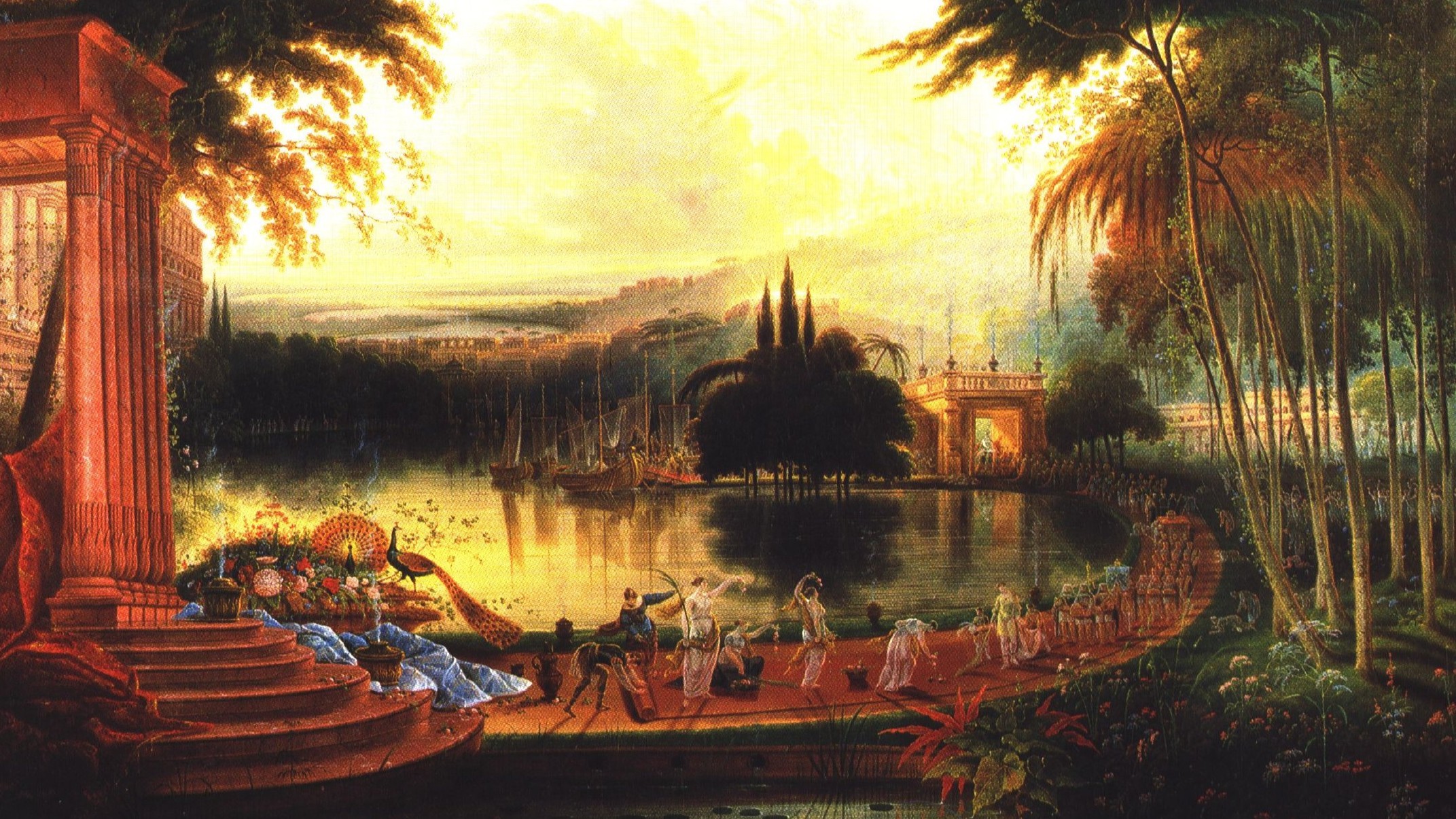
Image credit: “A Romantic Landscape with the Arrival of the Queen of Sheba” by Samuel Colman, 19th century.