
John 4:1-14
Narrative Lectionary
1 Now when JesusI learnedII that the PhariseesIII had heard,IV
I “Jesus” = Iesous. From Hebrew Yehoshua (Joshua, the Lord is salvation); {from YHVH (proper name of the God of Israel; the self-existent and eternal one); {from havah (to become) or from hayah (to come to pass, become, be)} + yasha (to deliver, defend, help, preserve, rescue; properly, to be open, wide or free, which implies being safe. So, in a causative sense, this is to free someone)}. This is Jesus or Joshua in Greek – the Lord saves or the Lord is salvation.
II “learned” = ginosko. This is to know, recognize, realize, perceive, learn. It is knowledge gained through personal experience.
III “Pharisees” = Pharisaios. From Aramaic peras (to divide, separate) and from Hebrew parash (to make distinct, separate, scatter). This is a Pharisee, a member of a Jewish sect active in the 1st century. Their name meant separate in the sense of wanting to live a life separated from sin. Whereas the Sadducees were part of the priestly line and inherited their religious position and responsibilities, Pharisees were regular people who studied the scriptures and offered guidance to regular folk. Sadducees were often wealthier and willing to sacrifice their identity to rub elbows with Roman society. Pharisees were often more concerned with what it meant to follow God without compromising what made them different as followers of God. Sadducees primarily believed in that which was written down (the first five books of the Bible) and Pharisees believed in the Bible and the traditions of the elders. Pharisees had a very wide range of interpretations and diversity of opinion. Their standard mode of religious engagement was lively debate with one another. To argue religion with another teacher was to recognize that they had something of value to offer.
IV “heard” = akouo. This is hear or listen, but it also means to understand by hearing. This is where the word “acoustics” comes from.
“Jesus is makingV and baptizingVI moreVII disciplesVIII than John”IX 2 (although it was not Jesus himself but his disciples who baptized),
V “making” = poieo. This is to make, do, act, construct, abide, or cause.
VI “baptizing” = baptizo. From bapto (to dip or dye; to entirely cover with liquid, to stain). This is to submerge, wash, or immerse. Used specially for baptism.
VII “more” = pleion. From polus (much, many, abundant). This is many, more, great, having a greater value, more excellent.
VIII “disciples” = mathetes. From matheteuo (to make a disciple of); from manthano (to learn key facts, gain knowledge from experience; generally implies reflection as part of the learning process); from math– (thinking things through). This is a disciple, learner, or student. It is where we get “mathematics” from.
IX “John” = Ioannes. Related to “Jesus” in v1. From Hebrew yochanan (Johanan); from Yehochanan (“the Lord has been gracious”); {from YHVH (see note I above) + chanan (beseech, show favor, be gracious; properly, to bend in kindness to someone with less status). This is John, meaning “the Lord has been gracious.”
3 he leftX JudeaXI and startedXII back to Galilee.XIII
X “left” = aphiemi. From apo (from, away from) + hiemi (to send). This is send away, release, permit, forgive, allow to depart, discharge, or send forth.
XI “Judea” = Ioudaia. From Hebrew Yehudah (Judah, son of Jacob, his tribal descendants, a name for the southern kingdom. Literally, it means praised); probably from yadah (to throw one’s hands into the air in a gesture of praise); from yad (hand). This is Judea, which was a Roman province.
XII “started” = aperchomai. From apo (from, away from) + erchomai (to come or go). This is to depart, follow, or go off in a literal or figurative sense.
XIII “Galilee” = Galilaia. From Hebrew galil (cylinder, circuit, district); from galal (to roll in a literal or figurative sense, roll away, roll down, wallow, remove, trust). This is Galilee, meaning perhaps region or cylinder.
4 But he had toXIV goXV through Samaria.XVI
XIV “had to” = dei. From deo (to tie, bind, compel; declare unlawful). This is what is necessary or proper. It is what is needed or what one should do – a duty or something inevitable. This refers to something absolutely necessary.
XV “go” = dierchomai. Related to “started” in v3. From dia (through, across to the other side, thoroughly) + erchomai (see note XII above). This is to go through, come, depart, pierce, travel, traverse.
XVI “Samaria” = Samareia. 11x in NT. From Hebrew Shomron (capital of the northern kingdom of Israel); from shamar (to keep, watch, or preserve; to guard something or to protect it as a thorny hedge protects something). This is Samaria, meaning watch station.
5 So he cameXVII to a SamaritanXVIII cityXIX calledXX Sychar,XXI
XVII “came” = erchomai. Related to “started” in v3 & “go” in v4. See note XII above.
XVIII “Samaritan” = Samareia. Same as “Samaria” in v4. See note XVI above.
XIX “city” = polis. This is a city or its inhabitants. It is a town of variable size, but one that has walls. This is where “metropolis” and “police” come from.
XX “called” = lego. This is to speak, say, name, call, command. It is generally to convey verbally.
XXI “Sychar” = Suchar. 1x in NT. From Hebrew shekar (strong wine, strong drink); from shakar (to become drunk or tipsy, be merry, satiate with alcoholic beverage; figuratively, to influence). This is Sychar, perhaps meaning drunkard.
nearXXII the plot of groundXXIII that JacobXXIV had givenXXV to his sonXXVI Joseph.XXVII
XXII “near” = plesion. 17x in NT. From pelas (near). This is near, nearby, or neighboring. As one nearby, it can also refer to a neighbor, a member of one’s country, a Christian, or a friend.
XXIII “plot of ground” = chorion. 10x in NT. From chora (space, land, region, fields, open area); from chasma (gap, gulf, chasm, open space); from chasko (to gape, yawn). This is place, estate, possession, piece of ground, property.
XXIV “Jacob” = Iakob. From Hebrew Yaaqob (Jacob); from the same as aqeb (heel, hind part, hoof, rear guard of an army, one who lies in wait, usurper). This is James, meaning heel grabber or usurper.
XXV “given” = didomi. To give, offer, place, bestow, deliver. This is give in a literal or figurative sense.
XXVI “son” = huios. This is son, descendant – a son whether natural born or adopted. It can be used figuratively for other forms of kinship.
XXVII “Joseph” = Ioseph. From Hebrew Yoseph (he increases; Joseph); from yasaph (to add, increase, continue, exceed). This is Joseph, meaning “he increases.”
6 Jacob’s wellXXVIII wasXXIX there, and Jesus, tired outXXX
XXVIII “well” = pege. 11x in NT. This is a fount in a literal or figurative sense. So, it could be a spring of water, a fountain, or a well. It is also used for a flow of blood. It can mean more generally the source of something: water, blood, fun.
XXIX “was” = eimi. This is to be, exist.
XXX “tired out” = kopiao. From kopos (labor that leads to exhaustion, depletion, weariness, fatigue; working until worn out); from kopto (to cut, strike, cut off; beating the chest to lament and so to mourn). This is working with effort, whether of the body or mind, growing weary, feeling tired, working hard.
by his journey,XXXI was sittingXXXII by the well. It was about noon.XXXIII
XXXI “journey” = hodoiporia. 2x in NT. From hodoiporos (traveler); {from hodos (way, road, journey) + poreuomai (to travel, transport, journey, die; emphasizes the personal significance in reaching the destination); from poros (passageway, ford)}. This is journeying or travel.
XXXII “sitting” = kathezomai. 7x in NT. From kata (down, against, according to, among) + hezomai (to sit); {from aphedron (a seat, a base). This is to sit down or be sitting.
XXXIII “noon” = hora…hektos. Literally” sixth hour.” Hora is a set time or period, an hour, instant, or season. This is where the word “hour” comes from. Hektos is 14x in NT. From hex (six). This is sixth.
7 A Samaritan womanXXXIV came to drawXXXV water,XXXVI and Jesus saidXXXVII to her, “Give me a drink.”XXXVIII
XXXIV “woman” = gune. Perhaps from ginomai (to come into being, to happen, become, be born; to emerge from one state or condition to another; this is coming into being with the sense of movement or growth). This is woman, wife, or bride. This is where the word “gynecologist” comes from.
XXXV “draw” = antleo. 4x in NT– all in the wedding at Cana (John 2) & the Samaritan woman at the well (John 4). From antlos (ship’s hold; waste water in a ship’s hold). This is to bail out, draw water from a well with a bucket or pitcher.
XXXVI “water” = hudor. Perhaps from huetos (rain); from huo (to rain). This is water literal or figurative. It is one of the roots that “hydrogen” and “hydroelectric” come from.
XXXVII “said” = lego. Same as “called” in v5. See note XX above.
XXXVIII “drink” = pino. This is to drink, literally or figuratively.
8 (His disciples had goneXXXIX to the city to buyXL food.)XLI
XXXIX “gone” = aperchomai. Same as “started” in v3. See note XII above.
XL “buy” = agorazo. From agora (assembly, forum, marketplace, town square, thoroughfare); from ageiro (to gather). This is to go and buy something at market with a focus on goods being transferred. It can also mean to purchase or redeem.
XLI “food” = trophe. 16x in NT. Perhaps from trepho (to bring up, rear, nourish, fatten, nurse; properly, to enlarge through proper nourishment). This is nourishment in a literal or figurative sense. By implication, it can be ration or wages.
9 The SamaritanXLII woman said to him, “How is it that you, a Jew,XLIII askXLIV a drink of me, a woman of Samaria?” (Jews do not share things in commonXLV with Samaritans.)XLVI
XLII “Samaritan” = Samaritis. Related to “Samaria” in v4. 2x in NT. From Samarites (Samaritan); from Samareia (see note XVI above). This is Samaritan or a Samaritan woman.
XLIII “Jew” = Ioudaios. Related to “Judea” in v3. From Ioudas (Judah, Judas); from Hebrew Yehudah (see note XI above). This is Jewish, a Jew, or Judea.
XLIV “ask” = aiteo. This is to ask, demand, beg, desire.
XLV “share things in common” = sugchraomai. 1x in NT. From sun (with, together with; closely identified) + chraomai (to use, make use of, give what is needed, act in a specific way, request). This is dealing with or using something jointly. Figuratively, it can refer to associating with someone or something.
XLVI “Samaritans” = Samarites. Related to “Samaria” in v4 & “Samaritan” in v9. 9x in NT. See note XLII above.
10 Jesus answered her, “If you knewXLVII the giftXLVIII of GodXLIX and who it is that is saying to you, ‘Give me a drink,’ you would have asked him, and he would have given you livingL water.”
XLVII “knew” = eido. This is to know, consider perceive, appreciate, behold, or remember. It means seeing with one’s eyes, but also figuratively, it means perceiving – seeing that becomes understanding. So, by implication, this means knowing or being aware.
XLVIII “gift” = dorea. Related to “given” in v5. 11x in NT. From doron (gift, offering, sacrifice; emphasizes that the gift is given freely, voluntarily); from didomi (see note XXV above). This is a free gift given voluntarily and not received by merit or entitlement. It emphasizes the benevolence of the giver.
XLIX “God” = Theos. From Proto-Indo-European origins, meaning do, put, place. This is God or a god in general.
L “living” = zao. This is to live literally or figuratively. It is used for life including the vitality of humans, plants, and animals – it is life physical and spiritual and life everlasting.
11 The woman said to him, “Sir,LI you haveLII no bucket,LIII and the wellLIV is deep.LV Where do you getLVI that living water?
LI “sir” = kurios. From kuros (authority, supremacy). This is a respectful address meaning master or sir. It refers to one who has control or power greater than one’s own. So, it was also applied to God and Jesus as Master or Lord.
LII “have” = echo. This is to have, hold, possess.
LIII “bucket” = antlema. Related to “draw” in v7. 1x in NT. From antleo (see note XXXV above). This is a vessel one uses to draw water – a bucket.
LIV “well” = phrear. 7x in NT. This is a well, pit, or cistern. Figuratively it is used to refer to the pit in Revelation 9.
LV “deep” = bathus. 4x in NT. Perhaps rom the same root as basis (step, foot); from baino (to walk, go). This is deep or profound in a literal or figurative sense. It can also mean very early.
LVI “get” = echo. Same as “have” in v11. See note LII above.
12 Are you greaterLVII than our ancestorLVIII Jacob, who gave us the wellLIX and with his sons and his flocksLX drank from it?”
LVII “greater” = megas. This is big in a literal or figurative sense – great, large, exceeding, abundant, high, mighty, perfect, strong, etc.
LVIII “ancestor” = pater. This is father in a literal or figurative sense. Could be elder, senior, ancestor, originator, or patriarch.
LIX “well” = phrear. Same as “well” in v11. See note LIV above.
LX “flocks” = thremma. Related to “food” in v8. 1x in NT. From trepho (see note XLI above). This is literally a nursling, but used for cattle or flocks.
13 Jesus said to her, “EveryoneLXI who drinks of this water will be thirstyLXII again, 14 but those who drink of the water that I will give them will neverLXIII be thirsty.
LXI “everyone” = pas. This is all or every.
LXII “be thirsty” = dipsao. 16x in NT. From dipsa (thirst); from dipsos (thirst). This is thirst in a literal or figurative sense. Can also mean keenly desire.
LXIII “never” = ou + me…eis + ho + aion. Literally, “not…to the age.” Aion is from the same as aei (ever, always, unceasingly, perpetually; on every occasion). This is an age, cycle of time, course, continued duration. It is also used to describe the eternal or forever. This is the word used to discuss the present age or the messianic age.
The water that I will give will becomeLXIV in them a springLXV of water gushing upLXVI to eternalLXVII life.”LXVIII
LXIV “become” = ginomai. Related to “woman” in v7. See note XXXIV above.
LXV “spring” = pege. Same as “well” in v6. See note XXVIII above.
LXVI “gushing up” = hallomai. 3x in NT. This is to leap or bubble up.
LXVII “eternal” = aionios. Related to “never” in v14. From aion (see note LXIII above). This is age-long, forever, everlasting. Properly, that which lasts for an age. This is where eon comes from.
LXVIII “life” = zoe. Related to “living” in v10. From zao (see note L above). This is life including the vitality of humans, plants, and animals – it is life physical and spiritual and life everlasting.
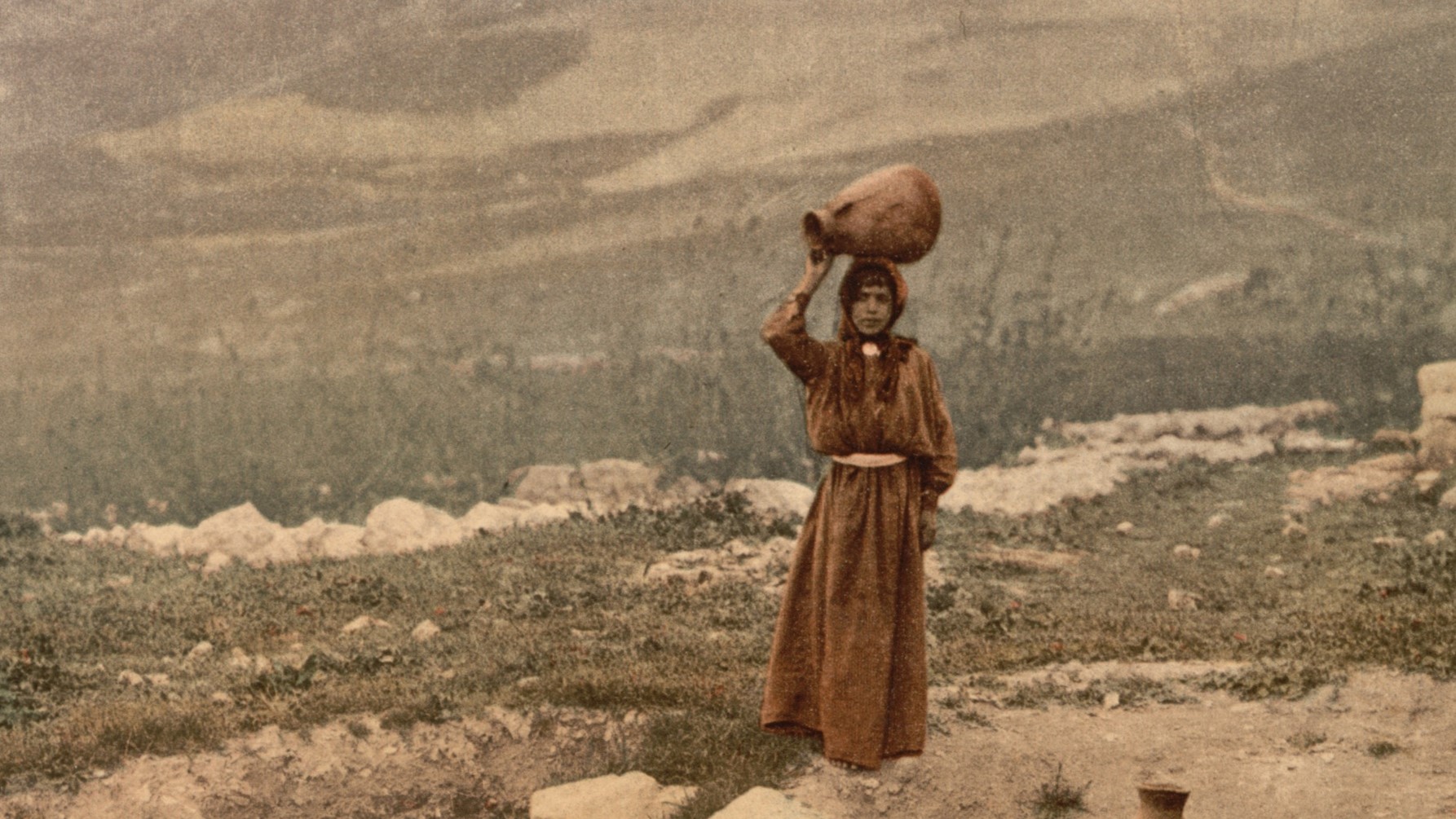
Image credit: “The well of the samaritan (Shechem), Napulus, Holy Land, (i.e., Nablus, West Bank)” from the Photochrom Print Collection, between 1890 and 1900.
