
Galatians 6
1 My brothersI and sisters, if anyoneII is detectedIII in a transgression,IV
I “brothers” = adelphos. From a (with, community, fellowship) + delphus (womb). This is a brother in a literal or figurative sense. It is also used of another member of the Church.
II “anyone” = anthropos. Probably from aner (man, male, husband) + ops (eye, face); {from optanomai (to appear, be seen); perhaps from horao (become, seem, appear)}. This is human, humankind. Used for all genders.
III “is detected” = prolambano. 3x in NT. From pro (before, first, in front of, earlier) + lambano (active acceptance/taking of what is available or what has been offered; emphasizes the choice and action of the individual). This is to anticipate, take by surprise, take before others have the chance to, take before.
IV “transgression” = paraptoma. From para (by, beside, in the presence of) + pipto (to fall in a literal or figurative sense). This is properly, falling away after having been devout or faithful. So, this is a lapse, sin, slip, transgression, offense. It is a deviation from what is true – it could be accidental or unconscious.
you who have received the SpiritV should restoreVI such a one in a spiritVII of gentleness.VIII
V “who have received the Spirit” = pneumatikos. From pneuma (wind, breath, or ghost; a breeze or blast of air, a breath; figuratively, a spirit, the human soul or the part of us that is rational; also angels, demons, God, and the Holy Spirit); from pneo (to blow, breath, breathe hard). This is spiritual, spiritual people, or spiritual things – that which is ethereal or divine or religious.
VI “restore” = katartizo. 13x in NT. From kata (down, against, throughout, among) + artizo (get ready, prepare); {from artios (perfect, complete, ready, adequate, fitted); from arti (now, in the moment); from airo (raise, take up, lift, remove)}. This is to prepare, complete, perfect for final use. This is restoring something to a good condition, whether for the first time or one more. It is to repair in a literal or figurative sense.
VII “spirit” = pneuma. Related to “who have received the Spirit” in v1. See note V above.
VIII “gentleness” = prautes. 12x in NT. From praus (gentle, meek, which implies humility); related to praios (meek, gentle, kind); related to praotes (mildness kindness, meekness; being temperate – gentle, but strong; implies humility). This is gentleness, mildness, meekness, or humility. It is strength mixed with gentleness.
Take careIX that you yourselves are not tempted.X 2 BearXI one another’sXII burdens,XIII
IX “take care” = skopeo. 6x in NT. From skopos (a mark or goal like the marker at the end of a race; figuratively, other goals or destinations; also, a watch or sentry); from skeptomai (to peer out, consider, gaze carefully); perhaps related to skapto (to dig or excavate). This is to look at, take heed, consider, observe, aim at, or spy. This word shares a root with “scope” in English.
X “tempted” = peirazo. From peira (trial, experiment, attempt, experience, assaying); from the base of peran (over, beyond, across); akin to pera (on the far side); from a derivative of peiro (to pierce). This is to test, try, tempt, or make proof of. It is to test, scrutinize, or assay something. It could also be examine, entice, prove, or discipline.
XI “bear” = bastazo. Related to “burdens” in v2. Perhaps from the base of basis (see note XIII below). This is to lift in a literal of figurative sense. It can also mean take up, carry, bear, or remove. Figuratively, it can mean declare, endure, or sustain.
XII “one another’s” = allelon. From allos (other, different, another; this is one more of the same kind or a similar type). So, this is each, another, together, or mutual. There is a different word in Greek that speaks of another as a different kind (heteros).
XIII “burdens” = baros. 6x in NT. From barus (heavy, burdensome; figuratively, violent, oppressive; that which presses down on someone so that they cannot move freely) OR from the same as basis (foot, step, pace); {from baino (to walk to go)}. This is weight, load, authority, abundance. It is something of worth.
and in this way you will fulfillXIV the lawXV of Christ.XVI
XIV “fulfill” = anapleroo. 6x in NT. From ana (up, again, back, among, anew) + pleroo (to fill, make full or complete; properly, filling something up to the maximum extent or induvial capacity; used figuratively for furnish, influence, satisfy, finish, preach, perfect, and fulfill); {from pleres (to be full, complete, abounding in, occupied with)}. This is to fill up, supply, occupy, fulfil. It is adding what is missing so that something can be full.
XV “law” = nomos. From nemo (to parcel out). Literally, this is that which is assigned. It can be usage, custom, or law. This word can be used for human or divine law. It can be used specifically for the law of Moses or as a name for the Torah (the first five books of the Bible). Sometimes it is used for scripture as a whole, used of the Gospel, or of any theology. It is also used for the “tradition of the elders,” which would be the oral Torah – the tradition of the laws plus their interpretations as they were passed down over time. We must carefully consider which meaning of “law” is meant when we interpret passages the word is found in.
XVI “Christ” = Christos. From chrio (consecrate by anointing with oil; often done for prophets, priests, or kings). Literally, the anointed one, Christ. The Greek word for Messiah.
3 For if those who areXVII nothing thinkXVIII they are something, they deceiveXIX themselves.
XVII “are” = eimi. This is to be, exist.
XVIII “think” = dokeo. From dokos (opinion). This is to have an opinion, seem, appear, think, suppose. It deals with a personal judgment. This is the root of the word “doxology.”
XIX “deceive” = phrenapatao. 1x in NT. From phrenapates (self-deceiver, seducer); {from phren (diaphragm, heart, intellect, understanding; figurative for personal opinion or inner mindset; thought regulating action; sympathy, feelings, cognition); {perhaps from phrao (to rein in or curb)} + apate (deception, cheating, treachery, fraud); {from apatao (to deceive, seduce, cheat, delude; focuses on the method used to lure astray)}}. This is to impose upon, act from a twisted sense of reality, to delude.
4 AllXX must testXXI their ownXXII work;XXIII
XX “all” = hekastos. Perhaps from hekas (separate). This is each one, any, every. It is every individual as a distinct entity as opposed to those counted as a group in small sets.
XXI “test” = dokimazo. Related to “think” in v3. From dokimos (what passes the test, approved, acceptable, genuine, verified); from dechomai (to warmly receive, be ready for what is offered, take, accept, or welcome; to receive in a literal or figurative sense) or dokeo (see note XVIII above). This is to test, examine, prove. It is to approve after subjecting to a test to determine if it is real or acceptable. It is to test in a literal or figurative sense.
XXII “own” = monos. Perhaps from meno (to stay, abide, wait, endure). This is alone, single, remaining, mere, desolate.
XXIII “work” = ergon. From ergo (to work, accomplish, do). This is work, task, deed, labor, effort.
then that work, rather than their neighbor’sXXIV work, will becomeXXV a cause for pride.XXVI
XXIV “neighbor’s” = heteros. This is other, another, different, strange. It is another of a different kind in contrast to the Greek word allos, which is another of the same kind. This could be a different quality, type, or group.
XXV “become” = echo. This is to have, hold, possess.
XXVI “cause for pride” = kauchema. 11x in NT. From kauchaomai (literally holding one’s head high – to boast proudly or to glory, joy, exult, rejoice; can be boasting in a positive or negative sense); perhaps from auchen (neck) OR from aucheo (to boast) + euchomai (to wish, request, pray to God). This is the reason for boasting or the boast itself. It could be confidence or reason for pride/glorying. It looks at the result of the boast.
5 For all must carryXXVII their ownXXVIII loads.XXIX
XXVII “carry” = bastazo. Same as “bear” in v2. See note XI above.
XXVIII “own” = idios. This is something that belongs to you or that is personal, private, apart. It indicates a stronger sense of possession than a simple possessive pronoun. This is where “idiot” comes from (denoting someone who hasn’t had formal training or education and so they rely on their own understanding).
XXIX “loads” = phortion. 6x in NT. From phortos (load, cargo); from phero (to bear, bring, lead, make known publicly; to carry in a literal or figurative sense). This is burden, cargo, ship freight. It is an individual’s burden. It can also be the invoice of freight.
6 Those who are taughtXXX the wordXXXI must shareXXXII
XXX “taught” = katecheo. 8x in NT. From kata (down, against, according to, among) + echeo (to sound, reverberate, give a loud sound); {from echos (a loud sound, roaring, or echo. It can also be a report, rumor, or fame); from eche (noise or sound)}. This is literally to sound down. It is to study something by sounding it out and repeating it. It can also imply indoctrinate. This is where “catechism” comes from.
XXXI “word” = logos. From lego (to speak, tell, mention). This is word, statement, speech, analogy. It is a word that carries an idea or expresses a thought, a saying. It could refer to a person with a message or reasoning laid out in words. By implication, this could be a topic, line of reasoning, or a motive. It can be used for a divine utterance or as Word – Christ.
XXXII “share” = koinoneo. 8x in NT. From koinonos (partner, companion, partaker, sharer); From koinos (common, shared, unclean, ritually profane); probably from sun (with, together with). This is to contribute, participate, or have a share in. It can also mean to distribute.
in allXXXIII good thingsXXXIV with their teacher.XXXV
7 Do not be deceived;XXXVI GodXXXVII is not mocked,XXXVIII
XXXIII “all” = pas. This is all, every.
XXXIV “good things” = agathos. This is good, a benefit, or a good thing. It is good by its very nature, intrinsically good. A different word, kalos, refers to external signs of goodness.
XXXV “teacher” = katecheo. Same as “taught” in v6. See note XXX above.
XXXVI “deceived” = planao. From plane (wandering – used figuratively for deceit, error, sin, fraudulence, or wandering from orthodoxy); from planos (wandering, misleading, a deceiver or imposter). This is to wander, lead astray, mislead, mistake, seduce, or deceive. Generally used to refer to sin – going off the right path or roaming from truth/virtue. This word shares a root with “planet” (as a heavenly body that wanders).
XXXVII “God” = Theos. From Proto-Indo-European origins, meaning do, put, place. This is God or a god in general.
XXXVIII “mocked” = mukterizo. 1x in NT. From mukter (nostril) OR from the base of mukaomai (to roar or bellow); {perhaps from muzo (to moo)}. This is to mock, scorn, reject, ridicule.
for you reapXXXIX whatever youXL sow.XLI 8 If you sow to your own flesh,XLII you will reap corruptionXLIII from the flesh,
XXXIX “reap” = therizo. From theros (summer; the heat, which implies summer); from thero (to heat). This is to gather or harvest.
XL “you” = anthropos. Same as “anyone” in v1. See note II above.
XLI “sow” = speiro. Probably from spao (to pull or draw like one draws a sword). This is sowing a seed or scattering. It is sowing in a literal or figurative sense.
XLII “flesh” = sarx. May be from saroo (to sweep, cleanse by sweeping); from sairo (to brush off). This is flesh, the body, human nature, materiality, kindred. Flesh is not always evil in scripture (as when it refers to Jesus taking on a human body). However, it is generally used in a negative way for actions made selfishly and not through faith. This can mean animal flesh, i.e. meat, or refer to body in contrast to soul/spirit. Flesh can be a way of talking about how things or people are related or talking about human frailty (physical or moral).
XLIII “corruption” = phthora. 9x in NT. From phtheiro (to destroy, corrupt, perish, waste away; figuratively, moral decay). This is destruction, corruption, or something perishable. It can be spontaneous decay or corruption inflicted on another in a literal or figurative sense.
but if you sow to the Spirit, you will reap eternalXLIV lifeXLV from the Spirit. 9 So let us not grow wearyXLVI in doingXLVII what is right,XLVIII
XLIV “eternal” = aionios. From aion (an age, length of time); from the same as aei (ever, always, unceasingly, perpetually; on every occasion). This is age-long, forever, everlasting. Properly, that which lasts for an age. This is where eon comes from.
XLV “life” = zoe. From zao (to live, be alive). This is life including the vitality of humans, plants, and animals – it is life physical and spiritual and life everlasting.
XLVI “grow weary” = ekkakeo. 6x in NT. From ek (from, from out of) + kakos (bad, evil, harm, ill; evil that is part of someone’s core character – intrinsic, rotted, worthless, depraved, causing harm; deep inner malice that comes from a rotten character). This is to be faint, bad, fail, or be weak. It is the aftermath of deep, inner weariness – exhausted or dispirited.
XLVII “doing” = poieo. This is to make, do, act, construct, abide, or cause.
XLVIII “right” = kalos. This is good, noble, beautiful, correct, or worthy. This is external signs of goodness like beauty, demonstrations of honorable character, showing moral virtues. A different word, agathos, speaks of intrinsic good.
for weXLIX will reap at harvestL time,LI if we do not give up.LII
XLIX {untranslated} = idios. Same as “own” in v5. See note XXVIII above.
L “reap at harvest” = therizo. Same as “reap” in v7. See note XXXIX above.
LI “time” = kairos. This is season, opportunity, occasion. The word chronos is used for chronological time. Kairos is used for spiritually significant time – the right time or appointed time.
LII “give up” = ekluo. 5x in NT. From ek (from, from out of) + luo (to loose, release, untie; figuratively, to break, destroy, or annul; releasing what had been withheld). This is to loose, release, lose. It can mean to succumb or be faint, i.e. become weak.
10 SoLIII then, whenever we haveLIV an opportunity,LV let us workLVI for the goodLVII
LIII “so” = ara. Related to “restore” in v1. Perhaps similar to aro (to join) OR from airo (see note VI above). This is therefore, perhaps, so, truly.
LIV “have” = echo. Same as “become” in v4. See note XXV above.
LV “opportunity” = kairos. Same as “time” in v9. See note LI above.
LVI “work” = ergazomai. Related to “work” in v4. From ergon (see note XXIII above). This is to work, labor, perform, toil.
LVII “good” = agathos. Same as “good things” in v6. See note XXXIV above.
of allLVIII and especiallyLIX for those of the familyLX of faith.LXI
LVIII “all” = pas. Same as “all” in v6. See note XXXIII above.
LIX “especially” = malista. 12x in NT. From mala (very, very much). This is most, especially, chiefly.
LX “family” = oikeios. 3x in NT. From oikos (house – the building, the household, the family, descendants; the temple). This is domestic or related to a family. It could be a relative or adherent.
LXI “faith” = pistis. From peitho (to have confidence, urge, be persuaded, agree, assure, believe, have confidence, trust). This is less about knowing, believing, and repeating a list of doctrines then it is about trusting God. Faith means listening to God and seeking to live a holy life even (and especially) when we don’t understand how everything works or fits together. Faith is about being faithful (trusting and doing) rather than being all knowing.
11 SeeLXII what largeLXIII lettersLXIV I make when I am writingLXV in my own hand!LXVI
LXII “see” = horao. Related to “anyone” in v1. See note II above.
LXIII “what large” = pelikos. 2x in NT. From the same as helikos (of what size, how much; properly, full grown, an adult); {from helix (mature, adult, of the same age) + houtos (this, they, that, third person pronoun); {ho (the) + autos (he, she, self, same) OR from the same base as pou (somewhere, nearly) + hos (who, which, that). This is how large or how great.
LXIV “letters” = gramma. 15x in NT. From grapho (to write, describe). This is something drawn or written. So, it could be a letter of the alphabet, an epistle, a book, literature, etc.
LXV “writing” = grapho. Related to “letters” in v11. See note LXIV above.
LXVI “hand” = cheir. Perhaps from cheimon (winter, storm – winter as the rainy season); related to the base of chasma (chasm, gap, gulf); from chasko (to yawn). This is the hand in a literal sense. Figuratively, the hand is the means a person uses to accomplish things so it can also mean power, means, or instrument.
12 It is those who wantLXVII to make a good showingLXVIII in the flesh who try to compelLXIX you to be circumcisedLXX—
LXVII “want” = thelo. This is to wish, desire, will, or intend. It is to choose or prefer in a literal or figurative sense. It can also mean inclined toward or take delight in. It can have a sense of being ready to act on the impulse in question.
LXVIII “make a good showing” = euprosopeo. Related to “anyone” in v1 & “see” in v11. 1x in NT. From eu (good, well done, rightly); {from eus (good)} + prosopon (face, surface, or front; can imply presence); {from pros (at, towards, with) + ops (see note II above). This is to look well, make a good display.
LXIX “try to compel” = anagkazo. 9x in NT. From anagke (necessity – something that happensaper that requires an immediate response; generally associated with pain or distress.); {from ana (up, again, anew) + agcho (to press tightly, compress)} or {from ana (up, again, anew) + agkale (the arm, particularly one that is bent to carry a load); {from agkos (a bend)}}. This is to urge, compel, or force.
LXX “be circumcised” = peritemno. 18x in NT. From peri (about, concerning, all around, encompassing) + same as tomos or tomoteros (sharp or keener); {from temno (to cut as with a single slice)}. This is to circumcise – literally to cut around.
onlyLXXI that they may not be persecutedLXXII for the crossLXXIII of Christ.LXXIV
LXXI “only” = monon. Related to “own” in v4. From monos (see note XXII above). This is merely, only, simply, sole. It can also imply alone.
LXXII “be persecuted” = dioko. From dio (put to flight). This is chase or pursue in an aggressive fashion. By implication, it is persecute. It can also be used positively for eagerly pursuing something.
LXXIII “cross” = stauros. From the same as histemi (to stand, cause to stand). This is an upright stake, cross. Literally refers to the horizontal beam of a Roman cross, generally carried by the one convicted to die.
LXXIV {untranslated} = Iesous. From Hebrew Yehoshua (Joshua, the Lord is salvation); {from YHVH (proper name of the God of Israel; the self-existent and eternal one); {from havah (to become) or from hayah (to come to pass, become, be)} + yasha (to deliver, defend, help, preserve, rescue; properly, to be open, wide or free, which implies being safe. So, in a causative sense, this is to free someone)}. This is Jesus or Joshua in Greek – the Lord saves or the Lord is salvation.
13 Even the circumcised do not themselves obeyLXXV the law, but they want you to be circumcised so that they may boastLXXVI about your flesh. 14 MayLXXVII I never boast of anything except the cross of our LordLXXVIII JesusLXXIX Christ,
LXXV “obey” = phulasso. This is to guard something so that it doesn’t escape – to watch over it vigilantly. This is being on guard in a literal or figurative sense.
LXXVI “boast” = kauchaomai. Related to “cause for pride” in v4. See note XXVI above.
LXXVII “may” = ginomai. This is to come into being, to happen, become, be born. It can be to emerge from one state or condition to another or is coming into being with the sense of movement or growth.
LXXVIII “Lord” = Kurios. From kuros (authority, supremacy). This is a respectful address meaning master or sir. It refers to one who has control or power greater than one’s own. So, it was also applied to God and Jesus as Master or Lord.
LXXIX “Jesus” = Iesous. Same as {untranslated} in v12. See note LXXIV above.
by which the worldLXXX has been crucifiedLXXXI to me and I to the world. 15 For neither circumcisionLXXXII nor uncircumcisionLXXXIII is anything,
LXXX “world” = kosmos. Perhaps from the base of komizo (to carry, convey, recover); from komeo (to take care of). This is order, the world, the universe, including its inhabitants. Literally, this is something that is ordered so it can refer to all creation. It can also refer to decoration in the sense that something is better ordered and, thus, made more beautiful. This is where “cosmos” and “cosmetics” come from.
LXXXI “crucified” = stauroo. Related to “cross” in v12. From stauros (see note LXXIII above). This can be to attach someone to a cross or fencing with stakes. In a figurative sense, it could be to destroy, mortify, or subdue passions/selfishness.
LXXXII “circumcision” = peritome. Related to “be circumcised” in v12. From peritemno (see note LXX above). This is properly, cut around, referring to the way that foreskin is removed and so this is to circumcise. It can be used or the rite or the people who are circumcised – in a literal or figurative sense.
LXXXIII “uncircumcised” = akrobustia. Perhaps from akron (end, tip, top, extreme); {related to akantha (thorn bush, thorn); from ake (point, edge)} + posthe (penis). This is foreskin – so, someone who is not circumcised or a Gentile.
but a newLXXXIV creationLXXXV is everything! 16 As for those who will followLXXXVI this ruleLXXXVII—peaceLXXXVIII be upon them,
LXXXIV “new” = kainos. This is not new as in new versus old. This is new in the sense of novel, innovative, or fresh.
LXXXV “creation” = ktisis. 19x in NT. From ktizo (to build, create, form, shape; God’s acts of creation); probably akin to ktaomai (to get, purchase, possess). This is creation, creature, or ordinance. It is also used for when a city is founded and creation as origin.
LXXXVI “follow” = stoicheo. 5x in NT. From stoichos (a row) OR from steicho (in a line). This is walking in rows, according to a uniform cadence. It can be marching in military style. Figuratively, it is one’s walk of life, living piously.
LXXXVII “rule” = kanon. 4x in NT. From kanna (a straight reed). This is a ruler, line, standard, doctrine, rule, boundary, sphere of activity.
LXXXVIII “peace” = eirene. Perhaps from eiro (to join, tie together to form a whole). This is one, peace, quietness, rest, peace of mind, harmony. Peace was a common farewell among Jews (i.e. shalom) and this well-wishing included a blessing of health and wholeness for the individual. This word also indicates wholeness and well-being – when everything that is essential is joined together properly. This is peace literally or figuratively. By implication, it is prosperity (but not in the sense of excessive wealth. Prosperity would have meant having enough from day to day.)
and mercy,LXXXIX and upon the IsraelXC of God.
17 From now on,XCI let no one makeXCII troubleXCIII for me,
LXXXIX “mercy” = eleos. This is mercy, pity, tender mercy, or compassion, whether from humans or from God. This is mercy, generally understood in action by word or deed. When we sing or say “kyrie eleison” (Lord, have mercy), it is related to this word.
XC “Israel” = Israel. From Hebrew Yisrael (God strives or one who strives with God; new name for Jacob and for his offspring); {from sarah (to persist, exert oneself, contend, persevere, wrestle, prevail) + El (God or god)}. This is Israel the people and the land.
XCI “from now on” = loipou. 2x in NT. From loipos (the rest, remained, remnant, other, residue); from leipo (to leave behind, be lacking). This is remaining time, finally, from now on.
XCII “make” = parecho. Related to “become” in v4. 16x in NT– including Luke 6:29: “if anyone strikes you on the cheek, offer the other also.” From para (beside, by, in the presence of) + echo (see note XXV above). This is present, to show, bring, give, offer to hold near.
XCIII “trouble” = kopos. Related to “be circumcised” in v12 & “circumcision” in v15. 18x in NT.
for I carry the marksXCIV of Jesus branded on my body.XCV
18 May the graceXCVI of our Lord Jesus Christ be with your spirit, brothers and sisters. Amen.XCVII
XCIV “marks” = stigma. 1x in NT. From stizo (to stick, prick). This is a mark or brand – burned or cut into skin to indicate ownership. Figuratively speaking, it is a mark of service.
XCV “body” = soma. Perhaps from sozo (to save, heal, rescue); from sos (safe, well, rescued). This is body or flesh. It can be body in a literal or figurative sense (as the body of Christ). This is where the word “somatic” comes from.
XCVI “grace” = charis. From chairo (to rejoice, be glad; used to say hello; properly, delighting in the grace of God or experiencing God’s favor); from char– (to extend favor, lean towards, be inclined to be favorable towards). This is grace, kindness, favor, gratitude, thanks. It is the sense of being inclined to or favorable towards – leaning towards someone to share some good or benefit. This can be literal, figurative, or spiritual. It is grace as abstract concept, manner, or action.
XCVII “amen” = amen. From Hebrew amen (verily, truly, amen, truth, so be it, faithfulness); from aman (to believe, endure, fulfill, confirm, support, be faithful, put one’s trust in, be steadfast. Figuratively, this is to be firm, steadfast, or faithful, trusting, believing, being permanent, morally solid). This word is literally firmness, but figuratively fidelity, faithfulness, honesty, responsibility, trust, truth, steadfastness. Properly, it is to be sure, certain, or firm. This is a word of emphasis indicating that something crucial follows.
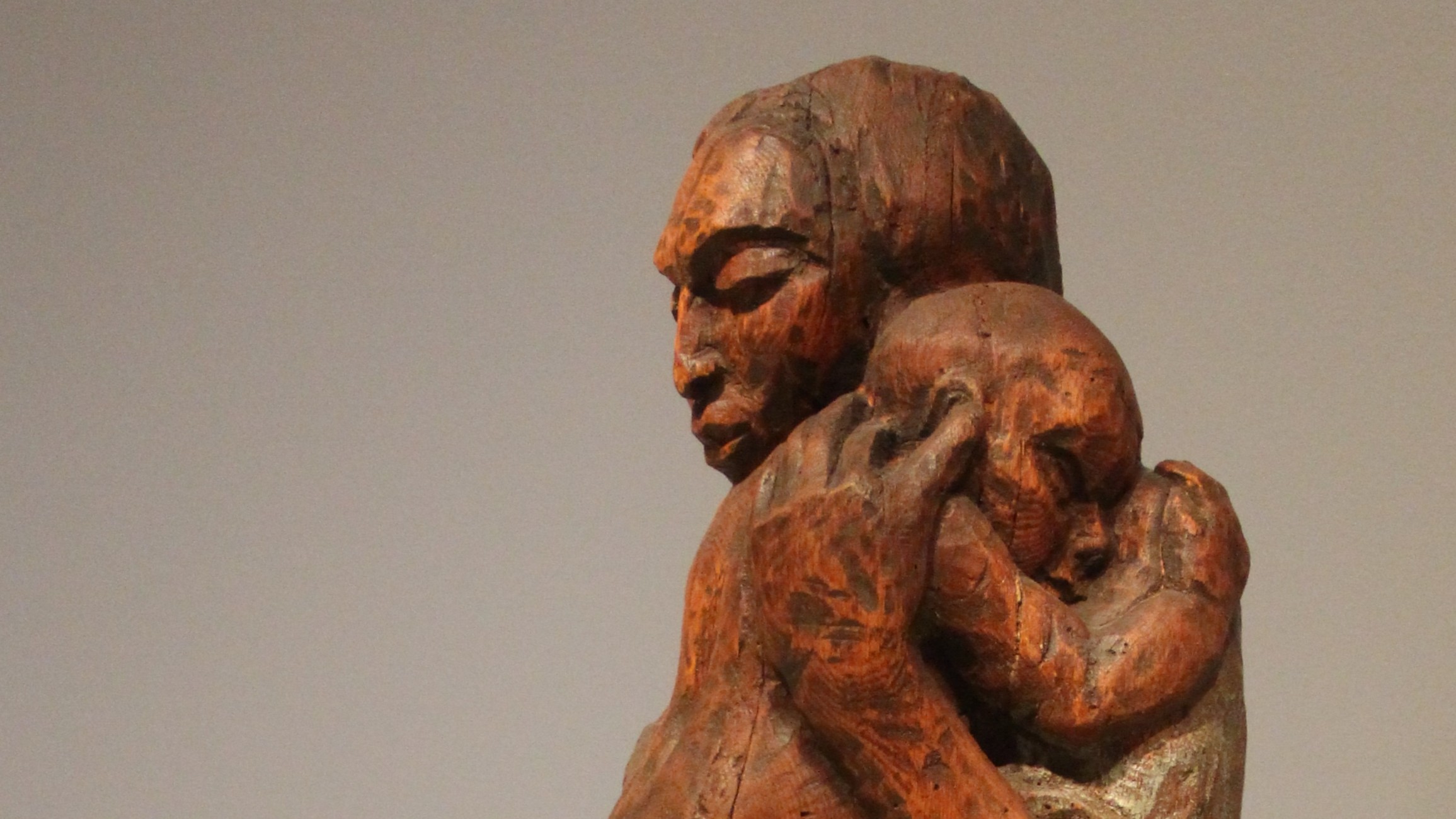
Image credit: Detail of “Untitled (Woman and Child)” by Selma Burke, about 1950.
