1 Kings 3
BibleHub
1 SolomonI made a marriage allianceII with PharaohIII
Notes on verse 1a
I “Solomon” = Shelomoh. From shalam (to be complete or sound; to have safety mentally, physically, or extending to one’s estate; so, if these things are safe and complete, the implication is that one would be friendly; and, if being friendly, one would make amends and that friendship would be reciprocated). This is Solomon or Shelomoh, meaning “peaceful.” It is the same word as the Hebrew word for peace – shalom.
II “made a marriage alliance” = chatan. Perhaps from chathan (bridegroom, son-in-law; someone who is related through marriage; figuratively can be a child who is circumcised). This is to intermarry, make an alliance through marriage, father-in-law, son-in-law, give one’s daughter in marriage.
III “Pharaoh” = Paroh. From Egyptian pr (palace, pharaoh; literally house + great). This is Pharaoh, a title for Egyptian kings. See https://en.wiktionary.org/wiki/pharaoh
kingIV of Egypt;V he tookVI Pharaoh’s daughterVII
Notes on verse 1b
IV “king” = melek. From malak (to be or become king or queen, to rise to the throne, to be crowned; by implication, to take counsel). This is king or royal.
V “Egypt” = Mitsrayim. Perhaps from matsor (besieged or fortified place, bulwark, entrenchment; something hemmed in; a siege or distress or fastness); from tsur (to confine, besiege, to cramp). This is Egypt.
VI “took” = laqach. This is to take, accept, carry away, receive. It can also have the sense of take a wife or take in marriage.
VII “daughter” = bat. From ben (son literal or figurative; also, grandson, subject, nation); from banah (to build or obtain children). This is daughter in a literal or figurative sense.
and broughtVIII her into the cityIX of DavidX
Notes on verse 1c
VIII “brought” = bo. This is to enter, come in, advance, fulfill, bring offerings, enter to worship, attack. It can also have a sexual connotation.
IX “city” = iyr. From uwr (to awaken or wake oneself up). This can mean excitement in the sense of wakefulness or city. Properly, this is a place that is guarded. Guards kept schedules according to watches. This sense of the word would include cities as well as encampments or posts that were guarded.
X “David” = David. From the same as dod (beloved, love, uncle); the root may mean to boil, which is used figuratively to describe love. So, this implies someone you love such as a friend, a lover, or a close family member like an uncle. David’s name likely means something like “beloved one.”
until he had finishedXI buildingXII his own houseXIII and the house of the LordXIV
Notes on verse 1d
XI “finished” = kalah. This is to end, be finished, complete, prepare, consume, spent, or completely destroyed.
XII “building” = banah. Related to “daughter” in v1. See note VII above.
XIII “house” = bayit. Related to “daughter” and “building” in v1. Probably from banah (see note XII above). This is house, court, family, palace, temple.
XIV “Lord” = YHVH. From havah (to be, become) or hayah (to come to pass, become, be). This is the name of the God of Israel, the self-existent and eternal one, the tetragrammaton. This pronunciation has been lost to time so “Lord” is generally used in its place.
and the wallXV aroundXVI Jerusalem.XVII
Notes on verse 1e
XV “wall” = chomah. From the same as cham (father-in-law – one’s husband’s father; perhaps from a root meaning to join). This is a wall – a wall as used for protection.
XVI “around” = sabib. From sabab (turning around, going around; to surround, cast, walk, fetch; to revolve or border in a literal or figurative sense). This is a circuit or a circle. It could refer to an environment, one’s neighbors, or a circular path round about.
XVII “Jerusalem” = Yerushalaim. Related to “Solomon” in v1. From yarah (to throw, shoot, be stunned; to flow as water so figuratively to instruct or teach) + shalam (see note I above). This is Jerusalem, dwelling of peace.
2 The peopleXVIII were sacrificingXIX at the high places,XX
Notes on verse 2a
XVIII “people” = am. From amam (to darken, hide, associate; creating shadows by huddling together). This is people or nation. It can be used specifically for a tribe, collectively of troops or armies, or figuratively to refer to a flock of animals.
XIX “sacrificing” = zabach. This is slaughtering an animal, generally for the purpose of sacrifice. It can mean kill or offer.
XX “high places” = bamah. The root might mean being high. This is height, wave, or elevation.
however,XXI because no house had yetXXII been built for the nameXXIII of the Lord.
Notes on verse 2b
XXI “however” = raq. From the same as raq (thin, surely, only); perhaps from raqaq (to spit). This is but, except, at least. In the sense of being thin, it figuratively refers to some kind of limit.
XXII “yet” = ad + yom + hem. Literally, “until those days.” Yom has a root that may mean being hot. This is the day in a literal or figurative sense. It can also mean birth, age, daylight, continually or other references to time.
XXIII “name” = shem. May be from sim (to put, place, set). This is name, fame, renown. A name was thought to indicate something essential about a person – something about their individuality. So, this word can also mean honor, authority, or character.
3 Solomon lovedXXIV the Lord, walkingXXV in the statutesXXVI
Notes on verse 3a
XXIV “loved” = aheb. This is to love, beloved, friend. It is to have affection for sexually or otherwise.
XXV “walking” = halak. This is go, come, walk. It is walk literally and figuratively and includes people and animals. It can be used figuratively for one’s moral life – how we walk according to God’s way or against it. It can also refer to the walk of life as in the course one’s life takes, the choices we make, etc.
XXVI “statutes” = chuqqah. From choq (statute, boundary, condition, custom, limit, ordinance; something that is prescribed or something that is owed); from chaqaq (to inscribe, carve, or decree; a lawmaker; literally, this is engraving, but it implies enacting a law because laws were carved into stone or metal). This is something prescribed such as a statue, custom, or ordinance.
of his fatherXXVII David, exceptXXVIII that he sacrificed and offered incenseXXIX at the high places.
Notes on verse 3b
XXVII “father” = ab. This is father, chief, or ancestor. It is father in a literal or figurative sense.
XXVIII “except” = raq. Same as “however” in v2. See note XXI above.
XXIX “offered incense” = qatar. Perhaps from qetoreth (smoke, incense, the scent of the sacrifice as it burned); from the same as qitor (thick smoke, vapor). This is to make an offering, particular one of burned incense. It focuses on the fragrance made from the sacrificial fire. This is generally used to refer to worship.
4 The king wentXXX to GibeonXXXI to sacrifice there, for that was the principalXXXII high place;
Notes on verse 4a
XXX “went” = halak. Same as “walking” in v3. See note XXV above.
XXXI “Gibeon” = Gibon. From the same as Geba (Geba or Gibeah; hillock); from the same as gabia (cup, bowl, flower; root might mean being convex). This is Gibeon or Gibon, meaning hilly.
XXXII “principal” = gadol. From gadal (to grow up, become great, become wealthy – to advance. The root meaning may be to twist in the sense of the process of growing). This is great, high, bigger, noble, old, marvelous. It can also refer to someone who is powerful or distinguished.
Solomon used to offerXXXIII a thousandXXXIV burnt offeringsXXXV on that altar.XXXVI
Notes on verse 4b
XXXIII “offer” = alah. Related to “burnt offerings” in v4. See note XXXV below.
XXXIV “thousand” = eleph. Perhaps from the same as eleph (herd, cattle); from alaph (to learn, speak, associate with). This is thousand.
XXXV “burnt offerings” = olah. From alah (to go up, climb, approach, bring; to be high or actively climb; can be literal or figurative). This is a step, stairs, or some kind of ascent. It is also used for whole burnt offerings, being the offering in which the whole thing is burned and rises as smoke. Burnt offerings were the least common of the offerings: most were eaten, shared with the priest and the one bringing the offering.
XXXVI “altar” = mizbeach. Related to “sacrificing” in v2. From zabach (see note XIX above). This is an altar.
5 At Gibeon the Lord appearedXXXVII to Solomon in a dreamXXXVIII by night,XXXIX and GodXL said,XLI “AskXLII what I should giveXLIII you.”
Notes on verse 5
XXXVII “appeared” = raah. This is to see in a literal or figurative sense so stare, advise, think, view.
XXXVIII “dream” = chalom. From chalam (properly, to bind solidly and so to be plump; to be healthy or strong, to recover; figuratively, to dream). This is a dream or dreamer.
XXXIX “night” = layil. Properly, this refers to light twisting away. It is used for night or midnight. Figuratively, this can mean adversity.
XL “God” = Elohim.
XLI “said” = amar. This is to speak, say, answer, command, promise, report.
XLII “ask” = shaal. This is to ask, inquire, beg, borrow, desire, request. It can also mean to demand.
XLIII “give” = natan. This is to give, put, set, offer. It is to give literally or figuratively.
6 And Solomon said, “You have shownXLIV greatXLV and steadfast loveXLVI to your servantXLVII my father David
Notes on verse 6a
XLIV “shown” = asah. This is to make, do, act, appoint, become in many senses.
XLV “great” = gadol. Same as “principal” in v4. See note XXXII above.
XLVI “steadfast love” = chesed. From chasad (being good, kind, merciful; may mean bowing one’s neck as is done in the presence of an equal for courtesy’s sake; so, if one in a superior position is treating you like an equal, that is what is captured here). This is favor, goodness, kindness, loving kindness, pity, reproach, or a good deed. When done by God to humanity, this is mercy/loving kindness. When done by humanity to God, it is piety.
XLVII “servant” = ebed. From abad (to work, serve, compel; any kind of work; used causatively, can mean to enslave or keep in bondage). This is a servant, slave, or bondservant.
because he walked beforeXLVIII you in faithfulness,XLIX in righteousness,L
Notes on verse 6b
XLVIII “before” = paneh. From panah (to turn, face, appear). This is face in a literal or figurative sense. It could be face, presence, anger, respect. It can also be used of God to indicate divine favor or presence.
XLIX “faithfulness” = emet. From aman (to believe, endure, fulfill, confirm, support, be faithful, put one’s trust in, be steadfast. Figuratively, this is to be firm, steadfast, or faithful, trusting, believing, being permanent, morally solid). This is firmness or stability. Figuratively, it is faithfulness, truth, or trustworthiness. This is the same root that “amen” comes from.
L “righteousness” = tsedeqah. From the same as tsedeq (rightness, righteousness, vindication. It is everything that is just or ethical. That which is right in a natural, moral, or legal sense. It also includes just weights (i.e. true weights). Figuratively, this is justice, righteousness, equity – even prosperity). This is righteousness, justice, righteous acts, and moral virtue.
and in uprightnessLI of heartLII toward you, and you have keptLIII for him this great and steadfast love
Notes on verse 6c
LI “uprightness” = yesharah. 1x in OT. From yashar (straight, right, level; pleasing, whether pleasing God or pleasing other people; upright or righteous); from yashar (to be straight, right, even, smooth, or agreeable; figuratively, to make something pleasant or prosperous). This is uprightness or rectitude.
LII “heart” = lebab. May be related to labab (to encourage; properly, to be encased as with fat; used in a good sense, this means to transport someone with love; used in a bad sense, it can mean to dull one’s senses). This is the heart, courage, one’s inner self, the mind, or the will. Heart is only used in a figurative sense in the Old and New Testaments.
LIII “kept” = shamar. This is to keep, watch, or preserve. It means to guard something or to protect it as a thorny hedge protects something.
and have given him a sonLIV to sitLV on his throneLVI today.LVII
Notes on verse 6d
LIV “son” = ben. Related to “daughter” and “building” and “house” in v1. See note VII above.
LV “sit” = yashab. This is to sit and so to remain and so to dwell. It is sitting for any reason – as a judge, in order to ambush, or just sitting quietly. Causatively, this can mean settling or marrying. This can also mean continue, endure, or establish.
LVI “throne” = kisse. From the same as kese (full moon); perhaps from kasah (to cover, conceal, overwhelm; to cover as clothes do or to hide a secret). This is throne – a seat that is covered or has a canopy. Thus, it is a seat that conveys authority.
LVII “today” = yom + zeh. Literally, “this day.” Yom is the same as “yet” in v2. See note XXII above.
7 And now,LVIII O Lord my God, you have made your servant kingLIX in place ofLX my father David, although I am only a littleLXI child;LXII
Notes on verse 7a
LVIII “now” = attah. Perhaps from et (a period or season; whenever or continually); probably from anah (to answer, sing, announce); from ad (forever, all, old); from adah (to pass on, advance, decorate oneself). This is now, from now on.
LIX “made…king” = malak. Related to “king” in v1. See note IV above.
LX “in place of” = tachat. This is underneath, below, the bottom, instead of.
LXI “little” = qaton. From qut (to cut off, be grieved; figuratively to detest). This is small, young, least, not important. It could be a small quantity, size, age, or importance.
LXII “child” = naar. May be from na’ar (to shake, toss up and down, tumble around). This is a child or a servant. It is a child in their active years so they could be aged anywhere from infancy to adolescence.
I do not knowLXIII how to go outLXIV or come in.LXV 8 And your servant is in the midstLXVI of the people whom you have chosen,LXVII
Notes on verses 7b-8a
LXIII “know” = yada. This is to know, acknowledge, advise, answer, be aware, be acquainted with. Properly, this is to figure something out by seeing. It includes ideas of observation, recognition, and care about something. It can be used causatively for instruction, designation, and punishment.
LXIV “go out” = yatsa. This is to go or come out, bring forth, appear. It is to go out in a literal or figurative sense.
LXV “come in” = bo. Same as “brought” in v1. See note VIII above.
LXVI “midst” = tavek. This is among, middle, in the midst, the center. Perhaps, properly, to sever.
LXVII “chosen” = bachar. This is to choose, appoint, try, excellent.
a greatLXVIII people so numerousLXIX they cannot be numberedLXX or counted.LXXI
Notes on verse 8b
LXVIII “great” = rab. From rabab (increasing in any aspect whether quantity, authority, size, quality, greatness, etc.). This is abundance, many, elder, exceedingly, great. It refers to abundance of amount, rank, or status.
LXIX “numerous” = rob. Related to “great” in v8. From rabab (see note LXVIII above). This is any kind of abundance.
LXX “numbered” = manah. To weigh out, reckon, count, number, set, tell. By implication, it is allotting or providing something officially.
LXXI “counted” = saphar. From sepher (writing, document, book, evidence). This is properly to tally or record something. It can be enumerate, recount, number, celebrate, or declare.
9 Give your servant, therefore, an understandingLXXII mindLXXIII, LXXIV to governLXXV your people,
Notes on verse 9a
LXXII “understanding” = shama. This is to hear, call, consent, or consider. It implies listening intelligently, giving attention, and, because of these two factors, obedience and action are often implied.
LXXIII “mind” = leb. Related to “heart” in v6. From the same as lebab (see note LII above). This is inner self, mind, will, feelings, the center.
LXXIV Literally “listening heart.”
LXXV “govern” = shaphat. This is to judge, defend, pronounce judgment, condemn, or govern. It can refer to God judging or to human judges. This is pronouncing a verdict in favor or against so it implies consequences or punishment. It can also mean to litigate or govern as one with authority.
able to discernLXXVI betweenLXXVII goodLXXVIII
Notes on verse 9b
LXXVI “discern” = bin. This is to discern, consider, attend to. It refers to distinguishing things in one’s mind or, more generally, to understand.
LXXVII “between” = bayin. Related to “discern” in v9. From bin (see note LXXVI above).
LXXVIII “good” = tob. From tob (to be pleasing, to be good). This is good, beautiful, pleasant, agreeable, bountiful, at ease. This word is used for goodness as a concept, a good thing, a good person. This can refer to prosperity and welfare as well as joy, kindness, sweetness, and graciousness. So, this is ethically good, but also enjoyably good.
and evil,LXXIX for who canLXXX govern this greatLXXXI people of yours?”
Notes on verse 9c
LXXIX “evil” = ra’. From ra’a’ (to be evil, bad, afflict; properly, to spoil – to destroy by breaking into pieces; figuratively, to cause something to be worthless; this is bad in a physical, social, or moral sense; that which displeases, to do harm or mischief, to punish or vex). This is bad, disagreeable, that which causes pain, misery, something having little or no value, something that is ethically bad, wicked, injury, calamity. This refers to anything that is not what it ought to be – a natural disaster, a disfigurement, an injury, a sin.
LXXX “can” = yakol. This is to be able, endure, overcome, prevail.
LXXXI “great” = kabed. From kabad (to be heavy, weighty, burdensome). This is heavy, grievous, sore. It can also be weighty in the sense of gravitas. The word for “glory” in Hebrew comes from this root (kabod).
10 ItLXXXII pleasedLXXXIII theLXXXIV LordLXXXV that Solomon had asked this.LXXXVI
Notes on verse 10
LXXXII “it” = dabar. From dabar (to speak, declare, discuss). This is speech, a word, a matter, an affair, charge, command, message, promise, purpose, report, request. It is a word, which implies things that are spoken of in a wide sense.
LXXXIII “pleased” = yatab. This is to be good or pleasing, joyful. It can also mean doing good in an ethical sense or be beautiful, happy, successful, or right.
LXXXIV {untranslated} = ayin. This is eye in a literal or figurative sense so eye, appearance, favor, or a fountain (the eye of the landscape).
LXXXV “Lord” = Adonai. From adon (lord, master, owner); root means to rule or be sovereign. This is the actual Hebrew word for Lord used (in a different form) of humans and (in the present form) of God. It means someone who is in control.
LXXXVI {untranslated} = dabar. Same as “it” in v10. See note LXXXII above.
11 God said to him, “BecauseLXXXVII you have asked thisLXXXVIII and have not asked for yourself longLXXXIX lifeXC, XCI
Notes on verse 11a
LXXXVII “because” = yaan. Related to “now” in v7. From anah (see note LVIII above). This is because, since, for the sake of, giving a reason.
LXXXVIII {untranslated} = dabar. Same as “it” in v10. See note LXXXII above.
LXXXIX “long” = rab. Same as “great” in v8. See note LXVIII above.
XC “life” = yom. Root may mean being hot. This is the day in a literal or figurative sense. It can also mean birth, age, daylight, continually or other references to time.
XCI Literally, “many days.”
orXCII richesXCIII orXCIV for the lifeXCV of your enemiesXCVI but have asked for yourself understanding to discern what is right,XCVII
Notes on verse 11b
XCII {untranslated} = shaal. Same as “asked” in v5. See note XLII above.
XCIII “riches” = osher. From ashar (to gain wealth, become rich, enrich; to accumulate). This is fortune or wealth.
XCIV {untranslated} = shaal. Same as “asked” in v5. See note XLII above.
XCV “life” = nephesh. Related to naphash (to refresh or be refreshed). This is soul, self, person, emotion. It is a breathing creature. Can also refer to appetites and desires.
XCVI “enemies” = oyeb. From ayab (to hate or be hostile to). This is a foe or enemy as one that you are hostile to.
XCVII “what is right” = mishpat. Related to “govern” in v9. From shaphat (see note LXXV above). This is a verdict or formal sentence whether from humans or from God. It includes the act of judging as well as the place that judging takes place, the suit itself, and the penalty. Abstractly, this is justice, which includes the rights of the participants.
12 I nowXCVIII doXCIX according to your word.C Indeed,CI I give you a wiseCII and discerning mind;
Notes on verse 12a
XCVIII “now” = hinneh. From hen (lo! Behold! If, though; an expression of surprise). This is to draw attention, show suddenness or surprise, or to emphasize the importance of the coming statement. See! Lo! Behold!
XCIX “do” = asah. Same as “shown” in v6. See note XLIV above.
C “word” = dabar. Same as “it” in v10. See note LXXXII above.
CI “indeed” = hinneh. Same as “now” in v12. See note XCVIII above.
CII “wise” = chakam. From chakam (to be wise or teach wisdom; this is wisdom in thought, word, or action). This is wise, skillful, cunning, or artful.
no one like you has beenCIII beforeCIV you, and no one like you shall ariseCV afterCVI you.
Notes on verse 12b
CIII “been” = hayah. Related to “Lord” in v1. See note XIV above.
CIV “before” = paneh. Same as “before” in v6. See note XLVIII above.
CV “arise” = qum. To arise, stand, accomplish, establish, abide. This is rising as in rising against, getting up after being sick or asleep, arising from one state to another, becoming powerful, or rising for action. It can also be standing in a figurative sense.
CVI “after” = achar. From achar (to remain behind, linger, continue, be behind, or delay; can also imply procrastination). This is after or the last part, following.
13 I give you alsoCVII what you have not asked, bothCVIII riches andCIX honorCX
Notes on verse 13a
CVII “also” = gam. This is also, moreover, again.
CVIII “both” = gam. Same as “also” in v13. See note CVII above.
CIX “and” = gam. Same as “also” in v13. See note CVII above.
CX “honor” = kabod. Related to “great” in v9. From kabad (see note LXXXI above). This is weighty. Figuratively, glorious, abundant, riches, honor, splendor – a reference to one’s reputation or character. This word is often used to describe God and God’s presence.
allCXI your life;CXII no otherCXIII king shall compareCXIV with you.
Notes on verse 13b
CXI “all” = kol. From kalal (to complete). This is all or every.
CXII “life” = yom. Literally, “days.” Same as “life” in v2. See note XC above.
CXIII “other” = ish. Perhaps from enosh (human, humankind, mortal); from anash (to be weak, sick, or frail). This is man, husband, another, or humankind.
CXIV “compare” = hayah. Same as “been” in v12. See note CIII above.
14 If you will walk in my ways,CXV keeping my statutesCXVI and my commandments,CXVII as your father David walked, then I will lengthenCXVIII your life.”CXIX
Notes on verse 14
CXV “ways” = derek. From darak (to tread, march, to walk. Can also mean affixing a string to a box since one needs to step on it to bend it in the process; so also an archer). This is a road as a thing that is walked on. Can be used figuratively for the path that one’s life takes or how one chooses to live one’s life.
CXVI “statutes” = choq. Related to “statutes” in v3. See note XXVI above.
CXVII “commandments” = mitsvah. From tsavah (to charge, command, order, enjoin). This is a commandment, law, ordinance obligation, or tradition. It is something commanded whether by God or by a human authority. This term is sometimes used collectively to refer to the Law.
CXVIII “lengthen” = arak. This is to continue, lengthen prolong, delay, or endure. It is being long or causing something to be long in a literal or figurative sense.
CXIX “life” = yom. Literally, “days.” Same as “life” in v2. See note XC above.
15 Then Solomon awoke;CXX CXXIit had been a dream. He cameCXXII to Jerusalem, where he stoodCXXIII beforeCXXIV the arkCXXV
Notes on verse 15a
CXX “awoke” = yaqats. 10x in OT. This is to awake.
CXXI {untranslated} = hinneh. Same as “now” in v12. See note XCVIII above.
CXXII “came” = bo. Same as “brought” in v1. See note VIII above.
CXXIII “stood” = amad. This is to stand up in a literal or figurative sense. So it can be establish, continue, endure, take a stand, act, be a servant, stand still, remain, stand against an enemy.
CXXIV “before” = paneh. Same as “before” in v6. See note XLVIII above.
CXXV “ark” = aron. Perhaps from arah (to gather or pluck). This is a chest, box, or coffin. It is used for the Ark of the Covenant.
of the covenantCXXVI of the Lord.CXXVII He offered up burnt offerings andCXXVIII offerings of well-beingCXXIX and providedCXXX a feastCXXXI for all his servants.
Notes on verse 15b
CXXVI “covenant” = berit. Perhaps from barah (to eat, choose, make clear); perhaps from bar (grain, wheat); from barar (to select, purify, cleanse, test, brighten, polish). This is a compact, covenant, alliance, treaty, or league.
CXXVII “Lord” = Adonai. Same as “Lord” in v10. See note LXXXV above.
CXXVIII {untranslated} = asah. Same as “shown” in v6. See note XLIV above.
CXXIX “offerings of well-being” = shelem. Related to “Solomon” and “Jerusalem” in v1. From shalam (see note I above). This is a peace offering or a sacrifice of well-being. It was a voluntary offering given when one celebrated thanksgiving, alliance, or friendship.
CXXX “provided” = asah. Same as “shown” in v6. See note XLIV above.
CXXXI “feast” = mishteh. From shathah (to drink literally or figuratively; a drinker). This is drink or the act of drinking. So it is a feast or banquet, as occasions with drinking.
16 Later,CXXXII twoCXXXIII womenCXXXIVwho were prostitutesCXXXV came to the king and stood beforeCXXXVI him.
Notes on verse 16
CXXXII “later” = az. This is beginning, now, from, since.
CXXXIII “two” = shenayim. From sheni (double, again, another, second); from shanah (to fold, repeat, double, alter, or disguise). This is two, both, second, couple.
CXXXIV “woman” = ishshah. Related to “other” in v13. From ish (see note CXIII above). This is woman, wife, or female.
CXXXV “prostitutes” = zonot. 2x in OT. From zanah (being or playing a prostitute; figuratively, fornicating). This is armor or prostitute.
CXXXVI “before” = paneh. Same as “before” in v6. See note XLVIII above.
17 The oneCXXXVII woman said, “Please,CXXXVIII my lord,CXXXIX this woman and I liveCXL in the sameCXLI house, and I gave birthCXLII while she was in the house.
Notes on verse 17
CXXXVII “one” = echad. Perhaps from achad (to unify, continue on a path; figuratively, to gather one’s thoughts). This is the number one, first, united. It can also be alone, altogether, a certain, a few.
CXXXVIII “please” = biy. 12x in OT. Perhaps from ba’ah (to inquire, search, boil, or swell out. Figuratively, it could be to sincerely desire). This is O, I pray – it is used to make a request or to speak to someone of higher social status. It is always followed by, “my lord.” In the Bible it is used in addressing a higher status human, an angel, and also God.
CXXXIX “lord” = adon. Related to “Lord” in v10. See note LXXXV above.
CXL “live” = yashab. Same as “sit” in v6. See note LV above.
CXLI “same” = echad. Same as “one” in v17. See note CXXXVII above.
CXLII “gave birth” = yalad. This is to bear or bring forth. It can mean to act as midwife or to show one’s lineage. This is often used for birth or begetting.
18 ThenCXLIII on the thirdCXLIV dayCXLV after I gave birth, this woman also gave birth. We were together;CXLVI there was noCXLVII oneCXLVIII else with us in the house; onlyCXLIX the two of us were in the house.
Notes on verse 18
CXLIII {untranslated} = hayah. Same as “been” in v12. See note CIII above.
CXLIV “third” = shelishi. From shalosh (three, fork, triad). This is third or one-third of something.
CXLV “day” = yom. Same as “life” in v2. See note XC above.
CXLVI “together” = yachad. From yachad (to join, be united). This is a unit, both, altogether, unitedness, alike.
CXLVII “no” = ayin. Perhaps from a word that means to be nothing. This means nothing, none, non-existent. It can also simply mean not or are not.
CXLVIII “one” = zur. This is to come from somewhere else – a stranger. It is to stop for lodging. Figuratively, it can also mean to profane or commit adultery.
CXLIX “only” = zulah. 16x in OT. Perhaps from zul (to shake out, lavish, despise). This is removal, except, besides.
19 Then this woman’s son diedCL in the night because she layCLI on him. 20 She got upCLII in the middleCLIII of the night and took my son from besideCLIV me while your servantCLV slept.CLVI
Notes on verses 19-20a
CL “died” = mut. This is to die in a literal or figurative sense. It can also refer to being a dead body.
CLI “lay” = shakab. This is to lie down, lodge. It is lying for sleep, sex, or other reasons.
CLII “got up” = qum. Same as “arise” in v12. See note CV above.
CLIII “middle” = tavek. Same as “midst” in v8. See note LXVI above.
CLIV “beside” = etsel. From atsal (to reserve, refuse, join, separate, keep). This is nearby, toward, joining.
CLV “servant” = amah. This is female servant or slave, handmaid.
CLVI “slept” = yashen. 5x in OT. From yashen (to be languid or go slack; it can mean to sleep, become old or stale, or die). This is sleeping, sleepy, those who sleep.
She laid him at her breastCLVII and laid her dead son at my breast. 21 When I roseCLVIII in the morningCLIX to nurseCLX my son,
Notes on verses 20b-21a
CLVII “breast” = cheq. Root may mean to enclose. This is bosom in a literal or figurative sense. So, this could be arms, lap, or midst. It can also be care or cherish.
CLVIII “rose” = qum. Same as “arise” in v12. See note CV above.
CLIX “morning” = boqer. From baqar (to seek, plow, break forth, admire, care for). This refers to the break of day. So it is dawn, early, morning, or morrow.
CLX “nurse” = yanaq. This is to suckle or to nurse. In a causative sense, it can mean to give milk. So, this word can be used for a nursing mother or for her suckling child.
CLXII saw that he was dead, but when I looked at him closelyCLXII in the morning, clearlyCLXIII it was not the son I had borne.”CLXIV
22 But the otherCLXV woman said, “No, the livingCLXVI son is mine, and the dead son is yours.”
Notes on verses 21b-22a
CLXI {untranslated} = hinneh. Same as “now” in v12. See note XCVIII above.
CLXII “looked…closely” = bin. Same as “discern” in v9. See note LXXVI above.
CLXIII “clearly” = hinneh. Same as “now” in v12. See note XCVIII above.
CLXIV “borne” = yalad. Same as “gave birth” in v17. See note CXLII above.
CLXV “other” = acher. Related to “after” in v12. From achar (see note CVI above). This is following, next, strange, other.
CLXVI “living” = chay. From chayah (to live or keep alive literally or figuratively). This is alive, living, lifetime. It can also be used to describe someone’s age. It can refer to animals, plants, water, or a company or congregation of people. It is life in a very broad sense.
The first said, “No, the dead son is yours, and the livingCLXVII son is mine.” So they arguedCLXVIII beforeCLXIX the king.
23 Then the king said, “The oneCLXX says, ‘This is my son who is alive,CLXXI and your son is dead,’ while the otherCLXXII says, ‘Not so! Your son is dead, and my son is the living one.’”
Notes on verses 22b-23
CLXVII “living” = chay. Same as “living” in v22. See note CLXVI above.
CLXVIII “argued” = dabar. Related to {untranslated} in v10. See note LXXXII above.
CLXIX “before” = paneh. Same as “before” in v6. See note XLVIII above.
CLXX “one” = zot. Literally, “this one.”
CLXXI “alive” = chay. Same as “living” in v22. See note CLXVI above.
CLXXII “other” = zot. Literally, “this one.”
24 So the king said, “BringCLXXIII me a sword,”CLXXIV and they broughtCLXXV a sword beforeCLXXVI the king.
Notes on verse 24
CLXXIII “bring” = laqach. Same as “took” in v1. See note VI above.
CLXXIV “sword” = chereb. From charab (to attack, slay). This is any sharp instrument like a sword, dagger, axe, or mattock.
CLXXV “brought” = bo. Same as “brought” in v1. See note VIII above.
CLXXVI “before” = paneh. Same as “before” in v6. See note XLVIII above.
25 The king said, “DivideCLXXVII the livingCLXXVIII boyCLXXIX in two; then give halfCLXXX to the oneCLXXXI and half to the other.”CLXXXII
Notes on verse 25
CLXXVII “divide” = gazar. 13x in OT. This is to cut or cut down. Used figuratively, it can mean to divide, exclude, decree, or destroy.
CLXXVIII “living” = chay. Same as “living” in v22. See note CLXVI above.
CLXXIX “boy” = yeled. Related to “gave birth” in v17. From yalad (see note CXLII above). This is something born – so, offspring, youth, fruit. It is the same word used in Isaiah 9:6 “for a child will be born to us.”
CLXXX “half” = chatsi. From chatsah (to halve, divide, reach, participate). This is half, middle, midnight, midst.
CLXXXI “one” = echad. Same as “one” in v17. See note CXXXVII above.
CLXXXII “other” = echad. Same as “one” in v17. See note CXXXVII above.
26 But the woman whose son was aliveCLXXXIII said to the king, because compassionCLXXXIV for her son burnedCLXXXV within her,CLXXXVI
Notes on verse 26a
CLXXXIII “alive” = chay. Same as “living” in v22. See note CLXVI above.
CLXXXIV “compassion” = racham. From the same as rechem (womb); from racham (to love, have compassion, have mercy); from racham (compassion, tender love, womb, compassion; the womb as that which cherishes the fetus). This is compassion, mercy, or tender love.
CLXXXV “burned” = kamar. 4x in OT. This is to grow hot, be aflame, to contract from proximity to heat, to desire or be impacted with passion or pity. It can have a sense of tenderness.
CLXXXVI {untranslated} = amar. Same as “said” in v5. See note XLI above.
“Please,CLXXXVII my lord,CLXXXVIII give her the livingCLXXXIX boy;CXC certainly do not killCXCI him!”
The otherCXCII said, “It shall be neitherCXCIII mine norCXCIV yours; divide it.”
Notes on verse 26b
CLXXXVII “please” = biy. Same as “please” in v17. See note CXXXVIII above.
CLXXXVIII “lord” = adon. Same as “lord” in v17. See note CXXXIX above.
CLXXXIX “living” = chay. Same as “living” in v22. See note CLXVI above.
CXC “boy” = yalad. Same as “gave birth” in v17. See note CXLII above.
CXCI “kill” = mut…mut. Same as “died” in v19. See note CL above. The word is repeated twice – the first time as an Infinitive Absolute. The Infinitive Absolute serves to emphasize the sentiment of the word. It is rather like Foghorn Leghorn’s speech pattern, “I said, I said.”
CXCII “other” = zoth. Literally, “this one.”
CXCIII “neither” = gam…lo. Gam is the same as “also” in v13. See note CVII above.
CXCIV “nor” = gam…lo. Gam is the same as “also” in v13. See note CVII above.
27 Then the king responded,CXCV, CXCVI “Give her the livingCXCVII boy;CXCVIII do not kill him. She is his mother.”CXCIX
Notes on verse 27
CXCV “responded” = anah. Related to “now” in v7 & “because” in v11. See note LVIII above.
CXCVI {untranslated} = amar. Same as “said” in v5. See note XLI above.
CXCVII “living” = chay. Same as “living” in v22. See note CLXVI above.
CXCVIII “boy” = yalad. Same as “gave birth” in v17. See note CXLII above.
CXCIX “mother” = em. This is a mother as binding a family together or a breeding female animal. It could be mother in a literal or figurative sense.
28 All IsraelCC heardCCI of the judgmentCCII that the king had rendered,CCIII and they stood in aweCCIV
Notes on verse 28a
CC “Israel” = Yisrael. Related to “God” in v5. From sarah (to persist, exert oneself, contend, persevere, wrestle, prevail) + El (see note XL above). This is Israel, meaning God strives or one who strives with God; new name for Jacob and for his offspring. This refers to the people and to the land.
CCI “heard” = shama. Same as “understanding” in v9. See note LXXII above.
CCII “judgment” = mishpat. Same as “what is right” in v19. See note XCVII above.
CCIII “rendered” = shaphat. Same as “govern” in v9. See note LXXV above.
CCIV “stood in awe” = yare. This is to fear, be afraid, dreadful. It can also refer to fearful reverence – to fear in a moral sense is to say to revere, respect.
ofCCV the king because they perceivedCCVI that the wisdomCCVII of God was inCCVIII him to executeCCIX justice.CCX
Notes on verse 28b
CCV “of” = paneh. Same as “before” in v6. See note XLVIII above.
CCVI “perceived” = raah. Same as “appeared” in v5. See note XXXVII above.
CCVII “wisdom” = chokmah. Related to “wise” in v12. From chakam (see note CII above). This is wisdom, wit, or skillfulness.
CCVIII “in” = qereb. Perhaps from qarab (to come near or approach). This is among, in the midst, before, the center It is the inward part, whether literal or figurative. It can also be used for the heart, the site of thoughts and feelings. This word is also used as a technical term for the entrails of the animals who are sacrificed.
CCIX “execute” = asah. Same as “shown” in v6. See note XLIV above.
CCX “justice” = mishpat. Same as “what is right” in v19. See note XCVII above.
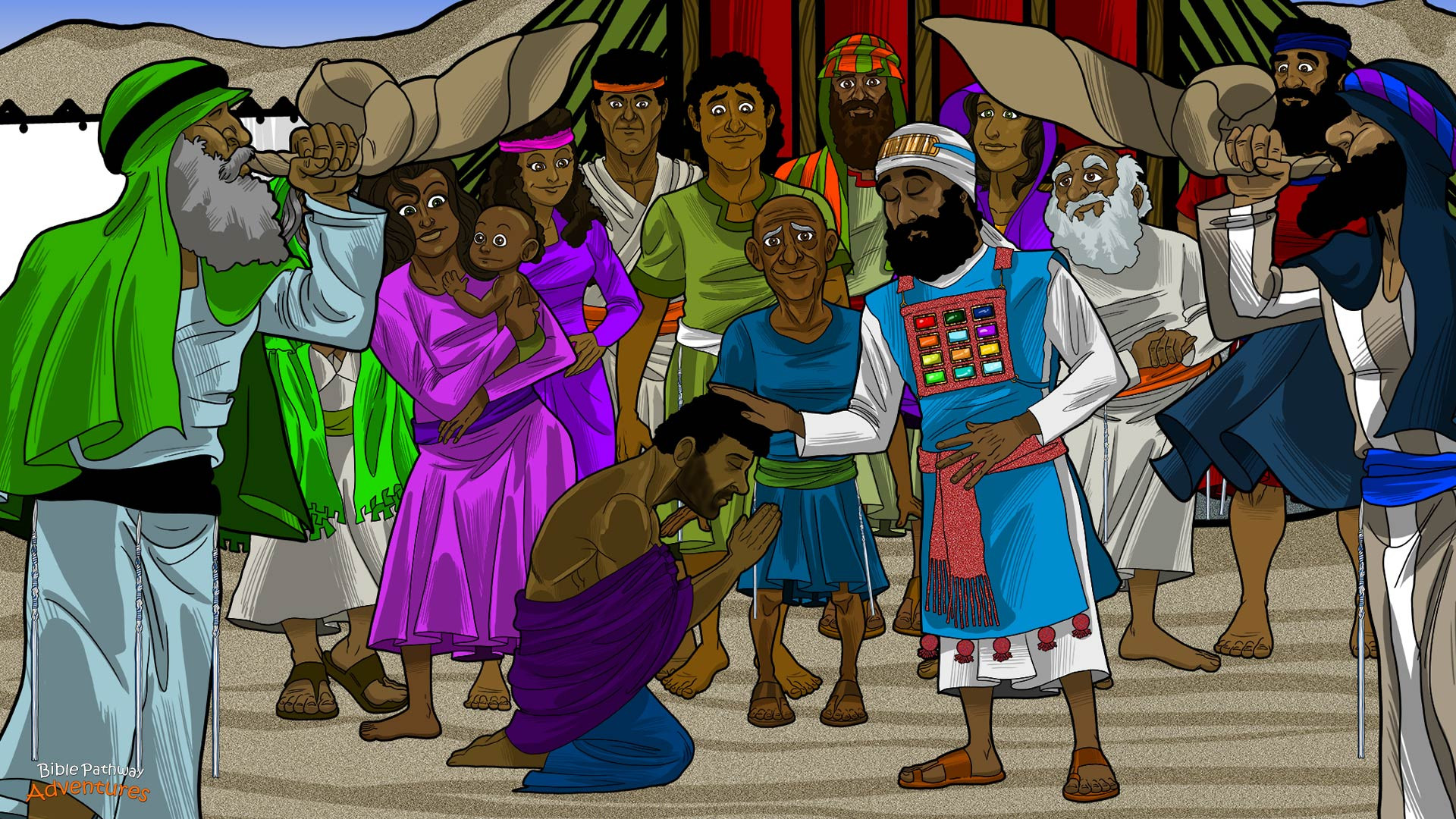
Image credit: “Solomon the Temple Builder” by Curtis and Pip Reid of Bible Pathway Adventures.