1 Kings 2
BibleHub
1 When David’sI timeII to dieIII drew near,IV
Notes on verse 1a
I “David’s” = David. From the same as dod (beloved, love, uncle); the root may mean to boil, which is used figuratively to describe love. So, this implies someone you love such as a friend, a lover, or a close family member like an uncle. David’s name likely means something like “beloved one.”
II “time” = yom. Root may mean being hot. This is the day in a literal or figurative sense. It can also mean birth, age, daylight, continually or other references to time.
III “die” = mut. This is to die in a literal or figurative sense. It can also refer to being a dead body.
IV “drew near” = qarab. This is to come near, offer, make ready, approach, take.
he chargedV his sonVI Solomon,VII saying:VIII
Notes on verse 1b
V “charged” = tsavah. This is to charge, command, order, appoint, or enjoin. This is the root that the Hebrew word for “commandment” comes from (mitsvah).
VI “son” = ben. From banah (to build or obtain children). This is son, age, child. It is son in a literal or figurative sense.
VII “Solomon” = Shelomoh. From shalam (to be complete or sound; to have safety mentally, physically, or extending to one’s estate; so, if these things are safe and complete, the implication is that one would be friendly; and, if being friendly, one would make amends and that friendship would be reciprocated). This is Solomon or Shelomoh, meaning “peaceful.” It is the same word as the Hebrew word for peace – shalom.
VIII “saying” = amar. This is to speak, say, answer, command, promise, report.
2 “I am about to goIX the wayX of allXI the earth.XII
Notes on verse 2a
IX “go” = halak. This is go, come, walk. It is walk literally and figuratively and includes people and animals. It can be used figuratively for one’s moral life – how we walk according to God’s way or against it. It can also refer to the walk of life as in the course one’s life takes, the choices we make, etc.
X “way” = derek. From darak (to tread, march, to walk. Can also mean affixing a string to a box since one needs to step on it to bend it in the process; so also an archer). This is a road as a thing that is walked on. Can be used figuratively for the path that one’s life takes or how one chooses to live one’s life.
XI “all” = kol. From kalal (to complete). This is all or every.
XII “earth” = erets. Root may mean to be firm. This is earth, ground, field land, or country.
Be strong,XIII beXIV courageous,XV 3 and keepXVI the chargeXVII
Notes on verses 2b-3a
XIII “be strong” = chazaq. This is to strengthen, seize, be courageous, repair, bind, heal, conquer, harden.
XIV “be” = hayah. This is to be or become, to happen.
XV “courageous” = ish. Perhaps from enosh (human, humankind, mortal); from anash (to be weak, sick, or frail). This is man, husband, another, or humankind.
XVI “keep” = shamar. This is to keep, watch, or preserve. It means to guard something or to protect it as a thorny hedge protects something.
XVII “charge” = mishmeret. Related to “keep” in v3. From mishmar (jail, guard, watch, guard post); from shamar (see note XVI above). This is a guard or watch or guard post. It is used figuratively for obligation, duty, or observance, including religious observance.
of the LordXVIII your God,XIX walkingXX in his ways and keeping his statutes,XXI his commandments,XXII
Notes on verse 3b
XVIII “Lord” = YHVH. Related to “be” in v2. From havah (to be, become) or hayah (see note XIV above). This is the name of the God of Israel, the self-existent and eternal one, the tetragrammaton. This pronunciation has been lost to time so “Lord” is generally used in its place.
XIX “God” = Elohim.
XX “walking” = halak. Same as “go” in v2. See note IX above.
XXI “statutes” = chuqqah. From choq (statute, boundary, condition, custom, limit, ordinance; something that is prescribed or something that is owed); from chaqaq (to inscribe, carve, or decree; a lawmaker; literally, this is engraving, but it implies enacting a law because laws were carved into stone or metal). This is something prescribed such as a statue, custom, or ordinance.
XXII “commandments” = mitsvah. Related to “charged” in v1. From tsavah (see note V above). This is a commandment, law, ordinance obligation, or tradition. It is something commanded whether by God or by a human authority. This term is sometimes used collectively to refer to the Law.
his ordinances,XXIII and his testimonies,XXIV as it is writtenXXV in the lawXXVI of Moses,XXVII
Notes on verse 3c
XXIII “ordinances” = mishpat. From shaphat (to judge, defend, pronounce judgment, condemn, govern). This is a verdict or formal sentence whether from humans or from God. It includes the act of judging as well as the place that judging takes place, the suit itself, and the penalty. Abstractly, this is justice, which includes the rights of the participants.
XXIV “testimonies” = eduth. From ed (witness, testimony, recorder); from ud (to admonish, repeat, duplicate, testify, restore, record, relieve). This is testimony, ordinance, decree, warning, or witness.
XXV “written” = katab. This is to inscribe, write, record, or decree.
XXVI “law” = torah. From yarah (to throw, shoot, be stunned; to flow as water so figuratively to instruct or teach). This is law, instruction, teaching, or statute. It can also refer to the first five books of the Bible – the Torah.
XXVII “Moses” = Mosheh. From mashah (to pull out in a literal or figurative sense, to draw out) OR from Egyptian mes or mesu (child, son i.e. child of…). This is Moses – the one drawn out from the water, which is to say, rescued. If derived from the Egyptian, his name would share a root with Rameses and Thutmose.
so thatXXVIII you may prosperXXIX in all that you doXXX and whereverXXXI you turn.XXXII
Notes on verse 3d
XXVIII “so that” = maan. From anah (to answer, respond, announce, sing, shout, or testify; to pay attention, which implies responding and, by extension, starting to talk; singing, shouting, testifying, etc.). This is because of, occurring because of a motive or purpose.
XXIX “prosper” = sakal. This is to consider or be prudent and so it can mean to instruct or be an expert. It can also mean dealing prudently, which implies success and prospering. This verb presumes intelligence of the subject. In one form of the verb, it can mean laying cross-wise.
XXX “do” = asah. This is to make, do, act, appoint, become in many senses.
XXXI “wherever” = kol. Same as “all” in v3. See note XI above.
XXXII “turn” = panah. This is to turn, regard, appear, look, prepare.
4 ThenXXXIII the Lord will establishXXXIV his wordXXXV that he spokeXXXVI concerning me:XXXVII
Notes on verse 4a
XXXIII “then” = maan. Same as “so that” in v3. See note XXVIII above.
XXXIV “establish” = qum. To arise, stand, accomplish, establish, abide. This is rising as in rising against, getting up after being sick or asleep, arising from one state to another, becoming powerful, or rising for action. It can also be standing in a figurative sense.
XXXV “word” = dabar. From dabar (to speak, declare, discuss). This is speech, a word, a matter, an affair, charge, command, message, promise, purpose, report, request. It is a word, which implies things that are spoken of in a wide sense.
XXXVI “spoke” = dabar. Related to “word” in v4. See note XXXV above.
XXXVII {untranslated} = amar. Same as “saying” in v1. See note VIII above.
‘If your heirsXXXVIII take heedXXXIX to their way, to walk beforeXL me in faithfulnessXLI
Notes on verse 4b
XXXVIII “heirs” = ben. Same as “son” in v1. See note VI above.
XXXIX “take heed” = shamar. Same as “keep” in v3. See note XVI above.
XL “before” = paneh. Related to “turn” in v3. From panah (see note XXXII above). This is face in a literal or figurative sense. It could be face, presence, anger, respect. It can also be used of God to indicate divine favor or presence.
XLI “faithfulness” = emet. From aman (to believe, endure, fulfill, confirm, support, be faithful, put one’s trust in, be steadfast. Figuratively, this is to be firm, steadfast, or faithful, trusting, believing, being permanent, morally solid). This is firmness or stability. Figuratively, it is faithfulness, truth, or trustworthiness. This is the same root that “amen” comes from.
with all their heartXLII and with all their soul,XLIII, XLIV there shall not failXLV you
Notes on verse 4c
XLII “heart” = lebab. May be related to labab (to encourage; properly, to be encased as with fat; used in a good sense, this means to transport someone with love; used in a bad sense, it can mean to dull one’s senses). This is the heart, courage, one’s inner self, the mind, or the will. Heart is only used in a figurative sense in the Old and New Testaments.
XLIII “soul” = nephesh. Related to naphash (to refresh or be refreshed). This is soul, self, person, emotion. It is a breathing creature. Can also refer to appetites and desires.
XLIV {untranslated} = amar. Same as “saying” in v1. See note VIII above.
XLV “fail” = karat. This is to cut down, cut off, or make a covenant (idiom for making a covenant is “to cut a covenant”). It can also mean to destroy, fail, or consume.
a successorXLVI on the throneXLVII of Israel.’XLVIII
Notes on verse 4d
XLVI “successor” = ish. Same as “courageous” in v2. See note XV above.
XLVII “throne” = kisse. From the same as kese (full moon); perhaps from kasah (to cover, conceal, overwhelm; to cover as clothes do or to hide a secret). This is throne – a seat that is covered or has a canopy. Thus, it is a seat that conveys authority.
XLVIII “Israel” = Yisrael. Related to “God” in v3. From sarah (to persist, exert oneself, contend, persevere, wrestle, prevail) + El (see note XIX above). This is Israel, meaning God strives or one who strives with God; new name for Jacob and for his offspring. This refers to the people and to the land.
5 “Moreover, you knowXLIX alsoL what JoabLI son of ZeruiahLII did to me,
Notes on verse 5a
XLIX “know” = yada. This is to know, acknowledge, advise, answer, be aware, be acquainted with. Properly, this is to figure something out by seeing. It includes ideas of observation, recognition, and care about something. It can be used causatively for instruction, designation, and punishment.
L “moreover…also” = gam. This is also, moreover, again.
LI “Joab” = Yoab. Related to “be” in v2 & “Lord” in v3. From YHVH (see note XVIII above) + ab (father, ancestor, grandfather; father in a literal or figurative sense). This is Joab or Yoab, meaning “the Lord is father.”
LII “Zeruiah” = Tseruyah. Related to “be” in v2 & “Lord” in v3 & “Joab” in v5. From the same as tsori (root might be to crack as under pressure, to leak; gum from the balsam tree – perhaps commiphora gileadensis) + Yah (the shortened form of the name of the God of Israel; God, Lord); {from YHVH (see note XVIII above)} OR tsur (rock, stone, cliff, boulder, rocky; a refuge, God); {from tsur (to confine, cramp, or bind in a literal or figurative sense; to besiege, assault, or distress)} + Yah (see above). This is Zeruiah, meaning “wounded” or “balsam of the Lord” or “his rock is the Lord.” See https://www.abarim-publications.com/Meaning/Zeruiah.html & https://en.wikipedia.org/wiki/Balsam & https://en.wikipedia.org/wiki/Balm_of_Gilead.
how he dealtLIII with the twoLIV commandersLV of the armiesLVI of Israel,
Notes on verse 5b
LIII “dealt” = asah. Same as “do” in v3. See note XXX above.
LIV “two” = shenayim. From sheni (double, again, another, second); from shanah (to fold, repeat, double, alter, or disguise). This is two, both, second, couple.
LV “commanders” = sar. This is chief, leader, ruler, lord, official, governor, prince, military leader. It refers to someone at the top of a rank or class.
LVI “armies” = tsaba. From tsaba (to wage war, serve, assemble, fight, perform, muster, wait on). This is a large group of persons (used figuratively for a group of things). It implies a campaign literally as with army, war, warfare, battle, company, soldiers. Can also be used figuratively for hardship or for worship.
AbnerLVII son of NerLVIII and AmasaLIX son of Jether,LX whom he murdered,LXI
Notes on verse 5c
LVII “Abner” = Abner. Related to “Joab” in v5. From ab (see note LI above) + ner (properly, to glisten; a lamp, light, burner, candle; light literal or figurative). This is Abner, a name meaning “my father is a lamp,” “father of light,” “enlightening.”
LVIII “Ner” = Ner. Related to “Abner” in v5. 16x in OT. From the same as ner (see note LVII above). This is Ner, a name meaning “lamp.”
LIX “Amasa” = Amasa. 16x in OT. From amas (to carry a load, to load, lift; figuratively, infliction). This is Amasa, which means “burden.”
LX “Jether” = Yether. 8x in OT. From the same as yether (a remainder or excess; abundant, superiority; a cord a free-hanging rope); from yathar (to jut over, remain behind, preserve, to excel). This is Jether or Jethro, a name that means “excellence” or “abundance.” See https://www.abarim-publications.com/Meaning/Jether.html
LXI “murdered” = harag. This is to strike with deadly intent so it can be kill, destroy, murder, or put to death.
retaliating in time of peaceLXII for bloodLXIII that had been shedLXIV in warLXV
Notes on verse 5d
LXII “time of peace” = shalom. Related to “Solomon” in v1. From shalam (see note VII above). This is completeness, soundness, welfare, favor, friend, good health. It is to be safe and figuratively well, happy, at peace, friendly. Abstractly, it includes the ideas of welfare and prosperity (not in excessive wealth, but in having enough).
LXIII “blood” = dam. Perhaps from damam (to cease, be or become mute, silent, still, cut off, hold peace, be astonished, die). This is blood, bloodshed, bloodguilt, lifeblood, and death. It is used for people and animals. More often blood from a wound or the blood of the innocent. Used figuratively for violence or for wine. Closely tied to life and death.
LXIV “shed” = sim. This is to put or place in a literal or figurative sense. It can be appoint, care, change, make, and may other things.
LXV “war” = milchamah. From lacham (to eat or feed on; figuratively, to battle as a kind of consumption/destruction). This is battle, war, fighting, or one who fights (i.e. a warrior).
and puttingLXVI innocent bloodLXVII on the beltLXVIII around my waistLXIX and on the sandalsLXX on my feet.LXXI
Notes on verse 5e
LXVI “putting” = natan. This is to give, put, set, offer. It is to give literally or figuratively.
LXVII {untranslated} = milchamah. Same as “war” in v5. See note LXV above.
LXVIII “belt” = chagor. 7x in OT. From chagar (to gird, bind, or arm; using a belt to gather up one’s garment so that it’s easier to run or move quickly). This is a loincloth, belt, or armor.
LXIX “waist” = mothen. This is the waist, slender, or small of back. It can also refer to the loins when in plural.
LXX “sandals” = naal. From naal (properly to secure with a bar or cord; to lock, bolt, enclose; to secure with a cord i.e. to put on a sandal). This is the tongue of a sandal and, by extension, a sandal or shoe itself. Figuratively, this can refer to occupancy, unwillingness to marry, or something without value.
LXXI “feet” = regel. This is foot, endurance, or journey. It is a foot as the means of walking and so it implies a step or a greater journey. It can be used euphemistically for private parts.
6 Act,LXXII therefore, according to your wisdom,LXXIII but do not let his gray headLXXIV go downLXXV to SheolLXXVI in peace.
Notes on verse 6
LXXII “act” = asah. Same as “do” in v3. See note XXX above.
LXXIII “wisdom” = chokmah. From chakam (to be wise or teach wisdom; this is wisdom in thought, word, or action). This is wisdom, wit, or skillfulness.
LXXIV “gray head” = sebah. 19x in OT. From sib (to have gray hair, become old). This is being gray or old.
LXXV “go down” = yarad. This is to go down, descend; going down in a literal or figurative sense. It can be going to the shore or a boundary, bringing down an enemy.
LXXVI “Sheol” = Sheol. Perhaps from shaal (to ask, request). This is the place where the dead go, the grace, the underworld.
7 Deal loyally,LXXVII however, with the sons of BarzillaiLXXVIII the Gileadite,LXXIX
Notes on verse 7a
LXXVII “loyally” = chesed. From chasad (being good, kind, merciful; may mean bowing one’s neck as is done in the presence of an equal for courtesy’s sake; so, if one in a superior position is treating you like an equal, that is what is captured here). This is favor, goodness, kindness, loving kindness, pity, reproach, or a good deed. When done by God to humanity, this is mercy/loving kindness. When done by humanity to God, it is piety.
LXXVIII “Barzillai” = Barzillay. 12x in OT. From barzel (iron as something used as a cutting implement; an ax head); from the same as Birzoth (a name meaning holes; root may mean to pierce). This is Barzillai or Barzillay, meaning “man of iron” or “iron-hearted” or “ironlike” or “Iron of the Lord.” See https://www.abarim-publications.com/Meaning/Barzillai.html
LXXIX “Gileadite” = Giladi. Related to “testimonies” in v3. 11x in OT. From Gilad (Gilead, meaning “perpetual fountain” or “heap of testimony.”); {from gala (to lay bare, quarrel, expose) OR from gal’ed (heap of testimony); {from gal (wave, billow, rock pile; something rolled; a spring of water); {from galal (to roll, roll away, wallow, commit, remove; rolling in a literal or figurative sense)} + ed (see note XXIV above). This is a Gileadite, someone descended from Gilead or who lives in Gilead. See https://www.abarim-publications.com/Meaning/Gilead.html#.Xw_EFShKhPY.
and let them be among those who eatLXXX at your table,LXXXI for with suchLXXXII loyalty they metLXXXIII me
Notes on verse 7b
LXXX “eat” = akal. This is to eat, devour, burn up, or otherwise consume. It can be eating in a literal or figurative sense.
LXXXI “table” = shulchan. Perhaps from shalach (to send, send for, forsake). This is a table or meal.
LXXXII “such” = ken. Perhaps from kun (properly, in a perpendicular position; literally, to establish, fix, fasten, prepare; figuratively, it is certainty, to be firm, faithfulness, render sure or prosperous). This is to set upright. Generally used figuratively to mean thus, so, afterwards, rightly so.
LXXXIII “met” = qarab. Same as “drew near” in v1. See note IV above.
when I fledLXXXIV fromLXXXV your brotherLXXXVI Absalom.LXXXVII
Notes on verse 7c
LXXXIV “fled” = barach. This is to flee, drive away, hurry, to bolt.
LXXXV “from” = paneh. Same as “before” in v4. See note XL above.
LXXXVI “brother” = ach. This is brother, kindred, another, other, like. It is literally brother, but it can also be someone who is similar, resembling, or related to.
LXXXVII “Absalom” = Abshalom. Related to “Joab” and “Abner” in v5 and related to “Solomon” in v1 & “time of peace” in v5. From ab (see note LI above) + shalom (see note LXII above). This is Absalom or Abishalom, which means “my father is peace” or “father of peace” or “friendly.”
8 There is alsoLXXXVIII with you ShimeiLXXXIX son of Gera,XC a BenjaminiteXCI
Notes on verse 8a
LXXXVIII “there is also” = hinneh. From hen (lo! Behold! If, though; an expression of surprise). This is to draw attention, show suddenness or surprise, or to emphasize the importance of the coming statement. See! Lo! Behold!
LXXXIX “Shimei” = Shimi. From shama (hear, call, consent, or consider; implies listening intelligently, giving attention; obedience and action are often implied). This is Shmei or Shimeah.
XC “Gera” = Gera. 9x in OT. Perhaps from gerah (a kernel, a tiny weight, a unit of currency of that weight); from garar (to drag or drag off in a rough fashion, chew, sweep, destroy; to chew the cud). This is Gera, a name that means “grain.”
XCI “Benjaminite” = Ben Yemini. Related to “son” in v1. 9x in OT. From Binyamin (Benjamin; meaning “son of the right hand”; Jacob’s son, his descendants, and their territory); {from ben (see note VI above) + from yamin (right hand or side; that which is stronger or more agile; the south); {perhaps yamam (to go or choose the right, use the right hand; to be physically fit or firm)}}. This is one descended from the tribe of Benjamin.
from Bahurim,XCII who cursedXCIII me with a terribleXCIV curseXCV on the dayXCVI
Notes on verse 8b
XCII “Bahurim” = Bachurim. 5x in OT. From bachur (choice, chosen, selected; a youth or young man); from bachar (to choose, appoint, try, excellent). This is Bahurim or Bachurim, meaning “young men” or “young men’s village” or “the preferred ones” or “village of young men.” See https://www.abarim-publications.com/Meaning/Bahurim.html
XCIII “cursed” = qalal. This is to be little, insignificant, swift. It can also mean to bring down in esteem, create contempt, curse.
XCIV “terrible” = marats. 4x in OT. Literally, this is to press. Figuratively, it can be to embolden, be sore, be violent, forceful, vehement, irritate.
XCV “curse” = qelalah. Related to “cursed” in v8. From qalal (see note XCIII above). This is cursing or vilification.
XCVI “day” = yom. Same as “time” in v1. See note II above.
when I went to Mahanaim,XCVII but when he came downXCVIII to meetXCIX me at the Jordan,C
Notes on verse 8c
XCVII “Mahanaim” = Machanayim. 13x in OT. From machaneh (an encampment, whether of people traveling together or soldiers; a camp band or company; an army of soldiers; other groups like animals, angels or stars.); from chanah (to decline, bending down, or living in tents; can be camping to create a home or camping as a part of battle). This is Mahanaim, a city whose name means “two camps” or “double camp.”
XCVIII “came down” = yarad. Same as “go down” in v6. See note LXXV above.
XCIX “meet” = qirah. From the same as qara (to happen, meet, bring about). This is any kind of encounter, whether peaceful, hostile, or incidental. It can also mean help or seek.
C “Jordan” = Yarden. Related to “go down” in v6. From yarad (see note LXXV above). This is the Jordan River, meaning “descending.”
I sworeCI to him by the Lord,CII ‘I will not put you to deathCIII with the sword.’CIV
Notes on verse 8d
CI “swore” = shaba. Perhaps from sheba (seven – the number of perfection/sacred fullness). This is to swear, curse, vow, make a covenant. Properly, it can mean to be complete. This is to seven oneself – as in affirming something so strongly it is as though it were said seven times.
CII {untranslated} = amar. Same as “saying” in v1. See note VIII above.
CIII “put…to death” = mut. Same as “die” in v1. See note III above.
CIV “sword” = chereb. From charab (to attack, slay). This is any sharp instrument like a sword, dagger, axe, or mattock.
9 ThereforeCV do not hold him guiltless,CVI for you are a wiseCVII man;CVIII you will know what you ought to do to him, and you must bring his gray head downCIX with blood to Sheol.”
Notes on verse 9
CV “therefore” = attah. Related to “so that” in v3. Perhaps from et (a period or season; whenever or continually); probably from anah (see note XXVIII above). This is now, from now on.
CVI “hold…guiltless” = naqah. This is to be empty, cleanse, acquit, blameless, immune, innocent. It is to be clean or to make clean in a literal or figurative sense. It can also be bare in a negative sense, destroyed.
CVII “wise” = chakam. Related to “wisdom” in v6. From chakam (see note LXXIII above). This is wise, skillful, cunning, or artful.
CVIII “man” = ish. Same as “courageous” in v2. See note XV above.
CIX “bring…down” = yarad. Same as “go down” in v6. See note LXXV above.
10 Then David sleptCX with his ancestorsCXI and was buriedCXII in the cityCXIII of David.
Notes on verse 10
CX “slept” = shakab. This is to lie down, lodge. It is lying for sleep, sex, or other reasons.
CXI “ancestors” = ab. Related to “Joab” and “Abner” in v5 & “Absalom” in v7. See note LI above.
CXII “buried” = qabar. This is to bury or inter. It could also refer to the person who does the burying.
CXIII “city” = iyr. From uwr (to awaken or wake oneself up). This can mean excitement in the sense of wakefulness or city. Properly, this is a place that is guarded. Guards kept schedules according to watches. This sense of the word would include cities as well as encampments or posts that were guarded.
11 The time that David reignedCXIV over Israel was fortyCXV years;CXVI he reigned sevenCXVII years in HebronCXVIII
Notes on verse 11a
CXIV “reigned” = malak. To be or become king or queen, to rise to the throne, to be crowned. By implication, to take counsel. This word may be from the Hebrew word for king “melek” or vice versa.
CXV “forty” = arbaim. From the same as arba (four); from raba (to make square or be four-sided); perhaps from raba (to lie down flat; can be to lie for mating). This is forty.
CXVI “years” = shanah. From shana (to change, alter). This is a year, age, old. It can also mean yearly.
CXVII “seven” = sheba. Related to “swore” in v8. See note CI above.
CXVIII “Hebron” = Chebron. From cheber (company, society, enchantment, wide); from chabar (to unite, ally, attach, touch; to join in a literal or figurative sense; also, specially, using magic knots or spells to fascinate or connect). This is Hebron, meaning “seat of association” or “league.”
andCXIX thirtyCXX-threeCXXI years in Jerusalem.CXXII
Notes on verse 11b
CXIX {untranslated} = malak. Same as “reigned” in v11. See note CXIV above.
CXX “thirty” = sheloshim. From the same as shalosh (three, fork, triad). This is thirty or thirtieth.
CXXI “three” = shalosh. Related to “thirty” in v11. See note CXX above.
CXXII “Jerusalem” = Yerushalaim. Related to “law” in v3 and related to “Solomon” in v1 & “time of peace” in v5 & “Absalom” in v7. From yarah (see note XXVI above) + shalam (see note VII above). This is Jerusalem, dwelling of peace.
12 So Solomon satCXXIII on the throne of his fatherCXXIV David, and his kingdomCXXV was firmlyCXXVI established.CXXVII
Notes on verse 12
CXXIII “sat” = yashab. This is to sit and so to remain and so to dwell. It is sitting for any reason – as a judge, in order to ambush, or just sitting quietly. Causatively, this can mean settling or marrying. This can also mean continue, endure, or establish.
CXXIV “father” = ab. Same as “ancestors” in v10. See note CXI above.
CXXV “kingdom” = melek. Related to “reigned” in v11. From malak (see note CXIV above). This is king or royal.
CXXVI “firmly” = meod. Perhaps from the same as uwd (firebrand, a poker). This is very, greatly, exceedingly. It can also mean vehemence, force, abundance.
CXXVII “established” = kun. Related to “such” in v7. See note LXXXII above.
13 Then AdonijahCXXVIII son of HaggithCXXIX cameCXXX to Bathsheba,CXXXI
Notes on verse 13a
CXXVIII “Adonijah” = Adoniyyahu. Related to “be” in v2 & “Lord” in v3 & “Joab” and “Zeruiah” in v5. From adon (lord, master, owner) + Yah (see note LII above} This is Adonijah or Adoniyyahu, meaning “my Lord is the Lord” or “worshipper of the Lord.”
CXXIX “Haggith” = Chaggith. 5x in OT. From Chaggi (Haggi or Chaggi, meaning “festal” “exultation,” or “festive”); from chag (a feast, a sacrifice as part of a festival, or the gathering of the festival); from chagag (feast, celebrating a festival, making a pilgrimage; properly, going in a circle or marching in sacred procession; implies giddiness and dancing; reeling to and fro). This is Haggith or Chaggith, meaning “festal” or “festive.” See https://www.abarim-publications.com/Meaning/Haggi.html
CXXX “came” = bo. This is to enter, come in, advance, fulfill, bring offerings, enter to worship, attack. It can also have a sexual connotation.
CXXXI “Bathsheba” = Bath-sheba. Related to “son” in v1 & “Benjaminite” in v8 and related to “swore” in v8 & “seven” in v11. 11x in OT. From bath (daughter in a literal or figurative sense; can also be branch) {from ben (see note VI above) + perhaps shaba (see note CI above). This is Bathsheba, perhaps meaning “daughter of oath.”
Solomon’s mother.CXXXII She asked,CXXXIII “Do you comeCXXXIV peaceably?”CXXXV
He said, “Peaceably.”
14 Then he said, “May I have a word with you?”
She said, “Go on.”CXXXVI
Notes on verses 13b-14
CXXXII “mother” = em. This is a mother as binding a family together or a breeding female animal. It could be mother in a literal or figurative sense.
CXXXIII “asked” = amar. Same as “saying” in v1. See note VIII above.
CXXXIV “come” = bo. Same as “came” in v13. See note CXXX above.
CXXXV “peaceably” = shalom. Same as “time of peace” in v5. See note LXII above.
CXXXVI “go on” = dabar. Same as “spoke” in v4. See note XXXVI above.
15 He said, “You know that the kingdomCXXXVII was mine and that all Israel expectedCXXXVIII me to reign; however, the kingdomCXXXIX has turned aboutCXL and becomeCXLI my brother’s, for it was his from the Lord.
Notes on verse 15
CXXXVII “kingdom” = melukah. Related to “reigned” in v11 & “kingdom” in v12. From the same as melek (see note CXXV above). This is kingship, kingdom, reign. It can also mean royalty.
CXXXVIII “expected” = sim…paneh. Literally, “set their faces on me.” Sim is the same as “shed” in v5. See note LXIV above. Paneh is the same as “before” in v4. See note XL above.
CXXXIX “kingdom” = melukah. Same as “kingdom” in v15. See note CXXXVII above.
CXL “turned about” = sabab. This is turning around, going around; to surround, cast, walk, fetch. It is to revolve or border in a literal or figurative sense.
CXLI “become” = hayah. Same as “be” in v2. See note XIV above.
16 And nowCXLII I have oneCXLIII requestCXLIV to makeCXLV of you; do not refuseCXLVI me.”CXLVII
She said to him, “Go on.”
Notes on verse 16
CXLII “now” = attah. Same as “therefore” in v9. See note CV above.
CXLIII “one” = echad. Perhaps from achad (to unify, continue on a path; figuratively, to gather one’s thoughts). This is the number one, first, united. It can also be alone, altogether, a certain, a few.
CXLIV “request” = sheelah. Related to “Sheol” in v6. 14x in OT. From shaal (see note LXXVI above). This is something that is requested like a petition, request, or loan. Used frequently in the book of Esther.
CXLV “make” = shaal. Related to “Sheol” in v6 & “request” in v16. See note LXXVI above.
CXLVI “refuse” = shub. To turn back, return, turn away – literally or figuratively. Doesn’t necessarily imply going back to where you started from. This is also the root verb for the Hebrew word for repentance “teshubah.”
CXLVII “me” = paneh. Same as “before” in v4. See note XL above.
17 He said, “PleaseCXLVIII ask King Solomon—he will not refuse youCXLIX—to giveCL me AbishagCLI the ShunammiteCLII as my wife.”CLIII
Notes on verse 17
CXLVIII “please” = na. This particle is used for requests or for urging. It can be we pray, now, I ask you, oh. This is the same “na” in “hosanna.”
CXLIX “you” = paneh. Same as “before” in v4. See note XL above.
CL “give” = natan. Same as “putting” in v5. See note LXVI above.
CLI “Abishag” = Abishag. Related to “Joab” and “Abner” in v5 & “Absalom” in v7 & “ancestors” in v10. 5x in OT. From ab (see note LI above) + shagah (to go astray, wander, mislead, sin; to reel as if drunk; figuratively being enraptured). This is Abishag, meaning “my father is a wanderer” or “father of error.”
CLII “Shunammite” = Shunammit. 8x in OT. From Shunem (Shunem, a city meaning “uneven” or “two resting places” or “quietly”); probably from the same as Shuni (Shuni, a name; root may mean to rest or to quiet); from sha’an (be quiet, relaxed, not disturbed) or from shanan (to sharpen by breaking apart as when one sharpens a blade; to point or pierce; fig. increasing mental astuteness, teach) or from shana (to change, repeat). This is a female resident of Shunam. See https://www.abarim-publications.com/Meaning/Shunem.html
CLIII “wife” = ishshah. Related to “courageous” in v2. From ish (see note XV above). This is woman, wife, or female.
18 Bathsheba said, “Very well;CLIV I will speak to the king on your behalf.”
19 So Bathsheba wentCLV to King Solomon, to speak to him on behalf of Adonijah. The king roseCLVI to meetCLVII her and bowed downCLVIII to her;
Notes on verses 18-19a
CLIV “very well” = tob. From tob (to be pleasing, to be good). This is good, beautiful, pleasant, agreeable, bountiful, at ease. This word is used for goodness as a concept, a good thing, a good person. This can refer to prosperity and welfare as well as joy, kindness, sweetness, and graciousness. So, this is ethically good, but also enjoyably good.
CLV “went” = bo. Same as “came” in v13. See note CXXX above.
CLVI “rose” = qum. Same as “establish” in v4. See note XXXIV above.
CLVII “meet” = qirah. Same as “meet” in v8. See note XCIX above.
CLVIII “bowed down” = shachah. This is to bow down, make a humble entreaty, to do homage to royalty or to God.
then he sat on his throne and had a throne broughtCLIX for the king’s mother, and she sat on his right.CLX
20 Then she said, “I have one smallCLXI request to make of you; do not refuse me.”CLXII
And the king said to her, “Make your request, my mother, for I will not refuse you.”CLXIII
21 She said, “Let Abishag the Shunammite be given to your brother Adonijah as his wife.”
Notes on verses 19b-21
CLIX “brought” = sim. Same as “shed” in v5. See note LXIV above.
CLX “right” = yamin. Related to “Benjaminite” in v8. See note XCI above.
CLXI “small” = qatan. From quwt (grieved, cut off, to detest). This is least, small, young, little one. It is literally smaller whether in amount or size. Figuratively it is smaller in the sense of younger or less important.
CLXII “me” = paneh. Same as “before” in v4. See note XL above.
CLXIII “you” = paneh. Same as “before” in v4. See note XL above.
22 King Solomon answeredCLXIV his mother,CLXV “And why do you askCLXVI Abishag the Shunammite for Adonijah? AskCLXVII for him the kingdomCLXVIII as well!
Notes on verse 22a
CLXIV “answered” = anah. Related to “so that” in v3 & “therefore” in v9. See note XXVIII above.
CLXV {untranslated} = amar. Same as “saying” in v1. See note VIII above.
CLXVI “ask” = shaal. Same as “make” in v16. See note CXLVI above.
CLXVII “ask” = shaal. Same as “make” in v16. See note CXLVI above.
CLXVIII “kingdom” = melukah. Same as “kingdom” in v15. See note CXXXVII above.
For he is my elderCLXIX brother, and the priestCLXX AbiatharCLXXI and Joab son of Zeruiah are on his side!”
Notes on verse 22b
CLXIX “elder” = gadol. From gadal (to grow up, become great, become wealthy – to advance. The root meaning may be to twist in the sense of the process of growing). This is great, high, bigger, noble, old, marvelous. It can also refer to someone who is powerful or distinguished.
CLXX “priest” = kohen. This is literally the one who officiates i.e. the priest. This is where the Jewish last name “Cohen” (and its variants) comes from.
CLXXI “Abiathar” = Ebyathar. Related to “Joab” and “Abner” in v5 & “Absalom” in v7 & “ancestors” in v10 & “Abishag” in v17 and related to “Jether” in v5. From ab (see note LI above) + yathar (see note LX above). This is Abiathar, which means “the great one is father” or “father of abundance” i.e. liberal or “father of a remnant” or “father of preeminence” or “father of plenty.” See https://www.abarim-publications.com/Meaning/Abiathar.html
23 Then King Solomon swore by the Lord,CLXXII “SoCLXXIII may God do to me, and moreCLXXIV also,CLXXV for Adonijah has devisedCLXXVI this schemeCLXXVII at the risk of his life!CLXXVIII
Notes on verse 23
CLXXII {untranslated} = amar. Same as “saying” in v1. See note VIII above.
CLXXIII “so” = koh. Perhaps from ki (that, for when, certainly) + hu (he, she, it). This is like this, thus, here, now.
CLXXIV “more” = yasaph. This is to add, increase, continue, exceed.
CLXXV “also” = koh. Same as “so” in v23. See note CLXXIII above.
CLXXVI “devised” = dabar. Same as “spoke” in v4. See note XXXVI above.
CLXXVII “scheme” = dabar. Same as “word” in v4. See note XXXV above.
CLXXVIII “life” = nephesh. Same as “soul” in v4. See note XLIII above.
24 Now thereforeCLXXIX as the Lord lives,CLXXX who has establishedCLXXXI me and placedCLXXXII me on the throne of my father David and who has madeCLXXXIII me a houseCLXXXIV
Notes on verse 24a
CLXXIX “now therefore” = attah. Same as “therefore” in v9. See note CV above.
CLXXX “lives” = chay. From chayah (to live or keep alive literally or figuratively). This is alive, living, lifetime. It can also be used to describe someone’s age. It can refer to animals, plants, water, or a company or congregation of people. It is life in a very broad sense.
CLXXXI “established” = kun. Same as “established” in v1. See note CXXVII above.
CLXXXII “placed” = yashab. Same as “sat” in v12. See note CXXIII above.
CLXXXIII “made” = asah. Same as “do” in v3. See note XXX above.
CLXXXIV “house” = bayit. Related to “son” in v1 & “Benjaminite” in v8 & “Bathsheba” in v13. Probably from banah (see note VI above). This is house, court, family, palace, temple.
as he promised,CLXXXV todayCLXXXVI Adonijah shall be put to death.”
25 So King Solomon sentCLXXXVII, CLXXXVIII BenaiahCLXXXIX son of Jehoiada;CXC he struck him down,CXCI and he died.
Notes on verses 24b-25
CLXXXV “promised” = dabar. Same as “spoke” in v4. See note XXXVI above.
CLXXXVI “today” = yom. Same as “time” in v1. See note II above.
CLXXXVII “sent” = shalach. Related to “table” in v7. See note LXXXI above.
CLXXXVIII {untranslated} = yad. This is hand, ability, power. Hand in a literal sense, but also what one can do or the means by which one does it.
CLXXXIX “Benaiah” = Benayahu. Related to “son” in v1 & “Benjaminite” in v8 & “Bathsheba” in v13 & “house” in v24 and related to “be” in v2 & “Lord” in v3 & “Joab” and “Zeruiah” in v5 & “Adonijah” in v13. From banah (see note VI above) + Yah (see note LII above) OR from ben (see note VI above) + Yah (see above). This is Benaiah, meaning “the Lord has built up” or “son of God.” See https://www.abarim-publications.com/Meaning/Benaiah.html
CXC “Jehoiada” = Yehoyada. Related to “be” in v2 & “Lord” in v3 & “Joab” and “Zeruiah” in v5 & “Adonijah” in v13 & “Benaiah” in v25 and related to “know” in v5. From YHVH (see note XVIII above) + yada (see note XLIX above). This is Jehoiada, which means “the Lord knows” or “Lord-known.”
CXCI “struck…down” = paga. This is to meet or happen, whether unintentionally or of violence. It can also be plead, spare, reach, or intercede.
26 The king said to the priest Abiathar, “GoCXCII to Anathoth,CXCIII to your estate,CXCIV for you deserveCXCV death.CXCVI
Notes on verse 26a
CXCII “go” = halak. Same as “go” in v2. See note IX above.
CXCIII “Anathoth” = Anathoth. Related to “so that” in v3 & “therefore” in v9 & “answered” in v22. 15x in OT. Perhaps from Anath (Anath, meaning “answer” or “eye” or “fountain” or “answer to prayer”); {from anah (see note XXVIII above) or from ayin (eye, appearance; eye in a literal or figurative sense; a fountain)} OR from anah (to be busy, occupied) OR from anah (to be bowed down; humility or being browbeaten, oppressed, afflicted, or depressed; literal or figurative – depressed in mood or circumstance). This is Anathoth, a place and a personal name. It may mean “answers” or “answers to prayers” or “afflictions.” See https://www.abarim-publications.com/Meaning/Anath.html & https://www.abarim-publications.com/Meaning/Anathoth.html
CXCIV “estate” = sadeh. From the same as shadday (almighty, field, land); from shadad (to devastate, ruin, destroy, oppress, be powerful). Or, it may be from a word that means to spread out. This is field, ground, soil, or land. It can be used to mean wild as in a wild animal.
CXCV Literally, “a man of death.” Ish is the same as “courageous” in v2. See note XV above.
CXCVI “death” = mavet. Related to “die” in v1. From muth (see note III above). This can be death, deadliness, the dead, or the place where the dead go. It can be used figuratively for pestilence or ruin.
But I will not at this time put you to death because you carriedCXCVII the arkCXCVIII of the LordCXCIX GodCC beforeCCI my father David and because you shared in all the hardshipsCCII my father endured.”CCIII
Notes on verse 26b
CXCVII “carried” = nasa. This is to lift in a broad sense, literally and figuratively. So it could be to carry, take, or arise. It could also be bring forth, advance, accept.
CXCVIII “ark” = aron. Perhaps from arah (to gather or pluck). This is a chest, box, or coffin. It is used for the Ark of the Covenant.
CXCIX “Lord” = Adonai. Related to “Adonijah” in v13. From adon (see note CXXVIII above). This is the actual Hebrew word for Lord used (in a different form) of humans and (in the present form) of God. It means someone who is in control.
CC “God” = YHVH. Related to “be” in v2 & “Lord” in v3 & “Joab” and “Zeruiah” in v5 & “Adonijah” in v13 & “Benaiah” and “Jehoiada” in v25. From the same as YHVH (see note XVIII above). This is a secondary spelling of the Lord, the name of the God of Israel. It has the same meaning.
CCI “before” = paneh. Same as “before” in v4. See note XL above.
CCII “shared in…hardships” = anah. Related to “Anathoth” in v26. See note CXCIII above.
CCIII “endured” = anah. Same as “shared in…hardships” in v26. See note CCII above.
27 So Solomon banishedCCIV Abiathar from being priest to the Lord,CCV thus fulfillingCCVI the word of the LordCCVII that he had spoken concerning the house of EliCCVIII in Shiloh.CCIX
Notes on verse 27
CCIV “banished” = garash. This is to cast out or expel. It can be to exile someone or to divorce them.
CCV “Lord” = YHVH. Same as “Lord” in v3. See note XVIII above.
CCVI “fulfilling” = male. This is fill, satisfy, replenish, accomplish, fulfill, confirm, or consecrate. It is fill in a literal or figurative sense.
CCVII “Lord” = YHVH. Same as “Lord” in v3. See note XVIII above.
CCVIII “Eli” = Eli. From alah (to go up, climb, approach, bring; to be high or actively climb; can be literal or figurative). This is Eli, meaning “lofty.”
CCIX “Shiloh” = Shiloh. From shalah (to draw out, take away, require) OR from the same as Shiyloh (Shiloh; perhaps “he whose it is” or “tranquil”); perhaps from shalah (to be quiet, safe, tranquil; can imply success or happiness; could also mean to deceive or be negligent). This is Shiloh, perhaps “he whose it is” or “tranquil.”
28 When the newsCCX came to Joab—for Joab had supportedCCXI Adonijah though he had not supported Absalom—Joab fledCCXII to the tentCCXIII of the LordCCXIV
Notes on verse 28a
CCX “news” = shemuah. Related to “Shimei” in v8. From shama (see note LXXXIX above). This is something heard – news, a rumor, fame, announcement.
CCXI “supported” = natah + achar. Natah is to stretch or spread out, to extend, or bend. In can also imply moral deflection. Achar is from achar (to remain behind, linger, continue, be behind, or delay; can also imply procrastination). This is after or the last part, following.
CCXII “fled” = nus. This is to flee, vanish away, hide, escape, be displayed.
CCXIII “tent” = ohel. Perhaps from ahal (to shine, be clear). This is a tent, covering, home, or side pillar.
CCXIV “Lord” = YHVH. Same as “Lord” in v3. See note XVIII above.
and graspedCCXV the hornsCCXVI of the altar.CCXVII 29 When it was toldCCXVIII King Solomon, “Joab has fledCCXIX to the tent of the LordCCXX
Notes on verses 28b-29a
CCXV “grasped” = chazaq. Same as “be strong” in v2. See note XIII above.
CCXVI “horns” = qeren. This is horn or hill. It can be a flask or cornet, ivory, altar corner, mountain peak, or figuratively power.
CCXVII “altar” = mizbeach. From zabach (to kill, slay, offer; slaughtering an animal to offer as a sacrifice). This is an altar.
CCXVIII “told” = nagad. This is to declare, make conspicuous, stand in front, manifest, predict, explain.
CCXIX “fled” = nus. Same as “fled” in v28. See note CCXII above.
CCXX “Lord” = YHVH. Same as “Lord” in v3. See note XVIII above.
and nowCCXXI is besideCCXXII the altar,”
Solomon sent Benaiah son of Jehoiada, saying, “Go,CCXXIII strike him down.”
30 So Benaiah came to the tent of the LordCCXXIV and said to him, CCXXV“The king commands,CCXXVI ‘Come out.’”CCXXVII
But he said, “No, I will die here.”
Notes on verses 29b-30a
CCXXI “now” = hinneh. Same as “there is also” in v8. See note LXXXVIII above.
CCXXII “beside” = etsel. From atsal (to reserve, refuse, join, separate, keep). This is nearby, toward, joining.
CCXXIII “go” = halak. Same as “go” in v2. See note IX above.
CCXXIV “Lord” = YHVH. Same as “Lord” in v3. See note XVIII above.
CCXXV {untranslated} = koh. Same as “so” in v23. See note CLXXIII above.
CCXXVI “commands” = amar. Same as “saying” in v1. See note VIII above.
CCXXVII “come out” = yatsa. This is to go or come out, bring forth, appear. It is to go out in a literal or figurative sense.
Then Benaiah brought the king word again,CCXXVIII saying, “ThusCCXXIX saidCCXXX Joab, and thus he answered me.”
31 The king repliedCCXXXI to him, “Do as he has said,CCXXXII strike him down and bury him, and thus take awayCCXXXIII from me
Notes on verses 30b-31a
CCXXVIII “brought…again” = shub. Same as “refuse” in v16. See note CXLVII above.
CCXXIX “thus” = koh. Same as “so” in v23. See note CLXXIII above.
CCXXX “said” = dabar. Same as “spoke” in v4. See note XXXVI above.
CCXXXI “replied” = amar. Same as “saying” in v1. See note VIII above.
CCXXXII “said” = dabar. Same as “spoke” in v4. See note XXXVI above.
CCXXXIII “take away” = sur. This is to turn aside in a literal or figurative sense – to depart, decline, rebel, remove, or withdraw.
and from my father’s house the guilt for the blood that Joab shedCCXXXIV without cause.CCXXXV 32 The LordCCXXXVI will bring backCCXXXVII his bloody deedsCCXXXVIII on his own headCCXXXIX because,
Notes on verses 31b-32a
CCXXXIV “shed” = shaphak. This is to pour out, gust, or slip. It can be to pour as blood, a drink offering, or molten metal. It can also mean to create a mound. Figuratively, it can refer to killing, or spending money.
CCXXXV “without cause” = chinnam. From chen (grace, favor, kindness, beauty, precious); from chanan (beseech, show favor, be gracious; properly, to bend in kindness to someone with less status). This is out of favor, so it can mean without cost, without payment, nothing, vain, or useless.
CCXXXVI “Lord” = YHVH. Same as “Lord” in v3. See note XVIII above.
CCXXXVII “bring back” = shub. Same as “refuse” in v16. See note CXLVII above.
CCXXXVIII “bloody deeds” = dam. Same as “blood” in v5. See note LXIII above.
CCXXXIX “head” = rosh. This may come a word that means to shake. It is the head, captain, or chief. It can also be excellent or the forefront. It can be first in position or in statue or in time (i.e. the beginning).
without the knowledgeCCXL of my father David, he attackedCCXLI and killedCCXLII with the sword two men more righteousCCXLIII and betterCCXLIV than he: Abner son of Ner, commander of the army of Israel, and Amasa son of Jether, commander of the army of Judah.CCXLV
Notes on verse 32b
CCXL “knowledge” = yada. Same as “know” in v5. See note XLIX above.
CCXLI “attacked” = paga. Same as “struck…down” in v25. See note CXCI above.
CCXLII “killed” = harag. Same as “murdered” in v5. See note LXI above.
CCXLIII “righteous” = tsaddiq. From the same as tsedeq (rightness, righteousness, just cause, vindication; that which is right in a natural, moral, or legal sense; abstractly equity; figuratively prosperity). This is just, innocent, righteous, righteous one, or lawful.
CCXLIV “better” = tob. Same as “very well” in v18. See note CLIV above.
CCXLV “Judah” = Yehudah. Probably from yadah (to throw one’s hands into the air in a gesture of praise); from yad (hand). This is Judah, meaning “praised.”
33 So shall their blood come backCCXLVI on the head of Joab and on the head of his descendantsCCXLVII forever,CCXLVIII but to David, and to his descendants, and to his house, and to his throne there shall be peace from the LordCCXLIX forevermore.”
34 Then Benaiah son of Jehoiada went upCCL and struck him down and killedCCLI him, and he was buried at his own house near the wilderness.CLII
Notes on verses 33-34
CCXLVI “come back” = shub. Same as “refuse” in v16. See note CXLVII above.
CCXLVII “descendants” = zera. From zara (to sow or scatter seed; conceive or yield). This is seed or sowing. It can, thus, mean a fruit, plant, sowing time, child, offspring, or posterity.
CCXLVIII “forever” = olam. This is a long scope of time whether in the past (antiquity, ancient time) or in the future (eternal, everlasting).
CCXLIX “Lord” = YHVH. Same as “Lord” in v3. See note XVIII above.
CCL “went up” = alah. Related to “Eli” in v27. See note CCVIII above.
CCLI “killed” = mut. Same as “die” in v1. See note III above.
CCLII “wilderness” = midbar. Related to “word” and “spoke” in v4. From dabar (see note XXXV above). This is mouth or speech. It can also be desert or wilderness. Additionally, it can be used for a pasture to which one drives cattle.
35 The king putCCLIII Benaiah son of Jehoiada over the army in his place,CCLIV and the king putCCLV the priest ZadokCCLVI in the place of Abiathar.
Notes on verse 35
CCLIII “put” = natan. Same as “putting” in v5. See note LXVI above.
CCLIV “in…place” = tachat. This is underneath, below, the bottom, instead of.
CCLV “put” = natan. Same as “putting” in v5. See note LXVI above.
CCLVI “Zadok” = Tsadoq. Related to “righteous” in v32. From tsadaq (to be just or righteous, do justice); from tsedeq (see note CCXLIII above). This is Zadok, a name meaning “just” or “righteous.” See https://www.abarim-publications.com/Meaning/Zadok.html
36 Then the king sent and summonedCCLVII Shimei and saidCCLVIII to him, “BuildCCLIX yourself a house in Jerusalem and liveCCLX there, and do not go outCCLXI from there to any place whatever.
Notes on verse 36
CCLVII “summoned” = qara. This is to call or call out – to call someone by name. Also used more broadly for calling forth.
CCLVIII “said” = amar. Same as “saying” in v1. See note VIII above.
CCLIX “build” = banah. Related to “son” in v1 & “Benjaminite” in v8 & “Bathsheba” in v13 & “house” in v24 & “Benaiah” in v25. See note VI above.
CCLX “live” = yashab. Same as “sat” in v12. See note CXXIII above.
CCLXI “go out” = yatsa. Same as “come out” in v30. See note CCXXVII above.
37 ForCCLXII on the day you go out and crossCCLXIII the WadiCCLXIV Kidron,CCLXV
Notes on verse 37a
CCLXII {untranslated} = hayah. Same as “be” in v2. See note XIV above.
CCLXIII “cross” = abar. This is to pass over or cross over. It is used for transitions, whether literal or figurative. It can also mean to escape, alienate, or fail. This is the root verb from which “Hebrew” is drawn.
CCLXIV “Wadi” = nachal. From nachal (to take as heritage, inherit, or distribute). This is a river or stream. It could be a wadi or arroyo – sometimes a narrow valley with no water at all, but in strong rains or when winter snow melts, it swells or floods with water.
CCLXV “Kidron” = Qidron. 11x in OT– all in 2 Samuel, 1 Kings, 2 Kings, 2 Chronicles, except 1x in Jeremiah. From qadar (to be dark, grow black; ashy or otherwise having a dark color; can also imply mourning, wearing sackcloth). This is Kidron, a brook or wadi. It may mean “dusky place” or “dark” or “turbid” or “very black” or “full of darkness.” See https://www.abarim-publications.com/Meaning/Kidron.html
know for certainCCLXVI that you shall die;CCLXVII your blood shall be on your own head.”
38 And Shimei said CCLXVIIIto the king, “The sentenceCCLXIX is fair;CCLXX
Notes on verses 37b-38a
CCLXVI “know for certain” = yada + yada. Same as “know” in v5. See note XLIX above. The word is repeated twice – the first time as an Infinitive Absolute. The Infinitive Absolute serves to emphasize the sentiment of the word. It is rather like Foghorn Leghorn’s speech pattern, “I said, I said.”
CCLXVII “die” = mut + mut. Same as “die” in v1. See note III above. The word is repeated twice – the first time as an Infinitive Absolute. The Infinitive Absolute serves to emphasize the sentiment of the word. It is rather like Foghorn Leghorn’s speech pattern, “I said, I said.”
CCLXVIII “said” = amar. Same as “saying” in v1. See note VIII above.
CCLXIX “sentence” = dabar. Same as “word” in v4. See note XXXV above.
CCLXX “fair” = tob. Same as “very well” in v18. See note CLIV above.
as my lordCCLXXI the king has said,CCLXXII so will your servantCCLXXIII do.”
SoCCLXXIV Shimei livedCCLXXV in Jerusalem manyCCLXXVI days.
Notes on verse 38b
CCLXXI “lord” = adon. Related to “Adonijah” in v13 & “Lord” in v26. See note CXXVIII above.
CCLXXII “said” = dabar. Same as “spoke” in v4. See note XXXVI above.
CCLXXIII “servant” = ebed. From abad (to work, serve, compel; any kind of work; used causatively, can mean to enslave or keep in bondage). This is a servant, slave, or bondservant.
CCLXXIV “so” = ken. Same as “such” in v7. See note LXXXII above.
CCLXXV “lived” = yashab. Same as “sat” in v12. See note CXXIII above.
CCLXXVI “many” = rab. From rabab (increasing in any aspect whether quantity, authority, size, quality, greatness, etc.). This is abundance, many, elder, exceedingly, great. It refers to abundance of amount, rank, or status.
39 But it happenedCCLXXVII at the endCCLXXVIII of three years that two of Shimei’s slavesCCLXXIX ran awayCCLXXX to King AchishCCLXXXI
Notes on verse 39a
CCLXXVII “happened” = hayah. Same as “be” in v2. See note XIV above.
CCLXXVIII “end” = qets. From qatsats (to cut or chop off in a literal or figurative sense). This is outer border, end, or extremity. It can also mean infinite.
CCLXXIX “slaves” = ebed. Same as “servant” in v38. See note CCLXXIII above.
CCLXXX “ran away” = barach. Same as “fled” in v7. See note LXXXIV above.
CCLXXXI “Achish” = Akish. This is Achish or Akish. It may mean “he was afraid” or “majestic” or “angry” or “gift of God.” See https://www.abarim-publications.com/Meaning/Achish.html
son of MaacahCCLXXXII of Gath.CCLXXXIII When it was told Shimei,CCLXXXIV CCLXXXV“Your slaves are in Gath,”
Notes on verse 39b
CCLXXXII “Maacah” = Maakah. From maak (to pierce, squeeze, stick, handle). This is Maacah or Maakath. It may mean “depression”, “oppression,” or “squeezer.” See https://www.abarim-publications.com/Meaning/Maacah.html
CCLXXXIII “Gath” = Gath. From the same as gath (wine press); {perhaps from nagan (to strike a stringed instrument, to pluck or play it)}. This is Gath, a Philistine city whose name means “wine press.” It shares a root with “Gethsemane.”
CCLXXXIV {untranslated} = amar. Same as “saying” in v1. See note VIII above.
CCLXXXV {untranslated} = hinneh. Same as “there is also” in v8. See note LXXXVIII above.
40 Shimei aroseCCLXXXVI and saddledCCLXXXVII a donkeyCCLXXXVIII and went to Achish in Gath, to searchCCLXXXIX for his slaves; Shimei went and broughtCCXC his slaves from Gath.
41 When Solomon was told that Shimei had gone from Jerusalem to Gath and returned,CCXCI 42 the king sent and summoned Shimei and saidCCXCII to him,
Notes on verses 40-42a
CCLXXXVI “arose” = qum. Same as “establish” in v4. See note XXXIV above.
CCLXXXVII “saddled” = chabash. This is to wrap tightly or bind, to bandage, or heal. It can be to saddle an animal or wrap a turban. Figuratively, it can mean to stop or to govern.
CCLXXXVIII “donkey” = chamor. From chamar (to be red, blush). This is a male donkey.
CCLXXXIX “search” = baqash. This is to seek, ask, desire, or request. It can be any kind of searching. It can also mean to worship or pray – implies a striving for.
CCXC “brought” = bo. Same as “came” in v13. See note CXXX above.
CCXCI “returned” = shub. Same as “refuse” in v16. See note CXLVII above.
CCXCII “said” = amar. Same as “saying” in v1. See note VIII above.
“Did I not make you swear by the LordCCXCIII and solemnly adjureCCXCIV you, saying,CCXCV ‘Know for certainCCXCVI that on the day you go out and go to any place whatever, you shall die’?CCXCVII
Notes on verse 42b
CCXCIII “Lord” = YHVH. Same as “Lord” in v3. See note XVIII above.
CCXCIV “solemnly adjure” = ud. Related to “testimonies” in v3 & “Gileadite” in v7. See note XXIV above.
CCXCV “saying” = amar. Same as “saying” in v1. See note VIII above.
CCXCVI “know for certain” = yada + yada. Same as “know” in v5. See note XLIX above. The word is repeated twice – the first time as an Infinitive Absolute. The Infinitive Absolute serves to emphasize the sentiment of the word. It is rather like Foghorn Leghorn’s speech pattern, “I said, I said.”
CCXCVII “die” = mut + mut. Same as “die” in v1. See note III above. The word is repeated twice – the first time as an Infinitive Absolute. The Infinitive Absolute serves to emphasize the sentiment of the word. It is rather like Foghorn Leghorn’s speech pattern, “I said, I said.”
And you saidCCXCVIII to me, ‘The sentence is fair; I accept.’CCXCIX 43 WhyCCC then have you not kept your oathCCCI to the LordCCCII and the commandment with which I chargedCCCIII you?”
Notes on verses 42c-43
CCXCVIII “said” = amar. Same as “saying” in v1. See note VIII above.
CCXCIX “accept” = shama. Related to “Shimei” in v8 & “news” in v28. See note LXXXIX above.
CCC “why” = maddua. Related to “know” in v5 & “Jehoiada” in v25. From mah (what, how long) + yada (see note XLIX above). This is why or how.
CCCI “oath” = shebuah. Related to “swore” in v8 & “seven” in v11 & “Bathsheba” in v13. From sheba (see note CI above). This is oath or curse.
CCCII “Lord” = YHVH. Same as “Lord” in v3. See note XVIII above.
CCCIII “charged” = tsavah. Same as “charged” in v1. See note V above.
44 The king also saidCCCIV to Shimei, “You know in your own heartCCCV all the evilCCCVI that you did to my father David, so the LordCCCVII will bring backCCCVIII your evil on your own head.
Notes on verse 44
CCCIV “said” = amar. Same as “saying” in v1. See note VIII above.
CCCV “in your own heart” = yada + lebab. Literally, “your heart knows.” Yada is the same as “know” in v5. See note XLIX above. Lebab is the same as “heart” in v4. See note XLII above.
CCCVI “evil” = ra’. From ra’a’ (to be evil, bad, afflict; properly, to spoil – to destroy by breaking into pieces; figuratively, to cause something to be worthless; this is bad in a physical, social, or moral sense; that which displeases, to do harm or mischief, to punish or vex). This is bad, disagreeable, that which causes pain, misery, something having little or no value, something that is ethically bad, wicked, injury, calamity. This refers to anything that is not what it ought to be – a natural disaster, a disfigurement, an injury, a sin.
CCVII “Lord” = YHVH. Same as “Lord” in v3. See note XVIII above.
CCVIII “bring back” = shub. Same as “refuse” in v16. See note CXLVII above.
45 But King Solomon shall be blessed,CCCIX and the throne of David shall be establishedCCCX beforeCCCXI the LordCCCXII forever.”
46 Then the king commanded Benaiah son of Jehoiada, and he went out and struck him down, and he died.
So the kingdomCCCXIII was establishedCCCXIV in the handCCCXV of Solomon.
Notes on verses 45-46
CCCIX “blessed” = barak. This is to kneel, to bless. It is blessing God as part of worship and adoration or blessing humans to help them. It can be used as a euphemism to say curse God.
CCCX “established” = kun. Same as “established” in v1. See note CXXVII above.
CCCXI “before” = paneh. Same as “before” in v4. See note XL above.
CCCXII “Lord” = YHVH. Same as “Lord” in v3. See note XVIII above.
CCCXIII “kingdom” = mamlakah. Related to “reigned” in v11 & “kingdom” in v12 & “kingdom” in v15. From the same as melek (see note CXXV above). This is kingdom, dominion, sovereignty, rule. It can also refer to the realm.
CCCXIV “established” = kun. Same as “established” in v1. See note CXXVII above.
CCCXV “hand” = yad. Same as {untranslated} in v25. See note CLXXXVIII above.
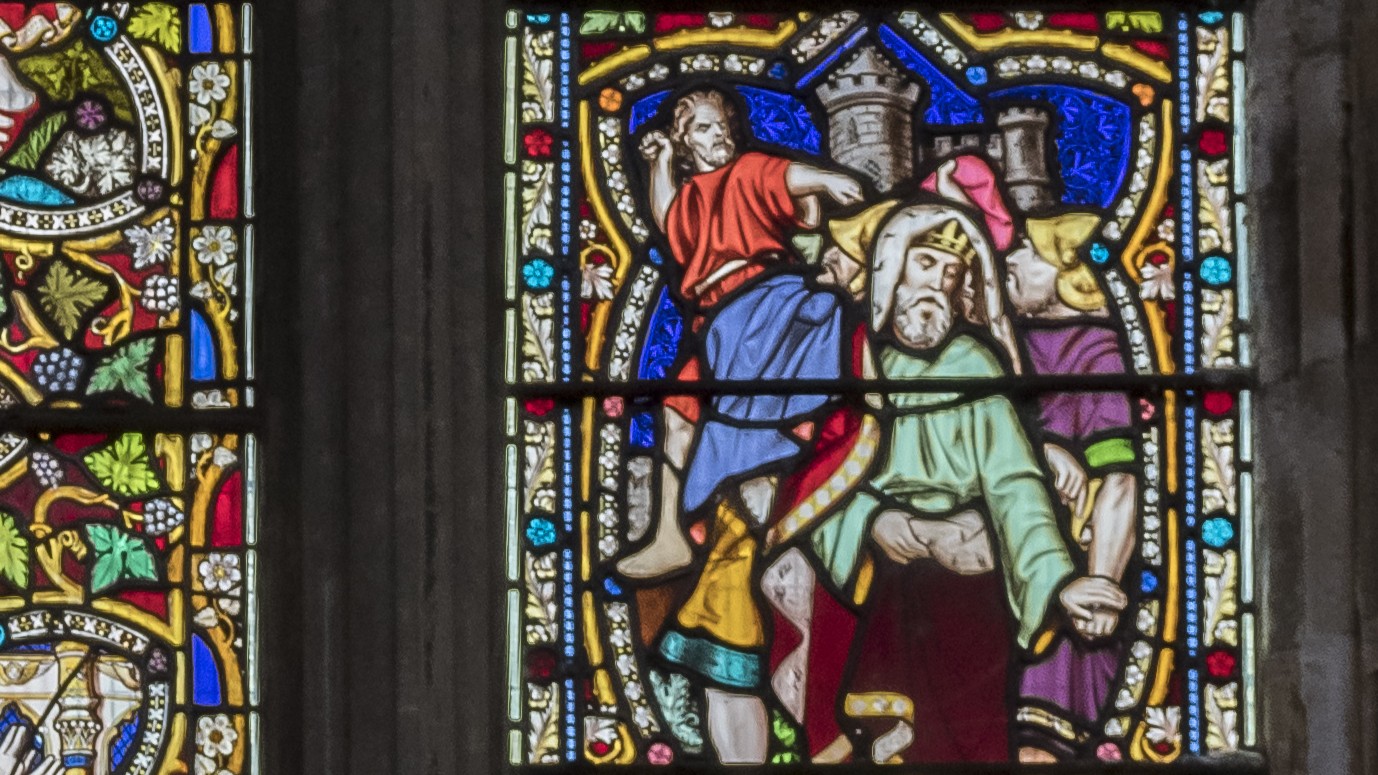
Image credit: Stained glass window (window sVIII) at Saint George’s Minster in Doncaster. Photo by Jules & Jenny, 2019.