1 Kings 11
BibleHub
1 KingI SolomonII lovedIII
Notes on verse 1a
I “King” = melek. From malak (to be or become king or queen, to rise to the throne, to be crowned; by implication, to take counsel). This is king or royal.
II “Solomon” = Shelomoh. From shalam (to be complete or sound; to have safety mentally, physically, or extending to one’s estate; so, if these things are safe and complete, the implication is that one would be friendly; and, if being friendly, one would make amends and that friendship would be reciprocated). This is Solomon or Shelomoh, meaning “peaceful.” It is the same word as the Hebrew word for peace – shalom.
III “loved” = aheb. This is to love, beloved, friend. It is to have affection for sexually or otherwise.
manyIV foreignV womenVI
Notes on verse 1b
IV “many” = rab. From rabab (increasing in any aspect whether quantity, authority, size, quality, greatness, etc.). This is abundance, many, elder, exceedingly, great. It refers to abundance of amount, rank, or status.
V “foreign” = nokri. From neker (strange; to act foreign or strange; to disguise; can also be misfortune or unexpected calamity); from nakar (to recognize, examine, take notice, show, scrutinize). This is foreign, alien, stranger, extraordinary, adulteress. It is strange in many different senses – foreign, not being one’s relative, different, wonderful, relating to adultery.
VI “women” = ishshah. From ish (man); perhaps from enosh (human, humankind, mortal); from anash (to be weak, sick, or frail). This is woman, wife, or female.
along with the daughterVII of Pharaoh:VIII Moabite,IX
Notes on verse 1c
VII “daughter” = bat. From ben (son literal or figurative; also, grandson, subject, nation); from banah (to build or obtain children). This is daughter in a literal or figurative sense.
VIII “Pharaoh” = paroh. From Egyptian pr (palace, pharaoh; literally house + great). This is Pharaoh, a title for Egyptian kings. See https://en.wiktionary.org/wiki/pharaoh
IX “Moabite” = Moabi. 16x in OT. From Moab (Moab or Moabite; meaning “from her faither” or “seed of a father” or “desirable land”); perhaps from ab (father, ancestor, grandfather; father in a literal or figurative sense). This is Moabite or Moab. See https://en.wikipedia.org/wiki/Moab
Ammonite,X Edomite,XI Sidonian,XII and HittiteXIII women,
Notes on verse 1d
X “Ammonite” = Ammoni. 17x in OT. From Ammon (Ammon, Ammonite; perhaps meaning “tribal”); {from im (with, against, before, beside); {perhaps from amam (to darken, hide, associate; creating shadows by huddling together)} OR from am (people or nation; a tribe, troops or armies, or figuratively to refer to a flock of animals); {from amam (see above)}}. This is Ammonite or like the Ammonites.
XI “Edomite” = Adomi. 11x in OT. From Edom (Edom or Idumaea); from adom (to be red or flushed). This is Edomite, meaning “red.”
XII “Sidonian” = Tsidoni. 16x in OT. From Tsidon (Sidon – a city in Phoenicia); from Phoenician tsydon (Sidon; probably meaning fishery or fishing town). This is Sidonian or Zidonian. See https://en.wiktionary.org/wiki/Sidon & https://en.wikipedia.org/wiki/Sidon
XIII “Hittite” = Chitti. From cheth (Heth or Cheth; one of Canaan’s sons from whom perhaps the Hittites descend) OR from hatat (terror, lacking strength or courage); perhaps from hata (to seize; often used of coals from a fire). This is Hittite – perhaps meaning terrors or terrible. See https://www.abarim-publications.com/Meaning/Hittite.html#.XyMgpp5KhPY
2 from the nationsXIV concerning which the LordXV had saidXVI to the Israelites,XVII
Notes on verse 2a
XIV “nations” = goy. From the same root as gevah (the back, person, or body); related to gev (among); related to gaah (to rise up). This is nation or people. Often used to refer to Gentiles or foreign nations. It can also be used figuratively for a group of animals. This is where the Yiddish “goy” comes from.
XV “Lord” = YHVH. From havah (to be, become) or hayah (to come to pass, become, be). This is the name of the God of Israel, the self-existent and eternal one, the tetragrammaton. This pronunciation has been lost to time so “Lord” is generally used in its place.
XVI “said” = amar. This is to speak, say, answer, command, promise, report.
XVII “Israelites” = ben + Yisrael. Literally, “children of Israel.” Ben is related to “daughter” in v1. See note VII above. Yisrael is from sarah (to persist, exert oneself, contend, persevere, wrestle, prevail) + El (God or god). This is Israel, meaning God strives or one who strives with God; new name for Jacob and for his offspring. This refers to the people and to the land.
“You shall not enterXVIII into marriage with them, neither shall theyXIX with you, for they will surelyXX inclineXXI your heartXXII
Notes on verse 2b
XVIII “enter” = bo. This is to enter, come in, advance, fulfill, bring offerings, enter to worship, attack. It can also have a sexual connotation.
XIX {untranslated} = bo. Same as “enter” in v2. See note XVIII above.
XX “surely” = aken. 18x in OT. From kun (properly, in a perpendicular position; literally, to establish, fix, fasten, prepare; figuratively, it is certainty, to be firm, faithfulness, render sure or prosperous). This is surely, truly, nevertheless.
XXI “incline” = natah. This is to stretch or spread out, to extend, or bend. In can also imply moral deflection.
XXII “heart” = lebab. May be related to labab (to encourage; properly, to be encased as with fat; used in a good sense, this means to transport someone with love; used in a bad sense, it can mean to dull one’s senses). This is the heart, courage, one’s inner self, the mind, or the will. Heart is only used in a figurative sense in the Old and New Testaments.
to followXXIII their gods.”XXIV Solomon clungXXV to these in love.XXVI
Notes on verse 2c
XXIII “follow” = achar. From achar (to remain behind, linger, continue, be behind, or delay; can also imply procrastination). This is after or the last part, following.
XXIV “gods” = elohim. Related to “Israelites” in v2. See note XVII above.
XXV “clung” = dabaq. This is to follow closely or abide fast, to cling or be joined together. Figuratively, it can mean to catch something by chasing after it, to overtake, or to stick. A man clings to his wife in Genesis 2:24, Shechem was deeply attracted to Dinah in Genesis 34:3, Ruth clung to Naomi in Ruth 1:14, Solomon clung to his foreign wives and concubines in 1 Kings 11:2. It is also used of a tongue sticking to the mouth, pursuing or overtaking as in battle, and also clinging to God.
XXVI “love” = ahabah. Related to “loved” in v1. From ahab (love or affection); from aheb (see note III above). This is love as a noun.
3 Among his wivesXXVII wereXXVIII sevenXXIX hundredXXX princessesXXXI
Notes on verse 3a
XXVII “wives” = ishshah. Same as “women” in v1. See note VI above.
XXVIII “were” = hayah. Related to “Lord” in v2. See note XV above.
XXIX “seven” = sheba. This is seven or by sevenfold. It can also be used to imply a week or an indefinite number. Symbolically, this is the number of fullness, sacredness, perfection.
XXX “hundred” = meah. This is hundred or some number times one hundred (i.e. hundredfold or the base of two hundred, three hundred, etc.).
XXXI “princesses” = sarah. 5x in OT. From sar (chief, official, prince). This is a noblewoman, mistress, princess, or queen. It is the root of Sarah’s name.
and threeXXXII hundred concubines,XXXIII and his wives turned awayXXXIV his heart.XXXV 4 ForXXXVI when Solomon was old,XXXVII
Notes on verses 3b-4a
XXXII “three” = shalosh. This is three, fork, three times.
XXXIII “concubines” = pilegesh. Perhaps of a foreign derivation. This is a concubine or a paramour.
XXXIV “turned away” = natah. Same as “incline” in v2. See note XXI above.
XXXV “heart” = leb. Related to “heart” in v2. From the same as lebab (see note XXII above). This is inner self, mind, will, feelings, the center.
XXXVI {untranslated} = et. Probably from anah (to answer, sing, announce); from ad (forever, all, old); from adah (to pass on, advance, decorate oneself). This is a period or season. It can also mean whenever or continually.
XXXVII “old” = ziqnah. 6x in OT. From zoqen (old age); from the same as zaqan (beard or chin – the beard represents old age); from zaqen (to be old or grow old). This is old or old age through the analogy of being bearded.
his wives turned away his heartXXXVIII afterXXXIX otherXL gods, and his heartXLI was not trueXLII
Notes on verse 4b
XXXVIII “heart” = lebab. Same as “heart” in v2. See note XXII above.
XXXIX “after” = achar. Same as “follow” in v2. See note XXIII above.
XL “other” = acher. Related to “follow” in v2. From achar (see note XXIII above). This is following, next, strange, other.
XLI “heart” = lebab. Same as “heart” in v2. See note XXII above.
XLII “true” = shalem. Related to “Solomon” in v1. From shalam (see note II above). This is safe, blameless, perfect, at peace, whole, friendly. It is complete in a literal or a figurative sense.
to the Lord his God,XLIII as was the heartXLIV of his fatherXLV David.XLVI
Notes on verse 4c
XLIII “God” = Elohim. Same as “gods” in v2. See note XXIV above.
XLIV “heart” = lebab. Same as “heart” in v2. See note XXII above.
XLV “father” = ab. Related to “Moabite” in v1. See note IX above.
XLVI “David” = David. From the same as dod (beloved, love, uncle); the root may mean to boil, which is used figuratively to describe love. So, this implies someone you love such as a friend, a lover, or a close family member like an uncle. David’s name likely means something like “beloved one.”
5 For Solomon followedXLVII AstarteXLVIII the goddessXLIX of the Sidonians
Notes on verse 5a
XLVII “followed” = halak…achar. Halak is go, come, walk. It is walk literally and figuratively and includes people and animals. It can be used figuratively for one’s moral life – how we walk according to God’s way or against it. It can also refer to the walk of life as in the course one’s life takes, the choices we make, etc. Achar is the same as “follow” in v2. See note XXIII above.
XLVIII “Astarte” = Ashtoreth. 3x in OT. From the same as Ashtoreth (Ashtoreth, Ashtaroth; a goddess); from ashath (to think) OR from ashtaroth (young, enlarge a flock); {from ashath (to think, concern) OR from ashar (to gain wealth, become rich, enrich; to accumulate)} OR from Akkadian Ishtar (Astarte, Ishtar); {probably related to Attar (Attar; a god similar to Venus)}. This is Ashtoreth, an ancient near eastern goddess of fertility and the heavens. See https://en.wiktionary.org/wiki/Astarte & https://en.wikipedia.org/wiki/Astarte & https://en.wikipedia.org/wiki/Attar_(god)
XLIX “goddess” = elohim. Same as “gods” in v2. See note XXIV above.
andL MilcomLI the abominationLII of the Ammonites.
Notes on verse 5b
L {untranslated} = achar. Same as “follow” in v2. See note XXIII above.
LI “Milcom” = Malkam. Related to “King” in v1. 5x in OT. related to Molek (Molech; god of the Ammonites; “king); from the same as melek (see note I above). This is Milcom or Malkam, an Ammonite god whose name means “their king” or “most high king.” See https://www.abarim-publications.com/Meaning/Milcom.html
LII “abomination” = shiqquts. From the same as sheqets (abhorrent, detestable thing; filth; figuratively an object used for idolatry); from shaqats (to detest, abhor, be filthy, pollute). This is something that is detested, filth, an abomination. It can also refer to an idol or something idolatrous.
6 So Solomon didLIII what was evilLIV in the sightLV of the Lord
Notes on verse 6a
LIII “did” = asah. This is to make, do, act, appoint, become in many senses.
LIV “evil” = ra’. From ra’a’ (to be evil, bad, afflict; properly, to spoil – to destroy by breaking into pieces; figuratively, to cause something to be worthless; this is bad in a physical, social, or moral sense; that which displeases, to do harm or mischief, to punish or vex). This is bad, disagreeable, that which causes pain, misery, something having little or no value, something that is ethically bad, wicked, injury, calamity. This refers to anything that is not what it ought to be – a natural disaster, a disfigurement, an injury, a sin.
LV “sight” = ayin. This is eye in a literal or figurative sense so eye, appearance, favor, or a fountain (the eye of the landscape).
and did not completelyLVI followLVII the Lord, as his father David had done. 7 ThenLVIII Solomon builtLIX a high placeLX
Notes on verses 6b-7a
LVI “completely” = male. This is fill, satisfy, replenish, accomplish, fulfill, confirm, or consecrate. It is fill in a literal or figurative sense.
LVII “follow” = achar. Same as “follow” in v2. See note XXIII above.
LVIII “then” = az. This is beginning, now, from, since.
LIX “built” = banah. Related to “daughter” in v1 & “Israelites” in v2. See note VII above.
LX “high place” = bamah. The root might mean being high. This is height, wave, or elevation.
for ChemoshLXI the abomination of MoabLXII and for MolechLXIII the abomination of the AmmonitesLXIV
Notes on verse 7b
LXI “Chemosh” = Kemosh. 8x in OT. Perhaps from yasha (to deliver, defend, help, preserve, rescue; properly, to be open, wide or free, which implies being safe. So, in a causative sense, this is to free someone) OR from Moabite Kamash (Chemosh) OR related to Akkadian Shamah (Shamash – Mesopotamian sun god). This is Chemosh, Kemosh, or Kemish. Its root may mean subdue. It may mean “the powerful” or “as if he saves” or “as if he moves” or “as if he feels.” See https://www.abarim-publications.com/Meaning/Chemosh.html & https://en.wiktionary.org/wiki/Chemosh & https://en.wikipedia.org/wiki/Chemosh & https://en.wikipedia.org/wiki/Utu
LXII “Moab” = Moab. Related to “Moabite” in v1 & “father” in v4. See note IX above.
LXIII “Molech” = Molek. Related to “King” in v1 & “Milcom” in v5. 9x in OT. See note LI above.
LXIV “Ammonites” = ben + Ammon. Literally, “children of Ammon.” Ben is the same as “Israelites” in v2. See note XVII above. Ammon is related to “Ammonite” in v1. See note X above.
on the mountainLXV eastLXVI of Jerusalem.LXVII
Notes on verse 7c
LXV “mountain” = har. From harar (hill or mountain). This is mountain, hill, hilly region.
LXVI “east” = paneh. From panah (to turn, face, appear). This is face in a literal or figurative sense. It could be face, presence, anger, respect. It can also be used of God to indicate divine favor or presence.
LXVII “Jerusalem” = Yerushalaim. Related to “Solomon” in v1 & “true” in v4. From yarah (to throw, shoot, be stunned; to flow as water so figuratively to instruct or teach) + shalam (see note II above). This is Jerusalem, dwelling of peace.
8 He did the sameLXVIII for allLXIX his foreign wives who offered incenseLXX and sacrificedLXXI to their gods.
Notes on verse 8
LXVIII “same” = ken. Related to “surely” in v2. Perhaps from kun (see note XX above). This is to set upright. Generally used figuratively to mean thus, so, afterwards, rightly so.
LXIX “all” = kol. From kalal (to complete). This is all or every.
LXX “offered incense” = qatar. Perhaps from qetoreth (smoke, incense, the scent of the sacrifice as it burned); from the same as qitor (thick smoke, vapor). This is to make an offering, particular one of burned incense. It focuses on the fragrance made from the sacrificial fire. This is generally used to refer to worship.
LXXI “sacrificed” = zabach. This is slaughtering an animal, generally for the purpose of sacrifice. It can mean kill or offer.
9 Then the Lord was angryLXXII with Solomon because his heartLXXIII had turned away from the Lord, the God of Israel,LXXIV who had appearedLXXV to him twiceLXXVI
Notes on verse 9
LXXII “was angry” = anaph. 14x in OT. This is to breathe hard, i.e. to be angry or displeased.
LXXIII “heart” = lebab. Same as “heart” in v2. See note XXII above.
LXXIV “Israel” = Yisrael. Same as “Israelites” in v2. See note XVII above.
LXXV “appeared” = raah. This is to see in a literal or figurative sense so stare, advise, think, view.
LXXVI “twice” = paam. From paam (to move, trouble; to tap in a regular rhythm; to agitate). This is a beat, stroke, footstep, or occurrence.
10 and had commandedLXXVII him concerning this matter,LXXVIII that he should notLXXIX followLXXX other gods, but he did not observeLXXXI what the Lord had commanded.
Notes on verse 10
LXXVII “commanded” = tsavah. This is to charge, command, order, appoint, or enjoin. This is the root that the Hebrew word for “commandment” comes from (mitsvah).
LXXVIII “matter” = dabar. From dabar (to speak, declare, discuss). This is speech, a word, a matter, an affair, charge, command, message, promise, purpose, report, request. It is a word, which implies things that are spoken of in a wide sense.
LXXIX “not” = bilti. From balah (to grow old, wear out, consume, waste, enjoy, fail, decay). This is nothing, not, lest, or except. From its root, it means “a failure of” – used for negative particles.
LXXX “follow” = halak + achar. Halak is the same as “followed” in v5. See note XLVII above. Achar is the same as “follow” in v2. See note XXIII above.
LXXXI “observe” = shamar. This is to keep, watch, or preserve. It means to guard something or to protect it as a thorny hedge protects something.
11 Therefore the Lord said to Solomon, “SinceLXXXII this has been your mind and you have not keptLXXXIII my covenantLXXXIV and my statutesLXXXV that I have commanded you,
Notes on verse 11a
LXXXII “since” = yaan. Related to {untranslated} in v4. From anah (see note XXXVI above). This is because, since, for the sake of, giving a reason.
LXXXIII “kept” = shamar. Same as “observe” in v10. See note LXXXI above.
LXXXIV “covenant” = berit. Perhaps from barah (to eat, choose, make clear); perhaps from bar (grain, wheat); from barar (to select, purify, cleanse, test, brighten, polish). This is a compact, covenant, alliance, treaty, or league.
LXXXV “statutes” = chuqqah. From choq (statute, boundary, condition, custom, limit, ordinance; something that is prescribed or something that is owed); from chaqaq (to inscribe, carve, or decree; a lawmaker; literally, this is engraving, but it implies enacting a law because laws were carved into stone or metal). This is something prescribed such as a statue, custom, or ordinance.
I will surely tearLXXXVI the kingdomLXXXVII from you and giveLXXXVIII it to your servant.LXXXIX
Notes on verse 11b
LXXXVI “surely tear” = qara + qara. This is to tear or cut out in a literal or figurative sense. It can also be to revile or to apply eye make up – as though they are made to look larger. The word is repeated twice – the first time as an Infinitive Absolute. The Infinitive Absolute serves to emphasize the sentiment of the word. It is rather like Foghorn Leghorn’s speech pattern, “I said, I said.”
LXXXVII “kingdom” = mamlakah. Related to “King” in v1 & “Milcom” in v5 & “Molech” in v7. From the same as melek (see note I above). This is kingdom, dominion, sovereignty, rule. It can also refer to the realm.
LXXXVIII “give” = natan. This is to give, put, set, offer. It is to give literally or figuratively.
LXXXIX “servant” = ebed. From abad (to work, serve, compel; any kind of work; used causatively, can mean to enslave or keep in bondage). This is a servant, slave, or bondservant.
12 YetXC for the sakeXCI of your father David I will not do it in your lifetime;XCII I will tear it out of the handXCIII of your son.XCIV
Notes on verse 12
XC “yet” = ak. Related to “surely” in v2 & “same” in v8. Related to aken (see note XX above). This is a positive statement – surely, also, certainly, alone, only.
XCI “sake” = maan. Related to {untranslated} in v4 & “since” in v11. From anah (see note XXXVI above). This is because of, occurring because of a motive or purpose.
XCII “lifetime” = yom. Root may mean being hot. This is the day in a literal or figurative sense. It can also mean birth, age, daylight, continually or other references to time.
XCIII “hand” = yad. This is hand, ability, power. Hand in a literal sense, but also what one can do or the means by which one does it.
XCIV “son” = ben. Same as “Israelites” in v2. See note XVII above.
13 I will not, however,XCV tear away the entireXCVI kingdom; I will give oneXCVII tribeXCVIII to your son for the sake of my servant David and for the sake of Jerusalem, which I have chosen.”XCIX
Notes on verse 13
XCV “however” = raq. From the same as raq (thin, surely, only); perhaps from raqaq (to spit). This is but, except, at least. In the sense of being thin, it figuratively refers to some kind of limit.
XCVI “entire” = kol. Same as “all” in v8. See note LXIX above.
XCVII “one” = echad. Perhaps from achad (to unify, continue on a path; figuratively, to gather one’s thoughts). This is the number one, first, united. It can also be alone, altogether, a certain, a few.
XCVIII “tribe” = shebet. This is a rod, staff, club, scepter, dart, or tribe. Literally a stick that can be used for punishing, writing, fighting, walking, ruling; thus, used figuratively for a clan.
XCIX “chosen” = bachar. This is to choose, appoint, try, excellent.
14 Then the Lord raised upC an adversaryCI against Solomon, HadadCII the Edomite;
Notes on verse 14a
C “raised up” = qum. To arise, stand, accomplish, establish, abide. This is rising as in rising against, getting up after being sick or asleep, arising from one state to another, becoming powerful, or rising for action. It can also be standing in a figurative sense.
CI “adversary” = satan. Perhaps from satan (to be an adversary, attack, accuse, resist). This is adversary. It could be personal, in reference to political enemies, or refer to Satan.
CII “Hadad” = Hadad. 13x in OT. From the same as hedad (a shout, cheer, thunder). This is Hadad, a personal name and that of an idol. It may mean “fierceness,” “chief,” “most eminent,” “most high,” “thunder,” or “shout.”
he was of the royalCIII houseCIV in Edom.CV 15 ForCVI when David wasCVII destroying Edom
Notes on verses 14b-15a
CIII “royal” = melek. Same as “King” in v1. See note I above.
CIV “house” = zera. From zara (to sow or scatter seed; conceive or yield). This is seed or sowing. It can, thus, mean a fruit, plant, sowing time, child, offspring, or posterity.
CV “Edom” = Edom. Related to “Edomite” in v1. See note XI above.
CVI {untranslated} = hayah. Same as “were” in v3. See note XXVIII above.
CVII “was” = hayah. Same as “were” in v3. See note XXVIII above.
and JoabCVIII the commanderCIX of the armyCX went upCXI
Notes on verse 15b
CVIII “Joab” = Yoab. Related to “Moabite” in v1 & “father” in v4 & “Moab” in v7 and related to “Lord” in v2 & “were” in v3. From YHVH (see note XV above) + ab (see note IX above). This is Joab or Yoab, meaning “the Lord is father.”
CIX “commander” = sar. Related to “princesses” in v3. See note XXXI above.
CX “army” = tsaba. From tsaba (to wage war, serve, assemble, fight, perform, muster, wait on). This is a large group of persons (used figuratively for a group of things). It implies a campaign literally as with army, war, warfare, battle, company, soldiers. Can also be used figuratively for hardship or for worship.
CXI “went up” = alah. This is to go up, approach, ascend, be high, be a priority; to arise in a literal or figurative sense.
to buryCXII the dead,CXIII he killedCXIV everyCXV maleCXVI in Edom
Notes on verse 15c
CXII “bury” = qabar. This is to bury or inter. It could also refer to the person who does the burying.
CXIII “dead” = chalal. From chalal (to pierce, to wound; figuratively, making someone or something profane or breaking your word; to begin as though one opened a wedge; to eat something as a common thing). This is to pierce, profane or pollute. It can also refer to slain or deadly.
CXIV “killed” = nakah. This is to hit whether lightly or severely. It can be used in a literal or figurative sense. So, this could be beat, punish, give wounds, kill, or slaughter.
CXV “every” = kol. Same as “all” in v8. See note LXIX above.
CXVI “male” = zakar. From zakar (to remember, to mark something so that it can be recalled, to be mindful of, to mention). This is male. Properly, perhaps, it means one who is remembered, which is to say a male.
16 (for Joab and all Israel remainedCXVII there sixCXVIII monthsCXIX until he had eliminatedCXX every male in Edom),
Notes on verse 16
CXVII “remained” = yashab. This is to sit and so to remain and so to dwell. It is sitting for any reason – as a judge, in order to ambush, or just sitting quietly. Causatively, this can mean settling or marrying. This can also mean continue, endure, or establish.
CXVIII “six” = shesh. This is six. Figuratively, it can be a surplus since it is one more than the number of fingers on the hand.
CXIX “months” = chodesh. From chadash (to renew, repair). This refers to a new moon. It can also mean monthly.
CXX “eliminated” = karat. This is to cut down, cut off, or make a covenant (idiom for making a covenant is “to cut a covenant”). It can also mean to destroy, fail, or consume.
17 but Hadad fledCXXI toCXXII EgyptCXXIII with someCXXIV Edomites who were servants of his father.
Notes on verse 17a
CXXI “fled” = barach. This is to flee, drive away, hurry, to bolt.
CXXII {untranslated} = bo. Same as “enter” in v2. See note XVIII above.
CXXIII “Egypt” = Mitsrayim. Perhaps from matsor (besieged or fortified place, bulwark, entrenchment; something hemmed in; a siege or distress or fastness); from tsur (to confine, besiege, to cramp). This is Egypt.
CXXIV “some” = ish. Related to “women” in v1. See note VI above.
HeCXXV was a youngCXXVI boyCXXVII at that time. 18 They set outCXXVIII from MidianCXXIX
Notes on verses 17b-18a
CXXV “he” = Hadad. Same as “Hadad” in v14. See note CI above.
CXXVI “young” = qatan. From quwt (grieved, cut off, to detest). This is least, small, young, little one. It is literally smaller whether in amount or size. Figuratively it is smaller in the sense of younger or less important.
CXXVII “boy” = naar. May be from na’ar (to shake, toss up and down, tumble around). This is a child or a servant. It is a child in their active years so they could be aged anywhere from infancy to adolescence.
CXXVIII “set out” = qum. Same as “raised up” in v14. See note C above.
CXXIX “Midian” = Midyan. From the same as madon (strife, contention, brawling); from din (to judge, defend, dispute, govern, strive). This is Midian or a Midianite. It means strife or place of judgment.
and cameCXXX to Paran;CXXXI they tookCXXXII peopleCXXXIII with them from Paran and came to Egypt, to Pharaoh king of Egypt,
Notes on verse 18b
CXXX “came” = bo. Same as “enter” in v2. See note XVIII above.
CXXXI “Paran” = Paran. 11x in OT. From the same as porah (a branch or spring; properly, ornamentation); perhaps from pa’ar (to beautify or adorn, to gleam; can refer to showing honor or glorifying someone; also to boast or to shake a tree for harvest). This is Paran, perhaps meaning ornamental.
CXXXII “took” = laqach. This is to take, accept, carry away, receive. It can also have the sense of take a wife or take in marriage.
CXXXIII “people” = enosh. Related to “women” in v1 & “some” in v17. See note VI above.
who gave him a house,CXXXIV assignedCXXXV him an allowance of food,CXXXVI and gave him land.CXXXVII
Notes on verse 18c
CXXXIV “house” = bayit. Related to “daughter” in v1 & “Israelites” in v2 & “built” in v7. Probably from banah (see note VII above). This is house, court, family, palace, temple.
CXXXV “assigned” = amar. Same as “said” in v2. See note XVI above.
CXXXVI “allowance of food” = lechem. From lacham (to eat, feed on). This is bread, food, loaf. It can refer to food more generally for people or for animals.
CXXXVII “land” = erets. Root may mean to be firm. This is earth, ground, field land, or country.
19 Hadad foundCXXXVIII greatCXXXIX favorCXL in the sight of Pharaoh,
Notes on verse 19a
CXXXVIII “found” = matsa. This is to find, catch or acquire. It can also mean to come forth or appear. Figuratively, this can mean to meet or be together with.
CXXXIX “great” = meod. Perhaps from the same as uwd (firebrand, a poker). This is very, greatly, exceedingly. It can also mean vehemence, force, abundance.
CXL “favor” = chen. From chanan (beseech, show favor, be gracious; properly, to bend in kindness to someone with less status). This is grace, favor, kindness, beauty, precious.
so that he gave him his sister-in-lawCXLI for a wife, the sisterCXLII of QueenCXLIII Tahpenes.CXLIV
Notes on verse 19b
CXLI “sister-in-law” = achot + ishshah. Literally, “the sister of his own wife.” Achot is from the same as ach (brother, kindred, another, other, like). This is sister in a literal or figurative sense. It can also mean another or together. Ish is the same as “women” in v1. See note VI above.
CXLII “sister” = achot. Same as “sister-in-law” in v19. See note CXLI above.
CXLIII “Queen” = gebirah. 6x in OT. From gebir (lord, master); from gabar (to be strong or mighty; to prevail or be insolent). This is queen, queen mother, or lady.
CXLIV “Tahpenes” = Tachpenes. 3x in OT – all in this passage. Perhaps from Egyptian t’ chmt nswt (the king’s wife); {from t’ (the) + chmt (woman, wife) + nswt (king, as the chosen one with divine power)}. This is Tahpenes, perhaps meaning “the king’s wife.” See https://en.wikipedia.org/wiki/Tahpenes
20 The sister of Tahpenes gave birthCXLV by him to his son Genubath,CXLVI whom Tahpenes weanedCXLVII inCXLVIII Pharaoh’s house;CXLIX
Notes on verse 20a
CXLV “gave birth” = yalad. This is to bear or bring forth. It can mean to act as midwife or to show one’s lineage. This is often used for birth or begetting.
CXLVI “Genubath” = Genubath. 2x in OT. From ganab (to steal in a stealthy way rather than through violence; to deceive). This is Genubath, meaning “theft.”
CXLVII “weaned” = gamal. This is how one deals with someone whether positively or negatively – so to reward, requite. It can also mean to wean or the work that goes into something ripening.
CXLVIII “in” = tavek. This is among, middle, in the midst, the center. Perhaps, properly, to sever.
CXLIX “house” = bayit. Same as “house” in v18. See note CXXXIV above.
Genubath was in Pharaoh’s houseCL amongCLI the childrenCLII of Pharaoh. 21 When Hadad heardCLIII in Egypt that David sleptCLIV with his ancestorsCLV
Notes on verses 20b-21a
CL “house” = bayit. Same as “house” in v18. See note CXXXIV above.
CLI “among” = tavek. Same as “in” in v20. See note CXLVIII above.
CLII “children” = ben. Same as “Israelites” in v2. See note XVII above.
CLIII “heard” = shama. This is to hear, call, consent, or consider. It implies listening intelligently, giving attention, and, because of these two factors, obedience and action are often implied.
CLIV “slept” = shakab. This is to lie down, lodge. It is lying for sleep, sex, or other reasons.
CLV “ancestors” = ab. Same as “father” in v4. See note XLV above.
and that Joab the commander of the army was dead,CLVI Hadad said to Pharaoh, “Let me depart,CLVII that I may goCLVIII to my own country.”CLIX
Notes on verse 21b
CLVI “was dead” = mut. This is to die in a literal or figurative sense. It can also refer to being a dead body.
CLVII “depart” = shalach. This is to send out, away, send for, forsake. It can also mean to divorce or set a slave free.
CLVIII “go” = halak. Same as “followed” in v5. Same note XLVI above.
CLIX “country” = erets. Same as “land” in v18. See note CXXXVII above.
22 But Pharaoh said to him, “What do you lackCLX with me that you nowCLXI seekCLXII to go to your own country?”
And he said, “No, do let me go.”CLXIII
Notes on verse 22
CLX “lack” = chaser. 19x in OT. From chaser (to lack, need, become empty, to fail). This is needy, lacking, without, void, or destitute. This is “I shall not want” from Psalm 23:1.
CLXI “now” = hen. This is a remark of surprise or excitement: lo! Behold! It can also mean if or though.
CLXII “seek” = baqash. This is to seek, ask, desire, or request. It can be any kind of searching. It can also mean to worship or pray – implies a striving for.
CLXIII “let…go” = shalach + shalach. Same as “depart” in v21. See note CLVII above. The word is repeated twice – the first time as an Infinitive Absolute. The Infinitive Absolute serves to emphasize the sentiment of the word. It is rather like Foghorn Leghorn’s speech pattern, “I said, I said.”
23 God raised up another adversary against Solomon, RezonCLXIV son of Eliada,CLXV who had fled from his master,CLXVI
Notes on verse 23a
CLXIV “Rezon” = Rezon. 1x in OT. From razan (to be heavy or weighty; figuratively, to be honorable or commanding; can mean a ruler or prince). This is Rezon, meaning “prince.”
CLXV “Eliada” = Elyada. Related to “Israelites” and “gods” in v2. 4x in OT. From El (see note XVII above) + yada (to know, be aware, see and so understand – includes observation, care, recognition; can also be used as a euphemism). This is Eliada, meaning “God is knowing” or “God has known.” See https://www.abarim-publications.com/Meaning/Eliada.html
CLXVI “master” = adon. From a root that means ruling or being sovereign. This is lord, master, or owner.
King HadadezerCLXVII of Zobah.CLXVIII 24 He gatheredCLXIX followersCLXX around him
Notes on verses 23b-24a
CLXVII “Hadadezer” = Hadadezer. Related to “Hadad” in v14. From Hadad (see note CII above) + ezer (help, aid, helper); {from azar (to help, protect, support, ally; properly, to surround so as to provide aid)}. This is Hadadezer, meaning “Hadad is help” or “Hadad is helper.” See https://www.abarim-publications.com/Meaning/Hadadezer.html
CLXVIII “Zobah” = Tsoba. Related to “army” in v15. 12x in OT. Perhaps from tsaba (see note CX above) OR from tsabah (to swell, grow, amass like an army). This is Zobah, Tsoba, or Tsobah, which may come from a word meaning to station. So, it is “a station” or “engagement” or “collective” or “beauty” or “depression.” See https://www.abarim-publications.com/Meaning/Zobah.html
CLXIX “gathered” = qabats. This is to collect, assemble, heap, grasp, or gather.
CLXX “followers” = ish. Same as “some” in v17. See note CXXIV above.
and becameCLXXI leaderCLXXII of a marauding band,CLXXIII after the killingCLXXIV by David; they went to Damascus,CLXXV settledCLXXVI there, and made him kingCLXXVII in Damascus.
Notes on verse 24b
CLXXI “became” = hayah. Same as “were” in v3. See note XXVIII above.
CLXXII “leader” = sar. Same as “commander” in v15. See note CIX above.
CLXXIII “marauding band” = gedud. From gadad (to cut, gather, assemble, crowd; also, to gash as pushing in). This is a crowd, but generally used to refer to soldiers. So, it is a band, troop, or company. It can also be a group of robbers.
CLXXIV “killing” = harag. This is to strike with deadly intent so it can be kill, destroy, murder, or put to death.
CLXXV “Damascus” = Dammeseq. From Old Aramaic dammasq (Damascus); perhaps related to d-r (dwelling) OR in Syriac darsuq (“a well-watered land”). This is Damascus. See https://en.wikipedia.org/wiki/Damascus.
CLXXVI “settled” = yashab. Same as “remained” in v16. See note CXVII above.
CLXXVII “made…king” = malak. Related to “King” in v1 & “Milcom” in v5 & “Molech” in v7 & “kingdom” in v11. See note I above.
25 He was an adversary of Israel all the daysCLXXVIII of Solomon, making troubleCLXXIX as Hadad did; he despisedCLXXX Israel and reignedCLXXXI over Aram.CLXXXII
Notes on verse 25
CLXXVIII “days” = yom. Same as “lifetime” in v12. See note XCII above.
CLXXIX “trouble” = ra’. Same as “evil” in v6. See note LIV above.
CLXXX “despised” = quts. 9x in OT. This is to feel dread, be distressed, tired, terrorized, be disgusted, be anxious, abhor.
CLXXXI “reigned” = malak. Same as “made…king” in v24. See note CLXXVII above.
CLXXXII “Aram” = Aram. Perhaps from ‘armon (any fortified building – castle, citadel, palace) OR from rum (to be high, rise, exalt self, extol, be haughty; to rise literally or figuratively). This is Aram, Syria, Mesopotamia – meaning elevated or citadel. See https://www.abarim-publications.com/Meaning/Aram.html#.XqfDX8hKhPY
26 JeroboamCLXXXIII son of Nebat,CLXXXIV an EphraimiteCLXXXV of Zeredah,CLXXXVI a servant of Solomon,
Notes on verse 26a
CLXXXIII “Jeroboam” = Yarobam. Related to “many” in v1 & related to “Ammonite” in v1 & “Ammonites” in v7. From rabab (to be or become much or many, multiply) + am (see note X above) OR from rib (properly to toss or grapple; used figuratively to mean wrangling and so for arguments, complaints, or disputes; used in a legal setting for pleading or defending a case) + am (see above). This is Jeroboam, a name meaning “the people increase” or “the people will contend” or “whose people are countless.” See https://www.abarim-publications.com/Meaning/Jeroboam.html
CLXXXIV “Nebat” = Nebat. From nabat (to behold, look at intently, consider, or scan; to have respect or regard someone favorably). This is Nebat, meaning “regard” or “look” or “aspect.” See https://www.abarim-publications.com/Meaning/Nebat.html
CLXXXV “Ephraimite” = Ephrathi. 5x in OT. From the same as apher (covering, ashes, bandage); {from the same as epher (ashes or dust – properly something strewn)} OR from ephrath (Ephrath or Ephrathah; a female name and the name of several places, including Bethlehem; may mean “fruitfulness,” “exhausted,” “worthless,” or “fruitful”); {from parah (to bear fruit, grow, be fruitful, increase; bearing fruit in a literal or figurative sense)}. This is Ephraimite or Ephrathite, someone in the lineage of Ephraim. See https://www.abarim-publications.com/Meaning/Ephrath.html
CLXXXVI “Zeredah” = Tsredah. 2x in OT. Perhaps from tsarad (to cool) OR from a word that means piercing. This is Zeredah, meaning “pierce” or “puncture” or “cooling.” See https://www.abarim-publications.com/Meaning/Zeredah.html
whose mother’sCLXXXVII nameCLXXXVIII was Zeruah,CLXXXIX
Notes on verse 26b
CLXXXVII “mother’s” = em. This is a mother as binding a family together or a breeding female animal. It could be mother in a literal or figurative sense.
CLXXXVIII “name” = shem. May be from sim (to put, place, set). This is name, fame, renown. A name was thought to indicate something essential about a person – something about their individuality. So, this word can also mean honor, authority, or character.
CLXXXIX “Zeruah” = Tseruah. 1x in OT. From the same as tsaraath (leprosy, a mark); {from tsara (to have leprosy)} OR from tsara (be duplicitous). This is Zeruah, meaning “leprous” or “hornet” or “smitten” or “multi-colored.” See https://www.abarim-publications.com/Meaning/Zeruah.html
a CXCwidow,CXCI rebelled against the king. 27 The followingCXCII was the reasonCXCIII he rebelledCXCIV againstCXCV the king.
Notes on verses 26c-27a
CXC {untranslated} = ishshah. Same as “women” in v1. See note VI above.
CXCI “widow” = almanah. Related to alman (widowed); from alam (to be silent, bound). This is a widow or a house that is desolate.
CXCII “following” = zeh. Literally, “this.”
CXCIII “reason” = dabar. Same as “matter” in v10. See note LXXVIII above.
CXCIV “rebelled” = rum. Related to “Aram” in v25. See note CLXXXII above.
CXCV {untranslated} = yad. Same as “hand” in v12. See note XCIII above.
Solomon built the MilloCXCVI and closed upCXCVII the gapCXCVIII in the wall of the cityCXCIX of his father David.
Notes on verse 27b
CXCVI “Millo” = Millo. Related to “completely” in v6. 10x in OT. From male (see note LVI above). This is Millo, a city near Shechem or a stronghold in Jerusalem. It means “filled,” “terrace,” “elevation,” “rampart,” filling,” “setting up,” or “storage facility.” See https://www.abarim-publications.com/Meaning/Millo.html
CXCVII “closed up” = sagar. This is to shut up, imprison, lock, hand over, or figuratively surrender.
CXCVIII “gap” = perets. 19x in OT. From parats (to make a breach, burst out, compel, disperse; to break out literally or figuratively). This is a breach or a gap. It could be a break, whether literal or figurative.
CXCIX “city” = iyr. From uwr (to awaken or wake oneself up). This can mean excitement in the sense of wakefulness or city. Properly, this is a place that is guarded. Guards kept schedules according to watches. This sense of the word would include cities as well as encampments or posts that were guarded.
28 The manCC Jeroboam was very able,CCI and when Solomon sawCCII that the young manCCIII was industrious,CCIV
Notes on verse 28a
CC “man” = ish. Same as “some” in v17. See note CXXIV above.
CCI “very able” = gibbor + chayil. Gibbor is related to “Queen” in v19. From gabar (see note CXLIII above). This is strong, mighty, or powerful. This can imply a warrior, hero, or tyrant. Chayil is from chul (to be firm, strong, prosperous; to endure). This is strength, wealth, ability, activity. It can refer to soldier or a company of soldiers as well as goods. It is a force of people, means, or goods. It can speak of valor, virtue, or strength.
CCII “saw” = raah. Same as “appeared” in v9. See note LXXV above.
CCIII “young man” = naar. Same as “boy” in v17. See note CXXVII above.
CCIV “was industrious” = asah + melakah. Asah is the same as “did” in v6. See note LIII above. Melakah is from the same as malak (messenger, an angel, or a deputy; human messengers literally or for prophets, priests, or teachers as messengers of God; also supernatural messengers i.e. angels). Properly, this is a deputyship or some kind of work. It can also be the product that comes from labor.
he gave him chargeCCV over all the forced laborCCVI of the houseCCVII of Joseph.CCVIII
Notes on verse 28b
CCV “gave…charge” = paqad. This is to attend to or visit – can be used for a friendly or violent encounter. So, it can be to oversee, care for, avenge, or charge.
CCVI “forced labor” = sebel. 3x in OT. From sabal (to carry a heavy load, do strong labor, be a burden; specially, to be pregnant). This is a load or burden in a literal or figurative sense. It can also refer to forced labor.
CCVII “house” = bayit. Same as “house” in v18. See note CXXXIV above.
CCVIII “Joseph” = Yoseph. From yasaph (to add, increase, continue, exceed). This is Joseph, meaning “he increases” or “let him add.”
29 CCIXAbout that time,CCX when Jeroboam was leavingCCXI Jerusalem, the prophetCCXII AhijahCCXIII
Notes on verse 29a
CCIX {untranslated} = hayah. Same as “were” in v3. See note XXVIII above.
CCX “time” = et. Same as {untranslated} in v4. See note XXXVI above.
CCXI “leaving” = yatsa. This is to go or come out, bring forth, appear. It is to go out in a literal or figurative sense.
CCXII “prophet” = nabi. This is prophet, prophecy, speaker, or someone inspired.
CCXIII “Ahijah” = Achiyyah. Related to “sister-in-law” in v19 & related to “Lord” in v2 & “were” in v3 & “Joab” in v15. From ach (see note CXLI above) + Yah (the shortened form of the name of the God of Israel; God, Lord); {from YHVH (see note XV above)}. This is Ahijah, meaning “brother of the Lord” or “ally of the Lord” or “worshipper of the Lord.” See https://www.abarim-publications.com/Meaning/Ahijah.html
the ShiloniteCCXIV found him on the road.CCXV AhijahCCXVI had clothedCCXVII himself
Notes on verse 29b
CCXIV “Shilonite” = Shiloni. 6x in OT. From Shiloh (Shiloh; perhaps meaning “he whose it is” or “tranquil”); from shalah (to draw out, take away, require) OR from the same as Shiyloh (Shiloh; perhaps “he whose it is” or “tranquil”); perhaps from shalah (to be quiet, safe, tranquil; can imply success or happiness; could also mean to deceive or be negligent). This is Shilonite – someone from Shiloh.
CCXV “road” = derek. From darak (to tread, march, to walk. Can also mean affixing a string to a box since one needs to step on it to bend it in the process; so also an archer). This is a road as a thing that is walked on. Can be used figuratively for the path that one’s life takes or how one chooses to live one’s life.
CCXVI “Ahijah” = hu. Literally, “he.”
CCXVII “clothed” = kasah. This is to cover, conceal, overwhelm. It is to cover as clothes do or to hide a secret.
with a newCCXVIII garment.CCXIX The twoCCXX of them were aloneCCXXI in the open countryCCXXII
Notes on verse 29c
CCXVIII “new” = chadash. Related to “months” in v16. From chadash (see note CXIX above). This is something fresh or new.
CCXIX “garment” = salmah. 16x in OT. From simlah (mantle, clothes, wrapper); perhaps from semel (image, figure, likeness). This is the same word as simlah with the letters transposed. So, this is clothing, a cloak, or mantle.
CCXX “two” = shenayim. From sheni (double, again, another, second); from shanah (to fold, repeat, double, alter, or disguise). This is two, both, second, couple.
CCXXI “alone” = bad. From badad (to divide or be separated; alone, solitary, lonely, isolated, straggler). This is apart, alone, separation, body part, tree branch, except. It can also be a city’s chief.
CCXXII “open country” = sadeh. From the same as shadday (almighty, field, land); from shadad (to devastate, ruin, destroy, oppress, be powerful). Or, it may be from a word that means to spread out. This is field, ground, soil, or land. It can be used to mean wild as in a wild animal.
30 when Ahijah laid holdCCXXIII of the new garment he was wearing and tore it into twelveCCXXIV pieces.CCXXV
31 He then said to Jeroboam, “Take for yourself tenCCXXVI pieces, for thusCCXXVII says the Lord, the God of Israel: See,CCXXVIII I am about to tear the kingdom from the hand of Solomon and will give you ten tribes. 32 One tribe will remainCCXXIX his, for the sake of my servant David and for the sake of Jerusalem, the city that I have chosen out of all the tribes of Israel.
Notes on verses 30-32
CCXXIII “laid hold” = taphas. This is to catch, seize, wield, capture. It can also mean to use unwarrantably.
CCXXIV “twelve” = shenayim + asar. Shenayim is the same as “two” in v29. See note CCXX above. Asar is from the same as eser (ten). This is -teen or -teenth.
CCXXV “pieces” = qera. Related to “surely tear” in v11. 4x in OT. From qara (see note LXXXVI above). This is rag or pieces of a garment.
CCXXVI “ten” = eser. Related to “twelve” in v30. See note CCXXIV above.
CCXXVII “thus” = koh. Perhaps from ki (that, for when, certainly) + hu (he, she, it). This is like this, thus, here, now.
CCXXVIII “see” = hen. Same as “now” in v22. See note CLXI above.
CCXXIX “remain” = hayah. Same as “were” in v3. See note XXVIII above.
33 This is becauseCCXXX he has forsakenCCXXXI me, worshipedCCXXXII Astarte the goddess of the Sidonians, Chemosh the god of Moab, and Milcom the god of the Ammonites,CCXXXIII and has not walkedCCXXXIV in my ways,CCXXXV
Notes on verse 33a
CCXXX “because” = yaan. Same as “since” in v11. See note LXXXII above.
CCXXXI “forsaken” = azab. To loosen, relinquish, permit, forsake, fail, leave destitute.
CCXXXII “worshiped” = shachah. This is to bow down, make a humble entreaty, to do homage to royalty or to God.
CCXXXIII “Ammonites” = ben + Ammon. Ben is the same as “Israelites” in v2. See note XVII above. Ammon is the same as “Ammonites” in v7. See note LXIV above.
CCXXXIV “walked” = halak. Same as “followed” in v5. Same note XLVI above.
CCXXXV “ways” = derek. Same as “road” in v29. See note CCXV above.
doing what is rightCCXXXVI in my sight and keeping my statutes and my ordinances,CCXXXVII as his father David did. 34 Nevertheless, I will not take the wholeCCXXXVIII kingdom away fromCCXXXIX him
Notes on verses 33b-34a
CCXXXVI “right” = yashar. From yashar (to be straight, right, even, smooth, or agreeable; figuratively, to make something pleasant or prosperous). This is straight, right, level. Also, it is pleasing, whether pleasing God or pleasing other people. So, it is upright or righteous.
CCXXXVII “ordinances” = mishpat. From shaphat (to judge, defend, pronounce judgment, condemn, govern). This is a verdict or formal sentence whether from humans or from God. It includes the act of judging as well as the place that judging takes place, the suit itself, and the penalty. Abstractly, this is justice, which includes the rights of the participants.
CCXXXVIII “whole” = kol. Same as “all” in v8. See note LXIX above.
CCXXXIX {untranslated} = yad. Same as “hand” in v12. See note XCIII above.
but will makeCCXL him rulerCCXLI all the days of his life,CCXLII for the sake of my servant David whom I chose and who did keep my commandmentsCCXLIII and my statutes,
Notes on verse 34b
CCXL “make” = shith. This is to place, set, bring, appoint, consider, bring, array or look.
CCXLI “ruler” = nasi. From nasa (to lift in a broad sense, literally and figuratively; to carry, take, or arise; to bring forth, advance, accept). This is one lifted up or exalter. So, it could be prince, chief, ruler, captain, king, or vapor.
CCXLII “life” = chay. From chayah (to live or keep alive literally or figuratively). This is alive, living, lifetime. It can also be used to describe someone’s age. It can refer to animals, plants, water, or a company or congregation of people. It is life in a very broad sense.
CCXLIII “commandments” = mitsvah. Related to “commanded” in v10. From tsavah (see note LXXVII above). This is a commandment, law, ordinance obligation, or tradition. It is something commanded whether by God or by a human authority. This term is sometimes used collectively to refer to the Law.
35 but I will take the kingdomCCXLIV away fromCCXLV his son and give it to you—that is, the ten tribes. 36 Yet to his son I will give one tribe, so thatCCXLVI my servant David may alwaysCCXLVII haveCCXLVIII
Notes on verses 35-36a
CCXLIV “kingdom” = melukah. Related to “King” in v1 & “Milcom” in v5 & “Molech” in v7 & “kingdom” in v11 & “made…king” in v24. From the same as melek (see note I above). This is kingship, kingdom, reign. It can also mean royalty.
CCXLV {untranslated} = yad. Same as “hand” in v12. See note XCIII above.
CCXLVI “so that” = maan. Same as “sake” in v12. See note XCI above.
CCXLVII “always” = kol + yom. Literally, “all of the days.” Kol is from the same as “all” in v8. See note LXIX above. Yom is the same as “lifetime” in v12. See note XCII above.
CCXLVIII “have” = hayah. Same as “were” in v3. See note XXVIII above.
a lampCCXLIX beforeCCL me in Jerusalem, the city where I have chosen to putCCLI my name. 37 I will take you, and you shall reign over all that your soulCCLII desires;CCLIII you shall be king over Israel.
Notes on verses 36b-37
CCXLIX “lamp” = ner. This is to glisten. It is used for a lamp, candle, or light in a literal or figurative sense.
CCL “before” = paneh. Same as “east” in v7. See note LXVI above.
CCLI “put” = sim. Related to “name” in v26. See note CLXXXVIII above.
CCLII “soul” = nephesh. Related to naphash (to refresh or be refreshed). This is soul, self, person, emotion. It is a breathing creature. Can also refer to appetites and desires.
CCLIII “desires” = avah. This is to desire, wish for, crave, lust after, to incline.
38 CCLIVIf you will listenCCLV to all that I command you, walk in my ways, and do what is right in my sight by keeping my statutes and my commandments, as David my servant did, I will be with you and will build you an enduringCCLVI house,CCLVII as I built for David, and I will give Israel to you.
Notes on verse 38
CCLIV {untranslated} = hayah. Same as “were” in v3. See note XXVIII above.
CCLV “listen” = shama. Same as “heard” in v21. See note CLIII above.
CCLVI “enduring” = aman. This is to believe, endure, fulfill, confirm, support, be faithful. It is to put one’s trust in, be steadfast. Figuratively, this is to be firm, steadfast, or faithful, trusting, believing, being permanent, morally solid. This is where the word “amen” comes from.
CCLVII “house” = bayit. Same as “house” in v18. See note CXXXIV above.
39 For this reasonCCLVIII I will punishCCLIX the descendantsCCLX of David, butCCLXI not forever.”CCLXII
Notes on verse 39
CCLVIII “for…reason” = maan. Same as “sake” in v12. See note XCI above.
CCLIX “punish” = anah. This is to be occupied with. It can also be bowed down. It can refer to a sense of humility or to a sense of being browbeaten, oppressed, afflicted, or depressed. This can be literal or figurative – depressed in mood or circumstance.
CCLX “descendants” = zera. Same as “house” in v14. See note CIV above.
CCLXI “but” = ak. Same as “yet” in v12. See note XC above.
CCLXII “forever” = kol + yom. Literally, “all of days.” Kol is from the same as “all” in v8. See note LXIX above. Yom is the same as “lifetime” in v12. See note XCII above.
40 Solomon sought therefore to killCCLXIII Jeroboam, but Jeroboam promptlyCCLXIV fled to Egypt, to King ShishakCCLXV of Egypt, and remainedCCLXVI in Egypt until the deathCCLXVII of Solomon.
Notes on verse 40
CCLXIII “kill” = mut. Same as “was dead” in v21. See note CLVI above.
CCLXIV “promptly” = qum. Same as “raised up” in v14. See note C above.
CCLXV “Shishak” = Shishaq. 7x in OT. Of Egyptian derivation. This is Shishak who may be the same as Shoshenq I. See https://en.wikipedia.org/wiki/Shishak
CCLXVI “remained” = hayah. Same as “were” in v3. See note XXVIII above.
CCLXVII “death” = mavet. Related to “was dead” in v21. From muth (see note CLVI above). This can be death, deadliness, the dead, or the place where the dead go. It can be used figuratively for pestilence or ruin.
41 Now the restCCLXVIII of the actsCCLXIX of Solomon, all that he did as well as his wisdom,CCLXX are they not writtenCCLXXI in the BookCCLXXII of the Acts of Solomon?
Notes on verse 41
CCLXVIII “rest” = yether. From yathar (to jut over, remain behind, preserve, to excel). This is a remainder or excess. It can imply abundant or superiority. Additionally, it can be cord a free-hanging rope.
CCLXIX “acts” = dabar. Same as “matter” in v10. See note LXXVIII above.
CCLXX “wisdom” = chokmah. From chakam (to be wise or teach wisdom; this is wisdom in thought, word, or action). This is wisdom, wit, or skillfulness.
CCLXXI “written” = kathab. This is to inscribe, write, record, or decree.
CCLXXII “Book” = sepher. Perhaps from saphar (to tally or record something; to enumerate, recount, number, celebrate, or declare). This can be writing itself or something that is written like a document, book, letter, evidence, bill, scroll, or register.
42 The timeCCLXXIII that Solomon reigned in Jerusalem over all Israel was fortyCCLXXIV years.CCLXXV 43 Solomon slept with his ancestors and was buried in the city of his father David, and his son RehoboamCCLXXVI succeededCCLXXVII him.
Notes on verses 42-43
CCLXXIII “time” = yom. Same as “lifetime” in v12. See note XCII above.
CCLXXIV “forty” = arbaim. From the same as arba (four); from raba (to make square or be four-sided); perhaps from raba (to lie down flat; can be to lie for mating). This is forty.
CCLXXV “years” = shanah. From shana (to change, alter). This is a year, age, old. It can also mean yearly.
CCLXXVI “Rehoboam” = Rechabam. Related to “Ammonite” in v1 & “Ammonites” in v7 & “Jeroboam” in v26. From rachab (to grow wide or enlarge in a literal or figurative sense; extend, relieve, rejoice, or speak boldly) + am (see note X above). This is Rehoboam, meaning “a people are enlarged” or “people of width” or “enlarges the people.” See https://www.abarim-publications.com/Meaning/Rehoboam.html
CCLXXVII “succeeded” = malak…tachat. Malak is the same as “made…king” in v24. See note CLXXVII above. Tachat is underneath, below, the bottom, instead of.
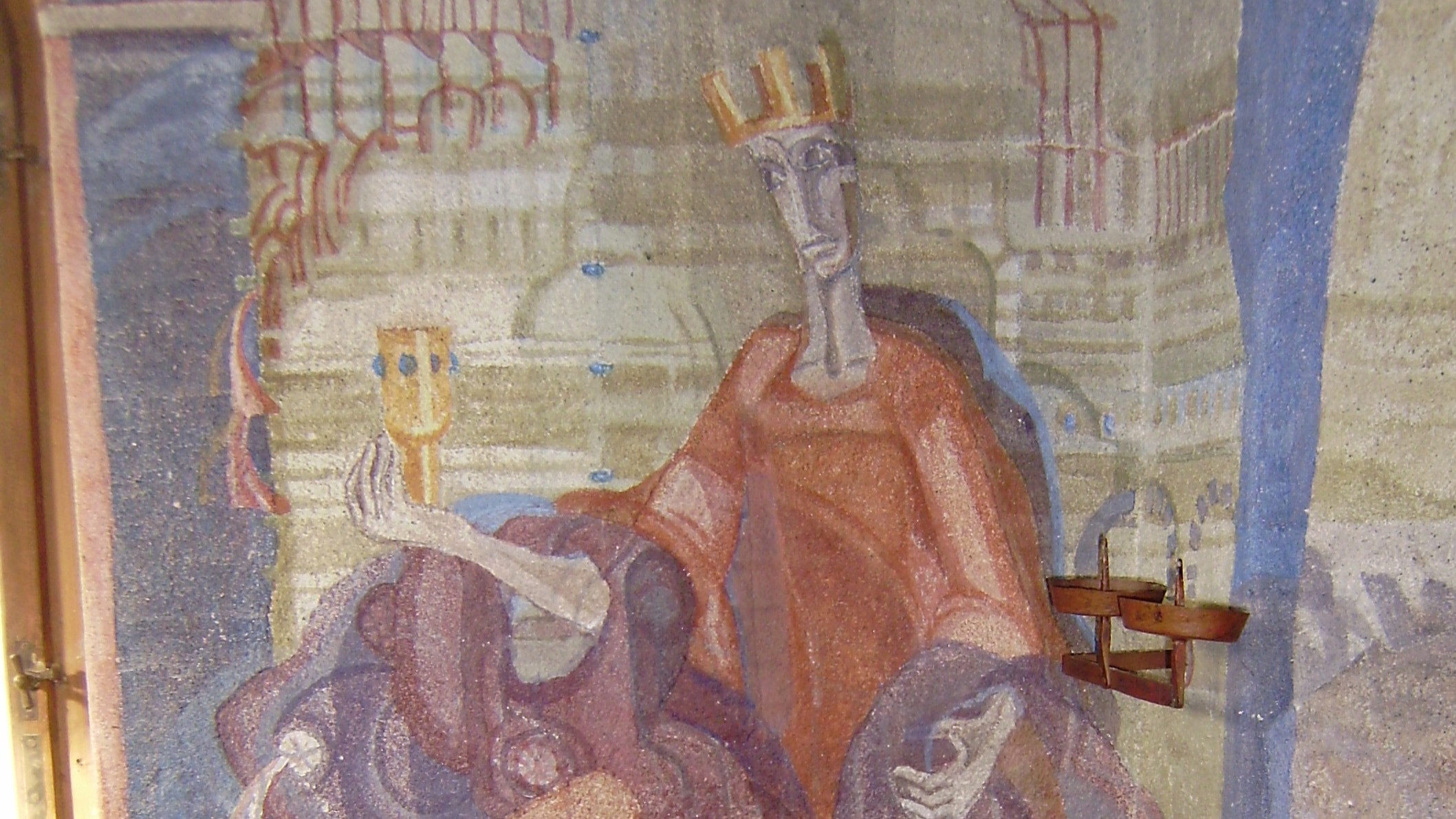
Image credit: Detail of “Solomon Receives the Queen of Sheba” by Silvia Nagacevschi, 1986-1987. Photo by Horst F. Freudenberger, 2012.