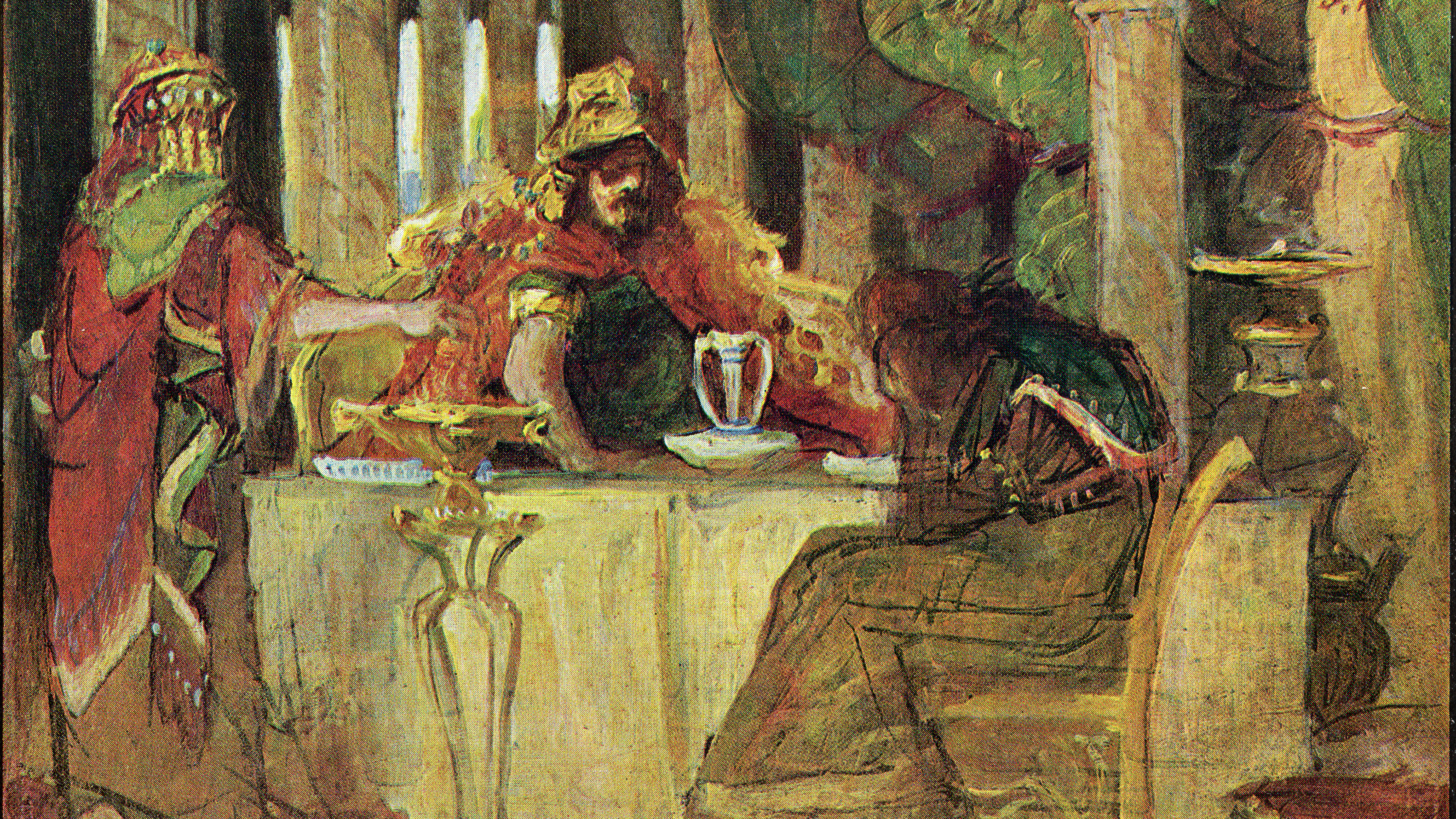
Esther 7:1-10 & 9:1-2, 20-22, 29-32
Narrative Lectionary
BibleHub
7:1 So the kingI and HamanII wentIII in
Notes on verse 7:1a
I “king” = melek. From malak (to be or become king or queen, to rise to the throne, to be crowned; by implication, to take counsel). This is king or royal.
II “Haman” = Haman. From Old Persian Imanis (Haman); {related to Old Persian hamayun (illustrious, magnificent)} OR from aman (to believe, endure, fulfill, confirm, support, be faithful, put one’s trust in, be steadfast. Figuratively, this is to be firm, steadfast, or faithful, trusting, believing, being permanent, morally solid) OR from hama (be noisy). This is Haman, which may mean rage, turbulent, noise, certainty, magnificent, trustworthy, unique. See https://en.wikipedia.org/wiki/Haman & https://www.abarim-publications.com/Meaning/Haman.html
III “went” = bo. This is to enter, come in, advance, fulfill, bring offerings, enter to worship, attack. It can also have a sexual connotation.
to feastIV with QueenV Esther.VI 2 On the secondVII day,VIII
Notes on verses 7:1b-2a
IV “feast” = shathah. This is to drink literally or figuratively. It could also be a drinker.
V “Queen” = malkah. Related to “king” in v7:1. From melek (see note I above). This is queen.
VI “Esther” = Ester. From Old Persian a-s-t-r (star) OR Akkadian ishtar (Ishtar) OR Median astra (myrtle). This is Esther or Ester, a name meaning, “star” or “myrtle.” See https://en.wiktionary.org/wiki/Esther & https://www.abarim-publications.com/Meaning/Esther.html
VII “second” = sheni. From shanah (to fold, repeat, double, alter, or disguise). This is double, again, another, second.
VIII “day” = yom. Root may mean being hot. This is the day in a literal or figurative sense. It can also mean birth, age, daylight, continually or other references to time.
as they were drinkingIX wine,X the king againXI saidXII to Esther, “What is your petition,XIII Queen Esther?
Notes on verse 7:2b
IX “drinking” = mishteh. Related to “feast” in v7:1. From shathah (see note IV above). This is drink or the act of drinking. So it is a feast or banquet, as occasions with drinking.
X “wine” = yayin. Root may mean to effervesce, referring to the fermentation process. This is wine, grape, or banquet. It can imply intoxication.
XI “again” = gam. This is also, moreover, again.
XII “said” = amar. This is to speak, say, answer, command, promise, report.
XIII “petition” = sheelah. 14x in OT. From shaal (to ask, inquire, beg, borrow, desire, request; can also mean demand). This is something that is requested like a petition, request, or loan. Used frequently in the book of Esther.
It shall be grantedXIV you. And what is your request?XV Even to halfXVI of my kingdom,XVII it shall be fulfilled.”XVIII
Notes on verse 7:2c
XIV “granted” = natan. This is to give, put, set, offer. It is to give literally or figuratively.
XV “request” = baqqashah. 8x in OT– all in Ezra & Esther. From baqash (to seek, ask, desire, or request; any kind of searching; to worship or pray – implies a striving for). This is a request or petition.
XVI “half” = chatsi. From chatsah (to halve, divide, reach, participate). This is half, middle, midnight, midst.
XVII “kingdom” = malkut. Related to “king” and “Queen” in v7:1. From melek (see note I above). This is royalty, kingdom, realm, empire – the power the sovereign has.
XVIII “fulfilled” = asah. This is to make, do, act, appoint, become in many senses.
3 Then Queen Esther answered,XIX, XX “If I have wonXXI yourXXII favor,XXIII O king,
Notes on verse 7:3a
XIX “answered” = anah. This is answer, respond, announce, sing, shout, or testify. It means to pay attention, which implies responding and, by extension, starting to talk. Used in a specific sense for singing, shouting, testifying, etc.
XX {untranslated} = amar. Same as “said” in v7:2. See note XII above.
XXI “won” = matsa. This is to find, catch or acquire. It can also mean to come forth or appear. Figuratively, this can mean to meet or be together with.
XXII “your” = ayin. Literally, “in your sight.” This is eye in a literal or figurative sense so eye, appearance, favor, or a fountain (the eye of the landscape).
XXIII “favor” = chen. From chanan (beseech, show favor, be gracious; properly, to bend in kindness to someone with less status). This is grace, favor, kindness, beauty, precious.
and if it pleasesXXIV the king, let my lifeXXV be givenXXVI me—that is my petition—and the lives of my peopleXXVII—that is my request.
Notes on verse 7:3b
XXIV “pleases” = tob. This is to be good, go well, please.
XXV “life” = nephesh. Related to naphash (to refresh or be refreshed). This is soul, self, person, emotion. It is a breathing creature. Can also refer to appetites and desires.
XXVI “given” = natan. Same as “granted” in v7:2. See note XIV above.
XXVII “people” = am. From amam (to darken, hide, associate; creating shadows by huddling together). This is people or nation. It can be used specifically for a tribe, collectively of troops or armies, or figuratively to refer to a flock of animals.
4 For we have been sold,XXVIII I and my people, to be destroyed,XXIX to be killed,XXX and to be annihilated.XXXI
Notes on verse 7:4a
XXVIII “sold” = makar. This is to sell – could be commerce/trade, a daughter to be married, someone into slavery. Figuratively, it can mean to surrender.
XXIX “destroyed” = shamad. This is to demolish, destroy, perish, overthrow, pluck down.
XXX “killed” = harag. This is to strike with deadly intent so it can be kill, destroy, murder, or put to death.
XXXI “annihilated” = abad. To wander off, lose self. This implies to perish, destroy, die, vanish, or be broken or corrupt.
IfXXXII we had been sold merely as slaves, menXXXIII and women,XXXIV I would have held my peace,XXXV
Notes on verse 7:4b
XXXII “if” = illu. 2x in OT. Perhaps from al (not, neither, never, nothing). This is if, but, though.
XXXIII “slaves, men” = ebed. From abad (to work, serve, compel; any kind of work; used causatively, can mean to enslave or keep in bondage). This is a servant, slave, or bondservant.
XXXIV “slaves…women” = shiphchah. Root may mean to spread out – it would be the same root used in mishpachah, which means family or clan. This is maidservant, female slave, or female bondslave.
XXXV “held my peace” = charash. This is to scratch, which implies etching or plowing. It can mean to manufacture regardless of materials used. Figuratively, it can be to devise or conceal. It can also have a sense of secrecy. Hence, being silent or left alone. It can also be speechless.
but noXXXVI enemyXXXVII can compensateXXXVIII for this damageXXXIX to the king.”
Notes on verse 7:4c
XXXVI “no” = ayin. Perhaps from a word that means to be nothing. This means nothing, none, non-existent. It can also simply mean not or are not.
XXXVII “enemy” = tsar. From tsarar (to bind, restrict, narrow, be cramped, an adversary). Properly, this is a narrow or constricted place. Figuratively, it can be trouble, a pebble, an enemy, anguish, or distress.
XXXVIII “compensate” = shavah. This is to equalize, resemble, agree with, compare, adjust, compose, place, or yield.
XXXIX “damage” = nezeq. 1x in OT. From the same as nezem (a ring worn for decorative reasons; earrings, nose rings, or other jewels). This is injury, annoyance, or loss.
5 Then King AhasuerusXL said to Queen Esther,XLI “Who is he, and where is he, who has presumedXLII to doXLIII this?”XLIV
Notes on verse 7:5
XL “Ahasuerus” = Achashverosh. From Old Persian xsayarsha (“ruler among kings” or “hero among kings”); {from xshaya (king) + arshan (male)}. This is Ahasuerus or Artaxerxes. It is the king’s title and not a personal name. See https://en.wiktionary.org/wiki/Ahasuerus & https://en.wikipedia.org/wiki/Ahasuerus
XLI {untranslated} = amar. Same as “said” in v7:2. See note XII above.
XLII “presumed” = male + leb. Literally, “filled his heart.” Male is fill, satisfy, replenish, accomplish, fulfill, confirm, or consecrate. It is fill in a literal or figurative sense. Leb is from the same as lebab (the heart, courage, one’s inner self, the mind, the will; only used in a figurative sense in the Bible); may be related to labab (to encourage; properly, to be encased as with fat; used in a good sense, this means to transport someone with love; used in a bad sense, it can mean to dull one’s senses). This is inner self, mind, will, feelings, the center.
XLIII “do” = asah. Same as “fulfilled” in v7:2. See note XVIII above.
XLIV “this” = ken. Perhaps from kun (properly, in a perpendicular position; literally, to establish, fix, fasten, prepare; figuratively, it is certainty, to be firm, faithfulness, render sure or prosperous). This is to set upright. Generally used figuratively to mean thus, so, afterwards, rightly so.
6 Esther said, “AXLV foeXLVI and an enemy,XLVII this wickedXLVIII Haman!”
Notes on verse 7:6a
XLV {untranslated} = ish. Perhaps from enosh (human, humankind, mortal); from anash (to be weak, sick, or frail). This is man, husband, another, or humankind.
XLVI “foe” = tsar. Same as “enemy” in v7:4. See note XXXVII above.
XLVII “enemy” = oyeb. From ayab (to hate or be hostile to). This is a foe or enemy as one that you are hostile to.
XLVIII “wicked” = ra’. From ra’a’ (to be evil, bad, afflict; properly, to spoil – to destroy by breaking into pieces; figuratively, to cause something to be worthless; this is bad in a physical, social, or moral sense; that which displeases, to do harm or mischief, to punish or vex). This is bad, disagreeable, that which causes pain, misery, something having little or no value, something that is ethically bad, wicked, injury, calamity. This refers to anything that is not what it ought to be – a natural disaster, a disfigurement, an injury, a sin.
Then Haman was terrifiedXLIX beforeL the king and the queen. 7 The king roseLI from the feastLII in wrathLIII
Notes on verses 7:6b-7a
XLIX “terrified” = baath. 16x in OT. This is to terrify, startle, overwhelm, terrorize, or fall upon.
L “before” = paneh. From panah (to turn, face, appear). This is face in a literal or figurative sense. It could be face, presence, anger, respect. It can also be used of God to indicate divine favor or presence.
LI “rose” = qum. To arise, stand, accomplish, establish, abide. This is rising as in rising against, getting up after being sick or asleep, arising from one state to another, becoming powerful, or rising for action. It can also be standing in a figurative sense.
LII “feast” = mishteh + yayin. Literally, “drinking of the wine.” Mishteh is the same as “drinking” in v7:2. See note IX above. Yayin is the same as “wine” in v7:2. See note X above.
LIII “wrath” = chemah. From yacham (to be hot, mate; figuratively, to conceive). This is heat – figuratively it can be anger or fury. It can also refer to poison or venom as they can cause fever.
and went into the palaceLIV garden,LV but Haman stayedLVI to begLVII his life from Queen Esther, for he sawLVIII that the king
Notes on verse 7:7b
LIV “palace” = bithan. 3x in OT. From bayit (house, court, family, palace, temple); probably from banah (to build, make, set up, obtain children; to build literally or figuratively). This is a big house – a palace.
LV “garden” = ginnah. 4x in OT. From gannah (garden, orchard); from gan (garden that is fenced in; an enclosure); from ganan (to put a hedge around – generally, protect or defend; to cover or surround). This is garden.
LVI “stayed” = amad. This is to stand up in a literal or figurative sense. So it can be establish, continue, endure, take a stand, act, be a servant, stand still, remain, stand against an enemy.
LVII “beg” = baqash. Related to “request” in v7:2. See note XV above.
LVIII “saw” = raah. This is to see in a literal or figurative sense so stare, advise, think, view.
had determinedLIX to destroyLX him.
8 When the king returnedLXI from the palace garden to the banquetLXII hall,LXIII
Notes on verses 7:7c-8a
LIX “determined” = kalah. This is to end, be finished, complete, prepare, consume, spent, or completely destroyed.
LX “destroy” = ra’. Same as “wicked” in v7:6. See note XLVIII above.
LXI “returned” = shub. To turn back, return, turn away – literally or figuratively. Doesn’t necessarily imply going back to where you started from. This is also the root verb for the Hebrew word for repentance “teshubah.”
LXII “banquet” = mishteh + yayin. Literally, “drinking of wine.” Mishteh is the same as “drinking” in v7:2. See note IX above. Yayin is the same as “wine” in v7:2. See note X above.
LXIII “hall” = bayit. Related to “palace” in v7:7. See note LIV above.
Haman had thrownLXIV himself on the couchLXV where Esther was reclining, and the king said, “Will he evenLXVI violateLXVII the queen in my presence, in my own house?”LXVIII
Notes on verse 7:8b
LXIV “thrown” = naphal. This is to fall, whether by accident, to fall prostrate, or to fall in violent death. Figuratively, it can refer to personal ruin or calamity, a city falling, an attack or a falling away. It can also be a deep sleep or wasting away.
LXV “couch” = mittah. From natah (to stretch or spread out, extend, bend). This is a couch or bed that is spread out to sleep on or for eating. It can also refer to a litter or a bier.
LXVI “even” = gam. Same as “again” in v7:2. See note XI above.
LXVII “violate” = kabash. 14x in OT. This is to subdue, tread down, trample, disregard, violate, assault, or conquer.
LXVIII “house” = bayit. Same as “hall” in v7:8. See note LXIII above.
As the wordsLXIX leftLXX the mouthLXXI of the king, they coveredLXXII Haman’s face.LXXIII
Notes on verse 7:8c
LXIX “words” = dabar. From dabar (to speak, declare, discuss). This is speech, a word, a matter, an affair, charge, command, message, promise, purpose, report, request. It is a word, which implies things that are spoken of in a wide sense.
LXX “left” = yatsa. This is to go or come out, bring forth, appear. It is to go out in a literal or figurative sense.
LXXI “mouth” = peh. This is mouth in a literal or figurative sense. So, more literally, it can be beak or jaws. More figuratively, it refers to speech, commands, or promises.
LXXII “covered” = chaphah. 12x in OT. This is to cover, veil, overlay, or protect. It is used for covering one’s head or face or overlaying with precious metals.
LXXIII “face” = paneh. Same as “before” in v7:6. See note L above.
9 Then Harbona,LXXIV oneLXXV of the eunuchsLXXVI in attendanceLXXVII on the king,
Notes on verse 7:9a
LXXIV “Harbona” = Charbona. 2x in OT. Of Persian origin. This is Harbona, a name which may mean one who drives a donkey. See https://www.biblestudytools.com/dictionary/harbona- harbonah/
LXXV “one” = echad. Perhaps from achad (to unify, continue on a path; figuratively, to gather one’s thoughts). This is the number one, first, united. It can also be alone, altogether, a certain, a few.
LXXVI “eunuchs” = saris. Root is likely foreign and may mean castrate. So, this could be a eunuch, valet, or other kind of officer.
LXXVII “attendance” = paneh. Same as “before” in v7:6. See note L above.
said, “Look,LXXVIII the veryLXXIX poleLXXX that Haman
Notes on verse 7:9b
LXXVIII “look” = hinneh. From hen (lo! Behold! If, though; an expression of surprise). This is to draw attention, show suddenness or surprise, or to emphasize the importance of the coming statement. See! Lo! Behold!
LXXIX “very” = gam. Same as “again” in v7:2. See note XI above.
LXXX “pole” = ets. Perhaps from atsah (to shut, fasten, firm up, to close one’s eyes). This is tree or other things related to trees like wood, sticks, or stalks. It can also refer to wood products like a plank or staff or gallows. Additionally, this can refer to a carpenter.
has preparedLXXXI for Mordecai,LXXXII whose word savedLXXXIII the king,
Notes on verse 7:9c
LXXXI “prepared” = asah. Same as “fulfilled” in v7:2. See note XVIII above.
LXXXII “Mordecai” = Mordekay. From Marduk (Marduk – “Bull Calf of Utu {the solar deity)”); {Sumerian Amarutu (Marduk); {from anum (god); {from an (sky, sky god)} + buru (calf) + shamshu (sun); {from ud (sun, day)}}}; {with a tongue in cheek Hebrew derivation of mar (bitterness literal or figurative) + dak (crushed so figuratively it refers to the injured or afflicted)}. This is Mordecai, a name meaning, “of Marduk” or “of bitter oppression.” See https://www.abarim-publications.com/Meaning/Mordecai.html & https://www.abarim-publications.com/Meaning/Marduk.html & https://en.wiktionary.org/wiki/Marduk
LXXXIII “word saved” = dabar + tob. Literally, “spoke good.” Dabar is related to “words” in v7:8. Tob is related to “pleases” in v7:3. From tob (see note XXIV above). This is good, beautiful, pleasant, agreeable, bountiful, at ease. This word is used for goodness as a concept, a good thing, a good person. This can refer to prosperity and welfare as well as joy, kindness, sweetness, and graciousness. So, this is ethically good, but also enjoyably good.
standsLXXXIV at Haman’s house, fiftyLXXXV cubitsLXXXVI high.”LXXXVII
And the king said, “HangLXXXVIII him on that.”
Notes on verse 7:9d
LXXXIV “stands” = amad. Same as “stayed” in v7:7. See note LVI above.
LXXXV “fifty” = chamishshim. From chamesh (five, fifth). This is fifty.
LXXXVI “cubits” = ammah. From the same as em (mother). This is a cubit, post, threshold, pivot. It is mother as the basic measure (the length of the forearm). It is also mother as the which bonds an entryway i.e. the base of the door.
LXXXVII “high” = gaboah. From gabah (to be tall, high, exalted, proud, haughty). This is high, tall, long, proud, or arrogant. It could also be a high ranking official, someone exalted, or something lofty.
LXXXVIII “hang” = talah. This is to hang or suspend. It can also be used for hanging someone on gallows.
10 So they hung Haman on the pole that he had preparedLXXXIX for Mordecai. Then the angerXC of the king abated.XCI
Notes on verse 7:10
LXXXIX “prepared” = kun. Related to “this” in v7:5. See note XLIV above.
XC “anger” = chemah. Same as “wrath” in v7:7. See note LIII above.
XCI “abated” = shakak. 5x in OT. This is to decrease, subside, pacify. It can also mean to weave as when one sets a trap. It is also used when the Great Flood subsides in Genesis 8.
9:1 Now in the twelfthXCII month,XCIII which is the month of Adar,XCIV on the thirteenthXCV day, when theXCVI
Notes on verse 9:1a
XCII “twelfth” = shenayim + asar. Shenayim is related to “second” in v7:2. From sheni (see note VII above). This is two, both, second, couple. Asar is from the same as eser (ten). This is -teen or -teenth.
XCIII “month” = chodesh. From chadash (to renew, repair). This refers to a new moon. It can also mean monthly.
XCIV “Adar” = Adar. 8x in OT– all in Esther. Perhaps from Akkadian addari (month of grain or barley; around February or March). This is the 12th month Adar. See https://en.wiktionary.org/wiki/%D7%90%D7%93%D7%A8#Hebrew
XCV “thirteenth” = shalosh + asar. Shalosh is three, fork, three times. Asar is the same as “twelfth” in v9:1. See note XCII above.
XCVI {untranslated} = naga. This is touch, reach, arrive, come near, strike. This is touching for any reason including sexual or violent.
king’s commandXCVII and edictXCVIII were about to be executed,XCIX on the very day when the enemiesC of the JewsCI
Notes on verse 9:1b
XCVII “command” = dabar. Same as “words” in v7:8. See note LXIX above.
XCVIII “edict” = dath. This is a law or command of the king.
XCIX “executed” = asah. Same as “fulfilled” in v7:2. See note XVIII above.
C “enemies” = oyeb. Same as “enemy” in v7:6. See note XLVII above.
CI “Jews” = Yehudi. From Yehudah (Judah, son of Jacob, his tribal descendants, a name for the southern kingdom. Literally, it means praised); probably from yadah (to throw one’s hands into the air in a gesture of praise); from yad (hand). This is Jew or Jewish – one descended from Judah.
hopedCII to gain powerCIII over them but that had been changedCIV to a day when the Jews would gain power over their foes,CV
Notes on verse 9:1c
CII “hoped” = sabar. 8x in OT. This is to look, inspect, wait. It can imply watching for in a hopeful and patient manner.
CIII “gain power” = shalat. 8x in OT. This is to rule, dominate, govern. It can also mean to bear or permit.
CIV “changed” = haphak. This is to turn, overturn, change, return, turn over, pervert.
CV “foes” = sane. This is to hate, an enemy. It is a personal hatred and not an abstract one.
2 the Jews gatheredCVI in their citiesCVII throughout allCVIII the provincesCIX
Notes on verse 9:2a
CVI “gathered” = qahal. From qahal (assembly, congregation, multitude). This is to gather, convene, assemble like a congregation.
CVII “cities” = iyr. From uwr (to awaken or wake oneself up). This can mean excitement in the sense of wakefulness or city. Properly, this is a place that is guarded. Guards kept schedules according to watches. This sense of the word would include cities as well as encampments or posts that were guarded.
CVIII “all” = kol. From kalal (to complete). This is all or every.
CIX “provinces” = medinah. From din (to judge, defend, dispute, govern, strive). This is an area or province overseen by a judge So, it’s a jurisdiction, region, or province.
of King Ahasuerus to killCX those who had soughtCXI their ruin,CXII and no oneCXIII
Notes on verse 9:2b
CX “kill” = shalach + yad. Literally, “stretch out a hand.” Shalach is to send out, away, send for, forsake. It can also mean to divorce or set a slave free. Yad is hand, ability, power. Hand in a literal sense, but also what one can do or the means by which one does it.
CXI “sought” = baqash. Same as “beg” in v7:7. See note LVII above.
CXII “ruin” = ra’. Same as “wicked” in v7:6. See note XLVIII above.
CXIII “one” = ish. Same as {untranslated} in v7:6. See note XLV above.
could withstandCXIV, CXV them, because the fearCXVI of them had fallenCXVII upon all peoples.
Notes on verse 9:2c
CXIV “withstand” = amad. Same as “stayed” in v7:7. See note LVI above.
CXV {untranslated} = paneh. Same as “before” in v7:6. See note L above.
CXVI “fear” = pachad. From pachad (to dread, be afraid, thrill, be in awe; feeling startled from a sudden sound or alarm). This is dread, fear, awe, panic. It can also refer to what someone fears or dreads.
CXVII “fallen” = naphal. Same as “thrown” in v7:8. See note LXIV above.
20 Mordecai recordedCXVIII these thingsCXIX and sentCXX lettersCXXI to all the Jews who were in all the provinces of King Ahasuerus,
Notes on verse 9:20a
CXVIII “recorded” = katab. This is to inscribe, write, record, or decree.
CXIX “things” = dabar. Same as “words” in v7:8. See note LXIX above.
CXX “sent” = shalach. Same as “kill” in v9:2. See note CX above.
CXXI “letters” = sepher. Perhaps from saphar (to tally or record something; to enumerate, recount, number, celebrate, or declare). This can be writing itself or something that is written like a document, book, letter, evidence, bill, scroll, or register.
both nearCXXII and far,CXXIII 21 enjoiningCXXIV them that they shouldCXXV keepCXXVI
Notes on verses 9:20b-21a
CXXII “near” = qarob. From qarab (to come near, offer, make ready). This is near whether nearby, related, near in time, or allied.
CXXIII “far” = rachoq. From rachaq (to widen, become distant, cast, or remove in a literal or figurative sense). This is distant or far, whether of space or of time.
CXXIV “enjoining” = qum. Same as “rose” in v7:7. See note LI above.
CXXV “should” = hayah. This is to be or become, to happen.
CXXVI “keep” = asah. Same as “fulfilled” in v7:2. See note XVIII above.
the fourteenthCXXVII day of the month Adar and also the fifteenthCXXVIII day of the same month, year by year,CXXIX 22 as the days on which the Jews gained reliefCXXX from their enemiesCXXXI
Notes on verses 9:21b-22a
CXXVII “fourteenth” = arba + asar. Arba is from raba (to make square or be four-sided). This is four. Asar is the same as “twelfth” in v9:1. See note XCII above.
CXXVIII “fifteenth” = chamesh + asar. Chamesh is related to “fifty” in v7:9. See note LXXXV above. Asar is the same as “twelfth” in v9:1. See note XCII above.
CXXIX “year by year” = kol + shanah + shanah. Kol is the same as “all” in v9:2. See note CVIII above. Shanah is from shana (to change, alter). This is a year, age, old. It can also mean yearly.
CXXX “gained relief” = nuach. This is to rest, calm, camp, free, place, remain, satisfy, settle, station, or wait. It is rest and so implies settling down in a literal or figurative sense. This is perhaps the root verb of the name “Noah.”
CXXXI “enemies” = oyeb. Same as “enemy” in v7:6. See note XLVII above.
and as the month that had been turnedCXXXII for them from sorrowCXXXIII into gladnessCXXXIV and from mourningCXXXV into a holiday,CXXXVI
Notes on verse 9:22b
CXXXII “turned” = haphak. Same as “changed” in v9:1. See note CIV above.
CXXXIII “sorrow” = yagon. 14x in OT. From yagah (to suffer, grieve, afflict). This is grief or sorrow.
CXXXIV “gladness” = simchah. From samach (to rejoice, be glad; properly, to brighten up; also used figuratively). This is joy, rejoicing, pleasure, or glee.
CXXXV “mourning” = ebel. From abal (to mourn, bewail). This is mourning or lamentation.
CXXXVI “holiday” = yom + tob. Literally, “good day.” Yom is the same as “day” in v7:2. See note VIII above. Tob is the same as “word saved” in v7:9. See note LXXXIII above.
that they should makeCXXXVII them days of feastingCXXXVIII and gladness, days for sendingCXXXIX giftsCXL of food
Notes on verse 9:22c
CXXXVII “make” = asah. Same as “fulfilled” in v7:2. See note XVIII above.
CXXXVIII “feasting” = mishteh. Same as “drinking” in v7:2. See note IX above.
CXXXIX “sending” = mishloach. Related to “kill” in v9:2. 10x in OT. From shalach (see note CX above). This is a sending out, an undertaking, a putting forth.
CXL “gifts” = manah. 14x in OT. From manah (to weigh out, reckon, count, number, set, tell. By implication, it is allotting or providing something officially). This is a part or portion. It is something that is weighed out so it can be used specifically for a ration or portion of food. It can also mean a lot as in casting lots.
to oneCXLI anotherCXLII and presentsCXLIII to the poor.CXLIV
Notes on verse 9:22d
CXLI “one” = ish. Same as {untranslated} in v7:6. See note XLV above.
CXLII “another” = rea. From raah (to associate with). This is the same as neighbor in Leviticus 19:18 “love your neighbor as yourself.” This is friend, companion, fellow, neighbor. It is someone with whom you associate, whether more or less close.
CXLIII “presents” = mattanah. Related to “granted” in v7:2. 17x in OT. From mattan (gift, reward); from natan (see note XIV above). This is a present, bribe, or offering.
CXLIV “poor” = ebyon. From abah (to consent, obey, want, yield, accept). This is needy, poor, beggar. Someone who is wanting.
29 Queen Esther daughterCXLV of Abihail,CXLVI along with Mordecai the Jew, gave fullCXLVII
Notes on verse 9:29a
CXLV “daughter” = bat. Related to “palace” in v7:7 & “hall” in v7:8. From ben (son literal or figurative; also, grandson, subject, nation); from banah (see note LIV above). This is daughter in a literal or figurative sense.
CXLVI “Abihail” = Abichayil. 6x in OT. From ab (father, chief, ancestor; father in a literal or figurative sense) + chayil (strength, wealth, ability, activity; a soldier or a company of soldiers; goods; a force of people, means, or goods; valor, virtue, or strength); {from chul (to be firm, strong, prosperous; to endure)}. This is Abihail, meaning “my father is might” or “possessor of might.”
CXLVII “full” = kol. Same as “all” in v9:2. See note CVIII above.
writtenCXLVIII authorityCXLIX confirmingCL this second letterCLI about Purim.CLII
Notes on verse 9:29b
CXLVIII “gave…written” = katab. Same as “recorded” in v9:20. See note CXVIII above.
CXLIX “authority” = toqeph. 3x in OT – 2x in Esther & 1x in Daniel 11. From taqeph (to prevail, overpower). This is authority, power, strength.
CL “confirming” = qum. Same as “rose” in v7:7. See note LI above.
CLI “letter” = iggereth. 10x in OT. Perhaps from agar (to gather, harvest) OR from Aramaic iggerah (a letter – from Persian). This is a letter.
CLII “Purim” = Pur. 8x in OT – all in Esther. Perhaps from Akkadian puru (stone, urn); perhaps from Sumeric bur (bowl, platter). This is Purim, a Jewish feast named after “lots.” See https://www.etymonline.com/word/Purim
30 LettersCLIII were sentCLIV wishingCLV peaceCLVI
Notes on verse 9:30a
CLIII “letters” = sepher. Same as “letters” in v9:20. See note CXXI above.
CLIV “sent” = shalach. Same as “kill” in v9:2. See note CX above.
CLV “wishing” = dabar. Same as “words” in v7:8. See note LXIX above.
CLVI “peace” = shalom. From shalam (to be complete or sound; to have safety mentally, physically, or extending to one’s estate; so, if these things are safe and complete, the implication is that one would be friendly; and, if being friendly, one would make amends and that friendship would be reciprocated). This is completeness, soundness, welfare, favor, friend, good health. It is to be safe and figuratively well, happy, at peace, friendly. Abstractly, it includes the ideas of welfare and prosperity (not in excessive wealth, but in having enough).
and securityCLVII to all the Jews, to the one hundredCLVIII twenty-sevenCLIX provinces of the kingdom of Ahasuerus,
Notes on verse 9:30b
CLVII “security” = emet. From aman (to believe, endure, fulfill, confirm, support, be faithful, put one’s trust in, be steadfast. Figuratively, this is to be firm, steadfast, or faithful, trusting, believing, being permanent, morally solid). This is firmness or stability. Figuratively, it is faithfulness, truth, or trustworthiness. This is the same root that “amen” comes from.
CLVIII “hundred” = meah. This is hundred or some number times one hundred (i.e. hundredfold or the base of two hundred, three hundred, etc.).
CLIX “twenty-seven” = sheba + esrim. Sheba is seven or by sevenfold. It can also be used to imply a week or an indefinite number. Symbolically, this is the number of fullness, sacredness, perfection. Esrim is related to “twelfth” in v9:1. From the same as eser (see note XCII above). This is twenty or twentieth.
31 and giving ordersCLX that these days of Purim should be observed at their appointed seasons,CLXI as Mordecai the Jew and Queen Esther enjoined on the Jews, just as they had laid downCLXII for themselvesCLXIII and for their descendantsCLXIV
Notes on verse 9:31a
CLX “giving orders” = qum. Same as “rose” in v7:7. See note LI above.
CLXI “appointed seasons” = zeman. 4x in OT– including twice in Esther of the time appointed for Purim. From zaman (to set a time, be appointed); perhaps from zamam (to devise, plot, imagine, intend, scheme, think evil; usually in an evil sense). This is a specific time, occasion, or season.
CLXII “laid down” = qum. Same as “rose” in v7:7. See note LI above.
CLXIII “themselves” = nephesh. Same as “life” in v7:3. See note XXV above.
CLXIV “descendants” = zera. From zara (to sow or scatter seed; conceive or yield). This is seed or sowing. It can, thus, mean a fruit, plant, sowing time, child, offspring, or posterity.
regulationsCLXV concerning their fastsCLXVI and their lamentations.CLXVII 32 The commandCLXVIII of Esther fixedCLXIX these practicesCLXX of Purim, and it was recorded in writing.CLXXI
Notes on verses 9:31b-32
CLXV “regulations” = dabar. Same as “words” in v7:8. See note LXIX above.
CLXVI “fasts” = tsom. From tsum (properly, covering one’s mouth; by extension, abstaining from food). This is fasting or a fast.
CLXVII “lamentations” = zeaqah. 19x in OT. From zaaq (to cry or call out; a call to assemble or gather together; a herald who announces a public gathering; a shriek from pain or danger). This is a cry, shriek. It is crying out as lament or distress.
CLXVIII “command” = amar. Same as “said” in v7:2. See note XII above.
CLXIX “fixed” = qum. Same as “rose” in v7:7. See note LI above.
CLXX “practices” = dabar. Same as “words” in v7:8. See note LXIX above.
CLXXI “writing” = sepher. Same as “letters” in v9:20. See note CXXI above.
Image credit: “Esther and Haman” by Aoki Shigeru, 1906.