1 Kings 7
BibleHub
1 SolomonI was buildingII his own houseIII
Notes on verse 1a
I “Solomon” = Shelomoh. From shalam (to be complete or sound; to have safety mentally, physically, or extending to one’s estate; so, if these things are safe and complete, the implication is that one would be friendly; and, if being friendly, one would make amends and that friendship would be reciprocated). This is Solomon or Shelomoh, meaning “peaceful.” It is the same word as the Hebrew word for peace – shalom.
II “building” = banah. Related to “house” in v1. See note III below.
III “house” = bayit. Probably from banah (to build, make, set up, obtain children; to build literally or figuratively). This is house, court, family, palace, temple.
thirteenIV years,V and he finishedVI his entireVII house.
Notes on verse 1b
IV “thirteen” = shalosh + asar. Shalosh is three, fork, three times. Asar is from the same as eser (ten). This is -teen or -teenth.
V “years” = shanah. From shana (to change, alter). This is a year, age, old. It can also mean yearly.
VI “finished” = kalah. This is to end, be finished, complete, prepare, consume, spent, or completely destroyed.
VII “entire” = kol. From kalal (to complete). This is all or every.
2 He built the House of the ForestVIII of the LebanonIX one hundredX
Notes on verse 2a
VIII “Forest” = ya’ar. This is honeycomb, forest, thicket. Root may mean thick with green growth. It is a forest as a place where one would find honeycomb.
IX “Lebanon” = Lebanon. From laben (to be white, make white, make bricks) OR form Aramaic lebab (heart); corresponding to Hebrew lebab (heart, courage, one’s inner self, the mind, or the will). This is Lebanon. The sense of “white” comes from the snow on the top of its mountains. See https://en.wikipedia.org/wiki/Lebanon
X “hundred” = meah. This is hundred or some number times one hundred (i.e. hundredfold or the base of two hundred, three hundred, etc.).
cubitsXI long,XII fiftyXIII cubits wide,XIV
Notes on verse 2b
XI “cubits” = ammah. From the same as em (mother). This is a cubit, post, threshold, pivot. It is mother as the basic measure (the length of the forearm). It is also mother as the which bonds an entryway i.e. the base of the door.
XII “long” = orek. From arak (to be long in a literal or figurative sense, to continue, defer, draw out). This is length, long, or forever.
XIII “fifty” = chamishshim. From chamesh (five, fifth). This is fifty.
XIV “wide” = rochab. From rachab (to grow wide or enlarge in a literal or figurative sense; extend, relieve, rejoice, or speak boldly). This is breadth, depth, thickness, expanse. It is width in a literal or figurative sense.
and thirtyXV cubits high,XVI built on fourXVII rowsXVIII
Notes on verse 2c
XV “thirty” = sheloshim. Related to “thirteen” in v1. From the same as shalosh (see note IV above). This is thirty or thirtieth.
XVI “high” = qomah. From qum (to arise, stand, accomplish, establish, abide; rising against, getting up after being sick or asleep, arising from one state to another, becoming powerful, or rising for action; standing in a figurative sense). This is tall, high, length, or height.
XVII “four” = arba. From raba (to make square or be four-sided). This is four.
XVIII “rows” = tur. May come from a word that means to arrange in an evenly spaced way. So, it can be row or wall.
of cedarXIX pillars,XX with cedar beamsXXI on the pillars. 3 It was roofedXXII with cedar onXXIII
Notes on verses 2d-3a
XIX “cedar” = erez. Perhaps from araz (made from cedar; to be firm, strong). This is cedar or a cedar tree as strong.
XX “pillars” = ammud. From amad (to stand up in a literal or figurative sense; to establish, continue, endure, take a stand, act, be a servant, stand still, remain, stand against an enemy). This is a pillar, stand, or platform.
XXI “beams” = karuthah. 3x in OT – all in 1 Kings 6-7. From karat (to cut down, cut off, or make a covenant; there is an idiom for making a covenant, which is “to cut a covenant”). This is cutting, beam, or hewn timber.
XXII “roofed” = saphan. 6x in OT. This is to hide, hoard, reserve. It can mean to cover over or figuratively to deny. In other places, it can mean to lurk.
XXIII “on” = maal. From alah (to go up, ascend, be high, be a priority; to arise in a literal or figurative sense). This is the upper part, forward, high above, upwards, greater, heaven, or exceedingly.
the forty-XXIVfiveXXV rafters,XXVI fifteenXXVII in each row, which were on the pillars.
Notes on verse 3b
XXIV “forty” = arbaim. Related to “four” in v2. From the same as arba (see note XVII above). This is forty.
XXV “five” = chamesh. Related to “fifty” in v2. See note XIII above.
XXVI “rafters” = tsela. Perhaps from tsala (to limp, be lame). This is rib, side, leaf, plank, side of a person or object; quarter of the sky.
XXVII “fifteen” = chamesh + asar. Chamesh is the same as “five” in v3. See note XXV above. Asar is the same as “thirteen” in v1. See note IV above.
4 There were window framesXXVIII in the threeXXIX rows, facing each otherXXX in the three rows.XXXI
Notes on verse 4
XXVIII “window frames” = shaquph. 2x in OT. From sheqeph (lattice, window, framework); from shaqaph (to look down or look out; properly, looking by leaning out a window; peeping or gazing). This is overhanging, frame, casing.
XXIX “three” = shalosh. Same as “thirteen” in v1. See note IV above.
XXX “facing each other” = mechezah + el + mechezah. Literally, “window to window.” Mechezah is 4x in OT. From chazah (to gaze at – to see or behold; perceiving as a mental process or looking at something with pleasure; seeing a vision). This is a place of seeing – appearance, widow, light.
XXXI “rows” = paam. From paam (to move, trouble; to tap in a regular rhythm; to agitate). This is a beat, stroke, footstep, or occurrence.
5 AllXXXII the doorwaysXXXIII and doorpostsXXXIV had four-sidedXXXV frames,XXXVI
Notes on verse 5a
XXXII “all” = kol. Same as “entire” in v1. See note VII above.
XXXIII “doorways” = petach. From patach (to open wide in a literal or figurative sense, loosen, plow, carve). This is opening, door, gate, entrance.
XXXIV “doorposts” = mezuzah. 19x in OT. From the same as ziz (moving things like animals, abundance). This is a door or gate post. In modern Judaism, a mezuzah adorns the doorpost of many Jewish homes in reference to Deuteronomy 6:9. See https://en.wiktionary.org/wiki/mezuzah
XXXV “four-sided” = raba. Related to “four” in v2 & “forty” in v3. 12x in OT. See note XVII above.
XXXVI “frames” = sheqeph. Related to “window frames” in v4. 1x in OT. See note XXVIII above.
opposite,XXXVII facing each other in the three rows.XXXVIII
6 He madeXXXIX the HallXL of Pillars fifty cubits long and thirty cubits wide.
Notes on verses 5b-6a
XXXVII “opposite” = mul. Perhaps from mul (to cut short, circumcise, blunt, destroy). This is in front of, opposite, with, abrupt. Literally, it refers to some kind of precipice.
XXXVIII “rows” = paam. Same as “rows” in v4. See note XXXI above.
XXXIX “made” = asah. This is to make, do, act, appoint, become in many senses.
XL “Hall” = ulam. From the same as ul (mighty, strength, body, belly; root may mean to twist and that implies strength and power); from alam (to bind or tie fast; to be silent or speechless, whether voluntary or involuntary) or from ayil (strength; things that are strong or powerful: political chiefs, rams, posts, trees, oaks). This is porch or hall.
There was a porchXLI in frontXLII with pillars and a canopyXLIII in frontXLIV of them.
Notes on verse 6b
XLI “porch” = ulam. Same as “Hall” in v6. See note XL above.
XLII “front” = paneh. From panah (to turn, face, appear). This is face in a literal or figurative sense. It could be face, presence, anger, respect. It can also be used of God to indicate divine favor or presence.
XLIII “canopy” = ab. 3x in OT. Perhaps akin to ab (a dark or thick cloud that can envelope in darkness; a copse or to clay); perhaps from ub (to be a think or dark cloud, a cloud covering). This is threshold, shading, plant, landing.
XLIV “front” = paneh. Same as “front” in v6. See note XLII above.
7 He made the Hall of the ThroneXLV where he was to pronounce judgment,XLVI the Hall of Justice,XLVII
Notes on verse 7a
XLV “Throne” = kisse. From the same as kese (full moon); perhaps from kasah (to cover, conceal, overwhelm; to cover as clothes do or to hide a secret). This is throne – a seat that is covered or has a canopy. Thus, it is a seat that conveys authority.
XLVI “pronounce judgment” = shaphat. This is to judge, defend, pronounce judgment, condemn, or govern. It can refer to God judging or to human judges. This is pronouncing a verdict in favor or against so it implies consequences or punishment. It can also mean to litigate or govern as one with authority.
XLVII “Justice” = mishpat. Related to “pronounce judgment’ in v7. From shaphat (see note XLVI above). This is a verdict or formal sentence whether from humans or from God. It includes the act of judging as well as the place that judging takes place, the suit itself, and the penalty. Abstractly, this is justice, which includes the rights of the participants.
coveredXLVIII with cedar from the floorXLIX to the rafters.L
8 His own house where he would reside,LI in the otherLII courtLIII
Notes on verses 7b-8a
XLVIII “covered” = saphan. Same as “roofed” in v3. See note XXII above.
XLIX “floor” = qarqa. 8x in OT. Perhaps from qara (to tear or cut out in a literal or figurative sense; to revile or to apply eye make up – as though they are made to look larger). This is floor or bottom (as in the bottom of the sea).
L “rafters” = qarqa. Same as “floor” in v7. See note XLIX above.
LI “reside” = yashab. This is to sit and so to remain and so to dwell. It is sitting for any reason – as a judge, in order to ambush, or just sitting quietly. Causatively, this can mean settling or marrying. This can also mean continue, endure, or establish.
LII “other” = acher. From achar (to be behind, delay, be late, procrastinate, continue). This is following, next, strange, other.
LIII “court” = chatser. From chatsar (to blow a trumpet, trumpeter, to surround); from chatsotsrah (trumpet). This is an enclosure or court – a yard that is fenced in. It could also be a village or hamlet that is walled in.
backLIV of the hall, was of the same construction.LV LVISolomon also made a house like this hall for Pharaoh’sLVII daughter,LVIII whom he had taken in marriage.LIX
Notes on verse 8b
LIV “back” = bayit. Same as “house” in v1. See note III above.
LV “construction” = maaseh. Related to “made” in v6. From asah (see note XXXIX above). This is a work – any action whether positive or negative. It can also be a transaction, construction, activity, property, or something that is produced.
LVI {untranslated} = hayah. This is to be or become, to happen.
LVII “Pharaoh’s” = paroh. From Egyptian pr (palace, pharaoh; literally house + great). This is Pharaoh, a title for Egyptian kings. See https://en.wiktionary.org/wiki/pharaoh
LVIII “daughter” = bat. Related to “house” and “building” in v1. From ben (son literal or figurative; also, grandson, subject, nation); from banah (see note III above). This is daughter in a literal or figurative sense.
LIX “taken in marriage” = laqach. This is to take, accept, carry away, receive. It can also have the sense of take a wife or take in marriage.
9 All these were made of costlyLX stones,LXI cutLXII according to measure,LXIII
Notes on verse 9a
LX “costly” = yaqar. From yaqar (to be precious, costly, rare, valued; properly, to be heavy; figuratively, valuable or inhibit). This is precious, splendid, noble, weighty, or rare. It is valuable in a subjective or objective sense.
LXI “stones” = eben. This is a stone, weight, or mason. It is part of the word “Ebenezer.”
LXII “cut” = gazith. 11x in OT. This is something cut like a smooth or hewn stone.
LXIII “measure” = middah. From mad (measure, cloth, cloak, armor, stature, height); from madad (to measure, stretch, be extended, continue). This is a measure, size, garment, height, width, or tribute.
sawedLXIV with saws,LXV back and front,LXVI from the foundationLXVII to the copingLXVIII
Notes on verse 9b
LXIV “sawed” = garar. 5x in OT. This is to drag or drag off in a rough fashion, to sweep, destroy. It can also refer to chewing cud.
LXV “saws” = megerah. Related to “sawed” in v9. 4x in OT. From garar (see note LXIV above). This is a saw or an ax.
LXVI “front” = chuts. Root may mean to sever. So, this is something that is separated by a wall – the outside, the street, a field, highway, or abroad.
LXVII “foundation” = massad. 1x in OT. From yasad (to establish, appoint, instruct; to set in a literal or figurative sense; also, to sit down together and so to consult or take counsel). This is foundation, support, base.
LXVIII “coping” = tephach. 4x in OT. From taphach (to flatten, spread, span, swaddle, nurse a baby). This is a span, the width of a palm, coping (architecture).
and from outsideLXIX to the greatLXX court. 10 The foundationLXXI was of costly stones, hugeLXXII stones, stones of eightLXXIII, LXXIV
Notes on verses 9c-10a
LXIX “outside” = chuts. Same as “front” in v9. See note LXVI above.
LXX “great” = gadol. From gadal (to grow up, become great, become wealthy – to advance. The root meaning may be to twist in the sense of the process of growing). This is great, high, bigger, noble, old, marvelous. It can also refer to someone who is powerful or distinguished.
LXXI “foundation” = yasad. Related to “foundation” in v9. See note LXVII above.
LXXII “huge” = gadol. Same as “great” in v9. See note LXX above.
LXXIII “eight” = shemoneh. Perhaps from shamen (to shine, which implies being oily, growing fat); from shaman (to grow fat, shine, be oily). This is eight or eighth. It can refer to abundance as being more than 7, the number of sacred fullness.
LXXIV {untranslated} = ammah. Same as “cubits” in v2. See note XI above.
andLXXV tenLXXVI cubits. 11 There were costly stones above,LXXVII cut to measure, and cedarwood.LXXVIII 12 The great court had three coursesLXXIX of dressed stoneLXXX
Notes on verses 10b-12a
LXXV {untranslated} = eben. Same as “stones” in v9. See note LXI above.
LXXVI “ten” = eser. Related to “thirteen” in v1. See note IV above.
LXXVII “above” = maal. Same as “on” in v3. See note XXIII above.
LXXVIII “cedarwood” = erez. Same as “cedar” in v2. See note XIX above.
LXXIX “courses” = tur. Same as “rows” in v2. See note XVIII above.
LXXX “dressed stone” = gazit. Same as “cut” in v9. See note LXII above.
to one layerLXXXI of cedar beams all around;LXXXII so had the innerLXXXIII court of the house of the LordLXXXIV and the vestibuleLXXXV of the house.
Notes on verse 12b
LXXXI “layer” = tur. Same as “rows” in v2. See note XVIII above.
LXXXII “all around” = sabib. From sabab (turning around, going around; to surround, cast, walk, fetch; to revolve or border in a literal or figurative sense). This is a circuit or a circle. It could refer to an environment, one’s neighbors, or a circular path round about.
LXXXIII “inner” = penimi. Related to “front” in v6. From panah (see note XLII above). This is inner, inside, interior.
LXXXIV “Lord” = YHVH. Related to {untranslated} in v8. From havah (to be, become) or hayah (see note LVI above). This is the name of the God of Israel, the self-existent and eternal one, the tetragrammaton. This pronunciation has been lost to time so “Lord” is generally used in its place.
LXXXV “vestibule” = ulam. Same as “Hall” in v6. See note XL above.
13 Now KingLXXXVI Solomon invitedLXXXVII and receivedLXXXVIII HiramLXXXIX from Tyre.XC
Notes on verse 13
LXXXVI “King” = melek. From malak (to be or become king or queen, to rise to the throne, to be crowned; by implication, to take counsel). This is king or royal.
LXXXVII “invited” = shalach. This is to send out, away, send for, forsake. It can also mean to divorce or set a slave free.
LXXXVIII “received” = laqach. Same as “taken in marriage” in v8. See note LIX above.
LXXXIX “Hiram” = Chiram. From Churam (Huram, a name); from Achiram (Ahiram; “brother of the lofty” or “brother of height”); {from ach (brother, kindred, another, other, like) + rum (to be high, rise, exalt self, extol, be haughty; to rise literally or figuratively)} OR from hor (noblemen) + rum (see above). This is Hiram or Chiram, a name that means “most noble,” “high born,” “brother of the lofty.” See https://www.abarim-publications.com/Meaning/Hiram.html
XC “Tyre” = Tsor. “From Phoenician “𐤑𐤓 (ṣr /Ṣur/, “rock”)”” OR from the same as tsor (flint, stone, knife, edge); from the same as tsar (pebble, flint) or tsur (to confine, cramp, or bind in a literal or figurative sense; to besiege, assault, or distress). This is Tyre, the Phoenician city. Its name may mean “rock.” See https://en.wiktionary.org/wiki/Tyre
14 He was the sonXCI of a widowXCII of the tribeXCIII of Naphtali,XCIV
Notes on verse 14a
XCI “son” = ben. Related to “house” and “building” in v1 & “daughter” in v8. See note LVIII above.
XCII “widow” = ishshah + almanah. Ishsah is from ish (man); perhaps from enosh (human, humankind, mortal); from anash (to be weak, sick, or frail). This is woman, wife, or female. Almanah is related to “Hall” in v6. Related to alman (widowed); from alam (see note XL above). This is a widow or a house that is desolate.
XCIII “tribe” = matteh. From natah (to stretch or spread out, extend, bend). This is a staff, rod, branch, or tribe. It could be a rod for discipline or correction. It could be a scepter to indicate authority, a throwing lance, or a walking staff. Figuratively, it could also be something that supports life (like bread).
XCIV “Naphtali” = Naphtali. From natah (to stretch or spread out, extend, bend). This is a staff, rod, branch, or tribe. It could be a rod for discipline or correction. It could be a scepter to indicate authority, a throwing lance, or a walking staff. Figuratively, it could also be something that supports life (like bread).
whose father,XCV a manXCVI of Tyre,XCVII had been an artisanXCVIII in bronze;XCIX
Notes on verse 14b
XCV “father” = ab. This is father, chief, or ancestor. It is father in a literal or figurative sense.
XCVI “man” = ish. Related to “widow” in v14. See note XCII above.
XCVII “of Tyre” = Tsori. Related to “Tyre” in v13. 5x in OT. From Tsor (see note XC above). This is someone living in Tyre or from Tyre.
XCVIII “artisan” = choresh. 2x in OT. From charash (to scratch, which implies etching or plowing; to manufacture regardless of materials used; figuratively, to devise or conceal; a sense of secrecy so being silent or left alone or speechless). This is a tool or artisan.
XCIX “bronze” = nechosheth. Perhaps from nechushah (copper, bronze, brass – something made from this metal like a coin or fetter; something that is considered base in contrast to gold or silver.; from nachush (made of bronze or brass, coppery; figuratively, hard); from nachash (to divine, interpret omens, learn from experience, observe; to hiss). This is bronze, copper, steel, brass or something made from copper. So, it could be a coin or chains. It can also figuratively mean something considered lesser in contrast to gold or silver.
he was fullC of skill,CI intelligence,CII and knowledgeCIII
Notes on verse 14c
C “was full” = male. This is fill, satisfy, replenish, accomplish, fulfill, confirm, or consecrate. It is fill in a literal or figurative sense.
CI “skill” = chokmah. From chakam (to be wise or teach wisdom; this is wisdom in thought, word, or action). This is wisdom, wit, or skillfulness.
CII “intelligence” = tebunah. From bin (to discern, consider, attend to; distinguishing things in one’s mind or, more generally, to understand). This is understanding, discernment, discretion, intelligence, skill, fruit, an argument.
CIII “knowledge” = daat. From yada (to know, be aware, see and so understand – includes observation, care, recognition; can also be used as a euphemism). This is knowledge, unawares, cunning, wittingly.
in workingCIV, CV bronze. He cameCVI to King Solomon and didCVII all his work.CVIII
Notes on verse 14d
CIV “working” = asah. Same as “made” in v6. See note XXXIX above.
CV {untranslated} = kol + melakah. Literally, “all kinds of work.” Kol is the same as “entire” inv 1. See note VII above. Melakah is from the same as malak (messenger, an angel, or a deputy; human messengers literally or for prophets, priests, or teachers as messengers of God; also supernatural messengers i.e. angels). Properly, this is a deputyship or some kind of work. It can also be the product that comes from labor.
CVI “came” = bo. This is to enter, come in, advance, fulfill, bring offerings, enter to worship, attack. It can also have a sexual connotation.
CVII “did” = asah. Same as “made” in v6. See note XXXIX above.
CVIII “work” = melakah. Same as {untranslated} in v14. See note CV above.
15 He castCIX twoCX pillars of bronze. EighteenCXI cubits was the heightCXII of the one,CXIII, CXIV
Notes on verse 15a
CIX “cast” = tsur. Related to “Tyre” in v13 & “of Tyre” in v14. See note XC above.
CX “two” = shenayim. From sheni (double, again, another, second); from shanah (to fold, repeat, double, alter, or disguise). This is two, both, second, couple.
CXI “eighteen” = shemoneh + asar. Shemoneh is the same as “eight” in v10. See note LXXIII above. Asar is the same as “thirteen” in v1. See note IV above.
CXII “height” = qomah. Related to “high” in v2. From qum (see note XVI above). This is tall, high, length, or height.
CXIII “one” = echad. Perhaps from achad (to unify, continue on a path; figuratively, to gather one’s thoughts). This is the number one, first, united. It can also be alone, altogether, a certain, a few.
CXIV{untranslated} = ammud. Same as “pillars” in v2. See note XX above.
and a cordCXV of twelveCXVI cubits would encircleCXVII it; the secondCXVIII pillar was the same.
Notes on verse 15b
CXV “cord” = chut. 7x in OT. Perhaps from achad (to unify, continue on a path; figuratively, to gather one’s thoughts). This is the number one, first, united. It can also be alone, altogether, a certain, a few.
CXVI “twelve” = shenayim + asar. Shenayim is the same as “two” in v15. See note CX above. Asar is the same as “thirteen” in v1. See note IV above.
CXVII “encircle” = sabab. Related to “all around” in v12. See note LXXXII above.
CXVIII “second” = sheni. Related to “two” in v15. See note CX above.
16 He also made two capitalsCXIX of moltenCXX bronze to setCXXI on the topsCXXII of the pillars; the height of the one capital was five cubits, and the height of the otherCXXIII capital was five cubits.
Notes on verse 16
CXIX “capitals” = kothereth. From kathar (to encircle, crown, besiege, bear with, restrain self). This is a capital – the structure on top of a column or pillar.
CXX “molten” = yatsaq. This is to pour out, flow, wash away, or overflow. It can imply melting as one does to cast metal. By extension, it can refer to something being steadfast, stiffened, firmly in place.
CXXI “set” = natan. This is to give, put, set, offer. It is to give literally or figuratively.
CXXII “tops” = rosh. This may come a word that means to shake. It is the head, captain, or chief. It can also be excellent or the forefront. It can be first in position or in statue or in time (i.e. the beginning).
CXXIII “other” = sheni. Same as “second” in v15. See note CXVIII above.
17 There were netsCXXIV of checkerCXXV workCXXVI with wreathsCXXVII
Notes on verse 17a
CXXIV “nets” = sebakah. 15x in OT. From sabak (to tangle, entwine). This is something that is interwoven. It could be latticework, a snare, or a balustrade.
CXXV “checker” = sebakah. Same as “nets” in v17. See note CXXIV above.
CXXVI “work” = maaseh. Same as “construction” in v8. See note LV above.
CXXVII “wreaths” = gedil. Related to “great” in v9. 2x in OT. From gadal (see note LXX above). This istassel, fringe, or festoon.
of chainCXXVIII workCXXIX for the capitals on the tops of the pillars, sevenCXXX for the one capital and seven for the otherCXXXI capital.
Notes on verse 17b
CXXVIII “chain” = sharsherah. 7x in OT. From the same as shor (body, umbilical cord, core of strength); {perhaps from sharar (enemy or watcher); akin to shur (to behold, see, watch, perceive; to spy out, lie in wait, lurk for; can also be to care for)} OR from sharash (to root into soil or uproot); {from shoresh (a root, depth, line, heel, bottom; root in a literal or figurative sense)}. This is a chain. When it’s an architectural element, it may well be a garland.
CXXIX “work” = maaseh. Same as “construction” in v8. See note LV above.
CXXX “seven” = sheba. This is seven or by sevenfold. It can also be used to imply a week or an indefinite number. Symbolically, this is the number of fullness, sacredness, perfection.
CXXXI “other” = sheni. Same as “second” in v15. See note CXVIII above.
18 He made the columnsCXXXII with two rowsCXXXIII aroundCXXXIV eachCXXXV latticeworkCXXXVI to coverCXXXVII the capitals
Notes on verse 18a
CXXXII “columns” = ammud. Same as “pillars” in v2. See note XX above.
CXXXIII “rows” = tur. Same as “rows” in v2. See note XVIII above.
CXXXIV “around” = sabib. Same as “all around” in v12. See note LXXXII above.
CXXXV “each” = echad. Same as “one” in v15. See note CXIII above.
CXXXVI “latticework” = sebakah. Same as “nets” in v17. See note CXXIV above.
CXXXVII “cover” = kasah. Related to “Throne” in v8. See note XLV above.
that were aboveCXXXVIII the pomegranates;CXXXIX he did the sameCXL with the otherCXLI capital. 19 Now the capitals that were on the tops of the pillars in the vestibule were of lily-work,CXLII four cubits high.
Notes on verses 18b-19
CXXXVIII “above” = rosh. Same as “tops” in v16. See note CXXII above.
CXXXIX “pomegranates” = rimmon. Of foreign origin OR from ramam (to rise in a literal or figurative sense; to get up or exalt). This is a pomegranate or a decoration in that shape. It can also refer to the pomegranate tree.
CXL “same” = ken. Perhaps from kun (properly, in a perpendicular position; literally, to establish, fix, fasten, prepare; figuratively, it is certainty, to be firm, faithfulness, render sure or prosperous). This is to set upright. Generally used figuratively to mean thus, so, afterwards, rightly so.
CXLI “other” = sheni. Same as “second” in v15. See note CXVIII above.
CXLII “lily-work” = maaseh + shushan. Maaseh is the same as “construction” in v8. See note LV above. Shushan is 15x in OT. Perhaps from sus (to rejoice, be glad; properly, to be bright or cheerful). This is lily, Shoshan, or Shoshannah. It could also be other flowers that look like lilies, architecture decoration in the shape of a lily, a musical tune, or trumpets due to the similar appearance. This is where the name “Susan” comes from.
20 The capitals were on the two pillars and alsoCXLIII aboveCXLIV the roundedCXLV projectionCXLVI that was besideCXLVII the latticework;
Notes on verse 20a
CXLIII “also” = gam. This is also, moreover, again.
CXLIV “above” = maal. Same as “on” in v3. See note XXIII above.
CXLV “rounded” = ummah. From im (with, against, before, beside); from amam (to darken, hide, associate; creating shadows by huddling together). This is close by, alike, parallel, corresponding.
CXLVI “projection” = beten. Root may mean to be hollow. This is the belly or womb. It can also refer to a body more broadly.
CXLVII “beside” = eber. From abar (to pass over, pass through, or pass by; cross over or to alienate; used for transitions). This is the place across or beyond, by, from, other, the opposite side, against, over. It often refers to the other side of the Jordan river or toward the east.
there were two hundred pomegranates in rowsCXLVIII all around, and so with the otherCXLIX capital. 21 He set upCL the pillars at the vestibule of the temple;CLI he set upCLII the pillar on the southCLIII
Notes on verses 20b-21a
CXLVIII “rows” = tur. Same as “rows” in v2. See note XVIII above.
CXLIX “other” = sheni. Same as “second” in v15. See note CXVIII above.
CL “set up” = qum. Related to “high” in v2 & “height” in v15. See note XVI above.
CLI “temple” = hekal. Perhaps from yakol (to be able, endure, overcome, prevail). This is a large building with public access such as a palace or temple.
CLII “set up” = qum. Same as “set up” in v21. See note CL above.
CLIII “south” = yemani. From the same as yamin (right hand or side; that which is stronger or more agile; the south); {perhaps yamam (to go or choose the right, use the right hand; to be physically fit or firm)}. This is right, right side, or south.
and calledCLIV itCLV Jachin,CLVI and he set upCLVII the pillar on the northCLVIII and calledCLIV itCLV Jachin,CLVI and he set upCLVII the pillar on the northCLVIII
Notes on verse 21b
CLIV “called” = qara. This is to call or call out – to call someone by name. Also used more broadly for calling forth.
CLV {untranslated} = shem. May be from sim (to put, place, set). This is name, fame, renown. A name was thought to indicate something essential about a person – something about their individuality. So, this word can also mean honor, authority, or character.
CLVI “Jachin” = Yakin. Related to “same” in v18. 8x in OT. From kun (see note CXL above). This is Jachin or Yakin. It is a personal as well as the name of a pillar that was in the Temple. It means “he will establish” or “he will give certainty.” See https://www.abarim-publications.com/Meaning/Jachin.html
CLVII “set up” = qum. Same as “set up” in v21. See note XVI above.
CLVIII “north” = semali. 9x in OT. From the same as semol (left, left side, or north as the part that is dark); perhaps from the same as simlah (mantle, clothes, wrapper); from semel (image, figure, likeness). This is left, left side, or around.
and called itCLIX Boaz.CLX 22 On the tops of the pillars was lily-work. Thus the workCLXI of the pillars was finished.CLXII
Notes on verses 21c-22
CLIX {untranslated} = shem. Same as {untranslated} in v21. See note CLV above.
CLX “Boaz” = Boaz. Perhaps from azaz (to be strong in a literal or figurative sense, overcome, be impudent). This is Boaz, a personal name as well as what one of the pillars at the Temple was called. It means “quickness” or “in strength” or “by strength” or “in him…is strength.” See https://www.abarim-publications.com/Meaning/Boaz.html
CLXI “work” = melakah. Same as {untranslated} in v14. See note CV above.
CLXII “finished” = tamam. This is to finish or accomplish. It is to make perfect, demonstrate that you are upright, consume or cease. It is to complete in a literal or figurative sense, positive or negative.
23 Then he made the moltenCLXIII sea;CLXIV it was round,CLXV ten cubits from brimCLXVI to brim, and five cubits high.
Notes on verse 23a
CXLIII “molten” = mutsaq. Related to “molten” in v16. 3x in OT. From yatsaq (see note CXX above). This is metal that is cast or, figuratively, a lump of clay.
CXLIV “sea” = yam. Root may mean to roar. This is the sea, often referring to the Mediterranean. It comes from the root in the sense of the roar of crashing surf. This word is sometimes used for rivers or other sources of water. It can mean to the west or to the south.
CXLV “round” = agol + sabib. Agol is 6x in OT. May come from a word that means revolve OR related to egel (male calf as one that frisks about; often one that is almost grown up). This is round or circular. Sabib is the same as “all around” in v12. See note LXXXII above.
CXLVI “brim” = saphah. This is lip, edge, border, bank – used for a boundary. It can also be speech or language.
A lineCLXVII of thirty cubits would encircle it completely.CLXVIII 24 UnderCLXIX its brim were gourdsCLXX all aroundCLXXI it, each of ten cubits,
Notes on verses 23b-24a
CLXVII “line” = qaveh. 3x in OT. From qavah (to wait, look, gather together, bind together, collect; figuratively, to expect). This is a line or cord used to measure.
CLXVIII “completely” = sabib. Same as “all around” in v12. See note LXXXII above.
CLXIX “under” = tachat. This is underneath, below, the bottom, instead of.
CLXX “gourds” = peqaim. 3x in OT. Akin to paqquoth (gourds, wild cucumber). This is a bud or gourd. Used architecturally, it is ornamentation in the shape of a globe.
CLXXI “all around” = sabib + sabab. Sabib is the same as “all around” in v12. See note LXXXII above. Sabab is the same as “encircle” in v12. See note CXVII above.
surroundingCLXXII the sea;CLXXIII there were two rowsCLXXIV of gourds, castCLXXV when it was cast.CLXXVI
Notes on verse 24b
CLXXII “surrounding” = naqaph. 19x in OT. This is to strike, cut down, surround, destroy, corrode, knock together, or enclose. It can be to surround as a guard or like the sea. It can meaning coming to the end of a festival time or enclosing in a net or trap.
CLXXIII {untranslated} = sabib. Same as “all around” in v12. See note LXXXII above.
CLXXIV “rows” = tur. Same as “rows” in v2. See note XVIII above.
CLXXV “cast” = yatsaq. Same as “molten” in v16. See note CXX above.
CLXXVI “cast” = yetsuqah. Related to “molten” in v16 & “molten” in v23. 2x in OT. From yatsaq (see note CXX above). This is cast metal poured into a mold.
25 It stoodCLXXVII on twelve oxen,CLXXVIII three facingCLXXIX north,CLXXX three facingCLXXXI west,CLXXXII
Notes on verse 25a
CLXXVII “stood” = amad. Related to “pillars” in v2. See note XX above.
CLXXVIII “oxen” = baqar. From baqar (to plow, break forth; figuratively, to inquire, inspect, consider). This is cattle – an animal used for plowing.
CLXXIX “facing” = panah. Related to “front” in v6 & “inner” in v12. See note XLII above.
CLXXX “north” = tsaphon. From tsaphan (to hide, hoard, reserve; to cover over or figuratively to deny; also to lurk). This is properly hidden, dark, or gloomy. It can also be used to refer to the north.
CLXXXI “facing” = panah. Same as “facing” in v25. See note CLXXIX above.
CLXXXII “west” = yam. Same as “sea” in v23. See note CLXIV above.
three facingCLXXXIII south,CLXXXIV and three facingCLXXXV east;CLXXXVI the sea was set onCLXXXVII them.
Notes on verse 25b
CLXXXIII “facing” = panah. Same as “facing” in v25. See note CLXXIX above.
CLXXXIV “south” = negeb. Root may mean to be parched. The Negeb is the south country – sometimes used to refer to Egypt. This is a land that suffers from a lot of drought.
CLXXXV “facing” = panah. Same as “facing” in v25. See note CLXXIX above.
CLXXXVI “east” = mizrach. From zarach (to rise, shine, or dawn; can also describe symptoms of leprosy). This is the east as the place where the sun rises. It can also refer to the sunrise itself.
CLXXXVII “on” = maal. Same as “on” in v3. See note XXIII above.
The hindquartersCLXXXVIII of eachCLXXXIX were toward the inside.CXC 26 Its thicknessCXCI was a handbreadth;CXCII
Notes on verses 25c-26a
CLXXXVIII “hindquarters” = achor. Related to “other” in v8. From achar (see note LII above). This is the back, behind, backward, time to come. It can also refer to facing to the north or the west.
CLXXXIX “each” = kol. Same as “entire” in v1. See note VII above.
CXC “inside” = bayit. Same as “house” in v1. See note III above.
CXCI “thickness” = abi. 4x in OT. From abah (to consent, obey, want, yield, accept). This is density, thickness, or depth.
CXCII “handbreadth” = tephach. Same as “coping” in v9. See note LXVIII above.
its brim was madeCXCIII like the brim of a cup,CXCIV like the flowerCXCV of a lily; it heldCXCVI two thousandCXCVII baths.CXCVIII
Notes on verse 26b
CXCIII “made” = maaseh. Same as “construction” in v8. See note LV above.
CXCIV “cup” = kos. This is a cup or it could refer to an owl since theirs eyes look similar to cups.
CXCV “flower” = perach. 17x in OT. From parach (to sprout, blossom, bloom, spread, flourish). This is a bud or blossom. It can refer to a real one or one artistically rendered.
CXCVI “held” = kul. This is to hold in. So, it can be to contain, measure, guide, or feed. It can also mean to be able to or sustain.
CXCVII “thousand” = eleph. Perhaps from the same as eleph (herd, cattle); from alaph (to learn, speak, associate with). This is thousand.
CXCVIII “baths” = bat. 13x in OT. Probably from the same as battah (precipice, desolation, steep; the root perhaps means to break in pieces). This is bath, a unit of liquid measure.
27 He also madeCXCIX the ten standsCC of bronze; eachCCI stand was four cubits long, four cubits wide, and three cubits high. 28 This was the construction of the stands: they had borders;CCII the borders were withinCCIII the frames;CCIV
Notes on verses 27-28
CXCIX “made” = asah. Same as “made” in v6. See note XXXIX above.
CC “stands” = mekonah. Related to “same” in v18 & “Jachin” in v21. From makon (a foundation, fixture, basis; a place or abode as somewhere that is established); from kun (see note CXL above). This is a base, foundation, or pedestal. It can also be a stand or a spot.
CCI “each” = echad. Same as “one” in v15. See note CXIII above.
CCII “borders” = misgereth. 17x in OT. From sagar (to shut up, imprison, lock, hand over, or figuratively surrender). This is something that encloses – a margin, panel, rim, hole, stronghold.
CCIII “within” = bayin. Related to “intelligence” in v14. From bin (see note CII above). This is among, between, interval.
CCIV “frames” = shelabbim. 3x in OT. From shalab (to fit, be bound at an equidistant interval). This is a raised space, a lattice, ledge, frame.
29 on the borders that were set inCCV the framesCCVI were lions,CCVII oxen, and cherubim.CCVIII On the frames,CCIX
Notes on verse 29a
CCV “set in” = bayin. Same as “within” in v28. See note CCIII above.
CCVI “frames” = shelabbim. Same as “frames” in v28. See note CCIV above.
CCVII “lions” = ari. From arah (to gather or pluck). This is a young lion.
CCVIII “cherubim” = kerub. Perhaps related to Akkadian (“to bless” or “one who blesses”). This is a cherub – perhaps a class of angels. See https://en.wiktionary.org/wiki/%D7%9B%D7%A8%D7%95%D7%91#Hebrew
CCIX “frames” = shelabbim. Same as “frames” in v28. See note CCIV above.
bothCCX aboveCCXI and belowCCXII the lions and oxen, there were wreathsCCXIII
Notes on verse 29b
CCX “both” = ken. Related to “same” in v18 & “Jachin” in v21 & “stands” in v27. 16x in OT. From the same as ken (see note CXL above). This is a stand, place, right, honest, office.
CCXI “above” = maal. Same as “on” in v3. See note XXIII above.
CCXII “below” = tachat. Same as “under” in v24. See note CLXIX above.
CCXIII “wreaths” = loyah. 3x in OT – all in 1 Kings 7. From livyah (garland, wreath, ornament); from lavah (to join, twine, unite, remain, borrow, lend). This is wreath, addition, or fatigue.
of beveledCCXIV work.CCXV 30 EachCCXVI stand had four bronze wheelsCCXVII and axlesCCXVIII of bronze;
Notes on verses 29c-30a
CCXIV “beveled” = morad. 5x in OT. From yarad (to go down, descend; going down in a literal or figurative sense; going to the shore or a boundary, bringing down an enemy). This is a slope, descent, or hanging (as in architecture).
CCXV “work” = maaseh. Same as “construction” in v8. See note LIV above.
CCXVI “each” = echad. Same as “one” in v15. See note CXIII above.
CCXVII “wheels” = ophan. Root might be to revolve so this is a wheel.
CCXVIII “axles” = seren. May be taken from the Philistine language. Literally, this is an axle. Figuratively, it is a lord. In some places, they are numbered as five lords – one for each of the Philistinian cities.
at the four cornersCCXIX were supportsCCXX forCCXXI a basin.CCXXII The supports were castCCXXIII with wreathsCCXXIV
Notes on verse 30b
CCXIX “corners” = paam. Same as “rows” in v4. See note XXXI above.
CCXX “supports” = katheph. Root may mean to clothe. This is shoulder, side, corner.
CCXXI “for” = tachat. Same as “under” in v24. See note CLXIX above.
CCXXII “basin” = kiyyor. From the same as kur (furnace, smelting pot). This is a firepot, basin, hearth, pulpit, scaffold.
CCXXIII “cast” = yetsuqah. Same as “cast” in v24. See note CLXXVI above.
CCXXIV “wreaths” = loyah. Same as “wreaths” in v29. See note CCXIII above.
at the sideCCXXV of each.CCXXVI 31 Its openingCCXXVII was withinCCXXVIII the crown,CCXXIX whose height was one cubit;
Notes on verses 30c-31a
CCXXV “side” = eber. Same as “beside” in v20. See note CXLVII above.
CCXXVI “each” = ish. Same as “man” in v14. See note XCVI above.
CCXXVII “opening” = peh. This is mouth in a literal or figurative sense. So, more literally, it can be beak or jaws. More figuratively, it refers to speech, commands, or promises.
CCXXVIII “within” = bayit. Same as “house” in v1. See note III above.
CCXXIX “crown” = kothereth. Same as “capitals” in v16. See note CXIX above.
its opening was round,CCXXX as a pedestalCCXXXI is made;CCXXXII it was a cubit and a halfCCXXXIII wide.CCXXXIV At its opening there were carvings;CCXXXV its borders were four-sided, not round.CCXXXVI
Notes on verse 31b
CCXXX “round” = agol. Same as “round” in v23. See note CLXV above.
CCXXXI “pedestal” = ken. Same as “both” in v29. See note CCX above.
CCXXXII “made” = maaseh. Same as “construction” in v8. See note LV above.
CCXXXIII “half” = chatsi. From chatsah (to halve, divide, reach, participate). This is half, middle, midnight, midst.
CCXXXIV {untranslated} = gam. Same as “also” in v20. See note CXLIII above.
CCXXXV “carvings” = miqlaath. 4x in OT. From qala (to sling, carve). This is covering, shelter, carving, sculpture.
CCXXXVI “round” = agol. Same as “round” in v23. See note CLXV above.
32 The four wheels were underneathCCXXXVII the borders; the axlesCCXXXVIII of the wheels were in the stands; and the height of aCCXXXIX wheel was a cubit and a half. 33 The wheels were madeCCXL like a chariotCCXLI wheel;CCXLII
Notes on verses 32-33a
CCXXXVII “underneath” = tachat. Same as “under” in v24. See note CLXIX above.
CCXXXVIII “axles” = yad. This is hand, ability, power. Hand in a literal sense, but also what one can do or the means by which one does it.
CCXXXIX “a” = echad. Same as “one” in v15. See note CXIII above.
CCXL “made” = maaseh. Same as “construction” in v8. See note LV above.
CCXLI “chariot” = merkabah. From merkab (chariot, saddle, covering; any seat in a vehicle); from rakab (to ride an animal or in some vehicle; also, bringing on a horse). This is a chariot.
CCXLII {untranslated} = maaseh. Same as “construction” in v8. See note LV above.
their axles,CCXLIII their rims,CCXLIV their spokes,CCXLV and their hubsCCXLVI were all cast.CCXLVII
Notes on verse 33b
CCXLIII “axles” = yad. Same as “axles” in v32. See note CCXXXVIII above.
CCXLIV “rims” = gab. 13x in OT. Root may mean to curve or hollow. It is a back because it is rounded, the brow of the eye, rim, a vault, higher place, or shrine.
CCXLV “spokes” = chishshuq. 1x in OT. From chashaq (to cling, have a desire, love, join, deliver). This is conjoined. So, it could refer to a rod or spoke on a wheel, a network, or a lattice.
CCXLVI “hubs” = chishshur. 1x in OT. Perhaps from chashrah (mass, collection, gathering). This is combined – spoke, hub, device.
CCXLVII “cast” = yatsaq. Same as “molten” in v16. See note CXX above.
34 There were four supports at the four cornersCCXLVIII of each stand; the supports were of one pieceCCXLIX with the stands. 35 On the top of the stand there was a roundCCL bandCCLI half a cubit high; on the top of the stand, its staysCCLII and its borders were of one piece with it.
Notes on verses 34-35
CCXLVIII “corners” = pinnah. Perhaps from pen (corner, angle, street, wall). This is an angle, corner, cornerstone, tower, bulwark, pinnacle. Figuratively, it can be a chieftain.
CCXLIX “one piece” = echad. Same as “one” in v15. See note CXIII above.
CCL “round” = agol. Same as “round” in v23. See note CLXV above.
CCLI “band” = sabib. Same as “all around” in v12. See note LXXXII above.
CCLII “stays” = yad. Same as “axles” in v32. See note CCXXXVIII above.
36 On the surfacesCCLIII of its stays and on its borders he carvedCCLIV cherubim, lions, and palm treesCCLV where eachCCLVI had space,CCLVII
Notes on verse 36a
CCLIII “surfaces” = luach. Root likely means glistening, so this would refer to a tablet as being polished in some sense, whether it’s made of stone, wood, or metal.
CCLIV “carved” = patach. Related to “doorways” in v5. See note XXXIII above.
CCLV “palm trees” = timorah. 19x in OT. From the same as tamar (root may mean being erect; a date palm or other palm tree; the root of Tamar’s name); from the same as tomer (palm tree, the trunk of that tree, a post). This is palm tree, column, or pillar.
CCLVI “each” = ish. Same as “man” in v14. See note XCVI above.
CCLVII “space” = maar. 2x in OT. From arah (to be bare, empty, raze, uncover, discover, demolish). This is nakedness or vacant place.
with wreathsCCLVIII all around.CCLIX 37 In this way he madeCCLX the ten stands; all of them were castCCLXI alike,CCLXII with the sameCCLXIII sizeCCLXIV
Notes on verses 36b-37a
CCLVIII “wreaths” = loyah. Same as “wreaths” in v29. See note CCXIII above.
CCLIX “all around” = sabib. Same as “all around” in v12. See note LXXXII above.
CCLX “made” = asah. Same as “made” in v6. See note XXXIX above.
CCLXI “cast” = mutsaq. Same as “molten” in v23. See note CLXIII above.
CCLXII “alike” = echad. Same as “one” in v15. See note CXIII above.
CCLXIII “same” = echad. Same as “one” in v15. See note CXIII above.
CCLXIV “size” = middah. Same as “measure” in v9. See note LXIII above.
and the sameCCLXV form.CCLXVI
38 He madeCCLXVII ten basins of bronze; eachCCLXVIII basin held forty baths; eachCCLXIX basin measured four cubits; there was a basin for eachCCLXX, CCLXXI of the ten stands.
Notes on verses 37b-38
CCLXV “same” = echad. Same as “one” in v15. See note CXIII above.
CCLXVI “form” = qetseb. 3x in OT. From qatsab (to cut, clip, chop, shape). This is size, form, base, roots.
CCLXVII “made” = asah. Same as “made” in v6. See note XXXIX above.
CCLXVIII “each” = echad. Same as “one” in v15. See note CXIII above.
CCLXIX “each” = echad. Same as “one” in v15. See note CXIII above.
CCLXX “each” = echad. Same as “one” in v15. See note CXIII above.
CCLXXI {untranslated} = mekonah. Same as “stands” in v27. See note CC above.
39 He setCCLXXII five of the stands on the southCCLXXIII sideCCLXXIV of the house and five on the northCCLXXV sideCCLXXVI of the house;
Notes on verse 39a
CCLXXII “set” = natan. Same as “set” in v16. See note CXXI above.
CCLXXIII “south” = yamin. Related to “south” in v21. See note CLIII above.
CCLXXIV “side” = katheph. Same as “supports” in v30. See note CCXX above.
CCLXXV “north” = semol. Related to “north” in v21. See note CLVIII above.
CCLXXVI “side” = katheph. Same as “supports” in v30. See note CCXX above.
he setCCLXXVII the sea onCCLXXVIII the southeastCCLXXIX cornerCCLXXX of the house.
Notes on verse 39b
CCLXXVII “set” = natan. Same as “set” in v16. See note CXXI above.
CCLXXVIII “on” = mul. Same as “opposite” in v5. See note XXXVII above.
CCLXXIX “southeast” = yemani + qedem...negeb Yemani is the same as “south” in v21. See note CLIII above. Qedem is perhaps from qadam (to come in front or be in front; to meet, anticipate, confront, receive, or rise; sometimes to meet for help). This is front, formerly, before, east, eternal, everlasting, antiquity. Negeb is the same as “south” in v25. See note CLXXXIV above.
CCLXXX “corner” = katheph. Same as “supports” in v30. See note CCXX above.
40 Hiram also madeCCLXXXI the pots,CCLXXXII the shovels,CCLXXXIII and the basins.CCLXXXIV So Hiram finishedCCLXXXV all the workCCLXXXVI that he did for King Solomon on the house of the Lord:
Notes on verse 40
CCLXXXI “made” = asah. Same as “made” in v6. See note XXXIX above.
CCLXXXII “pots” = kiyyor. Same as “basin” in v30. See note CCXXII above.
CCLXXXIII “shovels” = ya. 9x in OT– all used of tools in the tabernacle/Temple From yaah (to sweep together, brush aside). This is a shovel.
CCLXXXIV “basins” = mizraq. From zaraq (to toss, scatter, sprinkle). This is a bowl or basin. Itcomes from the root in the sense that it was used for sprinkling.
CCLXXXV “finished” = kalah. Same as “finished” in v1. See note VI above.
CCLXXXVI “work” = melakah. Same as {untranslated} in v14. See note CV above.
41 the two pillars, the two bowlsCCLXXXVII of the capitals that were on the tops of the pillars, the two latticeworks to coverCCLXXXVIII the two bowls of the capitals that were on the tops of the pillars; 42 the four hundred pomegranates for the two latticeworks, two rowsCCLXXXIX of pomegranates for eachCCXC latticework, to coverCCXCI the two bowls of the capitals that were on theCCXCII pillars;
Notes on verses 41-42
CCLXXXVII “bowls” = gullah. 15x in OT. From galal (to roll, roll away, wallow, commit, remove; rolling in a literal or figurative sense). This is something round like a basin, bowl, fountain, or globe. It is also the name of a place called Gulloth.
CCLXXXVIII “cover” = kasah. Same as “cover” in v18. See note CXXXVII above.
CCLXXXIX “rows” = tur. Same as “rows” in v2. See note XVIII above.
CCXC “each” = echad. Same as “one” in v15. See note CXIII above.
CCXCI “cover” = kasah. Same as “cover” in v18. See note CXXXVII above.
CCXCII {untranslated} = paneh. Same as “front” in v6. See note XLII above.
43 the ten stands, the ten basinsCCXCIII on the stands; 44 the one sea and the twelve oxen underneath the sea.
45 The pots,CCXCIV the shovels, and the basinsCCXCV—all these vesselsCCXCVI that Hiram madeCCXCVII for King Solomon for the house of the Lord were of burnishedCCXCVIII bronze.
Notes on verses 43-45
CCXCIII “basins” = kiyyor. Same as “basin” in v30. See note CCXXII above.
CCXCIV “pots” = siyr. From a root that may mean to boil. So it is a pot or pan. It can also be a thorn because it grows quickly or a hook.
CCXCV “basins” = mizraq. Same as “basins” in v40. See note CCLXXXIV above.
CCXCVI “vessels” = keli. Related to “finished” in v1. From kalah (see note VI above). This is something that was prepared – any implement, utensil, article, vessel, weapon, or instrument. Also includes jewels, weapons, bags, carriages, and furniture.
CCXCVII “made” = asah. Same as “made” in v6. See note XXXIX above.
CCXCVIII “burnished” = marat. 12x in OT. This is to be smooth or bald. It can also be to polish or sharpen.
46 In the plainCCXCIX of the JordanCCC the king castCCCI them, in the clayCCCII groundCCCIII
Notes on verse 46a
CCXCIX “plain” = kikkar. From karar (to dance or whirl). This is round so it can refer to a circle, a circular region, a weight used for measurement, money, a loaf of bread that is round, a cover, a plain, or a valley in the Jordan.
CCC “Jordan” = Yarden. Related to “beveled” in v29. From yarad (see note CCXIV above). This is the Jordan River, meaning “descending.”
CCCI “cast” = yatsaq. Same as “molten” in v16. See note CXX above.
CCCII “clay” = maabeh. Related to “thickness” in v26. 1x in OT. From abah (see note CXCI above). This is thicket, loam, clay.
CCCIII “ground” = adamah. From the same as adam (man, humankind); perhaps from ‘adom (to be red). This is ground, earth, soil as red, or land.
betweenCCCIV SuccothCCCV andCCCVI Zarethan.CCCVII
Notes on verse 46b
CCCIV “between” = bayin. Same as “within” in v28. See note CCIII above.
CCCV “Succoth” = Sukkoth. 18x in OT. From sukkah (booth, canopy, shelter, tent, or tabernacle); from sok (lair, thicket, den, or hiding place; a den or pavilion as made of intertwined boughs); from sakak (to interweave, knit). This is Succoth, perhaps meaning “booths” or “weavings.” It is related to the Jewish holiday “Sukkoth,” the Festival of Booths. See https://www.abarim-publications.com/Meaning/Succoth.html
CCCVI {untranslated} = bayin. Same as “within” in v28. See note CCIII above.
CCCVII “Zarethan” = Tsarethan. Related to “Tyre” in v13 & “Tyre” in v14 & “cast” in v15. 3x in OT. Perhaps from tsredah (Zereda or Tsredah; an Ephraimite city; root may mean pierce or puncture) OR form tsarar (to bind, restrict, narrow, be cramped, an adversary) OR form tsur (to confine, cramp, or bind in a literal or figurative sense; to besiege, assault, or distress, adversary). This is Zarethan or Tsarethan – it may mean “fortress,” “they vex,” or “place of oppression.” See https://www.abarim-publications.com/Meaning/Zarethan.html#.X1asA8hKhPY
47 Solomon left all the vessels unweighedCCCVIII because there were so manyCCCIX of them; the weightCCCX of the bronze was not determined.CCCXI
Notes on verse 47
CCCVIII “left…unweighed” = nuach. This is to rest, calm, camp, free, place, remain, satisfy, settle, station, or wait. It is rest and so implies settling down in a literal or figurative sense. This is perhaps the root verb of the name “Noah.”
CCCIX “so many” = rob + meod + meod. Rob is from rabab (to be or become much or many, multiply). This is any kind of abundance. Meod is perhaps from the same as uwd (firebrand, a poker). This is very, greatly, exceedingly. It can also mean vehemence, force, abundance.
CCCX “weight” = mishqal. From shaqal (to weigh, spend, trade). This is to weigh, or a unit of weight. It shares a root with the word “shekel.”
CCCXI “determined” = chaqar. Properly, this means to penetrate. So, it means to thoroughly investigate, examine, ponder, or seek out.
48 So Solomon madeCCCXII all the vessels that were in the house of the Lord: the goldenCCCXIII altar,CCCXIV the golden tableCCCXV for the breadCCCXVI of the Presence,CCCXVII
Notes on verse 48
CCCXII “made” = asah. Same as “made” in v6. See note XXXIX above.
CCCXIII “golden” = zahab. Root may mean to shimmer. This is gold or something that has the color of gold like oil. It can also refer to a clear sky – to good weather.
CCCXIV “altar” = mizbeach. From zabach (to kill, slay, offer; slaughtering an animal to offer as a sacrifice). This is an altar.
CCCXV “table” = shulchan. Related to “invited” in v13. Perhaps from shalach (see note LXXVII above). This is a table or meal.
CCCXVI “bread” = lechem. From lacham (to eat, feed on). This is bread, food, loaf. It can refer to food more generally for people or for animals.
CCCXVII “Presence” = paneh. Same as “front” in v6. See note XLII above.
49 the lampstandsCCCXVIII of pureCCCXIX gold, five on the south sideCCCXX and five on the north,CCCXXI in frontCCCXXII of the inner sanctuary;CCCXXIII
Notes on verse 49a
CCCXVIII “lampstands” = menorah. From the same as ner (properly, to glisten; a lamp, light, burner, candle; light literal or figurative). This is a lampstand or candlestick.
CCCXIX “pure” = sagar. Related to “borders” in v28. See note CCII above.
CCCXX “south side” = yamin. Same as “south” in v39. See note CCLXXIII above.
CCCXXI “north” = semol. Same as “north” in v39. See note CCLXXV above.
CCCXXII “front” = paneh. Same as “front” in v6. See note XLII above.
CCCXXIII “inner sanctuary” = debir. 16x in OT. Perhaps from dabar (to speak, declare, discuss). May mean a place of speaking like an oracle. It is the inner sanctuary of Solomon’s Temple.
the flowers, the lamps,CCCXXIV and the tongs,CCCXXV of gold; 50 the cups,CCCXXVI snuffers,CCCXXVII basins,CCCXXVIII
Notes on verses 49b-50a
CCCXXIV “lamps” = ner. Related to “lampstands” in v49. See note CCCXVIII above.
CCCXXV “tongs” = melqach. Related to “taken in marriage” in v8. 6x in OT. From laqach (see note LIX above). This is tongs or snuffers.
CCCXXVI “cups” = saph. From saphaph (to guard at the door; snatch from, bring an end to). This is some kind of dish like a basin, cup, or bowl. It can also be the threshold (as of a door).
CCCXXVII “snuffers” = mezammereth. 5x in OT. From zamar (making music; used specially of music to worship God; music with singing, singing praise, singing psalms); may be from zamar (to trim, prune). This is a tweezer or snuffer. It could refer to a song, too.
CCCXXVIII “basins” = mizraq. Same as “basins” in v40. See note CCLXXXIV above.
dishes for incense,CCCXXIX and firepans,CCCXXX of pure gold; the socketsCCCXXXI for the doorsCCCXXXII of the innermost partCCCXXXIII of the house,
Notes on verse 50b
CCCXXIX “dishes for incense” = kaph. From kaphaph (to bend – from a root meaning curve or bend down). This is palm of the hand or sole of the foot, footstep, grasp. Figuratively, it can also mean power.
CCCXXX “firepans” = machtah. From chathah (to take, snatch up, carry fire). This is a censer or firepan that holds burning coals.
CCCXXXI “sockets” = poth. 2x in OT. May come from a root – to open. This is a hole, whether an entrance, hinge, or vagina.
CCCXXXII “doors” = delet. From dalah (to draw, lift up; properly, to dangle; draw water; figuratively, to deliver). This is something that swings like a door, gate, leaf, lid, or other opening.
CCCXXXIII “innermost part” = penimi. Same as “inner” in v12. See note LXXXIII above.
the most holy place,CCCXXXIV and for the doorsCCCXXXV of the main hallCCCXXXVI of the temple, of gold. 51 Thus all the workCCCXXXVII that King Solomon did on the house of the Lord was finished.CCCXXXVIII Solomon brought inCCCXXXIX
Notes on verses 50c-51a
CCCXXXIV “most holy place” = qodesh + qodesh. Literally, “holy of holies.” This is set apart and so sacred. God is different from us and so God is holy/set apart. Things we dedicate to God’s service are set apart for God and so they, too, are holy, etc.
CCCXXXV “doors” = delet. Same as “doors” in v50. See note CCCXXXII above.
CCCXXXVI “main hall” = bayit. Same as “house” in v1. See note III above.
CCCXXXVII “work” = melakah. Same as {untranslated} in v14. See note CV above.
CCCXXXVIII “finished” = shalam. Related to “Solomon” in v1. See note I above.
CCCXXXIX “brought in” = bo. Same as “came” in v14. See note CVI above.
the things that his father DavidCCCXL had dedicated,CCCXLI the silver,CCCXLII the gold, and the vessels, and storedCCCXLIII them in the treasuriesCCCXLIV of the house of the Lord.
Notes on verse 51b
CCCXL “David” = David. From the same as dod (beloved, love, uncle); the root may mean to boil, which is used figuratively to describe love. So, this implies someone you love such as a friend, a lover, or a close family member like an uncle. David’s name likely means something like “beloved one.”
CCCXLI “things…dedicated” = qodesh. Same as “most holy place” in v50. See note CCCXXXIV above.
CCCXLII “silver” = keseph. From kasaph (to long for, be greedy; to become pale). This is silver or money.
CCCXLIII “stored” = natan. Same as “set” in v16. See note CXXI above.
CCCXLIV “treasuries” = otsar. From atsar (to store up, hoard). This is treasure or the place where one keeps treasure – a depository, storehouse, armory, cellar.
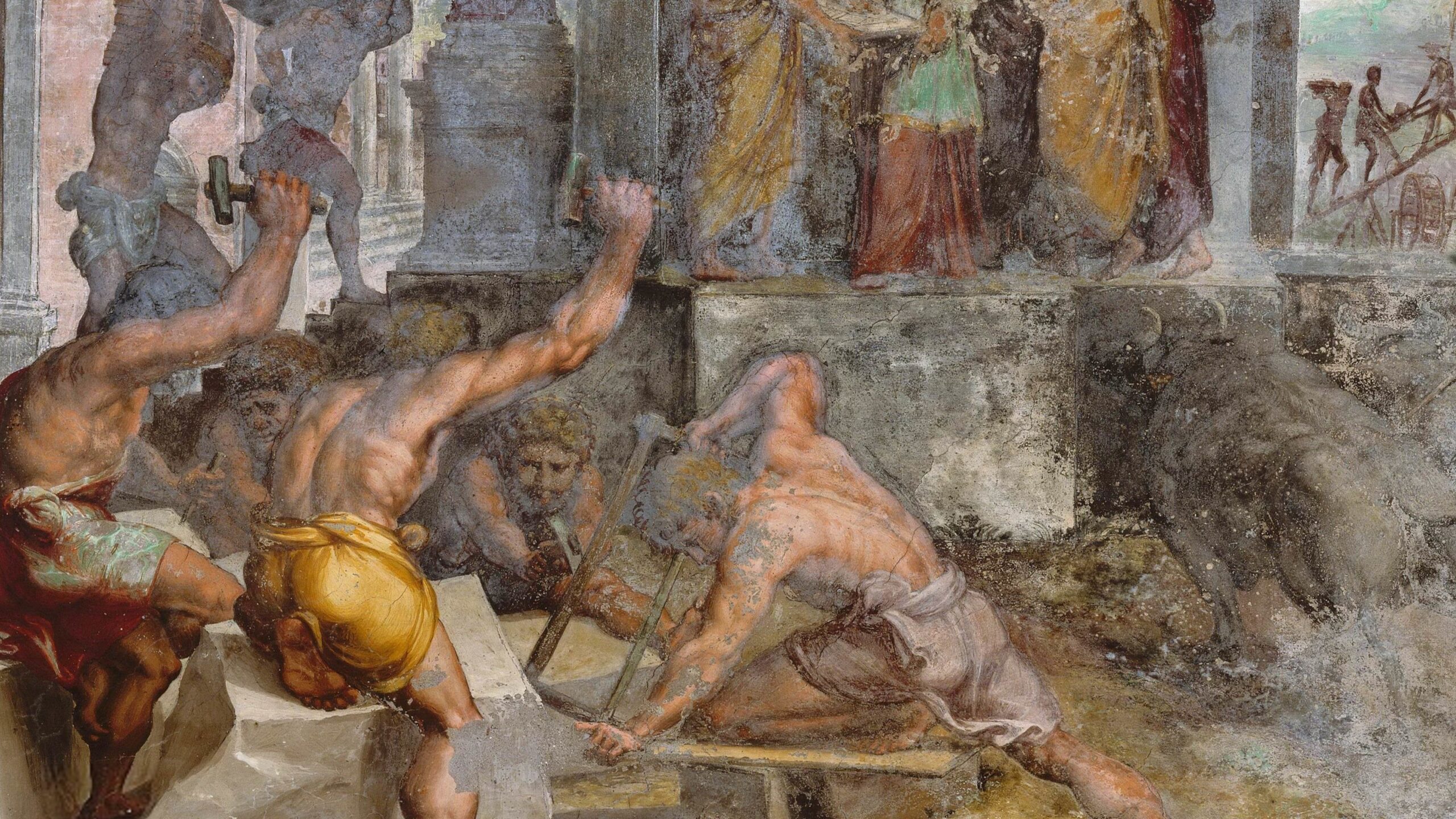
Image credit: Detail from the Loggia de Raffaello at the Vatican, 1519. Photo by Never covered, 2019.