
John 10:1-10
Fourth Sunday of Easter A
1 “Very truly,A I tell you, anyone who does not enterB the sheepfoldC by the gateD
A “very truly” = amen + amen. From Hebrew amen (verily, truly, amen, truth, so be it, faithfulness); from aman (to believe, endure, fulfill, confirm, support, be faithful, put one’s trust in, be steadfast. Figuratively, this is to be firm, steadfast, or faithful, trusting, believing, being permanent, morally solid). This word is literally firmness, but figuratively fidelity, faithfulness, honesty, responsibility, trust, truth, steadfastness. Properly, it is to be sure, certain, or firm. This is a word of emphasis indicating that something crucial follows.
B “enter” = eiserchomai. From eis (to, into, for, among) + erchomai (to come, go). This is to go in in a literal or figurative sense.
C “sheepfold” = aule + probaton. Aule is 12x in NT. Perhaps from the same as aer (air that we breathe); from aemi (to breathe or blow). This is a building that has a courtyard within it – an area that has no roof, but does have walls and is open to the air. It could also imply a palace or mansion as larger buildings that would include courtyards. Probaton is probably from probaino (to go forward literally or to advance in years); {from pro (before, ahead, earlier than, above) + the same as basis (a step, pace, foot); {from baino (to walk, to go)}}. This is literally easily led and so a sheep or another grazing animal. Also use figuratively of people who are led easily.
D “gate” = thura. This is opening or closure so it’s a door, gate, or entrance. Figuratively, this can refer to an opportunity.
but climbs inE by another way isF a thiefG and a bandit.H
E “climbs in” = anabaino. Perhaps related to “sheepfold” in v1. From ana (up, back, among, again, anew) + the same as basis (see note C above)}. This is to come up in a literal or figurative sense – ascent, rise, climb, enter.
F “is” = eimi. This is to be or exist.
G “thief” = kleptes. 16x in NT. From klepto (to steal secretively). This is a thief that steals using stealth rather than violence. It is a thief in a literal or figurative sense.
H “bandit” = lestes. 15x in NT– 3x “you are making [my house] a den of robbers” when Jesus cleanses the temple, 3x of Jesus’ arrest “did you come for me…as though I were a bandit?”; 3x of bandits crucified on Jesus’ left and right; 2x of the man falling into the hands of robbers in the Good Samaritan parable; 2x of the Good Shepherd speech (anyone who doesn’t come in by the gate is a bandit) in John 10:1, 8; 1x of Barrabbas as a bandit; and 1x Paul writes he is in danger from bandits. From leis (booty); from leizomai (to plunder). This is a bandit or thief – one who steals by violence/force out in the open as opposed to by stealth. These were part of armed gangs.
2 The one who enters by the gate is the shepherdI of the sheep. 3 The gatekeeperJ opensK the gate for him, and the sheep hearL his voice.M
I “shepherd” = poimen. 18x in NT. This is shepherd or pastor – one who protects. It is also used figuratively to mean ruler.
J “gatekeeper” = thuroros. Related to “gate” in v1. 4x in NT. From thura (see note D above) + ouros (guardian or watcher). This is doorkeeper, gatekeeper, or porter.
K “opens” = anoigo. From ana (up, back, again, among, between, anew) + oigo (to open). This is to open in literal or figurative sense.
L “hear” = akouo. This is hear or listen, but it also means to understand by hearing. This is where the word “acoustics” comes from.
M “voice” = phone. Probably from phemi (to declare, say, use contrasts in speaking to shed light on one point of view); {from phao (to shine) or phaino (to bring light, cause to appear, shine, become visible or clear). This is a voice, sound, tone or noise. It can also be a language or dialect.
He callsN his ownO sheep by nameP and leads them out.Q
N “calls” = phoneo. Related to “voice” in v3. From phone (see note M above). This is to call out, summon, shout, address. It is making a sound whether of an animal, a person, or an instrument.
O “his own” = idios. This is something that belongs to you or that is personal, private, apart. It indicates a stronger sense of possession than a simple possessive pronoun. This is where “idiot” comes from (denoting someone who hasn’t had formal training or education and so they rely on their own understanding).
P “name” = onoma. May be from ginosko (know, recognize, learn from firsthand experience). This is a name, authority, cause, character, fame, reputation. The name was thought to include something of the essence of the person so it was not thought to be separate from the person.
Q “leads…out” = exago. 12x in NT. From ek (from, from out of) + ago (to lead, bring, carry, guide). This is to lead out or forth. It can be one being led to their death.
4 When he has brought outR allS his own, he goesT ahead of them, and the sheep followU him because they knowV his voice.
R “brought out” = ekballo. From ek (from, from out of) + ballo (to throw, cast, place, put, drop). This is to throw, put out, produce, expel, banish. It is eject in a literal or figurative sense.
S “all” = pas. This is all or every.
T “goes” = poreuomai. From poros (ford, passageway). This is to go, travel, journey, or die. It refers to transporting things from one place to another and focuses on the personal significance of the destination.
U “follow” = akoloutheo. From a (with, fellowship, union) + keleuthos (road, way). This is to accompany or follow someone, especially the way a disciple does.
V “know” = eido. This is to know, consider perceive, appreciate, behold, or remember. It means seeing with one’s eyes, but also figuratively, it means perceiving – seeing that becomes understanding. So, by implication, this means knowing or being aware.
5 They will not follow a stranger,W but they will runX from him because they do not know the voice of strangers.” 6 JesusY used this figure of speechZ with them, but they did not understandAA what he was saying to them.
W “stranger” = allotrios. 14x in NT. From allos (other, different, another; this is one more of the same kind or a similar type). This is something or someone that belongs to others. By extension, this is another, stranger, foreign, or foreigner.
X “run” = pheugo. This is to run away in a literal or figurative sense. It can also be to flee, escape, shun, or vanish.
Y “Jesus” = Iesous. From Hebrew Yehoshua (Joshua, the Lord is salvation); {from YHVH (proper name of the God of Israel; the self-existent and eternal one); {from havah (to become) or from hayah (to come to pass, become, be)} + yasha (to deliver, defend, help, preserve, rescue; properly, to be open, wide or free, which implies being safe. So, in a causative sense, this is to free someone)}. This is Jesus or Joshua in Greek – the Lord saves or the Lord is salvation.
Z “figure of speech” = paroimia. 5x in NT. From paroimos (by the way); {from para (by, beside, in the presence of) + perhaps from oiomai (to think, imagine, suppose, expect); {from hoios (such as, what kind of); from ho (the)}}. This is a parable, allegory, or proverb. It is used for figurative language or an adage.
AA “understand” = ginosko. Related to “name” in v3. See note P above.
7 So again Jesus said to them, “Very truly, I tell you, I am the gate for the sheep. 8 All who cameBB before me are thieves and bandits; but the sheep did not listen to them. 9 I am the gate. Whoever enters by me will be saved,CC and will come in and go outDD and findEE pasture.FF
BB “came” = erchomai. Related to “enter” in v1. See note B above.
CC “be saved” = sozo. From sos (safe, rescued, well). This is to save, heal, preserve, or rescue. Properly, this is taking someone from danger to safety. It can be delivering or protecting literally or figuratively. This is the root that “savior” and “salvation” come from in Greek.
DD “go out” = exerchomai. Related to “enter” in v1 & “came” in v8. From ek (from, from out of) + erchomai (see note B above). This is to go out, depart, escape, proceed from, spread news abroad.
EE “find” = heurisko. This is to find, learn, or obtain. It is to discover something, which generally implies a period of searching for it. This is to find in a literal or figurative sense. This is where the word “heuristic” comes from.
FF “pasture” = nome. 2x in NT. From the same as nomos (what is assigned – usage, law, custom, principle; used for the law in general or of God’s law; sometimes used to refer to the first five books of the Bible or the entire Old Testament; also used to refer to theology or the practice and tradition of interpreting and implementing the law of God); {from nemo (to parcel out, assign)}}. This is pasture, grazing, or feeding. It can also refer to the act of feeding or figuratively growth, spreading, or increase.
10 The thief comes only to stealGG and killHH and destroy.II I came that they may haveJJ life,KK and have it abundantly.LL
GG “steal” = klepto. Related to “thief” in v1. 13x in NT. See note G above.
HH “kill” = thuo. 14x in NT. This is to rush along, breathe violently. It can also mean to offer sacrifice, specifically by fire (in reference to the blowing smoke).
II “destroy” = apollumi. From apo (from, away from) + ollumi (to destroy or ruin; the loss that comes from a major ruination). This is to destroy, cut off, to perish – perhaps violently. It can also mean to cancel or remove.
JJ “have” = echo. This is have, hold, or possess.
KK “life” = zoe. From zao (to live, be alive). This is life including the vitality of humans, plants, and animals – it is life physical and spiritual and life everlasting.
LL “abundantly” = perissos. From peri (all-around, encompassing, excess). This is abundant, more, excessive, advantage, vehemently.
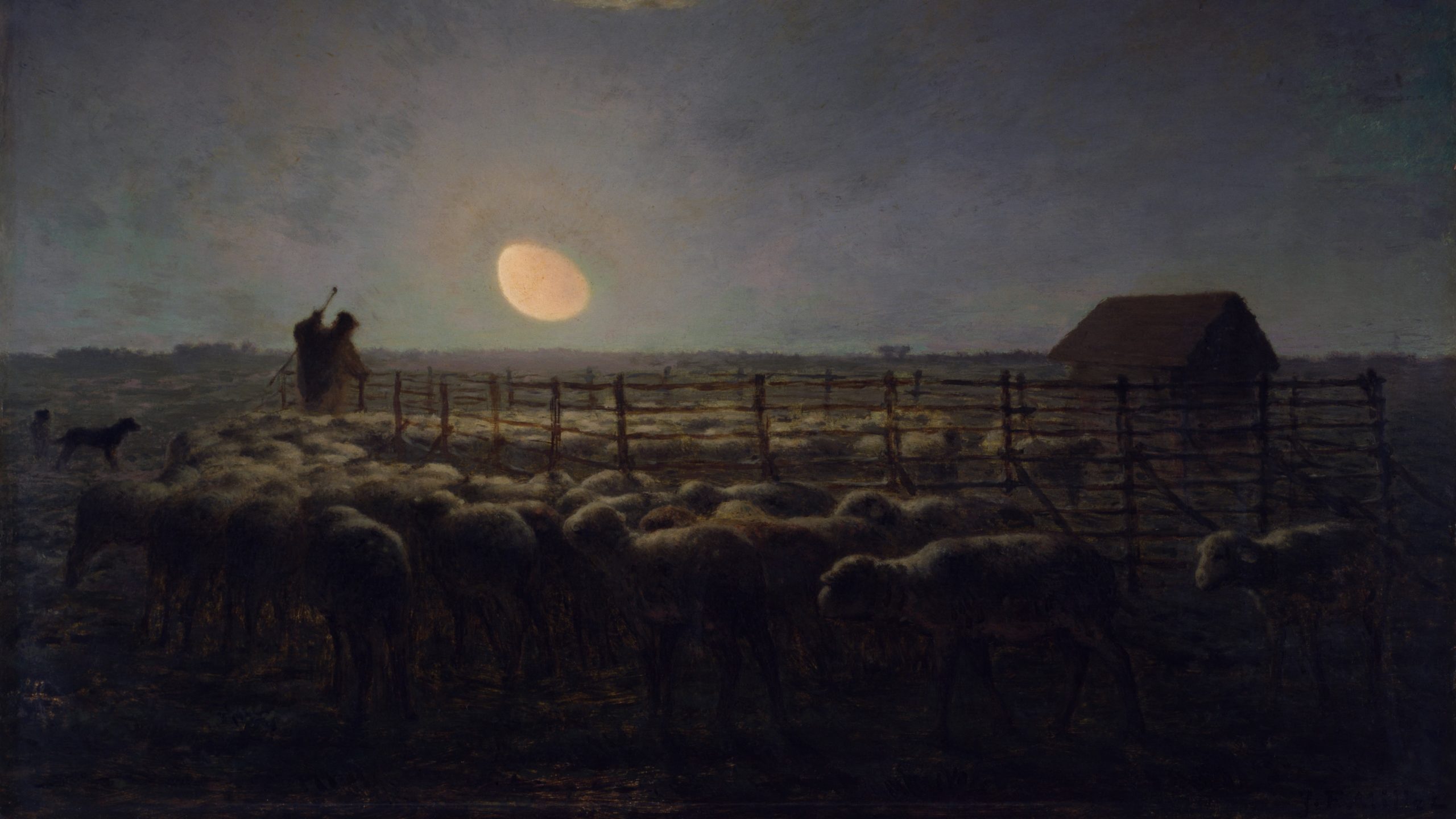
Image credit: “The Sheepfold, Moonlight” by Jean-François Millet, from 1856 until 1860.
